A single millimetre of kinking in a pneumatic line can halt an entire multi-million pound robotic cell, yet the tubing is often the most overlooked component in the system design. We recognise that for engineers managing automated systems, the constant threat of material fatigue and air leaks represents a significant risk to operational uptime. It's a common frustration to see high-speed movements compromised by tubing that cannot keep pace with the mechanical agility of modern robotics. This article provides the technical insight required to select high flexibility pneumatic tubing for robotics that ensures long-term reliability in even the most demanding high-cycle applications.
We recognise that the stability of your production line relies on consistent material performance. Our manufacturing facility represents the pinnacle of UK extrusion expertise, ensuring that the specialised components you receive are fit for purpose. This direct relationship between the designer and the manufacturer facilitates a deeper understanding of the technical requirements, allowing us to organise production schedules that align with your specific assembly cycles. Furthermore, for broader system support, global expertise from Megus1989 International Corporation can provide the machine tool spare parts and accessories required to maintain these complex automated setups.
By understanding the nuances of material science and bend radius specifications, you can effectively eliminate the primary causes of premature failure and system downtime. We shall explore how the correct choice of Polyurethane or Nylon 12 tubing, sourced from a specialist UK manufacturer, leads to optimised robotic cell performance and reduced maintenance cycles. Our collective expertise in the extrusion industry allows us to guide you through the process of matching specific pneumatic requirements with the most resilient materials available today, ensuring your automated systems remain both precise and productive.
Key Takeaways
- Identify why Polyurethane remains the superior choice for high flexibility pneumatic tubing for robotics due to its exceptional elastic memory and kink resistance.
- Learn the engineering principles behind calculating the minimum bend radius to ensure your moving joints don't suffer from premature material fatigue.
- Discover how to organise pneumatic lines within automated cells using spiral guards and protective sleeves to eliminate abrasion and tangling.
- Explore the technical advantages of sourcing bespoke tube forming from a UK manufacturer to solve complex space constraints in compact robotic designs.
To discuss your specific technical requirements or to request a sample for testing, please contact our specialist team today.
Understanding high flexibility pneumatic tubing for robotics applications
In the context of industrial automation, high flexibility is often misunderstood as mere softness or pliability. For engineers designing pneumatic systems, true high flexibility pneumatic tubing for robotics is defined by its dynamic performance over millions of operational cycles. It's not simply about how easily a tube can be bent by hand; it's about the material's ability to maintain its cross-sectional integrity whilst subjected to rapid, repetitive movements. Standard industrial hoses often fail in these environments because they lack the specific elastic memory required to return to their original shape instantly after a bend.
Robotic grade tubing differs significantly from general-purpose alternatives through the use of specialised polymer blends. These materials are engineered to resist fatigue, which is the primary cause of air leaks in automated cells. Whether a system is performing high-speed pick and place tasks or complex welding operations, the tubing must endure constant torsion and tension. Without these specialised properties, standard tubes will eventually "set" in a bent position or develop micro-fractures that lead to catastrophic pressure loss.
Defining flexibility in pneumatic systems
We distinguish between soft materials and high flexibility polymers by examining their molecular behaviour. Whilst a soft PVC might feel flexible, it often lacks the structural resilience needed for high-pressure robotics. High flexibility is achieved by selecting polymers with a specific Shore hardness that balances stiffness with elasticity. This allows the tube to navigate tight radii without kinking, ensuring a consistent airflow that's vital for the precision of robotic actuators. Our range of polyurethane tube is specifically formulated to provide this balance, offering superior kink recovery compared to standard materials.
Why robotics require specialised tubing solutions
Automated cells operate under stresses that are rarely encountered in static factory installations. Multi-axis robots move in three-dimensional space, creating complex bending moments that can quickly degrade inferior pneumatic lines. High-speed cycles accelerate this degradation, as the heat generated by constant internal friction can soften standard polymers. By opting for specialised nylon tube or advanced PU blends, manufacturers can prevent unplanned downtime. Selecting a material with a high fatigue resistance ensures that the pneumatic system remains a reliable partner to the mechanical hardware, rather than a point of failure.
To ensure your automated systems benefit from the highest grade materials, you may speak with our technical consultants about your specific application.
Comparing polyurethane and nylon 12 for dynamic robotic systems
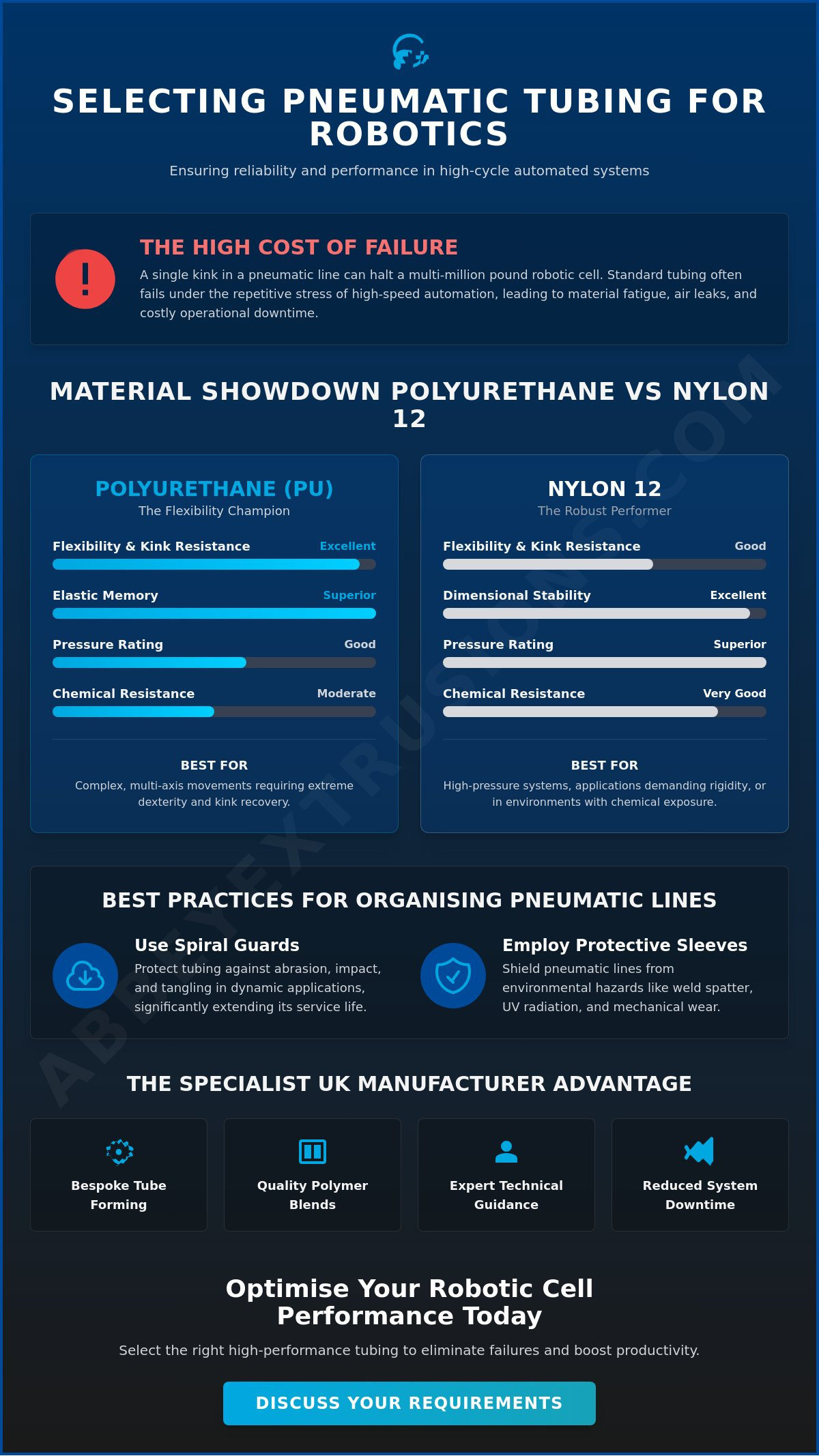
Selecting the optimal polymer for a robotic cell requires a nuanced understanding of how different materials behave under mechanical stress. Whilst many general industrial applications can rely on standard PVC or low-density polyethylene, high flexibility pneumatic tubing for robotics demands a higher level of performance. The primary choice usually falls between Polyurethane (PU) and Nylon 12, each offering distinct advantages depending on the cycle speed, pressure requirements, and environmental conditions of the workshop. We find that the decision often rests on the balance between pure dexterity and long-term dimensional stability.
Polyurethane is widely regarded as the premier choice for applications requiring extreme flexibility. Its rubber-like elasticity allows it to navigate the complex, multi-axis movements of a robotic arm without permanent deformation. Conversely, Nylon 12 serves as a robust alternative when the system must operate at higher pressures or within environments where chemical exposure is a concern. Both materials must be evaluated against the specific dynamic fatigue they will encounter during a standard production shift.
Polyurethane tubing for maximum kink resistance
Our polyurethane tube is engineered specifically to address the problem of kinking in tight spaces. PU's molecular structure allows it to be bent to a much tighter radius than most other plastics without collapsing the internal bore. This is vital for maintaining consistent airflow to end-of-arm tooling. We recommend ether-based PU for most UK manufacturing environments, as it offers superior resistance to hydrolysis and fungal attack compared to ester-based variants. This ensures the tubing doesn't become brittle or degrade when exposed to moisture or humidity over several years of service.
Nylon 12 as a high performance alternative
Whilst PU excels in flexibility, nylon tube manufactured from Grade 12 polymer provides superior performance in terms of pressure rating and temperature stability. Nylon 12 is significantly more flexible than Nylon 6 or 11, making it suitable for robotic applications that require a more rigid yet still adaptable line. It's particularly effective in systems where the tubing must interface with push-in connectors, as its dimensional stability ensures a secure, leak-free seal according to BS ISO 14743;2020 standards. If your robotic cell operates near heat sources or handles aggressive lubricants, Nylon 12 often provides the necessary environmental resilience that PU cannot match. If you are unsure which polymer suits your specific cycle counts, our team can provide a technical assessment to help you decide.
For technical guidance on specific bend radius requirements for your automated cell, please contact our engineering team.
Calculating bend radius and dynamic fatigue for pneumatic longevity
Engineering a reliable automated system requires more than just selecting a pliable material. We must distinguish between static flexibility, where a tube remains in a fixed position, and the dynamic fatigue encountered in high-cycle robotics. Static bend radius specifications provided by many manufacturers are often insufficient for moving joints. When high flexibility pneumatic tubing for robotics is subjected to continuous motion, the internal stresses on the polymer chains are significantly higher than in a stationary installation. Failing to account for this distinction often leads to premature cracking or permanent deformation of the tube wall.
The relationship between wall thickness and flexibility is a critical design factor. Whilst a thinner wall might appear more flexible, it's more susceptible to kinking under vacuum or high pressure. Conversely, a thicker wall provides better pressure resistance but increases the force required to bend the tube, which can put unnecessary strain on robotic actuators. Achieving the correct balance depends on the specific polyurethane tube or nylon grade selected for the application.
Determining the minimum bend radius for your robot
To calculate the safe working radius for a moving robotic joint, we recommend using a dynamic safety factor. A standard rule of thumb is to ensure the bend radius is at least ten times the outer diameter of the tubing. For example, a tube with a 10mm outer diameter should ideally maintain a bend radius of no less than 100mm during its full range of motion. You must also adjust these calculations for operating temperatures and air pressures. As temperature increases, the polymer softens, which can lower the pressure at which the tube might kink or burst. We use advanced tube forming techniques to help clients manage these constraints in compact automated cells.
Understanding dynamic fatigue and cycle life
At a microscopic level, constant bending causes the polymer chains within the tubing to slide past one another, generating internal heat. Over millions of cycles, this heat can lead to molecular degradation and the formation of micro-fractures. High flexibility pneumatic tubing for robotics is specifically designed to dissipate this energy and resist "stress whitening," which is a precursor to material failure. To predict replacement intervals, we analyse the duty cycle of the robotic arm. A system performing sixty cycles per minute will reach the fatigue limit of standard tubing much faster than a slower assembly line. Monitoring for changes in the tube's surface texture or a loss of elastic memory is essential for preventing unplanned downtime.
To discuss bespoke routing solutions for your automated facility, you can request a technical consultation with our team.
Best practices for organising pneumatic tubing in automated cells
The operational longevity of a robotic system depends as much on the organisation of its pneumatic lines as it does on the quality of the polymer itself. Even the most resilient high flexibility pneumatic tubing for robotics will suffer from premature failure if it's allowed to rub against sharp mechanical edges or become tangled during complex multi-axis movements. Abrasion is a silent contributor to system downtime, slowly thinning the tube wall until it can no longer contain the operating pressure. We advocate for a methodical approach to routing that prioritises clear paths and controlled movement.
In compact robotic structures where space is at a premium, standard straight tubing often creates unnecessary bulk. We utilise advanced tube forming techniques to create permanent, pre-shaped bends that navigate internal mechanical components without kinking. This precision engineering approach ensures that the airflow remains laminar and the tubing stays securely within its designated envelope, preventing snags during high-speed operations.
Routing and bundling for multi axis movement
Managing slack is the primary challenge when routing lines across moving joints. If a line is too long, it may swing into the path of other machinery; if it is too short, it will pull against the fittings at full extension. We recommend bundling multiple lines together using a systematic approach that maintains individual flexibility whilst ensuring a neat installation. It's essential to use high-quality fittings that allow for slight rotational movement, as this prevents torsional stress from building up within the tube wall. For applications requiring significant reach and retraction, integrating a nylon recoil air hose can provide a self-organising solution that naturally manages its own slack.
Protecting tubing from external environmental hazards
Industrial environments often present hazards such as weld spatter, metal shavings, or aggressive chemical coolants. Whilst the base polymer provides the primary defence, external protection is often necessary to extend the service life of the system. Applying nylon spiral cut hose guards offers a robust layer of defence against mechanical abrasion and impact whilst allowing the bundle to remain flexible. For a deeper understanding of how different materials respond to these stressors, you may refer to our technical guide on nylon tubing properties. If you require custom-length protection or formed sections for a specific project, contact our UK manufacturing facility for a tailored quote.
To explore how our manufacturing capabilities can support your next automation project, please contact our technical sales department for a bespoke quotation.
Sourcing bespoke high performance tubing from a UK manufacturer
For engineers and system integrators, the reliability of a robotic cell is often determined by the weakest link in the supply chain. Sourcing high flexibility pneumatic tubing for robotics directly from a specialist UK manufacturer offers a level of technical oversight that off the shelf stockists simply can't provide. We maintain strict control over the entire extrusion process, from the selection of raw polymer granules to the final dimensional inspection. This domestic oversight ensures that every metre of tubing meets the rigorous standards required for modern automated environments, whilst also insulating your projects from the volatility of international logistics.
We recognise that the stability of your production line relies on consistent material performance. Our manufacturing facility represents the pinnacle of UK extrusion expertise, ensuring that the specialised components you receive are fit for purpose. This direct relationship between the designer and the manufacturer facilitates a deeper understanding of the technical requirements, allowing us to organise production schedules that align with your specific assembly cycles.
The benefits of UK based extrusion manufacturing
Working with a domestic partner allows for rapid prototyping and immediate technical support when challenges arise during the commissioning phase. We understand that high performance industrial polymers require precise processing temperatures and cooling rates to maintain their elastic memory. By manufacturing in the UK, we provide significantly shorter lead times for bespoke orders, which is critical for maintaining project timelines in the fast moving automation sector. Additionally, our commitment to quality ensures that every profile we produce adheres to the necessary safety regulations, such as the Pressure Systems Safety Regulations 2000. Sourcing locally also reduces the carbon footprint of your supply chain, aligning your procurement with modern sustainability goals.
Custom tube forming for complex robotic geometries
One of the most significant advantages of our service is the ability to provide bespoke tube forming. In modern robotics, internal space is often extremely limited, making standard straight tubing difficult to route without risking a kink. We use controlled heat forming to create permanent shapes that fit perfectly within the robotic structure. This process reduces the need for multiple elbows and connectors, which are common points of air leakage and pressure drop. By collaborating on bespoke extrusion designs, we help you develop high flexibility pneumatic tubing for robotics that is specifically tailored to the unique geometries of your automated system. This collaborative approach ensures that the final assembly is as efficient as possible, reducing the total cost of ownership over the robot's lifespan.
For expert advice on selecting the right tubing for your automation project, please get in touch with our technical team.
Optimising automated system longevity with precision tubing
Selecting the correct high flexibility pneumatic tubing for robotics is a technical necessity that directly influences the operational efficiency and maintenance cycles of your automated cells. We've explored how the precise balance between material science and engineering calculations ensures that your pneumatic lines can withstand millions of cycles without failure. Whether you require the extreme dexterity of polyurethane or the robust environmental resistance of Nylon 12, the decision should always be informed by the specific dynamic stresses of your application.
As a specialist UK manufacturer established in 1985, we provide more than just standard components. Our bespoke tube forming capabilities allow us to solve the most complex space constraints, ensuring that your pneumatic systems are as streamlined as the robots they power. By prioritising domestic quality and technical precision, you can effectively eliminate the risks associated with material fatigue and unplanned downtime. We remain committed to supporting the UK’s robotics sector with reliable, high-performance extrusion solutions that you can trust for the long term.
Frequently Asked Questions
What is the best material for high flexibility pneumatic tubing in robotics
Polyurethane is the superior choice for high flexibility pneumatic tubing for robotics due to its exceptional elastic memory and resistance to kinking. Whilst other materials might offer higher pressure ratings, polyurethane allows for the tight bend radii required in compact automated cells. Its molecular structure permits repetitive bending without the material developing a permanent set, which is vital for maintaining consistent airflow during high-speed robotic cycles.
How do I calculate the minimum bend radius for my pneumatic hose
You should calculate the minimum bend radius by multiplying the outer diameter of the tube by ten for dynamic robotic applications. Whilst static installations might permit a smaller radius, moving joints require this larger safety margin to prevent material fatigue. It's essential to measure this radius at the point of maximum joint extension to ensure the tubing never exceeds its mechanical limits during a full range of motion.
Can I use standard nylon tubing for a moving robotic arm
Standard nylon tubing is generally unsuitable for moving robotic arms because it lacks the necessary flexibility and fatigue resistance. Traditional Nylon 6 or 11 variants are designed for static lines where rigidity is an advantage. For robotic movement, we recommend using Nylon 12 or Polyurethane, as these polymers are specifically engineered to handle the constant torsion and bending stresses of an automated production line.
What is the difference between ester and ether based polyurethane tubing
The primary difference lies in their resistance to environmental factors like moisture and oils. Ether based polyurethane is the preferred choice for most UK industrial environments because it offers superior resistance to hydrolysis and fungal growth. Conversely, ester based polyurethane provides better resistance to oils and fuels but can degrade more quickly if exposed to high humidity or water based fluids over long periods.
How does temperature affect the flexibility of pneumatic tubing
Temperature significantly alters the mechanical properties of polymers by changing their molecular mobility. As temperatures rise, the tubing becomes more flexible but its safe working pressure decreases proportionally. In colder workshop environments, the material can become brittle, which increases the risk of cracking under dynamic stress. You must always consult the technical data sheet to ensure the selected material suits your facility's specific thermal range.
Why is kink resistance so important for automated systems
Kink resistance is vital because a collapsed tube creates an immediate restriction in airflow that can cause robotic actuators to stutter or stall. In a high-speed automated system, even a momentary drop in pressure can lead to synchronisation errors or damage to the end of arm tooling. High flexibility polymers are designed to spring back to their original bore shape instantly, ensuring that the pneumatic circuit remains open and efficient.
How can I protect my pneumatic tubing from abrasion in a robotic cell
You can defend your pneumatic lines from abrasion by installing nylon spiral cut hose guards or protective textile sleeves. These external layers absorb the friction caused by the tubing rubbing against the robot frame or other cables during multi-axis movements. In environments with weld spatter or sharp debris, these guards provide a necessary sacrificial barrier that prevents the primary pressure line from being compromised or thinned over time.
Is it possible to get custom shaped pneumatic tubing for tight spaces
Custom shaped pneumatic tubing is achievable through a process known as heat based tube forming. This technique allows us to create permanent, pre-set bends in Polyurethane or Nylon tubing that follow the specific internal contours of a robotic assembly. Using formed sections eliminates the need for multiple elbow fittings, which reduces the number of potential leak points and helps to maintain a neater, more compact installation.

Article by
Bryan Cowan
Bryan Cowan is the Founder and Managing Director of Abbey Extrusions Ltd, a leading UK manufacturer of high-quality plastic tubes and hoses. With over 40 years of industry experience, Bryan established the company in 1985, growing it from a startup into a BS ISO9001-registered supplier for global sectors including aerospace, automotive, and pharmaceuticals.
Disclaimer
This article is intended for informational purposes only. Please ensure you seek expert advice or carry out your own research to confirm the information is suitable for your specific needs.