The standard PVC hose your facility relies on for chemical dosing might be the very reason your maintenance costs are spiralling out of control. Sodium hypochlorite is one of the most aggressive chemicals in water treatment, yet many operators treat the selection of transfer lines as an afterthought. Choosing the correct tubing material for sodium hypochlorite is not merely a matter of chemical compatibility; it's a critical engineering decision that affects system uptime and worker safety. Whilst standard materials often suffice for mild fluids, the corrosive nature and constant off-gassing of bleach require a more sophisticated polymer approach to prevent premature failure.
We understand the frustration of finding your tubing brittle and cracked just weeks after installation, or dealing with the persistent gas locks that disrupt your dosing accuracy. This technical guide provides a comprehensive overview of chemical-resistant polymers designed to withstand the unique challenges of sodium hypochlorite transfer. You'll learn how to balance initial costs against long-term chemical longevity whilst ensuring your system meets the latest safety standards, such as the NSF/ANSI/CAN 60-2025 requirements. We'll examine the performance of fluoropolymers like PFA and specialised LDPE, helping you reduce maintenance frequency and eliminate the risks associated with hazardous leaks.
Key Takeaways
- Understand the specific oxidative properties of sodium hypochlorite that cause standard industrial polymers to become brittle and fail prematurely.
- Identify the most resilient tubing material for sodium hypochlorite by comparing the chemical resistance of LDPE, reinforced PVC, and high-performance fluoropolymers.
- Ensure your facility remains compliant with the latest NSF/ANSI/CAN 60-2025 health standards for drinking water treatment chemicals.
- Implement mechanical best practices to manage gas locks and pressure fluctuations whilst extending the service life of your chemical transfer lines.
- Learn how to source bespoke industrial solutions from a specialist British manufacturer to improve overall system reliability and safety.
If you require technical guidance on polymer compatibility for your specific application, please contact our technical team for expert support.
Understanding the Challenges of Sodium Hypochlorite Transfer
Sodium hypochlorite is an exceptionally powerful oxidising agent, widely utilised across the UK for water disinfection, cooling tower maintenance, and industrial cleaning. Whilst it's a highly effective biocide, its chemical behaviour presents a hostile environment for most fluid handling components. Choosing a robust tubing material for sodium hypochlorite is not just a preference; it's a necessity for maintaining system reliability. The chemical doesn't merely flow through the tube; it actively seeks to react with the polymer matrix of the conduit, leading to structural degradation over time.
Standard industrial polymers and elastomers often suffer when exposed to concentrated bleach because of the aggressive way the solution attacks molecular bonds. When incompatible materials meet this chemical, a rapid oxidation reaction occurs. This process doesn't only discolour the tube; it fundamentally alters the material's physical properties, often causing it to lose its elastomeric qualities. The primary goal of our technical assessment is to help you identify a safe and durable transfer solution that prevents the hazardous leaks and frequent replacements common in poorly designed systems.
Chemical Properties and Corrosive Nature
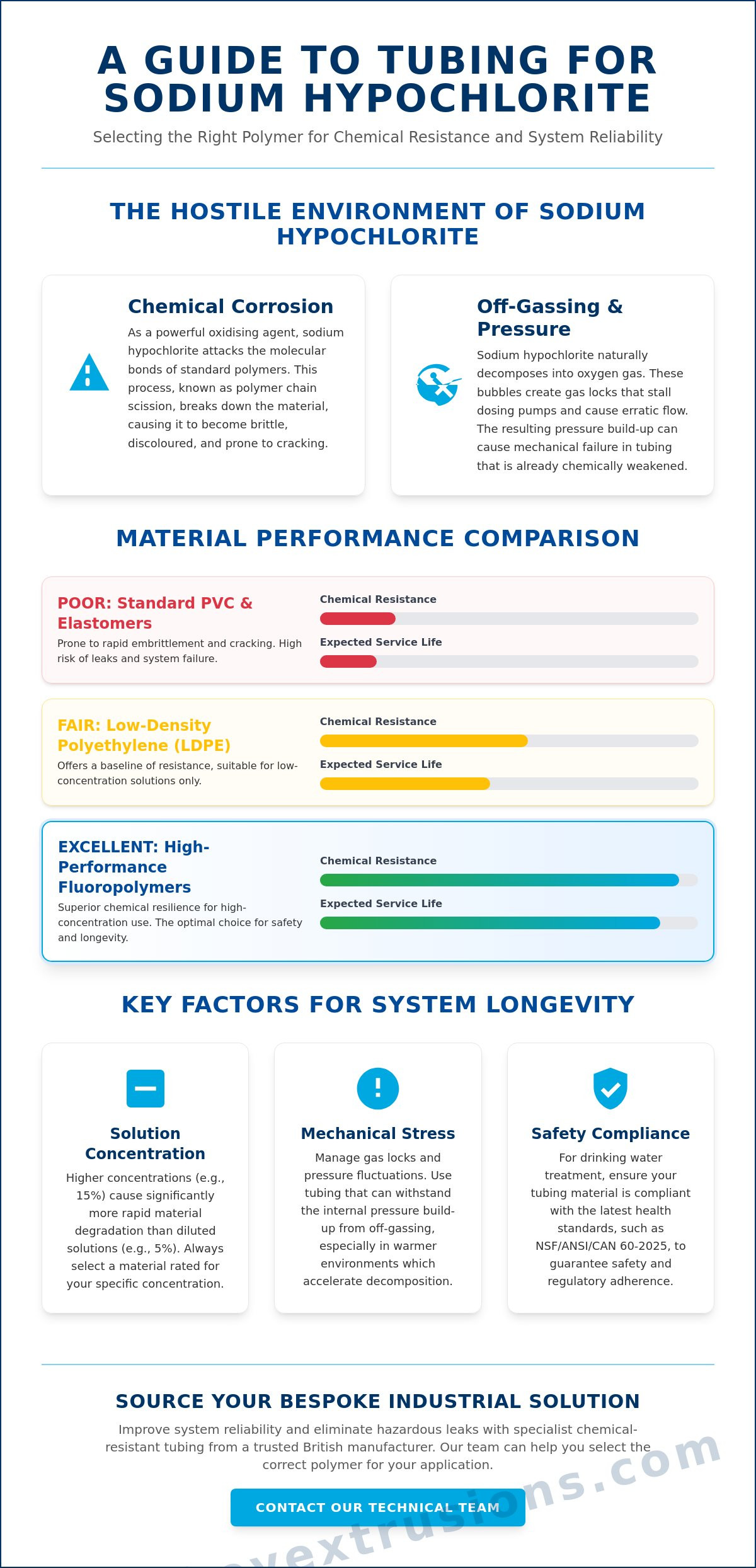
Industrial bleach solutions typically maintain high pH levels, often ranging between 11 and 13. This high alkalinity, paired with the oxidising power of the chlorine, triggers a phenomenon known as polymer chain scission. In this state, the long-chain molecules that provide the tubing with its flexibility and tensile strength are broken into smaller, weaker fragments. The rate of this material degradation is directly linked to the concentration of the solution. A 15% concentrated solution will cause far more rapid embrittlement than a diluted 5% wash, making the choice of a high-grade tubing material for sodium hypochlorite even more critical for high-strength applications. Whilst a standard low-density polythene tube offers a baseline of resistance, higher concentrations demand even more specialised polymers to ensure longevity.
The Problem of Off-gassing and Decomposition
One of the most persistent issues in chemical dosing is the natural decomposition of sodium hypochlorite into salt and oxygen gas. This process is unavoidable and results in the constant formation of oxygen bubbles within the transfer lines. In flexible tubing systems, these bubbles accumulate to create gas locks, which can stall dosing pumps and cause erratic flow rates. Temperature fluctuations amongst industrial environments accelerate this chemical breakdown. As heat increases, so does the volume of gas produced, leading to significant pressure build-up within the lines. A successful installation must account for these mechanical stresses by using materials that can withstand both the chemical attack and the resulting internal pressure without cracking.
If your project requires specific dimensions or high-volume production, you can get a bespoke quote to ensure your system is built to the correct technical standards.
Comparing Tubing Materials for Bleach and Hypochlorite Solutions
Selecting a suitable tubing material for sodium hypochlorite requires a nuanced understanding of the hierarchy of chemical resistance. Whilst many materials claim compatibility, the reality of long-term exposure often reveals hidden weaknesses. As noted in the Sodium Hypochlorite Hazardous Substance Fact Sheet, this chemical is highly reactive and can cause severe degradation if paired with the wrong polymer. Material purity is equally vital; even trace amounts of metallic impurities or certain additives within the plastic can act as catalysts, accelerating the decomposition of the bleach and causing the tube to fail from the inside out.
Certain materials, such as Nylon tube, are generally unsuitable for high concentrations of oxidising agents. Nylon's molecular structure is particularly susceptible to chemical attack, leading to rapid loss of tensile strength. We also see a clear performance gap between rigid and flexible variants of the same base polymer. Rigid pipes often offer better resistance but lack the vibration damping and ease of installation required in dosing systems. Flexible tubing must rely on its inherent polymer properties rather than external coatings to maintain its integrity.
Fluoropolymers as the Gold Standard for Chemical Resistance
Fluoropolymers like PTFE, FEP, and PFA represent the pinnacle of chemical resistance. Amongst these, PFA is frequently the preferred choice for sophisticated industrial systems. It offers an exceptionally smooth internal bore that prevents the accumulation of salt deposits whilst maintaining incredibly low permeability. These materials remain stable across extreme temperature ranges, often exceeding 200 degrees Celsius, which is far beyond the requirements of most sodium hypochlorite applications but provides a significant safety margin during process upsets.
Polyethylene and PVC as Cost-Effective Alternatives
For facilities handling lower concentrations or operating on tighter budgets, low density polythene tube offers a reliable and cost-effective solution. LDPE provides good resistance to dilute bleach without the high price point of fluoropolymers. Alternatively, PVC tube and its reinforced variants are common in short-term applications. However, operators must be cautious. Standard PVC often contains plasticisers that can leach out over time when exposed to aggressive oxidisers, leading to embrittlement. If your system requires frequent cleaning or handles varying concentrations, you might speak with our technical team to determine if a more resilient material is necessary.
If you are designing a complex dosing system and require specific material data, you can speak with a manufacturing expert to ensure your specifications meet industrial safety standards.
Technical Specifications for Safe Chemical Handling
Safe chemical transfer depends on mechanical integrity as much as it does on chemical compatibility. Whilst the previous sections established the hierarchy of polymers, an engineer must also consider the physical stresses placed upon the tubing material for sodium hypochlorite during operation. These requirements extend beyond simple resistance; they involve the precise matching of tubing dimensions to the specific pump type in use. For instance, peristaltic pumps require tubing with excellent wall recovery and specific shore hardness to maintain accurate dosing, whilst metering pumps often demand higher dimensional stability to handle pulsed flow without excessive expansion.
Safety factors are paramount when handling hazardous liquids like sodium hypochlorite, which is regulated under DOT identification number UN 1791. A standard burst pressure rating for industrial tubing is typically calculated at ambient temperature, but for chemical applications, a safety margin of at least 3 to 1 or 4 to 1 is advisable. The Harrington Chemical Resistance Guide provides essential data on how different polymers respond to specific concentrations, helping to inform these safety calculations. Wall thickness plays a dual role here; thicker walls increase the pressure capability and kink resistance of the line, yet they can also make the tubing more difficult to route through tight industrial enclosures.
Pressure Ratings and Wall Thickness Requirements
There is a direct and inverse relationship between operating temperature and the pressure capability of plastic tubing. For example, many polyethylene variants are suitable for use up to 26 degrees Celsius, but as temperatures rise, the effective pressure rating drops significantly. In industrial environments where fluid temperatures might fluctuate, it's recommended to keep operating pressures at or below 80 psi to prevent stress cracking. For high-pressure discharge applications, a reinforced PVC tube or a braided fluoropolymer hose may be necessary to provide the structural support that a standard unreinforced tube cannot offer.
UV Resistance for Outdoor Transfer Lines
Outdoor installations introduce the added challenge of ultraviolet radiation. Sunlight doesn't just damage the polymer; it also accelerates the internal decomposition of the bleach. If you use translucent tubing in an outdoor setting, the UV rays can trigger the release of oxygen gas, leading to the gas locks discussed earlier. Utilising black or opaque tubing is a standard industry best practice to block these rays. Selecting UV-stabilised polymers ensures the tubing itself doesn't become brittle and fail due to sun exposure, a common issue with standard grade low-density polythene tube that lacks the necessary additives for external longevity.
For specialised applications requiring precise configurations or unique geometries, please enquire about custom tube forming to meet your specific facility requirements.
Operational Best Practices for Industrial Tubing Systems
The integrity of a chemical transfer system relies as much on installation precision as it does on the initial selection of the tubing material for sodium hypochlorite. Even the most resilient fluoropolymer can fail prematurely if operational stresses aren't properly managed. A primary objective for any maintenance engineer should be the reduction of mechanical failure points. When evaluating the tubing material for sodium hypochlorite in your facility, always prioritise a seamless run from source to destination. Minimising the number of joints and couplings along the transfer line is essential; each connection represents a potential leak path where corrosive fluid can escape, especially under the pressure fluctuations caused by off-gassing.
Selecting compatible fittings is equally critical to the safety of the installation. Using metallic fittings with sodium hypochlorite is a catastrophic error that leads to rapid corrosion and catalytic decomposition of the chemical. Instead, ensure all connectors are made from high-density plastics or specialised alloys that match the chemical resistance of the tube. In high-risk areas, such as those near electrical panels or pedestrian walkways, secondary containment is not just a recommendation but a safety necessity. Utilising a dual-containment system prevents hazardous exposure in the event of a primary line failure and ensures compliance with environmental protection standards.
Avoiding Gas Locks and Crystallisation in the Line
To manage the oxygen bubbles discussed in previous sections, transfer lines should be installed with a consistent slope towards a vent or the discharge point. This prevents gas pockets from trapping liquid and causing dosing inaccuracies or "slugging" in the flow. Another risk is the formation of sodium carbonate crystals, which occurs when bleach residue is exposed to air at a leak or an open port. These crystals are abrasive and can damage pump seals or clog narrow bores. Regular flushing with deionised water during maintenance periods is the most effective way to prevent this build-up and maintain a clear internal bore.
Monitoring Wear and Establishing Replacement Schedules
A proactive replacement strategy is far more cost-effective than reacting to a burst line. Visual inspections should look for discolouration, swelling, or a loss of flexibility in the tube. If the material feels tacky or shows signs of surface crazing, it has reached the end of its chemical life. Whilst replacement intervals vary based on concentration and temperature, many industrial facilities organise a full hose replacement every 6 to 12 months. The cost of a planned maintenance window is negligible compared to the expense of cleaning a chemical spill and repairing damaged infrastructure. If you are unsure about the current state of your transfer lines, contact us for a technical assessment of your system's requirements.
If you require a specific polymer configuration for your industrial facility, please request a technical consultation to discuss your project requirements with our engineering team.
Sourcing High Performance Chemical Tubing from Abbey Extrusions
Abbey Extrusions stands as a premier UK manufacturer, providing the technical competence required to navigate the complexities of hazardous chemical transfer. Unlike suppliers that offer only standard, off-the-shelf products, we focus on the engineering precision necessary for high-stakes environments. Our manufacturing facility is equipped to produce bespoke extrusion profiles that are specifically tailored to the unique demands of your chemical systems. This capability is vital when selecting a tubing material for sodium hypochlorite, as it allows for the adjustment of polymer properties to better withstand the oxidative stress and off-gassing discussed in earlier sections.
Abbey Extrusions provides a significant advantage through our specialised tube forming services. This process allows us to create permanent, pre-set bends in the tubing, which is essential for complex routing within tight industrial enclosures. By utilising formed tubes, engineers can reduce the reliance on elbow fittings and joints, thereby eliminating potential leak paths and improving the overall safety of the sodium hypochlorite transfer line. We maintain a strict commitment to quality and technical excellence, ensuring that every product leaving our facility meets the rigorous standards of the traditional manufacturing industry.
Bespoke Manufacturing for Demanding Industrial Requirements
We can adjust material formulations to meet specific chemical resistance needs, ensuring that the polymer matrix is optimised for the concentration and temperature of your application. Abbey Extrusions has the capacity to produce non-standard diameters and wall thicknesses that are not typically available from stockists. This level of customisation ensures that your tubing material for sodium hypochlorite fits your pumps and connectors perfectly, maintaining the safety factors required for hazardous liquid handling. Direct communication with our manufacturing experts allows for a collaborative approach to engineering projects, ensuring that every technical parameter is met with precision.
Technical Support and Material Selection Expertise
We invite readers to leverage our decades of experience in plastic extrusion to solve their most difficult fluid handling challenges. Our extensive range of materials includes high-performance low-density polythene tube and advanced fluoropolymers, all manufactured to the highest standards of quality and technical excellence. Whether you are upgrading an existing water treatment plant or designing a new chemical dosing system, our expertise ensures that you select a material that offers the best balance of cost and longevity. We encourage you to engage with our team for a detailed assessment of your specific project requirements.
To discuss your specific system requirements or to request a technical material evaluation, please contact our technical team.
Optimising Your Chemical Transfer Infrastructure
Successful fluid handling requires a meticulous approach to polymer selection and system design. Identifying the correct tubing material for sodium hypochlorite is the first step in preventing the embrittlement and gas locks that lead to costly system downtime. Precision matters here. By prioritising materials like PFA for high concentrations or specialised LDPE for more dilute solutions, you ensure both operational safety and long-term chemical longevity. Implementing best practices, such as proper sloping and proactive replacement schedules, further secures your facility against the risks of hazardous leaks. Safety is paramount.
Since 1985, Abbey Extrusions has provided UK-based manufacturing excellence with specialist expertise in fluoropolymer and nylon extrusions. Our capacity for bespoke tube forming and custom profile services allows us to solve the most complex routing challenges that standard off-the-shelf products cannot address. Standard products often fail. We remain committed to delivering the technical precision and reliability that your industrial processes demand. To ensure your next installation meets the highest standards of safety and efficiency, contact our technical team for expert advice on chemical-resistant tubing. We look forward to supporting your engineering requirements with our decades of manufacturing experience.
Frequently Asked Questions
Is PTFE tubing compatible with concentrated sodium hypochlorite
Yes, PTFE and other fluoropolymers offer the highest level of compatibility with concentrated sodium hypochlorite solutions. These materials are virtually inert and do not suffer from the polymer chain scission that affects lesser plastics. This makes them the ideal tubing material for sodium hypochlorite in high-concentration industrial dosing systems where long-term reliability is the primary concern. They maintain their structural integrity even when exposed to 15% concentrations for extended periods.
Can I use standard PVC hose for bleach transfer
Standard PVC is only suitable for short-term or highly diluted applications. Whilst it is often rated as compatible, the plasticisers within standard PVC can leach out over time when exposed to strong oxidisers. This process leads to the tubing becoming brittle and eventually cracking under pressure. For more permanent installations, a reinforced variant or a move to polyethylene is recommended to avoid the risks of hazardous leaks and frequent system maintenance.
Why does my tubing turn yellow or brown when using sodium hypochlorite
Discolouration is typically caused by the accumulation of metallic impurities or the initial stages of polymer oxidation. If your water source contains trace amounts of iron or manganese, the bleach will oxidise these metals, causing them to deposit on the internal walls of the tube. However, if the material itself is discolouring, it is a clear sign that the chemical is attacking the plastic. You should inspect the line for signs of hardening or loss of flexibility immediately.
What is the best material for a peristaltic pump handling bleach
Peristaltic pumps require a material that balances chemical resistance with excellent mechanical wall recovery. Whilst PFA is chemically superior, it is often too rigid for the rollers of a peristaltic pump head. Specialised thermoplastic elastomers are typically used in these instances to provide the necessary flexibility. For the rest of the transfer line, using a more robust tubing material for sodium hypochlorite like LDPE or PTFE will ensure the system remains secure outside of the pump head.
How does temperature affect the chemical resistance of tubing
Increased temperatures significantly accelerate the rate of chemical attack and reduce the pressure rating of the tubing. As the fluid temperature rises, the molecular motion within the polymer increases, allowing the sodium hypochlorite to penetrate the material more easily. Most polyethylene tubing is rated for use up to 26 degrees Celsius; exceeding this temperature without adjusting the pressure safety factor can lead to rapid material failure and stress cracking.
Does sodium hypochlorite cause polyethylene tubing to crack
Polyethylene is generally resistant but can eventually suffer from environmental stress cracking if the system is poorly managed. This usually occurs at points of high mechanical stress, such as where the tubing is tightly bent or clamped over a fitting. Using high-quality LDPE helps mitigate this risk, but engineers must ensure that the tubing is installed without excessive tension to maximise its service life in corrosive environments.
Should I use clear or opaque tubing for sodium hypochlorite
Opaque or black tubing is always the better choice for sodium hypochlorite transfer. Clear tubing allows UV light to reach the chemical, which triggers a rapid decomposition into salt and oxygen gas. This not only weakens the strength of your bleach but also creates the gas locks that disrupt dosing accuracy. Opaque walls provide an essential barrier that maintains chemical stability and protects the polymer from UV degradation.
How often should I replace chemical transfer tubing
In most industrial environments, we recommend a proactive replacement schedule of every 6 to 12 months. The exact interval depends on the chemical concentration, operating pressure, and ambient temperature of the facility. Waiting for a visible leak to occur is a high-risk strategy that often results in expensive clean-up costs and damaged equipment. A planned replacement ensures your facility remains compliant with safety standards whilst minimising unplanned downtime.

Article by
Bryan Cowan
Bryan Cowan is the Founder and Managing Director of Abbey Extrusions Ltd, a leading UK manufacturer of high-quality plastic tubes and hoses. With over 40 years of industry experience, Bryan established the company in 1985, growing it from a startup into a BS ISO9001-registered supplier for global sectors including aerospace, automotive, and pharmaceuticals.
Disclaimer
This article is intended for informational purposes only. Please ensure you seek expert advice or carry out your own research to confirm the information is suitable for your specific needs.