Could a minor inconsistency in your supply chain be the hidden catalyst for systemic component failure? We understand that for procurement and engineering teams, the frustration of assembly rejection rates and the resulting industrial downtime is a constant challenge. When bulk orders arrive from non-specialist suppliers, inconsistent tolerances often compromise the integrity of the entire system. Selecting high performance extruded plastic profiles requires more than just picking a material; it demands a deep understanding of how polymers behave under extreme stress and chemical exposure.
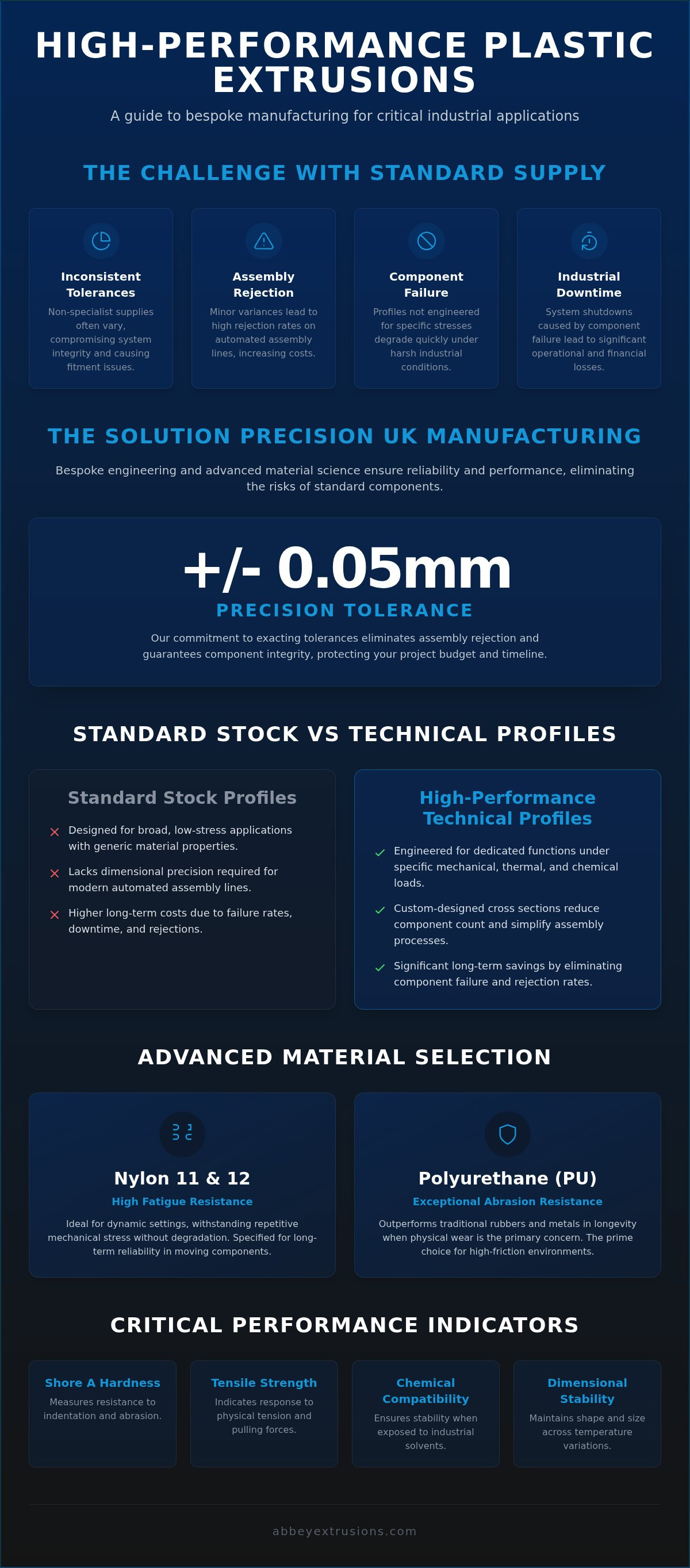
We believe that true excellence in manufacturing stems from a synergy between bespoke tool engineering and advanced material science. This article explores how our four decades of UK manufacturing expertise help optimise the performance and longevity of industrial extrusions. You will discover how precision engineering to tolerances of +/- 0.05mm and the strategic use of high performance materials like Nylon 11 and 12 can ensure long term reliability in the harshest environments. We will guide you through the complexities of custom tube forming and complex cross sections to help you secure a stable, scalable production partnership.
Key Takeaways
- Learn how selecting the correct polymer, such as Nylon 11 or 12, ensures that high performance extruded plastic profiles maintain their structural integrity under significant industrial stress.
- Discover how bespoke tool engineering allows for the creation of complex cross sections that reduce component count and simplify assembly processes in machinery.
- Understand the impact of precision tolerances, often as tight as +/- 0.05mm, in eliminating assembly rejection rates and protecting your project budget.
- Explore the logistical and quality control advantages of partnering with an established UK manufacturer for large volume industrial requirements.
- Gain insights into the transition from technical drawings to finished bespoke profiles through a structured and professional manufacturing partnership.
For large volume industrial orders and technical enquiries regarding bespoke shapes, please reach out to our UK based manufacturing team for a consultation.
The Role of High Performance Extruded Plastic Profiles in Modern Industry
High performance in industrial manufacturing refers to the capacity of a component to maintain its structural integrity whilst subjected to extreme mechanical stress, thermal fluctuations, or aggressive chemical exposure. As industrial requirements become more stringent following the full implementation of the Building Safety Act 2022, the reliance on high performance extruded plastic profiles has shifted from a preference to a necessity. Standard stock profiles often lack the specific material chemistry or dimensional precision required for modern automated assembly lines, where even a fraction of a millimetre in variance can cause a total system shutdown. By focusing on bespoke engineering, we ensure that every profile is capable of withstanding the unique pressures of its intended application.
The Polymer extrusion process serves as the technical foundation for these components, allowing for the creation of intricate geometries that are essential for optimising fluid or gas flow within complex industrial systems. Precise cross sections can be designed to manage internal pressures or to provide specific sealing properties that generic alternatives simply cannot match. This level of customisation ensures that the profile doesn't just fit the assembly but actively enhances the efficiency of the machinery it's part of.
The Difference Between Standard Stock and Technical Profiles
Generic PVC tubes or off the shelf shapes are designed for broad, low stress applications. They don't possess the specialised properties required for the 2026 manufacturing landscape, where high performance extruded plastic profiles must meet rigorous safety and efficiency standards. Technical profiles are engineered from the outset to perform a dedicated function under specific loads. By utilising custom dies, we can eliminate the need for secondary assembly steps or the addition of separate gaskets, creating a more streamlined and reliable production flow. Whilst the initial investment in bespoke tooling is higher, the reduction in assembly rejection rates and the elimination of component failure during high volume production provide significant long term economic advantages for our partners.
Critical Performance Indicators for Industrial Applications
Determining the suitability of a profile involves assessing specific mechanical metrics that define its longevity. Shore A hardness and tensile strength are fundamental indicators of how a material, such as a high grade Polyurethane tube, will respond to abrasion and physical tension over time. Chemical compatibility is equally vital, especially when components must handle aggressive industrial solvents or lubricants without degrading or leaching. High performance profiles are components engineered for exact environmental tolerances, ensuring dimensional stability amongst varying temperatures. This stability is crucial for maintaining airtight seals and precise alignments in harsh industrial environments where thermal expansion could otherwise lead to catastrophic failure.
If you are planning a large volume industrial project, you can discuss your bespoke material requirements with our specialist engineering team.
Advanced Material Selection for Technical Extrusion Applications
The selection of a base polymer is the most critical decision in the engineering of high performance extruded plastic profiles. Whilst standard PVC is sufficient for general purpose use, technical industrial environments demand materials with superior mechanical properties. Nylon 11 and 12 are frequently specified for dynamic settings due to their high fatigue resistance and ability to withstand repetitive mechanical stress. For applications where physical wear is the primary concern, Polyurethane (PU) offers exceptional abrasion resistance, often outperforming traditional rubbers and metals in longevity.
When chemical inertness is required without the premium cost of advanced engineering plastics, Low Density Polyethylene (LDPE) remains a preferred choice for industrial tubing. However, in environments involving high temperatures or highly corrosive substances, fluoropolymers such as PTFE are essential. These materials maintain their stability in settings where other plastics would suffer from rapid thermal degradation or chemical breakdown. The successful deployment of high performance extruded plastic profiles relies on matching the polymer to the operational environment.
Polymer Selection for Chemical and Thermal Resistance
Thermoplastics used in UK manufacturing exhibit vastly different thermal operating ranges, which must be carefully matched to the application. For instance, whereas LDPE may soften at temperatures exceeding 80 degrees Celsius, PTFE can operate effectively at temperatures up to 260 degrees Celsius. According to data supported by the Plastics Industry Association, selecting the correct material prevents catastrophic system failure by ensuring the profile doesn't become brittle or lose its shape under heat. Chemical resistance is equally vital; exposure to aggressive solvents requires a material that won't degrade or leach. We provide guidance on selecting materials that meet specific regulatory requirements, including food grade standards or anti static properties for volatile environments.
Advanced Properties of Nylon 11 and 12 Tubing
The technical superiority of a Nylon tube lies in its low moisture absorption rate. This characteristic ensures that the component maintains its dimensional stability and mechanical strength even in humid conditions. Nylon 12, in particular, is noted for its flexibility and impact resistance at sub zero temperatures, making it ideal for outdoor industrial equipment. For a more detailed analysis of these materials, you may refer to our Nylon tubing properties technical guide. If you require assistance in determining which polymer is best suited for your specific industrial environment, our engineering team can provide a bespoke material assessment based on your technical drawings.
To discuss your specific technical drawings or to request a quote for large volume orders, please contact our specialist engineering department for expert assistance.
Custom Engineering for Bespoke Profile Requirements
Whilst material selection provides the chemical foundation for a component, the physical geometry of high performance extruded plastic profiles is what defines their mechanical utility. Off the shelf solutions often require secondary machining or additional fasteners to integrate into complex machinery, which increases both assembly time and the risk of component failure. Through bespoke engineering, we can design profiles that consolidate multiple functions into a single part, effectively reducing the total part count in industrial assemblies. This approach not only streamlines production but also enhances the structural integrity of the final product by eliminating unnecessary joints and interfaces.
In the transport sector, the technical requirements for Curtainsider Pelmet Sections demonstrate the need for profiles that balance flexibility with extreme weather resistance. These components must maintain their shape and sealing properties whilst subjected to high speed wind loads and constant mechanical vibration. Similarly, the production of Kedar Cord for tensioned fabric structures requires exceptional dimensional precision to ensure even load distribution across the entire architectural installation. These applications highlight why simple shape replication is insufficient for high performance environments where failure is not an option.
Custom Tooling and Die Design for Unique Cross Sections
The manufacturing of bespoke profiles begins with the development of custom dies, which are essential for achieving precision tolerances as tight as +/- 0.05mm. As noted by the Society of Plastics Engineers, the success of a complex extrusion depends heavily on flow analysis during the die design phase. This analysis ensures that non standard polymers move through the tooling at a consistent rate, preventing internal stresses that could lead to warping or structural weaknesses. Our four decades of experience in the UK allow us to manage these technical variables, ensuring that every bespoke cross section meets the exact requirements of the original engineering specification.
Integrating Multiple Functions into a Single Profile
Modern extrusion techniques allow for the integration of diverse features that enhance the performance of industrial hoses and tubes. For instance, adding specific fluting for better water management in fluted water hoses improves grip and prevents kinking in demanding environments. Furthermore, we can manufacture nylon spiral cut hose guards to provide essential abrasion protection for complex hydraulic systems. Beyond the initial extrusion, our capability for tube forming ensures that finished components can be shaped to fit specific spatial constraints, offering a complete engineering solution that standard suppliers cannot provide.
For large volume orders and technical manufacturing enquiries, please contact our UK based specialist team to discuss your specific requirements.
Manufacturing Excellence and Precision Tolerances in the United Kingdom
UK based manufacturing is essential for maintaining the rigorous quality standards required in modern industrial sectors. By keeping production within the United Kingdom, we provide a reliable national supply chain that mitigates the risks associated with global logistics. Our facility integrates advanced tube forming capabilities to create ready to install industrial components that meet exact spatial requirements. This level of oversight ensures that every batch of high performance extruded plastic profiles adheres to the strict performance benchmarks established for the 2026 industrial environment. We believe that proximity to the point of use is a significant advantage for quality control and technical collaboration.
Precision tolerances are the cornerstone of manufacturing excellence. Inconsistent dimensions in bulk orders from non specialist suppliers frequently lead to high assembly rejection rates; this causes unnecessary project costs and industrial downtime. We maintain a capability for precision tolerances of +/- 0.05mm, ensuring that every profile fits perfectly within its intended assembly. Our adherence to ISO standards provides our partners with the security that their components are manufactured under a controlled and audited quality management system. This level of accuracy is vital for maintaining the structural integrity of complex machinery where multiple components must interface without friction or leakage.
Achieving Dimensional Accuracy in Large Volume Production
Maintaining consistency across thousands of metres of extrusion presents significant technical challenges. Factors such as material melt temperature and cooling rates must be monitored constantly to prevent dimensional variance. We utilise sophisticated monitoring systems to ensure that wall thickness and diameter remain strictly within specification throughout the entire production run. This prevents the "drifting" of tolerances that often occurs in high volume output. For a deeper understanding of these technical variables, you may review our guide on the engineering principles of plastic extrusion.
Testing Protocols for Pressure and Durability
Every high performance component must undergo rigorous validation before it leaves our facility. We employ specific pressure testing methods for our polyurethane tubes to verify their burst pressure and operational safety margins. Accelerated ageing tests are also conducted to simulate long term performance in harsh industrial environments; this ensures that the polymer selection will not degrade prematurely when exposed to UV or chemicals. Batch testing is a necessity for high volume bespoke orders to maintain the integrity of the entire shipment. These protocols guarantee that our high performance extruded plastic profiles deliver the reliability our clients expect.
If your project requires guaranteed precision and UK based manufacturing reliability, enquire about our large volume production capabilities to secure your supply chain.
If you require technical assistance with a custom design or wish to place a large volume order, please contact our specialist manufacturing team to discuss your requirements.
Sourcing High Performance Solutions from a Specialist UK Manufacturer
Partnering with an independent manufacturer provides a level of technical flexibility that is often absent in larger, more rigid corporate structures. When sourcing high performance extruded plastic profiles, the ability to communicate directly with the engineers responsible for production ensures that your technical requirements aren't lost in translation. The transition from a technical drawing to a finished bespoke profile is a methodical process that requires careful validation of material flow and cooling parameters. By maintaining all manufacturing within the UK, we offer a stable and responsive supply chain that is essential for large scale industrial projects where delays can result in significant financial penalties.
Our facility is equipped to handle specialist materials for highly specific applications, such as the production of food grade brewery hoses and chemically resistant diesel fuel hoses. These products demand a deep understanding of polymer behaviour to ensure they don't leach or degrade when exposed to their respective fluids. A national UK supply chain also offers logistical advantages, including reduced lead times and a smaller carbon footprint compared to international sourcing. We believe that a manufacturing partnership should be built on technical competence and a shared commitment to component longevity.
Streamlining the Bespoke Enquiry Process
To ensure an accurate custom quote and an efficient production timeline, we recommend providing a comprehensive technical checklist during the initial enquiry phase. This should include precise cross sectional dimensions, the preferred polymer type, expected operating temperatures, and any specific chemical exposure the profile will encounter. Early collaboration with our extrusion engineers can often identify opportunities to simplify the die design, which effectively reduces tooling costs and improves manufacturing speed. Specifying the exact environmental conditions whilst the project is still in the design stage prevents costly adjustments later in the production cycle.
Scalable Manufacturing for National Industrial Supply
Abbey Extrusions possesses a 40 year history of reliability and technical expertise in the UK manufacturing sector. Our facility is designed for scalable production, allowing us to handle large volume orders whilst maintaining the precision quality expected of bespoke high performance extruded plastic profiles. We encourage procurement teams to seek long term partnerships rather than transactional supply; this approach ensures a consistent component supply and allows for the continuous refinement of manufacturing processes. Our experience amongst diverse industrial sectors allows us to provide a stable foundation for your national supply chain needs, ensuring that every extrusion meets the rigorous standards of modern industry.
If you're ready to optimise your production with precision engineered components, please reach out to our technical department for a bespoke consultation.
Securing Industrial Reliability Through Bespoke Engineering
The industrial landscape of 2026 demands a level of precision that off the shelf components simply cannot provide. By integrating advanced polymer selection with bespoke tool design, we enable our partners to achieve long term reliability in the most challenging environments. Our expertise in high performance Nylon 11 and 12 flexible tubing, combined with a capability to maintain precision tolerances of +/- 0.05mm, ensures that every component performs exactly as intended. Choosing high performance extruded plastic profiles from a specialist UK manufacturer since 1985 provides the security of a stable national supply chain and direct access to engineering expertise.
This partnership approach reduces assembly rejection rates and protects your operations from the costly impact of industrial downtime. We're proud to support your large volume projects with the technical competence and manufacturing excellence that has defined our business for over 40 years. Contact our technical team to discuss your bespoke extrusion requirements and take the first step towards a more reliable industrial supply chain. We look forward to helping you achieve your engineering goals with precision and professionalism.
Frequently Asked Questions
What are high performance extruded plastic profiles?
High performance extruded plastic profiles are technical components engineered to maintain their structural integrity whilst subjected to significant mechanical stress, chemical exposure, or thermal fluctuations. Unlike standard stock shapes, these profiles are often manufactured from advanced polymers such as Nylon 11 or 12 to ensure long term durability in harsh industrial environments. They're designed for specific industrial applications where failure isn't an option.
How do I specify bespoke tolerances for an industrial plastic extrusion?
To specify bespoke tolerances, you should provide a comprehensive technical drawing that identifies the critical dimensions of the component. We utilise precision engineering and advanced monitoring systems to maintain tolerances as tight as +/- 0.05mm. This level of accuracy is essential for reducing assembly rejection rates and ensuring that components fit perfectly within automated production lines.
Which materials offer the best chemical resistance for extruded profiles?
Fluoropolymers such as PTFE, FEP, and PFA offer the highest level of resistance to aggressive chemicals and extreme temperatures. For industrial applications requiring a cost effective yet chemically inert solution, Low Density Polyethylene (LDPE) is a preferred choice. The selection depends entirely on the specific solvents or fluids the profile will encounter during its operational life.
Can you manufacture custom cross sections for large volume orders?
We specialise in developing bespoke tooling and dies for unique cross sections tailored to large volume industrial orders. Our engineering team works closely with you to move from a technical drawing to a finished bespoke profile. This process allows for the creation of intricate geometries that consolidate multiple functions into a single, high performance component.
What is the difference between rigid and flexible extruded profiles?
The primary difference lies in the Shore hardness of the base polymer selected for the manufacturing process. Rigid profiles provide structural stability and framing for industrial systems. Conversely, flexible profiles, such as those made from Polyurethane or flexible Nylon, are engineered for applications requiring high abrasion resistance, impact strength, or a specific bend radius.
How does custom tube forming improve the performance of a plastic profile?
Custom tube forming allows a profile to be shaped into a permanent, repeatable configuration that fits specific spatial constraints within complex machinery. This process reduces the internal stress on the material that would otherwise occur if a straight tube was forced into a curve. It results in a ready to install component that enhances the overall reliability of the industrial assembly.
What are the benefits of sourcing plastic extrusions from a UK manufacturer?
Sourcing from a UK manufacturer ensures a stable national supply chain and direct communication with the engineers responsible for your production. It allows for rigorous quality control and adherence to UK industrial performance benchmarks. Partnering with a specialist like Abbey Extrusions, with over 40 years of experience, provides the technical security needed for large scale industrial projects.
How do I ensure my bespoke profile meets food grade or anti static standards?
You must specify these regulatory requirements during the initial enquiry phase so that we can select the appropriate certified polymers. We can manufacture high performance extruded plastic profiles using specific food grade materials or integrate anti static additives to meet your industry standards. Our team ensures that the material chemistry aligns perfectly with your environmental and safety obligations.

Article by
Bryan Cowan
Bryan Cowan is the Founder and Managing Director of Abbey Extrusions Ltd, a leading UK manufacturer of high-quality plastic tubes and hoses. With over 40 years of industry experience, Bryan established the company in 1985, growing it from a startup into a BS ISO9001-registered supplier for global sectors including aerospace, automotive, and pharmaceuticals.
Disclaimer
This article is intended for informational purposes only. Please ensure you seek expert advice or carry out your own research to confirm the information is suitable for your specific needs.