A single hairline fracture in a pneumatic line can halt an entire production floor in seconds, yet many facilities still treat tubing as a secondary commodity rather than a critical safety component. We recognise that maintaining system integrity in high-pressure environments is a constant challenge for engineers who must balance performance with rigorous safety standards. Selecting the right high pressure pneumatic tubing is not merely about finding a fit; it is about ensuring long-term reliability whilst preventing catastrophic failures that lead to expensive downtime.
You likely agree that the difficulty of sourcing specific UK manufactured dimensions or dealing with chemical degradation in harsh settings can compromise even the most well-designed systems. This article promises to help you identify the most durable solutions by understanding material performance and technical specifications. We will examine why materials like Nylon 12 are essential for demanding applications, how to calculate the correct safety factor for your needs, and the ways precision manufacturing can significantly reduce your maintenance requirements.
Key Takeaways
- Identify why Nylon 11 and Nylon 12 are the preferred materials for maintaining system integrity in demanding industrial environments.
- Learn to specify high pressure pneumatic tubing by calculating the necessary safety factors to withstand both operating pressures and unexpected surges.
- Compare the performance characteristics of different polymers to balance the need for flexibility with the requirement for high burst pressure.
- Minimise system downtime by sourcing bespoke dimensions directly from a specialist UK manufacturer to ensure a precise fit for your equipment.
To discuss your specific technical requirements or to request a quote for high-performance components, please contact our specialist engineering team.
Understanding High Pressure Pneumatic Tubing Requirements
High pressure pneumatic tubing represents a specialised category of conduit designed to withstand significantly higher mechanical stresses than standard industrial hoses. These solutions typically consist of reinforced structures or high density polymer formulations that maintain their dimensional profile under extreme load. A reliable pneumatic air line serves as the critical backbone of any industrial system, ensuring that air flow remains consistent and the entire network maintains its mechanical integrity. If the tubing fails, the system fails. This makes the selection process a matter of operational safety as much as it is about mechanical efficiency.
Engineers prioritise burst pressure ratings as the primary safety metric because they represent the ultimate limit of a material's physical capability. Choosing components manufactured in the UK provides a level of traceability and quality assurance that is often missing from mass-produced imports. We ensure that every batch meets rigorous standards, allowing for precise system design without the guesswork associated with unverified specifications. This commitment to manufacturing excellence ensures that your high pressure pneumatic tubing performs exactly as the technical data sheet suggests.
The Role of Working Pressure and Burst Pressure
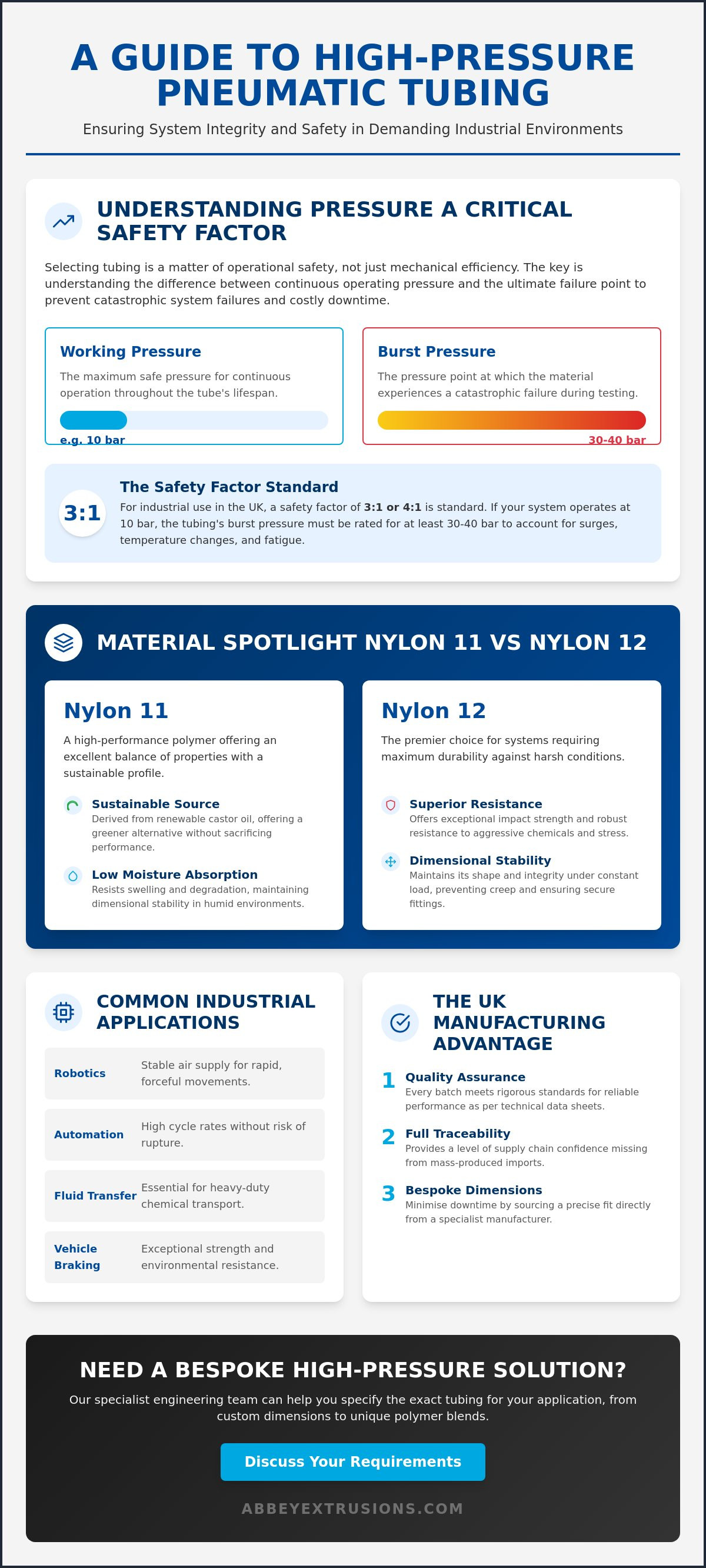
Working pressure refers to the maximum safe limit at which a tube can operate continuously throughout its intended lifespan. In contrast, burst pressure is the specific point where the material suffers a catastrophic failure during controlled testing. In the UK, we typically apply a safety factor of 3 to 1 or 4 to 1 for industrial applications. This means if your system operates at 10 bar, the tubing should be rated for a burst pressure of at least 30 to 40 bar. This margin accounts for pressure spikes, temperature fluctuations, and material fatigue over time.
Common Industrial Applications for High Pressure Lines
High pressure systems are ubiquitous in modern robotics where rapid, forceful movements require a stable air supply. Automated assembly lines rely on these durable lines to maintain high cycle rates without the risk of rupture. Beyond simple air distribution, these components are essential for heavy duty fluid transfer where chemical resistance is required. For instance, specialised Nylon tube is frequently utilised in vehicle braking systems because of its exceptional strength and resistance to environmental stress.
If you require detailed material data sheets or wish to discuss custom polymer blends, please get in touch with our technical department.
Performance Characteristics of Nylon 11 and Nylon 12 Tubing
Nylon 11 and Nylon 12 are widely regarded as the premier materials for high pressure pneumatic tubing due to their exceptional mechanical properties and chemical resilience. These polymers offer a level of dimensional stability that is essential for maintaining secure connections with push-in or compression fittings. Unlike softer plastics that may creep or deform under constant load, these high-grade nylons retain their shape and structural integrity even when subjected to continuous high-pressure cycles. This precision is a hallmark of our manufacturing process, ensuring that every millimetre of tubing meets the exact tolerances required by sophisticated pneumatic circuits.
A notable advantage of Nylon 11 is its derivation from renewable castor oil sources, providing a more sustainable profile without sacrificing technical performance. Both grades exhibit remarkably low moisture absorption rates, which is a critical factor in preventing the swelling or degradation that often plagues lesser materials in humid environments. Adherence to OSHA safety standards regarding the inspection and securing of compressed air lines is significantly easier to manage when using materials that resist environmental aging. If you are unsure which grade best suits your operational environment, we invite you to consult with our engineering team for tailored advice.
Nylon 12 for Maximum Chemical and Pressure Resistance
Nylon 12 is frequently favoured for industrial systems that demand superior impact resistance and durability against aggressive chemicals. It performs exceptionally well in cold weather environments, maintaining its toughness whilst other polymers might become brittle and prone to cracking. For an in-depth analysis of polymer behaviour, our technical guide on nylon tubing properties provides essential data for system designers who require precise performance metrics across varying temperature ranges.
Flexibility and Fatigue Resistance in Pneumatic Systems
The ability to withstand repeated flexing without developing stress fractures is a defining characteristic of high-quality nylon. We produce both rigid and flexible grades to accommodate different routing requirements, from straight-line distribution to complex robotic joints. In heavy-duty settings where external abrasion is a risk, we often recommend the added protection of a Nylon spiral cut hose guard. This ensures the primary pressure line remains shielded from mechanical wear, further extending the service life of your pneumatic network.
For bespoke material advice or to discuss your specific pressure requirements, please reach out to our technical specialists.
Comparing High Pressure Materials for Pneumatic Systems
Selecting the appropriate polymer for high pressure pneumatic tubing requires a nuanced understanding of the trade-offs between mechanical strength and physical flexibility. Whilst Nylon 11 and 12 remain the industry standard for high-pressure integrity, other materials serve critical roles in specific industrial contexts. The longevity of a pneumatic circuit depends entirely on how well the chosen material resists the specific stresses of its environment, whether those are mechanical, chemical, or thermal. A failure to match the material to the application often results in premature degradation or catastrophic system failure.
Polyurethane (PU) is frequently utilised where tight routing and extreme flexibility are paramount. A high-quality Polyurethane tube offers excellent kink resistance and a much smaller bend radius than its nylon counterparts. However, this flexibility comes at the cost of lower pressure thresholds. In systems where pressure remains high and constant, PU may eventually suffer from ballooning or creep. In contrast, Nylon maintains its dimensional profile with far greater stability under sustained load, making it the preferred choice for heavy-duty actuation and long-distance air distribution.
Polyurethane versus Nylon for Industrial Routing
PU is the ideal choice for dynamic applications such as pneumatic hand tools or robotic pick-and-place heads where the line is in constant motion. Its rubber-like elasticity allows it to return to its original shape after bending without fatigue. Conversely, Nylon is the superior choice for static distribution lines where the line must not expand under load. Recognising these environmental factors ensures that the selected tubing does not become the weak point in the system, particularly when operating near the upper limits of the material's rated capacity.
Specialist Polymers for Extreme Conditions
For applications involving lower pressures but requiring high chemical inertness, low density polythene tube (LDPE) provides a cost-effective solution, particularly in laboratory or water treatment settings. When temperatures exceed the limits of standard polymers, Fluoropolymers like PTFE become necessary. PTFE stands as the favourite for high-temperature pneumatic paths due to its near-total chemical resistance and ability to operate in environments that would melt or degrade conventional nylon or PU lines. Selecting these specialist materials requires a precise understanding of the chemical interactions present in your facility.
To ensure your pneumatic system meets all safety and performance criteria, speak with our technical engineering consultants today.
Selection Criteria for Compressed Air and Fluid Transfer
Selecting the correct high pressure pneumatic tubing involves a rigorous assessment of the entire pneumatic circuit. It's not simply a matter of matching a diameter to a fitting; it's about anticipating how the material will behave under stress. The first step is determining the maximum system pressure, which must include potential surges or water hammer effects that can momentarily exceed standard operating limits. If these peaks are not accounted for, even the highest quality high pressure pneumatic tubing can suffer from micro-fractures that eventually lead to failure.
Chemical compatibility is equally vital for maintaining system integrity over time. The conveyed medium, whether it's lubricated air or specific industrial fluids, must not react with the polymer's chemical structure. You must also consider external contaminants such as cleaning agents or hydraulic sprays present in the facility. Environmental factors like UV exposure for outdoor lines or constant vibration from heavy machinery also dictate the required durability. Finally, verifying precise dimensions is essential to ensure a leak-free seal with standard push-in or compression fittings. For expert assistance in matching materials to your specific industrial environment, consult with our manufacturing team.
Temperature Derating and Pressure Limits
As the ambient or fluid temperature rises, the safe working pressure of plastic tubing decreases significantly. This physical reality means that a tube rated for 20 bar at room temperature might only safely handle 12 bar when the temperature reaches 50 degrees Celsius. Calculating the derated pressure involves applying a specific percentage multiplier based on the material's unique thermal property profile. This level of thermal stability is vital in engine bays or factory centres where heat soak can weaken a line that would otherwise be perfectly safe.
Bend Radius and Installation Constraints
The minimum bend radius defines the tightest curve a tube can achieve before it kinks or restricts the internal air flow. Exceeding this limit creates stress points that invite premature failure and system inefficiency. Proper support and routing are necessary to avoid abrasion against moving machinery or sharp structural edges. In instances where space is extremely limited or routing is particularly complex, professional tube forming can provide pre-shaped lines. These custom-formed components solve routing issues in tight spaces without compromising the material's structural integrity.
To discuss your specific technical requirements or to request a quote for high-performance components, please contact our specialist engineering team.
Bespoke Manufacturing Solutions for High Pressure Systems
Sourcing directly from a UK manufacturer like Abbey Extrusions offers a distinct advantage over standard retail procurement. When you deal with the extruder, you gain direct access to decades of material science knowledge and technical proficiency. We have maintained in house production since 1985, allowing us to oversee every stage of the manufacturing process from polymer selection to final inspection. This level of oversight is essential for high pressure pneumatic tubing where the margin for error is non-existent. Our facility is geared toward precision, ensuring that the components we produce are not just compliant, but superior in their application.
Engineers often face challenges that standard products cannot solve. Whether it is a unique diameter for a legacy system or a specific chemical environment requiring a custom polymer blend, we provide the flexibility to create bespoke solutions. We encourage professional engineers to consult with us on non standard requirements whilst the project is still in the design phase. This collaborative approach ensures that the resulting components are optimised for both performance and cost efficiency, providing a tailored fit that mass-produced alternatives simply cannot match.
Custom Extrusion and Tube Forming Services
Custom extrusion profiles allow for the integration of multiple functions into a single component, reducing the number of parts and potential leak points in a system. Our precision tube forming services enable the creation of repeatable, pre-shaped industrial components that fit perfectly within complex assemblies. The development of a bespoke solution begins with an initial enquiry where we assess your pressure, temperature, and routing constraints to determine the most reliable manufacturing method. This structured process ensures that even the most complex geometries maintain their structural integrity under load.
Quality Assurance and Industrial Standards
Our commitment to UK industry is reflected in our rigorous adherence to technical specifications for Nylon 11 and 12. Every batch of high pressure pneumatic tubing undergoes strict testing protocols to ensure it meets the required burst pressure and dimensional tolerances. These protocols are designed to verify reliability in the most demanding industrial settings, from automotive plants to automated warehouses. By maintaining high performance standards and providing full traceability, we give our partners the confidence that their pneumatic systems will operate safely and efficiently for the long term.
To discuss your specific technical requirements or to request a quote for high-performance components, please contact our specialist engineering team.
Ensuring Long Term Reliability in Pneumatic Systems
Selecting the correct high pressure pneumatic tubing is a critical decision that influences the safety and efficiency of your entire industrial operation. We have explored how understanding the relationship between working pressure and temperature derating prevents premature failure, whilst choosing materials like Nylon 12 ensures maximum chemical resistance. By prioritising precision manufacturing and technical traceability, you can significantly reduce system downtime and maintenance costs.
As a specialist UK manufacturer since 1985, we pride ourselves on our expertise in Nylon 11 and 12 extrusion. Whether you require expert tube forming or bespoke profile services for unique applications, our team is ready to support your engineering goals with proven technical competence. We invite you to contact our technical team for high pressure tubing advice to discuss your specific project requirements. We look forward to helping you build a more robust and reliable pneumatic network.
Frequently Asked Questions
What is the maximum pressure rating for Nylon 12 pneumatic tubing
The maximum pressure rating for Nylon 12 depends on the specific wall thickness and the ambient temperature of your application. For standard dimensions at room temperature, this material can often handle working pressures up to 60 bar, though burst pressures are significantly higher to provide a necessary safety margin. It's essential to consult the specific material data sheet for your chosen diameter to ensure it meets the safety requirements of your system.
How does temperature affect the burst pressure of pneumatic hoses
Increasing temperatures cause the polymer chains in plastic tubing to soften, which directly reduces the material's burst pressure. As the environment heats up, the safe working limit must be derated using a specific multiplier to prevent premature failure. This is why a tube rated for high pressure at 20 degrees Celsius will have a significantly lower capacity at 60 degrees Celsius, requiring engineers to calculate the safe limit for the highest expected temperature.
Can I use polyurethane tubing for high pressure air applications
Polyurethane is typically unsuitable for sustained high pressure pneumatic tubing applications due to its lower tensile strength compared to nylon. Whilst PU offers excellent flexibility and kink resistance, it's prone to ballooning or rupturing under high loads. For systems operating at elevated pressures, Nylon 11 or 12 provides the necessary dimensional stability and structural integrity to ensure long term safety and prevent catastrophic system failure.
What is the difference between Nylon 11 and Nylon 12 for pneumatics
Nylon 11 is derived from renewable castor oil and offers slightly better thermal stability and impact resistance in certain conditions. Nylon 12 is a petroleum based polymer that provides superior resistance to moisture absorption and exceptional dimensional stability. Both materials are premier choices for industrial systems, but the final selection often depends on the specific chemical environment and the sustainability requirements of the project.
Why is the bend radius important when installing high pressure tubing
The minimum bend radius is a critical installation parameter that prevents the tubing from kinking or collapsing during operation. If a tube is bent too sharply, it creates stress concentrations that can lead to premature fatigue and eventual failure under pressure. Maintaining the correct radius also ensures that air flow remains unrestricted, preserving the efficiency and response time of your pneumatic actuators whilst protecting the material from mechanical stress.
Are there specific safety factors I should follow for compressed air lines
Industrial standards in the UK typically recommend a safety factor of 3 to 1 or 4 to 1 for compressed air systems. This means the burst pressure of the tubing should be at least three or four times the maximum working pressure of the system. This margin accounts for unexpected pressure spikes, material fatigue, and the natural degradation that occurs over years of continuous industrial service in harsh environments.
Can Abbey Extrusions manufacture custom sizes for high pressure tubing
We have the technical capability to manufacture bespoke dimensions and custom profiles to meet unique industrial requirements for high pressure pneumatic tubing. Since we manage the entire extrusion process in house, we can produce non standard diameters or wall thicknesses that are not available from off the shelf retailers. This ensures a precise fit for legacy equipment or specialised machinery where standard sizes are insufficient for the required pressure.
How do I choose between rigid and flexible pneumatic tubing
Rigid tubing is the preferred choice for long, straight distribution lines where minimal expansion under pressure is required. Flexible grades are necessary for applications involving moving parts, such as robotic arms or hand tools, where the line must bend repeatedly without fatigue. Your choice should be dictated by the physical routing constraints of your system and the degree of movement the line will experience during its service life.

Article by
Bryan Cowan
Bryan Cowan is the Founder and Managing Director of Abbey Extrusions Ltd, a leading UK manufacturer of high-quality plastic tubes and hoses. With over 40 years of industry experience, Bryan established the company in 1985, growing it from a startup into a BS ISO9001-registered supplier for global sectors including aerospace, automotive, and pharmaceuticals.
Disclaimer
This article is intended for informational purposes only. Please ensure you seek expert advice or carry out your own research to confirm the information is suitable for your specific needs.