Selecting a standard plastic guard for a high-pressure hydraulic system is often the first step towards an expensive and avoidable equipment failure. We recognise that maintenance engineers frequently struggle with premature hose degradation when a high-quality nylon spiral wrap hose protector is not utilised in harsh environments. Whilst basic polyethylene wraps offer a level of surface protection, they rarely possess the structural integrity or thermal stability required for the most rigorous industrial applications.
In this technical overview, you will discover how specialist nylon spiral wrap provides the superior abrasion resistance and chemical stability necessary to safeguard critical hydraulic and pneumatic assemblies. We shall examine the specific performance advantages of Nylon 11 and 12 materials, the technical benefits of sourcing bespoke sizes from a reliable UK manufacturer, and how these high-performance guards help your operation maintain strict compliance with evolving industrial safety standards. By choosing components engineered for longevity, you can effectively extend the service life of your equipment and eliminate the frequent downtime caused by inferior protection solutions.
Key Takeaways
- Understand how a nylon spiral wrap hose protector acts as a secondary skin to mitigate abrasion, which remains the primary cause of hydraulic hose failure in industrial settings.
- Compare the technical properties of Nylon 11 and 12 against standard materials to see why they offer superior thermal stability in high temperature engine bays.
- Learn the precise method for measuring hose bundles and how the spiral pitch directly influences the final flexibility of your assemblies.
- Identify the specific industrial environments where the resistance of nylon to oils, fuels, and UV radiation is essential for maintaining safety and compliance.
- Discover the operational advantages of sourcing bespoke extrusion profiles directly from a UK manufacturer to meet your unique engineering requirements.
If you require technical assistance with hose bundling or need to source bespoke protection solutions for your machinery, please reach out to our engineering team to discuss your specific requirements.
The Role of a Nylon Spiral Wrap Hose Protector in System Longevity
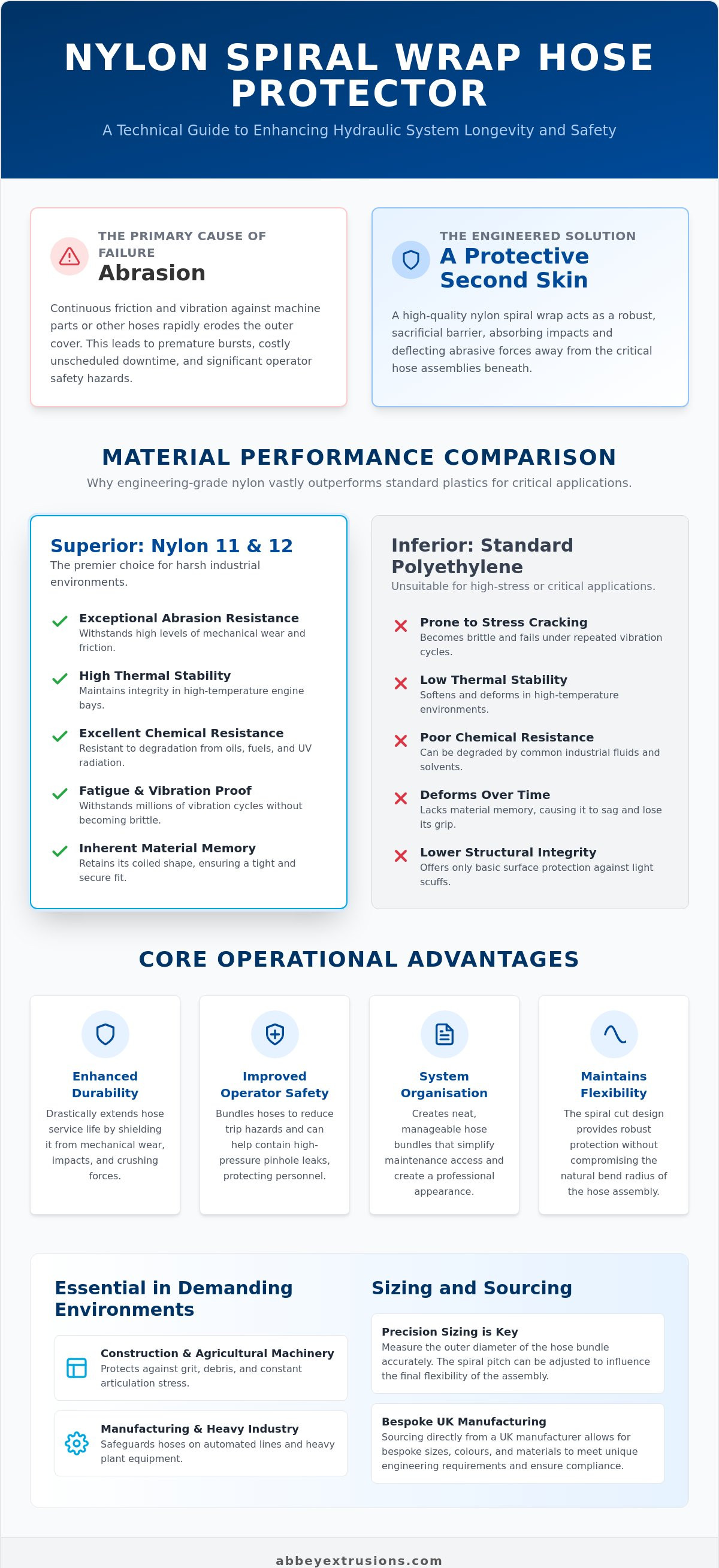
In the demanding environments of British manufacturing and heavy industry, the longevity of hydraulic and pneumatic systems depends on the integrity of their humblest components. We view the nylon spiral wrap hose protector as a critical secondary skin, designed to shield vulnerable lines from the relentless mechanical stresses of the shop floor. Abrasion accounts for a vast majority of hydraulic hose failures in the UK; it often occurs when hoses vibrate against machine chassis or rub against adjacent lines. Without a dedicated barrier, the outer cover of a hose quickly erodes, leading to catastrophic bursts and expensive unscheduled downtime.
A key advantage of our Nylon Spiral Cut Hose Guard is its inherent material memory. Unlike cheaper plastic alternatives that may sag or deform over time, high-grade nylon retains its coiled shape. This ensures it stays tightly bound to the hose bundle even under high-vibration conditions. This tight fit is essential for maintaining consistent coverage and preventing the ingress of abrasive particles. You can learn more about the fundamental Technical Properties of Nylon to understand why this polymer is preferred over standard HDPE for critical applications.
Preventing Mechanical Wear and External Damage
Mechanical wear is a constant threat in moving machinery. When a hose is in motion, it experiences friction that can strip away layers of rubber in a matter of weeks. The physics of our spiral design allows for a hard, protective barrier that doesn't compromise the natural bend radius of the hose. Whilst the guard remains rigid enough to deflect grit and metal debris, its segmented structure ensures the assembly remains flexible. This is particularly vital in construction and agricultural machinery where hoses are subjected to constant articulation.
Improving Operator Safety and Workplace Organisation
Safety is a non-negotiable standard in the modern workplace. By bundling multiple lines into a single, organised column, we significantly reduce trip hazards and simplify maintenance access for engineers. Beyond mere organisation, a robust guard provides an additional layer of protection by helping to contain small pinhole leaks or high-pressure sprays that could otherwise injure an operator. A clean and well-managed hose system doesn't just look professional; it reflects a commitment to technical excellence and operational safety that defines the UK's leading industrial partners.
For technical specifications on material compatibility or to request a sample of our high-grade polymers, please contact our Leicestershire facility.
Technical Properties of Nylon 11 and 12 for Hose Guards
The performance of a nylon spiral wrap hose protector is fundamentally dictated by the molecular structure of its base polymer. Whilst many commodity guards utilise High-Density Polyethylene (HDPE), we prioritise Nylon 11 and 12 for critical industrial applications. These polyamides feature long-chain carbon structures that provide a superior balance of flexibility and mechanical strength. Unlike HDPE, which can be prone to environmental stress cracking, Nylon 11 and 12 offer exceptional fatigue resistance. This ensures that the guard can withstand millions of vibration cycles without losing its structural integrity or becoming brittle.
Engineering professionals often specify these materials due to their "self-lubricating" nature. Nylon has an inherently low coefficient of friction, which allows the guard to shift slightly against the hose surface without causing internal wear. This property is vital for maintaining the Safe Use of Hydraulic Systems, as it prevents the protective layer itself from becoming an abrasive agent. Additionally, these polyamides exhibit high dimensional stability because they have significantly lower moisture absorption rates compared to Nylon 6, making them ideal for precision engineering.
Nylon compared with HDPE and Polypropylene
When evaluating tensile strength and impact resistance, Nylon 11 and 12 consistently outperform standard plastics. HDPE is often selected for its low cost, yet it lacks the recovery memory required for tight hose bundling. Polypropylene, whilst more rigid, can become dangerously brittle in cold conditions. Nylon provides a high-performance middle ground, offering the impact resistance of a soft plastic with the tensile strength of a hard engineering resin. This makes it the preferred choice for heavy-duty plant machinery where constant movement is a daily reality.
Thermal Performance and Operating Temperatures
Thermal stability is perhaps the most significant differentiator for our nylon tube and spiral products. Industrial engine bays often reach temperatures that cause standard HDPE to soften and lose its protective shape. Nylon 11 and 12 maintain their mechanical properties at continuous operating temperatures up to 100°C, with some grades tolerating even higher intermittent peaks. Conversely, in sub-zero environments, these materials remain ductile. This prevents the shattering that commonly occurs with lower-grade plastics during winter operations in the construction and agricultural sectors. If you are unsure which polymer grade suits your specific thermal requirements, you can consult our technical team for detailed material data sheets.
If you require a specific size or wall thickness for a non-standard hose bundle, please contact our technical sales office for expert guidance.
Sizing and Installing Your Nylon Spiral Cut Hose Guard
Precision in sizing is the foundation of effective hose management. When you specify a nylon spiral wrap hose protector, the dimensions must be calculated with care to ensure the secondary skin performs as intended. An oversized guard will slide along the hose, potentially bunching at corners or leaving critical areas exposed to abrasion. Conversely, a guard that is too small will be excessively difficult to install and may restrict the natural movement of the hose assembly. We advise engineers to consider both the static and dynamic states of the machinery during the sizing process.
The relationship between the pitch of the spiral and the flexibility of the assembly is a vital engineering consideration. A wider pitch allows for a tighter bend radius, which is essential for hoses that undergo constant articulation. However, a narrower pitch provides more comprehensive surface coverage, offering better protection against fine grit and external impacts. Our Nylon Spiral Cut Hose Guard is manufactured to exacting UK standards, ensuring that the wall thickness and pitch remain consistent throughout the entire length of the product. This consistency is paramount for maintaining the structural integrity of the protection system.
Calculating the Correct Internal Diameter
To achieve a secure, non-slip fit, we recommend selecting a guard with an internal diameter (ID) that is slightly smaller than the outside diameter (OD) of the hose or bundle. This utilise the material's inherent memory to grip the line firmly. For a single hose, a simple calliper measurement of the OD is sufficient. For bundles, you should measure the circumference of the gathered lines and divide by pi (3.14) to find the effective diameter. When calculating the required length of wrap, remember that as the guard expands to fit the hose, its linear length decreases. A common industry guideline is to multiply the length of the hose by the ratio of the hose OD to the guard ID to ensure full coverage.
Professional Installation Techniques for Longevity
Installation should begin at one end of the assembly, threading the first coil onto the hose and then rotating the guard into place. Avoid over-stretching the material during this process, as excessive tension can lead to premature fatigue or cracking. Once the guard is in position, the ends can be secured amongst other fittings using industrial cable ties or specialised clamps to prevent migration. For systems requiring pre-bent lines, our protection solutions can be integrated with professional tube forming services. Applying the guard to the tube before the forming process ensures that the protective layer follows the precise contours of the bend, maintaining consistent wall thickness even in complex geometric configurations.
To discuss the specific environmental challenges of your facility or to request technical data on chemical compatibility, please speak with our engineering consultants.
Industrial Environments Where Nylon Protection is Essential
Whilst standard plastic guards may suffice for light-duty indoor applications, the nylon spiral wrap hose protector is an operational necessity in environments defined by chemical exposure and physical volatility. In British manufacturing hubs and offshore installations, equipment is frequently subjected to substances that would compromise the structural integrity of lower-grade polymers. We have observed that whilst commodity HDPE wraps are often chosen for their initial cost, they lack the specialised resistance required for long-term survival in aggressive chemical atmospheres. You can explore our Nylon tubing properties guide for a deeper analysis of how these polymers behave under stress.
The global nylon market has seen significant price volatility in early 2026, with the US Polyamide Price Index rising by 5.58% in the first quarter alone. This trend makes the protection of existing hose assemblies more critical than ever from a financial perspective. By investing in a high-performance guard, you are not merely purchasing a consumable; you are implementing a strategic barrier that reduces the frequency of hose replacements and mitigates the risk of environmental contamination caused by fluid leaks.
Chemical Compatibility and Fluid Resistance
Nylon 11 and 12 are renowned for their exceptional resistance to a broad spectrum of industrial fluids. In environments where hoses are in constant contact with hydraulic oils, greases, and diesel fuels, standard plastics can swell or soften, eventually losing their protective function. Our nylon guards remain dimensionally stable amongst these substances. This resistance is vital for preventing chemical degradation, which often leads to pinhole leaks. Such failures don't just stop production; they pose severe safety risks to operators and can result in costly fines for environmental non-compliance if fluids enter local drainage systems.
Heavy Duty Construction and Agricultural Applications
In the construction and agricultural sectors, machinery operates in a constant state of mechanical abrasion. Diggers, tractors, and site plant equipment face a daily barrage of stone chips, heavy soil, and abrasive grit. A nylon guard provides the necessary impact resistance to deflect these hazards without cracking. Furthermore, agricultural environments often involve exposure to fertilisers and salt, both of which can accelerate the weathering of unprotected lines. The UV stability of our nylon material ensures that the guard does not become brittle when exposed to direct sunlight for extended periods, maintaining its "self-lubricating" properties and flexibility throughout the seasons. If your machinery operates in these arduous conditions, we recommend you request a technical consultation to ensure your hose protection strategy meets current safety standards.
To discuss your specific manufacturing requirements or to request a quotation for bespoke extrusion profiles, please contact our Leicestershire engineering team.
Bespoke Manufacturing and Sourcing from Abbey Extrusions
Selecting a domestic manufacturing partner ensures that your technical specifications are translated into a high performance nylon spiral wrap hose protector without the logistical delays or quality inconsistencies often associated with international sourcing. At our Leicestershire facility, we maintain strict oversight of the extrusion process for Nylon 11 and 12 tubing, ensuring each batch meets rigorous industrial tolerances. This commitment to technical excellence allows us to support national clients with a level of precision that commodity suppliers simply cannot match. We recognise that in critical hydraulic systems, there is no margin for material failure.
Our manufacturing capability extends beyond standard product lines. We utilise decades of experience to provide tailored solutions that address the specific pain points of maintenance engineers and machine builders. By managing the entire production cycle from raw polymer selection to final spiral cutting, we ensure that every metre of guard provides the essential abrasion resistance and chemical stability discussed in previous sections. This end to end control is fundamental to our reputation as a reliable partner for UK industry.
Custom Profiles and Material Specialisation
We recognise that unique engineering challenges require more than off the shelf solutions. Abbey Extrusions can adjust wall thickness and spiral pitch for specific orders, allowing for a perfect balance between impact protection and hose flexibility. For operations requiring clear identification of different lines, we offer a variety of colours to assist with safety coding and workplace organisation. Whilst our primary focus remains on high performance polyamides, we also possess the capability to produce guards that match the properties of low density polythene tube if your application requires a more economical or lightweight solution for less demanding environments.
Supporting UK Industry with Reliable Supply Chains
In an era of global material volatility, sourcing from a UK manufacturer provides significant operational security. Recent data from early 2026 indicates that global nylon prices have fluctuated considerably, with the Polyamide Price Index in Germany rising by 1.62% in the first quarter. By maintaining a domestic supply chain, we help our partners mitigate these external pressures through reduced lead times and direct technical support. Our engineers are available to assist with material selection for new projects, ensuring that your hose protection strategy is both cost effective and technically sound. All our products are manufactured to rigorous industrial standards, providing the long term reliability that modern manufacturing demands.
If you require technical support for your hose management systems or wish to discuss a bespoke manufacturing order, please contact our engineering team.
Securing System Integrity with Specialist Protection
Implementing a high performance nylon spiral wrap hose protector is a strategic investment in the operational stability of your hydraulic and pneumatic systems. Throughout this guide, we have explored how the superior thermal and chemical resistance of Nylon 11 and 12 polymers provides a level of durability that standard plastic guards cannot achieve. By prioritising technical precision in both material selection and installation, you can effectively mitigate the risks of abrasive wear whilst ensuring full compliance with safety standards.
Abbey Extrusions has been a specialist in high performance polymers since 1985. We operate from our established manufacturing facility in Leicestershire, providing national delivery and deep technical expertise to the UK's industrial sectors. Whether you require standard dimensions or a bespoke extrusion profile for complex bundles, our team is equipped to deliver components that meet the most rigorous safety and performance standards. We take pride in our ability to provide precise engineering solutions that protect your critical assets.
Contact our technical team for a bespoke extrusion quote to discuss how we can support your next engineering project. We look forward to helping you extend the service life of your critical machinery.
Frequently Asked Questions
What is the difference between HDPE and nylon spiral wrap hose protectors?
Nylon 11 and 12 offer significantly higher thermal stability and chemical resistance than standard HDPE. Whilst HDPE is often used for light duty applications, a nylon spiral wrap hose protector maintains its structural integrity at temperatures up to 100°C and possesses "self lubricating" properties that reduce friction. Nylon also has superior material memory, ensuring it stays tightly bound to the hose over long periods without sagging.
Can a nylon spiral wrap be used for bundling multiple hydraulic hoses?
Yes, bundling multiple lines is a primary function of these guards. It organises complex machinery by gathering various hydraulic or pneumatic hoses into a single, manageable column. This reduces trip hazards and protects the entire bundle from external mechanical wear amongst moving parts. When bundling, you should calculate the effective diameter of the gathered hoses to ensure you select a guard with the correct internal diameter for a secure fit.
How do I calculate the length of spiral wrap needed for my hose?
The required length is determined by the ratio between the hose outside diameter and the guard internal diameter. Because the spiral expands to fit the hose, its linear length decreases during installation. A standard engineering guideline is to multiply the total hose length by the result of the hose OD divided by the guard ID. This calculation ensures complete coverage from fitting to fitting without leaving exposed gaps that could invite abrasion.
Is nylon spiral wrap resistant to UV light and outdoor weather conditions?
Nylon 11 and 12 are inherently UV stable, making them ideal for outdoor industrial equipment. Unlike lower grade plastics that become brittle and crack when exposed to direct sunlight, these polyamides retain their flexibility and impact resistance over many years. This durability is essential for machinery used in the agricultural and construction sectors, where equipment must withstand constant exposure to the elements and varying seasonal temperatures without failing.
What temperature range can a nylon spiral hose guard withstand?
Our nylon guards are designed to operate continuously at temperatures up to 100°C. They can also tolerate higher intermittent peaks without softening or losing their protective shape in hot engine bays. In extremely cold environments, the material remains ductile rather than becoming brittle. This wide operating window ensures the guard protects against stone chips and abrasion regardless of the ambient or internal system temperature.
Can I install a spiral wrap without disconnecting the hose fittings?
Yes, the spiral cut design allows for easy installation on existing assemblies without disconnecting any fittings or lines. You simply thread the start of the wrap onto the hose and rotate it until the entire length is covered. This retrofitting capability is a significant advantage for maintenance teams, as it allows for the immediate protection of vulnerable lines without causing system downtime or requiring fluid drainage.
Are bespoke colours available for hose identification and safety?
We provide a range of colours for our nylon protection solutions to assist with safety coding and line identification. Using different colours allows operators and maintenance engineers to quickly distinguish between high pressure, return, or pneumatic lines. As a UK manufacturer, we can produce bespoke colours to match your specific organisational requirements, ensuring a professional and organised machinery layout that complies with safety standards.
How does a spiral guard prevent internal hose abrasion in high vibration systems?
Nylon possesses "self lubricating" properties that result in a low coefficient of friction against the hose surface. In high vibration systems, the guard is able to shift slightly without wearing away the outer cover of the hose. Because the material has excellent fatigue resistance, it doesn't crack under constant movement; it provides a consistent and durable barrier that deflects external grit whilst protecting the hose from internal friction.

Article by
Bryan Cowan
Bryan Cowan is the Founder and Managing Director of Abbey Extrusions Ltd, a leading UK manufacturer of high-quality plastic tubes and hoses. With over 40 years of industry experience, Bryan established the company in 1985, growing it from a startup into a BS ISO9001-registered supplier for global sectors including aerospace, automotive, and pharmaceuticals.
Disclaimer
This article is intended for informational purposes only. Please ensure you seek expert advice or carry out your own research to confirm the information is suitable for your specific needs.