A single batch of sub-standard tubing can compromise an entire industrial system, leading to catastrophic failure and irreparable damage to your operational reputation. You likely recognise that initial cost savings are quickly erased when faced with the risk of chemical leakage or assembly delays caused by inconsistent dimensional tolerances. As global market complexities grow and new regulations like the NSF/ANSI 14-2025 standard take effect, the challenge of verifying material integrity for specialised applications has never been more demanding. Relying on a robust tubing supplier quality assurance checklist is no longer optional for those who prioritise technical compliance and long term reliability.
We understand that procurement requires more than just a transaction; it demands a partnership built on transparency and manufacturing excellence. This guide provides a professional framework to help you vet plastic tubing manufacturers with engineering precision. We shall examine the critical benchmarks for material traceability, pressure resistance, and the rigorous quality control protocols necessary to ensure your components perform exactly as specified under the most demanding industrial conditions.
Key Takeaways
- Identify the specific polymer resin verification steps needed to ensure material integrity and chemical compatibility for industrial applications.
- Understand the technical requirements for dimensional accuracy, focusing on wall thickness consistency and concentricity in extruded profiles.
- Implement a professional tubing supplier quality assurance checklist to standardise your vetting process and reduce the incidence of component failure.
- Learn how to conduct effective factory audits that prioritise manufacturing traceability and adherence to international quality management standards.
- Establish a reliable framework for managing supplier non-conformance and maintaining high technical compliance across your entire procurement lifecycle.
Understanding Quality Assurance for Plastic Tubing Suppliers
Within the plastic extrusion industry, Understanding Quality Assurance involves a systematic approach to preventing defects throughout the manufacturing cycle rather than merely identifying them during final inspection. This methodology ensures that every metre of tubing, whether it's a standard PVC tube or a complex bespoke profile, meets the precise technical specifications required by the end user. For a procurement professional, a robust tubing supplier quality assurance checklist serves as the primary mechanism to verify that a manufacturing centre operates under a total quality management framework. This commitment to excellence guarantees that the finished product maintains its physical integrity under operational stress.
Many industrial buyers mistakenly apply generic metal piping checklists to polymer based components, failing to account for the unique viscoelastic behaviour of plastics. Whilst metal standards focus on grain structure and weld integrity, plastic extrusion requires a focus on melt temperature consistency, polymer chain orientation, and moisture content. Aligning supplier protocols with your specific industrial application is vital; a failure to account for these variables can lead to environmental stress cracking or premature degradation in the field. Our approach ensures that the manufacturing process is tailored to the specific demands of the polymer, providing a level of reliability that generic checklists simply cannot match.
Why Polymer Extrusions Require Dedicated Inspection Protocols
The fundamental behaviour of flexible plastic tubing differs significantly from rigid metallic alternatives. Polymers are susceptible to creep and deformation under constant load, meaning that dimensional stability must be monitored across varying temperature gradients. Environmental factors such as UV exposure and fluctuating thermal conditions can alter the molecular structure of the material, potentially compromising the burst pressure of a Nylon tube. In sensitive sectors, material purity is paramount. For brewery hose applications, the absence of contaminants and the use of virgin resins are critical to prevent leaching and ensure the organoleptic properties of the fluid remain unaffected.
The Role of Material Certification in Industrial Sourcing
A comprehensive tubing supplier quality assurance checklist must prioritise the verification of raw material data sheets, particularly for high performance polymers like Nylon 11 and Nylon 12. These documents provide the necessary evidence of a material's mechanical properties and chemical resistance. We ensure that all components comply with REACH and RoHS standards, protecting your supply chain from restricted substances and regulatory risk. Material certification represents the essential foundation of supplier trust in 2026.
To ensure your procurement process meets these technical standards, you can speak with our technical consultants directly.Essential Material Verification and Chemical Compatibility Checks
The integrity of any industrial system relies entirely on the chemical and mechanical properties of the base polymer. A comprehensive tubing supplier quality assurance checklist must prioritise the verification of resin grades at the point of origin to prevent material substitution. Unlike metal components, where grade verification is relatively straightforward, polymers can be easily blended with regrind or lower grade alternatives that compromise long term performance. We maintain a strict focus on traceability, ensuring that every batch of raw material is accompanied by a Certificate of Analysis (CoA) from the primary resin producer. This level of scrutiny is vital for ensuring that a Diesel Fuel Hose or a chemical transfer line won't degrade when exposed to aggressive hydrocarbons or industrial solvents.
When organising a material audit, procurement teams should look for specific indicators of quality. A reliable supplier should provide evidence of the following:
- Batch-specific Certificates of Conformity that link finished products to raw material lots.
- Documented procedures for preventing cross-contamination between different polymer types.
- Strict controls on the use of recycled content, ensuring only virgin resins are used for critical applications.
- Verified technical data sheets that outline the specific chemical resistance ratings for the intended environment.
Specialised variants, such as anti-static or flame-retardant tubing, require even more rigorous validation. In explosive atmospheres or high-risk environments, the conductivity and self-extinguishing properties of the material are not just performance metrics; they are essential safety requirements. Verifying these properties requires specific testing protocols that go beyond visual inspection, ensuring the additives are uniformly dispersed throughout the extrusion.
Validating Nylon 11 and 12 Specifications for High Pressure
In pneumatic systems, Nylon tube is often the preferred choice due to its excellent strength to weight ratio. However, Nylon 11 and Nylon 12 offer superior moisture absorption resistance compared to more common grades like Nylon 6, which can swell and lose dimensional stability in humid conditions. We evaluate burst pressure ratings against a standard safety factor, typically 4 to 1, to ensure the tubing can handle pressure spikes without failure. This technical precision is what separates industrial grade extrusions from generic alternatives.
Food Grade and Chemical Resistance Certification Requirements
For sensitive sectors, such as food production or brewing, Essential Material Verification must include compliance with strict regulatory standards. When sourcing a Brewery hose, it's necessary to confirm that the supplier uses polymers approved by the FDA or relevant EU bodies. These certifications ensure that no harmful substances leach into the fluid during transfer. We recommend regular testing for migration and organoleptic properties to maintain the highest standards of product safety and flavour integrity.
If you require technical assistance with bespoke profile specifications or dimensional tolerance requirements, please contact our expert engineering team through our enquiry page.Dimensional Accuracy and Physical Property Testing Protocols
Precision in plastic extrusion requires a more sophisticated approach than the measurement of rigid metallic components. Whilst a standard calliper might suffice for a steel pipe, it's often inadequate for flexible polymer extrusions because the pressure of the tool itself can distort the measurement. A professional tubing supplier quality assurance checklist must therefore specify non-contact measurement techniques, such as laser micrometres, to ensure that every Polyurethane tube or bespoke section remains within its defined tolerance zone. This is particularly critical for tube forming and coiled air hoses, where the structural memory of the polymer must be managed to maintain consistent performance throughout the product's lifecycle.
The evaluation of physical properties extends beyond simple dimensions; it involves assessing how the material behaves under mechanical stress. For flexible tubing, testing flexibility and kink resistance is essential to prevent flow restrictions in tight industrial installations. We employ rigorous protocols to ensure that our bespoke profiles and standard lines can withstand repeated bending without losing their cross-sectional integrity. This level of technical scrutiny ensures that the components you procure will integrate seamlessly into your assemblies without the risk of dimensional drift or mechanical failure.
Wall Thickness Consistency and Concentricity Standards
Variations in wall thickness are a primary cause of premature failure in industrial systems, as thin spots create weak points susceptible to bursting under pressure. When Auditing Supplier Capability, it's vital to verify that the manufacturer uses ultrasonic measurement tools to monitor concentricity in real time during the extrusion process. For a standard pvc tube used in industrial drainage, maintaining these tight tolerances ensures that couplings and fittings remain secure, preventing costly leaks and system downtime.
Performance Testing for Flexible Tubing and Reinforced Hoses
Performance validation must involve bend radius testing to confirm the tube meets the specific needs of your application without collapsing. In reinforced pvc tube products, we also verify the adhesion strength between the inner core, the reinforcement braid, and the outer cover to prevent delamination. Physical testing must simulate the actual operating environment of the hose.
To discuss your specific auditing requirements or to arrange a technical review of our manufacturing processes, please visit our contact page to speak with our quality management team.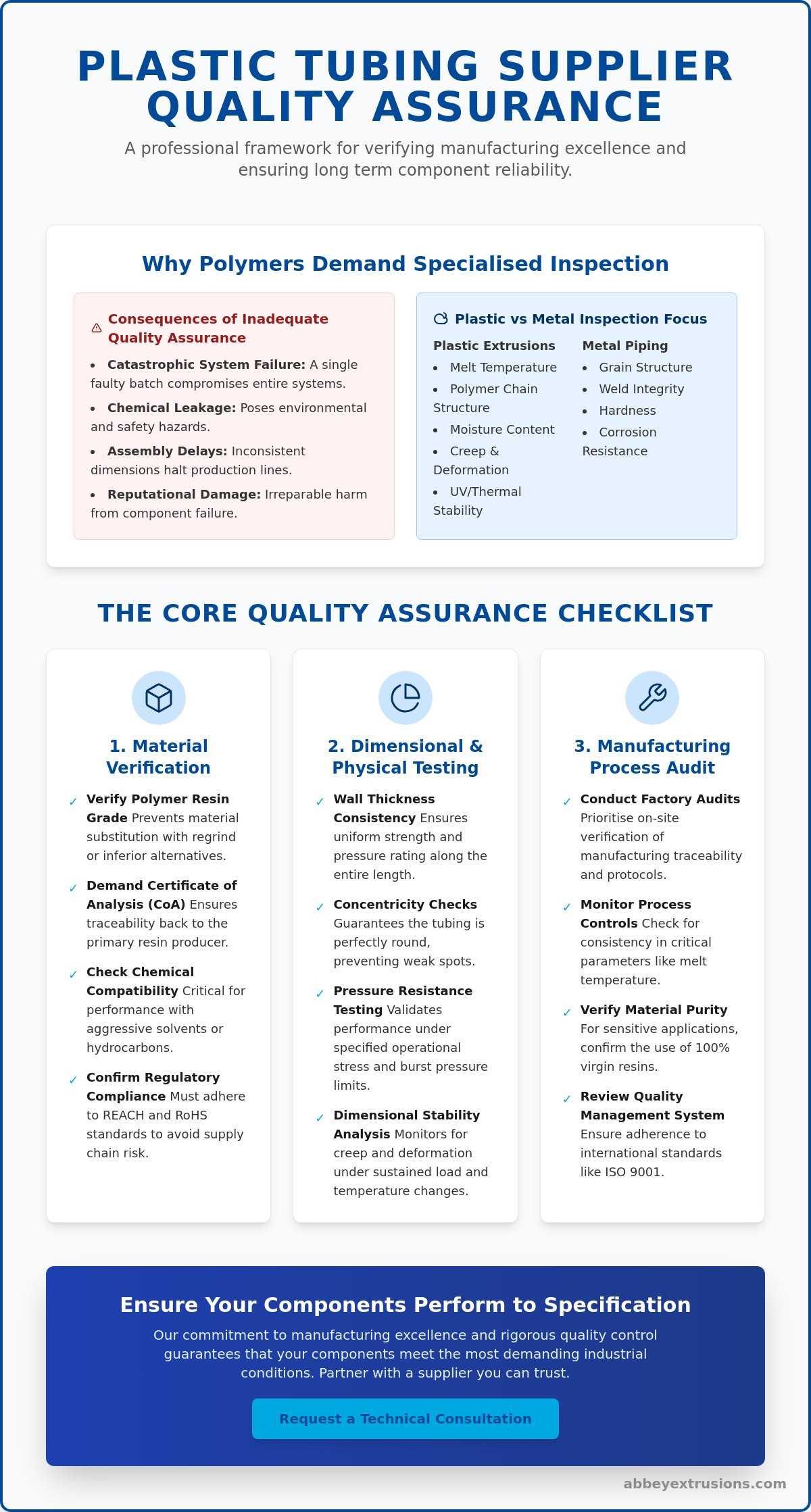
Auditing Supplier Capability and Traceability Systems
A rigorous factory audit is the most effective method to move beyond paper certifications and verify the actual manufacturing culture of a potential partner. When applying your tubing supplier quality assurance checklist, it is vital to assess the internal quality management systems that govern the production floor. Whilst an ISO 9001 certification provides a necessary baseline, the audit should focus on how these standards are executed in practice. This includes evaluating the calibration frequency of extrusion equipment and the proficiency of the technical staff in managing complex polymer behaviours. A supplier's ability to produce precision bespoke profiles, such as Kedar cord, serves as a significant indicator of their engineering capability and attention to detail.
Choosing a UK-based manufacturer often facilitates a higher level of oversight and more direct communication between procurement teams and production engineers. Local sourcing allows for more frequent site visits and real time problem solving, which is often impossible when dealing with distant overseas suppliers. This proximity ensures that technical specifications are not lost in translation and that any deviations from the agreed quality standards are identified and corrected immediately. Our commitment to transparent manufacturing allows partners to audit our processes with confidence, ensuring that every extrusion meets the required industrial benchmarks.
UK Manufacturing Standards and Regulatory Compliance
Sourcing from a UK manufacturer provides significant advantages regarding regulatory compliance and the mitigation of supply chain risk. Local production significantly reduces the likelihood of non-compliant or counterfeit materials entering your inventory, as UK facilities operate under strict national and international oversight. Our expert engineers play a pivotal role in developing custom solutions, such as curtainsider pelmet sections, where precise material properties and structural integrity are essential for safety and performance. This domestic expertise ensures that your components are manufactured to the highest possible standards whilst adhering to all relevant environmental and safety regulations.
Traceability from Raw Polymer to Finished Extrusion
Traceability is a fundamental requirement for industrial accountability, particularly when managing high volume orders of components like Low-density polythene tube. A robust system must provide a clear documentation trail that links every finished batch back to the original raw polymer lot. This process relies on detailed production logs and unique batch numbers that are stored and managed within a secure quality record system. Should a performance issue arise in the field, these records allow for a precise investigation into the material source and production conditions, enabling swift and effective corrective actions. We maintain these records as part of our core commitment to manufacturing excellence and long term partnership trust.
To discuss how we can support your quality management goals, please reach out to our technical department directly.
Implementing Your Tubing Supplier Quality Assurance Checklist
Integrating the tubing supplier quality assurance checklist into your standard procurement cycle ensures that technical compliance is established before a single pound is spent. It isn't enough to have a list; it must be embedded in the Request for Quote (RFQ) process. By clearly stating your quality expectations, material certifications, and tolerance requirements at the outset, you filter out sub-standard suppliers who cannot meet industrial benchmarks. This ensures that every potential partner understands the technical rigour required for your specific application, from chemical resistance to pressure ratings. This proactive approach prevents the high failure rates associated with low-quality imports and ensures that your assembly lines operate without interruption.
When non-conformance occurs, the response should be methodical and data-driven. A professional supplier will have a clear Corrective and Preventive Action (CAPA) protocol to address deviations, whether they involve dimensional drift or material impurities. This system should include a root cause analysis to prevent recurrence, ensuring that quality remains a continuous improvement process rather than a static goal. Ongoing quality monitoring amongst your preferred partners allows for a more collaborative approach to product development, where technical feedback loops improve the final extrusion's performance. By standardising your vetting procedures with a tubing supplier quality assurance checklist, you can maintain a high level of technical compliance across all projects.
Integrating Quality Checks into Your Procurement Process
A preliminary supplier assessment is essential before placing large scale orders. This involves reviewing technical documentation and production capacity to ensure the manufacturer can handle your specific volume requirements. The role of first-article inspection is critical in validating that the production process can consistently meet your specified tolerances before mass manufacture begins. This step provides a final safeguard against systemic errors, ensuring that the finished products align perfectly with your technical drawings and performance criteria.
Partnering with Abbey Extrusions for Technical Excellence
Abbey Extrusions is a specialist UK manufacturer with over 40 years of expertise in the plastic extrusion industry. Our team maintains a steadfast commitment to quality across our entire range, from standard Nylon tube to specialist reinforced hoses. We offer comprehensive tube forming and bespoke extrusion services, providing the engineering precision required for complex industrial projects. By choosing a partner with deep material knowledge and established quality protocols, you gain the assurance that your components will perform reliably in any application.
Securing Technical Integrity in Your Tubing Supply Chain
Establishing a reliable procurement framework requires a move away from generic inspection and towards a polymer specific approach. By implementing a robust tubing supplier quality assurance checklist, you ensure that material integrity and dimensional precision remain consistent across every batch. We have explored the necessity of rigorous material verification for high performance resins and the importance of auditing manufacturing traceability to mitigate long term operational risks. These steps are fundamental to maintaining the safety and efficiency of your industrial systems whilst reducing the likelihood of component failure.
As a specialist UK manufacturer founded in 1985, Abbey Extrusions provides the technical expertise needed to support your most demanding projects. We specialise in high performance polymers, including Nylon 11 and 12, and offer advanced bespoke extrusion and tube forming capabilities to meet unique specifications. Our commitment to engineering excellence ensures that every component performs exactly as specified under pressure.
Contact our technical team today to discuss your quality requirements and discover how our manufacturing standards can strengthen your supply chain. We look forward to building a partnership based on precision and professional trust.
Frequently Asked Questions
What are the most common defects found in extruded plastic tubing
Surface irregularities, wall thickness variation, and internal contamination are the primary defects encountered in polymer extrusions. These issues often result from inconsistent melt temperatures or inadequate filtration during the manufacturing process. Identifying these defects through rigorous inspection prevents mechanical failure and ensures that components meet the exacting standards required for industrial applications.
How do I verify if a tubing supplier uses high-quality Nylon 12
Verification requires a batch-specific Certificate of Analysis from the primary resin producer to confirm the polymer grade and its mechanical properties. A reliable manufacturer will include this verification as a core component of their tubing supplier quality assurance checklist to guarantee material performance. This documentation provides the necessary transparency to ensure the tubing is suitable for high-pressure pneumatic systems.
Why is dimensional tolerance so critical for industrial hoses
Precise tolerances are essential to ensure that hoses interface securely with couplings and connectors without leaking or disconnecting under pressure. Inconsistent outer diameters or wall thicknesses can lead to significant assembly failures and costly system downtime. Maintaining tight dimensional control is a fundamental requirement for technical compliance and long-term operational safety in demanding industrial environments.
Can I use a generic metal piping checklist for plastic tubing
Generic metal checklists are insufficient because they do not account for the unique viscoelastic properties and thermal expansion rates of polymers. Plastic extrusions require specific protocols for moisture absorption, chemical compatibility, and environmental stress cracking. A dedicated polymer-focused checklist is necessary to address the specific technical nuances of materials like polyurethane and reinforced PVC.
What certifications should I look for in a UK plastic extrusion company
ISO 9001 certification remains the primary international standard for a robust quality management system within a manufacturing centre. You should also verify compliance with REACH and RoHS regulations to ensure the absence of restricted chemical substances. For specialised sectors, look for FDA or EU food-grade approvals that confirm the material is safe for sensitive fluid transfer applications.
How does a supplier ensure the chemical resistance of a diesel fuel hose
Suppliers ensure resistance by selecting specific hydrocarbon-resistant resins and conducting rigorous immersion testing according to industrial standards. These tests verify that the polymer structure does not swell, soften, or degrade when exposed to fuel over extended periods. This technical validation is crucial for preventing hazardous leaks and maintaining the structural integrity of the hose in automotive settings.
What is the difference between quality control and quality assurance in manufacturing
Quality assurance focuses on the systemic processes used to prevent defects throughout the production cycle, whilst quality control involves the inspection of finished products to identify errors. Assurance is a proactive methodology that builds reliability into the manufacturing workflow. Both are essential elements of a total quality management framework that ensures consistent excellence and material integrity.
How often should I audit my plastic tubing supplier
Annual audits are the standard for critical industrial suppliers, although more frequent reviews may be required if technical specifications change or performance issues occur. Regular site visits allow procurement teams to verify that the tubing supplier quality assurance checklist is being actively followed on the production floor. This consistent oversight maintains high standards and strengthens the technical partnership between both parties.

Article by
Bryan Cowan
Bryan Cowan is the Founder and Managing Director of Abbey Extrusions Ltd, a leading UK manufacturer of high-quality plastic tubes and hoses. With over 40 years of industry experience, Bryan established the company in 1985, growing it from a startup into a BS ISO9001-registered supplier for global sectors including aerospace, automotive, and pharmaceuticals.
Disclaimer
This article is intended for informational purposes only. Please ensure you seek expert advice or carry out your own research to confirm the information is suitable for your specific needs.