A single month of direct sunlight can compromise the structural integrity of standard polymer systems, yet many industrial setups remain exposed for years without a formal assessment protocol. You likely recognise that ultraviolet exposure is a constant threat to material longevity, but identifying the early signs of UV degradation in plastic tubing is difficult when the transition from cosmetic discolouration to catastrophic brittle failure happens internally. Unexpected downtime caused by compromised hoses isn't just an operational nuisance; it's a significant safety risk that demands a methodical approach to material management.
We provide this technical guide to help engineers accurately assess damage and establish clear criteria for maintenance and replacement. You'll learn how to evaluate tubing using the latest industry benchmarks, including the ISO/TS 24110:2026 standard for combined UV and creep load testing. We also outline which materials, such as Nylon 12 or specialised LDPE, offer the best resistance to photodegradation and what strategies you can implement to extend the service life of your outdoor installations whilst maintaining peak system pressure.
Key Takeaways
- Understand how photo-oxidation leads to the breakage of covalent bonds and the propagation of free radicals throughout the polymer structure.
- Identify the critical signs of UV degradation in plastic tubing through visual indicators such as surface chalking and physical changes like increased brittleness.
- Compare the inherent UV resistance of various industrial polymers to determine which materials provide the best longevity for outdoor UK applications.
- Establish rigorous inspection protocols and physical protection methods to mitigate the safety risks associated with high pressure leaks.
- Learn how collaborating with a specialist UK manufacturer allows for the specification of UV stabilised materials tailored to your exact operational requirements.
If you require technical guidance regarding material selection for high-exposure environments, please contact our engineering team for specialist advice on UV-stabilised polymers.
Understanding the mechanism of UV radiation on polymer chains
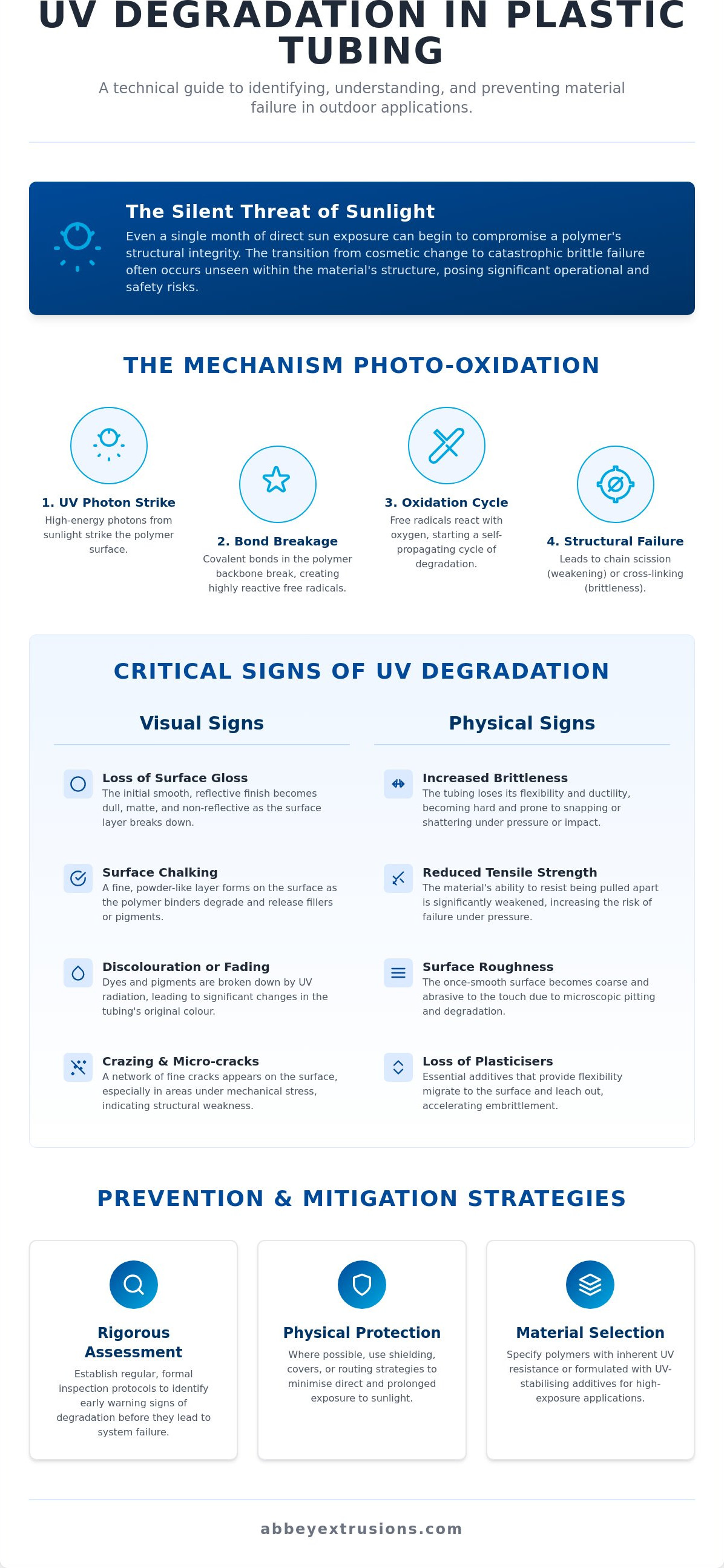
Ultraviolet radiation consists of high-energy photons that possess enough energy to disrupt the covalent bonds holding a polymer's carbon backbone together. When these photons strike the surface of an industrial hose, they initiate homolytic cleavage, which results in the formation of highly reactive free radicals. Whilst the initial damage is often microscopic, the cumulative effect manifests as the physical signs of UV degradation in plastic tubing that maintenance teams eventually observe during routine inspections. This degradation isn't merely a surface-level aesthetic issue; it's a fundamental chemical change that compromises the structural integrity of the entire fluid handling system.
Flexible extrusions frequently face more aggressive degradation profiles than rigid piping systems. This is partly due to the higher surface area to volume ratio found in smaller diameter tubing, which exposes a larger percentage of the material matrix to direct solar irradiance. Unlike rigid pipes that are often shielded or buried, flexible hosing is commonly utilised in dynamic, exposed applications. In these environments, the material must withstand constant movement and internal pressure whilst its chemical bonds are being systematically dismantled by UV energy.
The chemical process of photo-oxidation
Once the initial free radicals are created by sunlight, the presence of atmospheric oxygen triggers a self-propagating cycle of Photo-oxidation. These radicals react with oxygen to form peroxy radicals, which then abstract hydrogen from adjacent polymer chains to create hydroperoxides. This leads to two primary structural failures: chain scission, which reduces the molecular weight and causes the material to soften or lose tensile strength, and cross-linking, which creates an excessively rigid and brittle network. Photo-oxidation is the primary driver of polymer failure in outdoor environments.
Why flexible tubing is particularly vulnerable
Flexible materials such as Nylon tube or low-density polythene tube are particularly susceptible because they rely on molecular mobility to maintain their performance characteristics. UV exposure can cause essential additives like plasticisers to migrate to the surface and leach out, leaving the host polymer vulnerable to environmental stress cracking. Recognising the early signs of UV degradation in plastic tubing is essential because, in flexible systems, the combined effect of mechanical stress and chemical weakening can lead to sudden failure. Furthermore, thinner wall sections offer less sacrificial material, meaning the degradation path to the inner diameter is significantly shorter than in heavy-walled industrial piping.
For technical assistance in identifying material fatigue in your specific application, you can speak with our production specialists directly.
Common physical and visual signs of UV degradation in plastic tubing
Visual inspection remains the most practical method for the early detection of material failure in industrial environments. Whilst chemical changes occur at the molecular level, they eventually manifest as observable signs of UV degradation in plastic tubing that can be identified by trained maintenance personnel. One of the earliest indicators is a significant loss of surface gloss. As the polymer matrix begins to break down, the smooth, reflective finish typical of a new PVC tube or nylon extrusion becomes dull and matte. This change in surface morphology is often accompanied by increased roughness, which can be felt during a tactile assessment.
The progression of damage often leads to the development of micro-cracks, a phenomenon known as crazing. These tiny fissures typically appear on the outer radius of bends where the material is under the highest mechanical tension. Unlike surface scratches, crazing follows a distinct pattern perpendicular to the direction of stress. This process is well-documented in technical literature, including an experimental study on uPVC pipes, which highlights how UV exposure fundamentally alters mechanical properties such as tensile strength and surface hardness. If you notice these patterns, it's a clear signal that the polymer's structural integrity is compromised.
Surface changes and colour shifts
Pigment fading or yellowing is frequently the primary warning sign of deep-seated chemical change. In clear or translucent hoses, UV exposure often results in a distinct amber tint, whilst coloured tubing may appear bleached or unevenly toned. You must distinguish this from simple dirt accumulation. Genuine UV bleaching cannot be wiped away; it represents a permanent loss of the polymer's original chemical composition. In advanced cases, you might observe "chalking," where the degraded polymer turns into a white, powdery residue that easily rubs off on your hands. This indicates that the outer layer of the extrusion has completely failed.
Structural brittleness and loss of flexibility
A simple manual flex test can reveal a significant loss of elasticity before a failure occurs. If a previously flexible reinforced PVC tube feels rigid or produces audible cracking sounds when bent, it has reached the end of its safe service life. This brittleness is caused by the cross-linking of polymer chains, which prevents them from sliding past one another under load. Structural brittleness often precedes catastrophic burst failure in reinforced hoses. If your systems operate under high pressure, regular tactile checks are essential to ensure the safety of your operators. For a more detailed analysis of your current system's health, we recommend requesting a technical evaluation from our engineering team.
If you need assistance selecting the most durable material for your specific outdoor application, please contact our technical department for a consultation.
How different materials react to prolonged sunlight exposure
Industrial polymers exhibit vastly different thresholds for solar irradiance based on their molecular structure and the presence of specialised additives. Whilst a standard low-density polythene tube might show early signs of UV degradation in plastic tubing within months of exposure, high-performance engineering plastics like Nylon 12 are engineered to maintain their mechanical properties for significantly longer periods. Understanding these material-specific reactions is vital for engineers designing systems for the UK's variable climate, where moisture and UV exposure often act in tandem to accelerate polymer failure.
The rate of decay is not uniform across all polymer families. Some materials possess inherent photostability due to their chemical bonds, whilst others require complex stabilisation packages to survive even moderate exposure. When evaluating a system, you must consider the specific polymer base, as the failure mode of a polyurethane extrusion will differ fundamentally from that of a vinyl-based hose. Accurate identification of these patterns ensures that replacement cycles are based on technical data rather than guesswork.
UV resistance in Nylon 11 and Nylon 12
Nylon 11 and Nylon 12 are often the preferred choice for demanding industrial environments due to their exceptional dimensional stability and chemical resistance. When specifying a Nylon tube for outdoor use, the choice of stabilising agent is critical. Carbon black remains the most effective additive for these materials; it acts as both a UV absorber and a screen, preventing photons from penetrating deep into the polymer matrix. Nylon 12 is particularly valued amongst engineering plastics for its lower moisture absorption compared to Nylon 11, which provides an extra layer of protection against the combined effects of weathering and mechanical stress.
Degradation patterns in Polyurethane and PVC
Polyurethane (PU) is highly valued for its flexibility and abrasion resistance, but standard variants can be exceptionally vulnerable to solar radiation. A Polyurethane tube without specific UV inhibitors can lose significant tensile strength in a relatively short timeframe. This material is also prone to hydrolysis, where moisture breaks down the polymer chains. When combined with UV energy, this process is significantly accelerated. You'll often see the surface become sticky or tacky before it eventually turns brittle and cracks.
In contrast, a PVC tube relies heavily on the quality of its compounding. Titanium dioxide is a common additive used to reflect UV rays and protect the underlying vinyl structure. However, prolonged exposure can still lead to plasticiser migration. This is a process where the chemicals that provide the PVC with its flexibility move to the surface and dissipate. The result is a material that transitions from a flexible hose to a rigid, glass-like state. Identifying these material-specific signs of UV degradation in plastic tubing allows for more accurate maintenance scheduling and prevents the safety risks associated with sudden material failure.
To discuss a tailored inspection protocol for your facility, please enquire with our technical team for expert guidance.
Practical methods for assessing and preventing UV damage
Managing the risk of ultraviolet damage requires a dual approach that combines proactive monitoring of existing installations with the strategic implementation of protective technologies. Identifying the early signs of UV degradation in plastic tubing requires more than a cursory glance; it necessitates a structured methodology to ensure that material fatigue is caught before it leads to system failure. We advise that any hose or tube situated in an outdoor environment or near high-intensity artificial light sources should be subject to a documented inspection cycle, with the frequency determined by the intensity of exposure and the criticality of the application.
Effective prevention also extends to the management of spare inventory. It is common for replacement hoses to undergo significant degradation before they are even installed if they are stored near warehouse skylights or open bay doors. We recommend keeping all polymer products in their original UV-opaque packaging and ensuring that storage areas are temperature-controlled and shielded from direct sunlight. This ensures that the material's service life begins at the moment of installation, rather than being compromised during storage.
Inspection protocols for industrial installations
A rigorous inspection protocol should prioritise high-flex points and areas adjacent to heat-reflective surfaces, as these conditions often accelerate the chemical breakdown of the polymer. Engineers should use a magnifying glass to check for early-stage crazing, which often appears as a network of fine, hair-like fractures on the surface. These micro-fractures are the definitive signs of UV degradation in plastic tubing and serve as a precursor to deeper structural failure. If these patterns are detected, a proactive replacement programme should be initiated immediately to prevent safety incidents related to high-pressure leaks.
Protective measures and additive technologies
For existing installations where rerouting is not possible, physical shielding offers a highly effective secondary line of defence. Utilising a Nylon spiral cut hose guard provides both mechanical protection and a sacrificial barrier against UV radiation, significantly extending the life of the primary tube. During the manufacturing phase, we can also incorporate sophisticated chemical solutions such as UV absorbers, which convert radiation into harmless heat, or Hindered Amine Light Stabilisers (HALS) that scavenge the free radicals created by photo-oxidation. Selecting opaque colours, particularly those with high carbon black content, remains one of the most reliable ways to block radiation from penetrating the tube wall. If you are unsure which protective strategy best suits your environment, we encourage you to consult our engineers for a material audit of your current systems.
If you require a bespoke material formulation for an outdoor application, please contact our engineering team for a technical consultation.
Selecting UV resistant tubing for high performance applications
Specifying the correct material grade at the design phase is the most effective way to eliminate the risks associated with ultraviolet damage. Whilst generic "off the shelf" products may appear cost effective, they often lack the precise concentration of stabilisers required for long term outdoor longevity. Partnering with an experienced UK manufacturer allows engineers to define exact performance parameters, ensuring that the polymer matrix is tailored to the specific UV index and mechanical load of the operating environment. This proactive approach prevents the early appearance of the signs of UV degradation in plastic tubing and ensures that your systems remain compliant with modern safety standards.
The selection process must take into account the latest industry benchmarks, such as the ISO/TS 24110:2026 technical specification. This standard is particularly relevant for applications where tubing is subjected to both solar radiation and mechanical creep load. By choosing a material that has been validated under these combined stressors, you can more accurately predict replacement cycles and avoid the safety risks of brittle failure. Our manufacturing processes ensure that every batch meets these rigorous requirements, providing a level of reliability that mass produced imports simply cannot match.
Custom extrusions with stabilised polymers
Abbey Extrusions specialises in bespoke production runs where UV stabilisation is integrated directly into the melt. This ensures a uniform distribution of absorbers and HALS throughout the entire wall thickness, rather than just a surface coating. We also offer advanced tube forming services to create pre-shaped components. This technique is vital for outdoor installations because it eliminates the internal stresses that occur when a straight tube is forced into a tight radius. Reducing this "built-in" stress significantly slows the rate at which signs of UV degradation in plastic tubing, such as crazing or stress cracking, begin to manifest.
Technical support for material specification
Leveraging decades of manufacturing expertise allows us to guide you away from common material selection errors that lead to premature system failure. For instance, whilst a standard polyurethane might be chosen for its flexibility, we may recommend a specific grade of Nylon 12 for its superior resistance to both UV and moisture absorption in exposed UK environments. If you are experiencing recurring failures in your current setup, we can provide a technical review of your failure points to identify whether the issue is chemical, mechanical, or a combination of both. We invite you to consult with Abbey Extrusions for custom UV resistant solutions tailored to your specific industrial requirements.
For expert assistance with material selection and system audits, please contact our technical specialists to ensure your installations are fully protected against ultraviolet damage.
Optimising material longevity in high exposure environments
Ensuring the long term reliability of industrial fluid systems requires a disciplined approach to material monitoring and specification. By identifying the early signs of UV degradation in plastic tubing, such as surface crazing or a significant loss of elasticity, engineers can prevent the safety risks and operational costs associated with sudden brittle failure. Selecting the correct polymer grade, whilst implementing physical shielding like spiral guards, remains the most effective strategy for maintaining system integrity in challenging outdoor conditions.
Abbey Extrusions has operated as a specialist UK manufacturer since 1985, providing the technical competence required for demanding industrial applications. We are specialists in Nylon 11 and 12 flexible tubing and maintain extensive bespoke extrusion and compounding capabilities to meet unique environmental challenges. If you require technical advice regarding material suitability for outdoor environments, please contact our specialist team for further assistance. We look forward to helping you secure the longevity and safety of your polymer tubing systems.
Frequently Asked Questions
How does UV light affect plastic tubing
Ultraviolet radiation initiates a chemical process called photo-oxidation, where high-energy photons break the covalent bonds within the polymer chains. This molecular disruption creates reactive free radicals that lead to either chain scission, which weakens the material, or cross-linking, which causes excessive brittleness. Over time, these changes compromise the structural integrity and pressure rating of the extrusion, eventually leading to sudden failure under normal operating conditions.
Which plastics are most resistant to UV degradation
Fluoropolymers such as PTFE, FEP, and PFA offer the highest levels of inherent resistance to ultraviolet radiation due to their stable chemical bonds. Amongst common industrial polymers, Nylon 12 and specialised LDPE variants provide excellent durability when correctly compounded with stabilising agents. Materials like standard Polyurethane or PVC are significantly more vulnerable and always require specific inhibitors to survive prolonged exposure in outdoor installations.
Can you tell if tubing is damaged just by looking at it
Visual indicators provide the most immediate evidence, though they don't always reveal the full extent of deep structural damage. Common signs of UV degradation in plastic tubing include surface discolouration, a dull matte finish, or the appearance of a white powdery residue known as chalking. Engineers should also look for crazing, which consists of microscopic cracks on the outer radius of bends, as this indicates the material is nearing failure.
What is the difference between UV stabilised and UV resistant
UV resistant polymers possess a molecular structure that is naturally stable when exposed to radiation, whereas UV stabilised materials rely on chemical additives for protection. These additives, such as Hindered Amine Light Stabilisers (HALS) or UV absorbers, are mixed into the polymer during the extrusion process to intercept radiation or neutralise free radicals. Both methods aim to extend service life, but the choice depends on the specific environmental demands of the application.
How long does it take for UV damage to occur
The timeframe for damage depends on the polymer type and the local UV index, but changes can occur surprisingly quickly. For instance, the ASTM F876 standard requires PEX tubing to have a minimum UV resistance of only one month for certain applications. In high-exposure environments, unprotected or poorly stabilised polymers may show a measurable loss of tensile strength and surface cracking within just thirty days of direct summer sunlight.
Does colour affect the UV resistance of plastic tubing
Opaque pigments significantly improve a material's longevity by acting as a physical barrier against radiation penetration. Whilst clear or translucent tubing allows UV rays to pass through the entire wall thickness, darker pigments reflect or absorb the energy at the surface. Carbon black is the most effective additive for this purpose, as it provides a sacrificial layer that protects the underlying polymer matrix from deep-tissue degradation.
Can UV damaged tubing be repaired
Chemical degradation caused by ultraviolet exposure is a permanent and irreversible molecular change that affects the entire material matrix. Once the polymer chains have been broken or cross-linked, the material cannot be restored to its original mechanical specifications or pressure rating. Attempting to patch or coat damaged tubing is not a viable safety solution; the only reliable method to ensure system integrity is to replace the affected sections immediately.
Is black plastic always better for outdoor use
Black plastic is generally superior for outdoor use provided the colour is achieved using high-quality carbon black. This specific pigment is an exceptionally efficient UV absorber that converts radiation into harmless heat before it can damage the polymer bonds. However, the base material must still be appropriate for the task. A black LDPE tube will offer excellent UV resistance but may lack the pressure rating required for high-performance hydraulic systems.

Article by
Bryan Cowan
Bryan Cowan is the Founder and Managing Director of Abbey Extrusions Ltd, a leading UK manufacturer of high-quality plastic tubes and hoses. With over 40 years of industry experience, Bryan established the company in 1985, growing it from a startup into a BS ISO9001-registered supplier for global sectors including aerospace, automotive, and pharmaceuticals.
Disclaimer
This article is intended for informational purposes only. Please ensure you seek expert advice or carry out your own research to confirm the information is suitable for your specific needs.