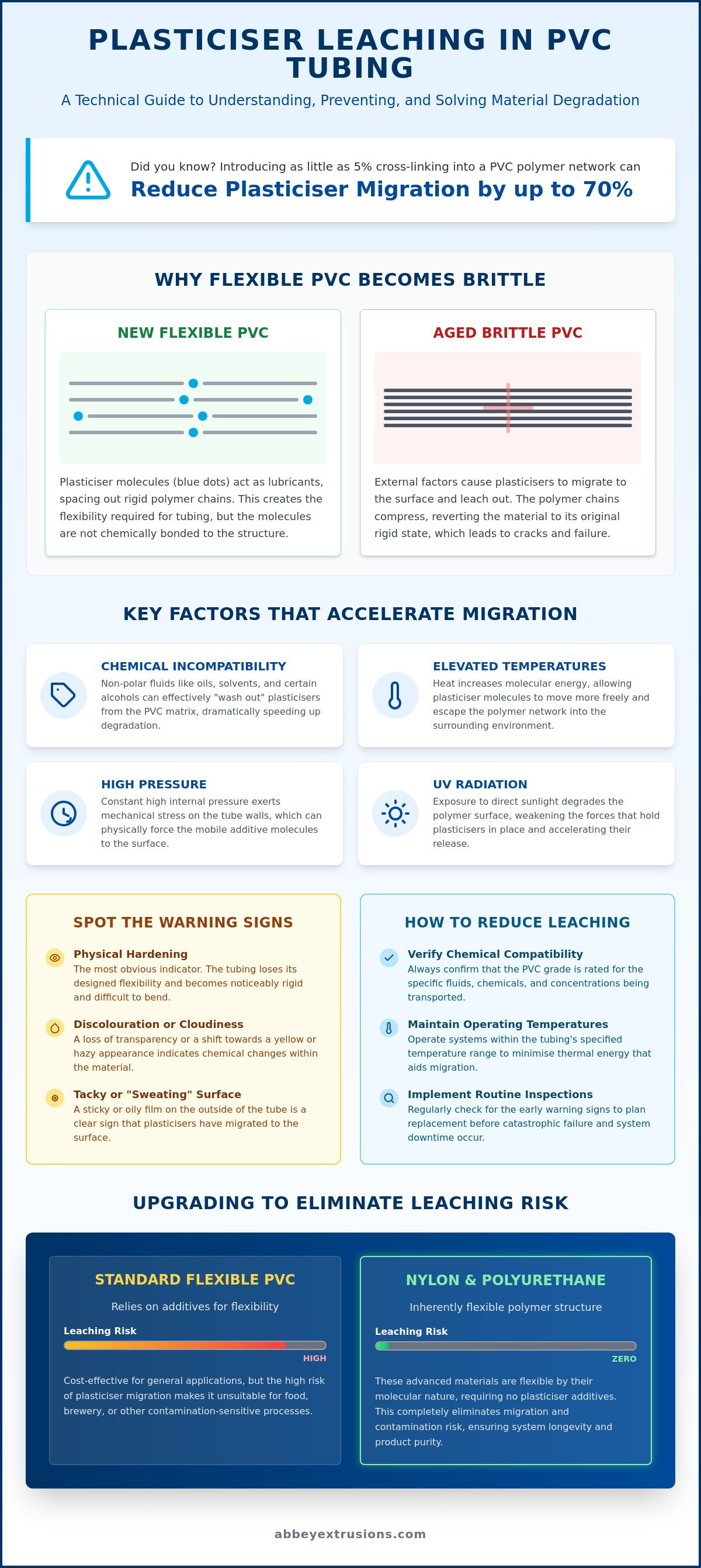
Did you know that introducing as little as 5% cross-linking into a PVC polymer network can reduce plasticiser migration by as much as 70%? For many industrial professionals, the gradual degradation of flexible tubing is an accepted but costly inconvenience. You likely recognise the pattern where hoses become brittle, lose their transparency, and eventually crack under pressure. This phenomenon is more than a maintenance headache; it represents a significant risk of fluid contamination, especially in brewery and food processing environments where compliance with Regulation EU 10/2011 is mandatory.
At Abbey Extrusions, we believe that the longevity of your systems depends on material stability. Learning how to prevent plasticiser leaching from PVC requires a deep understanding of the chemical interactions between the polymer and the fluids it carries. This technical guide provides a comprehensive overview of the mechanics behind migration. We shall outline specific strategies to preserve the flexibility of your existing PVC installations whilst providing clear criteria for when you should consider upgrading to high-performance alternatives such as Nylon or Polyurethane to ensure long-term operational safety.
Key Takeaways
- Understand the molecular mechanics of migration, where weak Van der Waals forces amongst polymer chains allow additives to escape and lead to material brittleness.
- Implement practical strategies regarding how to prevent plasticiser leaching from PVC by regulating operating temperatures and ensuring total chemical compatibility with transported fluids.
- Recognise the impact of external stressors like UV radiation and high pressure which force additives to the surface and compromise the integrity of the hose.
- Evaluate the benefits of switching to Nylon 11 or Polyurethane tubing for critical applications where maintaining a contamination-free environment is paramount.
- Gain insights into specifying high-performance tubing and the advantages of professional tube forming for complex industrial layouts.
To discuss your specific application and material requirements, please reach out to our technical team for expert guidance.
Understanding the mechanics of plasticiser migration in PVC
Raw polyvinyl chloride is a naturally rigid polymer. To achieve the flexibility required for industrial hoses and tubes, manufacturers incorporate specific chemical additives. If you're researching what are plasticizers, you'll find they act as internal lubricants that space out polymer chains. These molecules reduce the intermolecular forces, allowing the chains to slide past one another. However, these additives aren't chemically bonded to the PVC backbone. Instead, they're held in place by relatively weak Van der Waals forces amongst the polymer chains.
Because no covalent bond exists, these molecules remain mobile. Over time, or when exposed to specific environmental triggers, they migrate from the centre of the material to the surface. This process is the fundamental reason why understanding how to prevent plasticiser leaching from PVC is vital for maintaining system integrity. Once the additives reach the surface, they can be washed away by fluids or evaporate into the air. The physical consequences are immediate. The tubing loses its elastic properties, becomes increasingly brittle, and eventually develops micro-cracks that lead to catastrophic failure under pressure.
The role of phthalates in flexible tubing
Phthalates, such as DEHP or DINP, have long been the standard choice for industrial PVC extrusions due to their cost-effectiveness. These are small, non-polar molecules that fit easily between polymer strands. Their size makes them particularly prone to leaching, especially when the material is subjected to heat or mechanical stress. Unlike internally plasticised systems, where flexibility is built into the molecular structure of the polymer itself, phthalate-based PVC relies entirely on these "floating" additives. When they depart, the material reverts to its original rigid state. This isn't just a physical change; it's a loss of the material's primary functional benefit.
Why leaching occurs during fluid transfer
Migration is often accelerated by a concentration gradient between the tube wall and the media being transported. If you're moving non-polar fluids like oils, hydrocarbons, or certain alcohols, these substances act as solvents that pull the plasticisers out of the matrix. This is why selecting the correct PVC tube for your specific chemical environment is a critical engineering decision. In brewery or food applications, this leaching risks contaminating the product. Under Regulation EU 10/2011, migration limits are strictly enforced to ensure that additives don't compromise food safety. Ensuring the material is rated for the specific fluid is the first step in managing this risk.
If you require technical assistance in selecting the most durable material for your fluid transfer systems, please enquire with our engineering team for a detailed consultation.
Practical techniques to reduce plasticiser migration
Whilst advanced chemical research into covalently attached plasticizers offers a glimpse into the future of polymer science, industrial operators require immediate, tangible methods to manage existing infrastructure. Managing how to prevent plasticiser leaching from PVC involves a combination of environmental control and rigorous maintenance protocols. The primary goal is to stabilise the additives within the polymer matrix by reducing the energy and external stressors that facilitate their movement to the surface.
Routine inspections serve as the first line of defence. Operators should look for subtle changes in the appearance and texture of the tubing. Hardening of the tube wall is a primary indicator that plasticisers have already begun to migrate, leaving the remaining PVC structure rigid and brittle. Discolouration, a loss of transparency, or a "tacky" feeling on the outer surface often suggests that additives have moved to the interface. This "sweating" effect is a clear sign that the material's integrity is compromised. Early detection allows for planned replacements, preventing the high costs associated with sudden hose failure and fluid contamination.
Thermal management in industrial systems
Heat is a significant catalyst for additive migration. As the temperature of the system rises, the kinetic energy of the plasticiser molecules increases, allowing them to overcome the weak Van der Waals forces more easily. For standard flexible PVC, operating temperatures should ideally remain below 60 degrees Celsius. In environments where this is not possible, implementing active cooling or installing thermal insulation and reflective shielding can significantly extend the service life of the components. Monitoring ambient temperature at the point of installation is just as important as monitoring the fluid temperature itself.
Surface treatments and barrier layers
Advanced manufacturing techniques such as co-extrusion provide a physical barrier against leaching. By extruding a chemically resistant inner liner within a flexible outer shell, manufacturers can isolate the plasticised material from the transported media. This is particularly effective in high pressure environments. Whilst a reinforced PVC tube provides the mechanical strength to resist bursting, the internal concentration gradient still exists. Using barrier layers ensures that even under pressure, the additives remain trapped within the tube wall. If you are unsure which barrier technology suits your process, contact our specialists to discuss bespoke extrusion options.
To consult with a technical specialist regarding the specific stressors in your industrial environment, please contact our expert team for professional assistance.
Environmental and operational factors that accelerate migration
Whilst temperature is a critical variable, the physical and chemical environment surrounding the extrusion plays an equally vital role in additive stability. High pressure environments are particularly problematic as they compress the polymer matrix, physically forcing mobile plasticiser molecules towards the surface of the tube. This migration often results in the blooming effect, where the leached material crystallises upon reaching the exterior. You'll likely notice a white, powdery residue or a sticky film on the hose, both of which indicate that the material's internal structure is failing. Understanding these operational stressors is essential for mastering how to prevent plasticiser leaching from PVC in demanding factory settings.
The loss of these additives doesn't just affect the flexibility of the hose; it creates a cycle of degradation. As the plasticisers leave the matrix, the material becomes more porous, which in turn allows the transported media to penetrate deeper into the tube wall. This accelerates the extraction process and can lead to a sudden loss of pressure rating. Ensuring that the hose is correctly specified for both the internal pressure and the external environment is the only way to avoid premature brittleness and the associated replacement costs.
UV degradation and outdoor exposure
British sunlight, whilst often obscured by cloud, delivers sufficient UV radiation to trigger photo-oxidation in unprotected PVC. This chemical breakdown severs polymer chains, creating pathways for plasticisers to escape more easily. For outdoor installations, we recommend incorporating specific UV stabilisers into custom extruded profiles to maintain molecular stability over long durations. Additionally, applying a nylon spiral cut hose guard provides a robust physical shield. This not only prevents direct radiation from reaching the PVC surface but also offers significant protection against mechanical abrasion in mobile industrial applications.
Chemical extraction by industrial fluids
The chemical composition of the media being transported is often the most aggressive factor in additive loss. Hydrocarbons and alcohols are notorious for acting as extraction agents that interact with the non-polar nature of many phthalates. In a diesel fuel hose, the constant contact with fuel can strip the plasticisers within weeks if the material grade is incorrect. Similarly, a brewery hose must withstand both the ethanol content of the product and the caustic agents used in cleaning cycles. Chemical extraction is the process where the transported fluid dissolves and removes the plasticising agent. To manage how to prevent plasticiser leaching from PVC, engineers must ensure the material's solubility parameter is as far removed from the transported fluid as possible.
To discuss material alternatives and technical specifications for your application, please get in touch with our technical consultants for professional guidance.
Selecting alternative polymers to eliminate leaching risks
Whilst previous sections covered how to prevent plasticiser leaching from PVC through environmental controls, the most definitive solution for critical applications is often a total material transition. PVC relies on additives for flexibility, but certain high performance polymers are inherently flexible at a molecular level. By removing the additive from the equation entirely, you eliminate the risk of migration and the subsequent brittleness that plagues standard PVC installations. This transition is particularly important in industries where fluid purity and long term mechanical reliability are non-negotiable. For many UK manufacturers, the shift from PVC to more stable polymers represents a strategic move towards reduced maintenance cycles and improved system safety.
The advantages of Nylon 11 and 12
A high quality nylon tube offers a robust alternative for systems requiring long term stability. Nylon 11 and 12 are semi-crystalline polymers that provide flexibility through their molecular structure rather than through external chemical softening agents. This makes them ideal for high pressure air lines and chemical transfer where material purity is vital. You can find more detailed information on nylon tubing properties in our technical guide. Compared to PVC, these materials offer superior thermal stability and a much lower permeability to gases and liquids. This means they don't just stop leaching; they also prevent the absorption of external contaminants into the fluid stream.
Polyurethane and Fluoropolymer solutions
For applications involving constant movement or high levels of abrasion, a polyurethane tube often outperforms flexible PVC. Polyurethane possesses an exceptional memory that allows it to return to its original shape after bending, making it the preferred choice for coiled hoses and robotic systems. It's naturally resistant to oils and fuels, which are the primary extraction agents for PVC plasticisers. In even more extreme environments, fluoropolymers like PTFE or FEP provide a zero-leaching solution. These materials are chemically inert and can withstand temperatures far exceeding the limits of standard polymers. They are the benchmark for food-grade and medical applications where even trace amounts of migration could have severe consequences.
Choosing between PU and Nylon depends on your specific balance of pressure requirements and bend radius. Whilst the initial cost of these materials is higher than PVC, the total cost of ownership is often significantly lower. You avoid the expenses associated with premature failure, system downtime, and the risks of fluid contamination. When you factor in the labour costs of frequent hose replacements, high performance polymers emerge as the more economical choice for professional industrial setups. If you are evaluating how to prevent plasticiser leaching from PVC in a sensitive process, switching to an inherently stable polymer is the most secure path forward. Contact our team today to explore our range of high-performance alternatives and receive a bespoke material recommendation.
For bespoke engineering solutions and technical material data, please consult with our specialist manufacturing team to ensure your systems meet the highest industrial standards.
Specifying high performance tubing for critical applications
Success in complex fluid transfer depends on the precision of the initial specification. When considering how to prevent plasticiser leaching from PVC, engineers must look beyond off the shelf solutions and partner with an experienced UK manufacturer. Abbey Extrusions provides the technical depth required to navigate material traceability and quality control, ensuring that every batch of tubing meets the exact chemical and mechanical requirements of your facility. By maintaining a transparent supply chain and rigorous testing protocols, we help our partners avoid the hidden costs of material failure and contamination.
Modern industrial layouts often require more than simple straight runs of hose. Our specialised process for tube forming allows for the creation of complex, pre-shaped configurations that fit perfectly within restricted spaces. This eliminates the need for excessive fittings, which are often the primary sites for leaks and fluid stagnation. Formed tubes maintain their internal diameter and structural integrity far better than forced bends, reducing the mechanical stress that can otherwise accelerate the migration of additives to the surface.
Bespoke extrusion and material selection
Specifying custom additives during the extrusion process allows for enhanced performance in challenging environments. Whether you require increased UV resistance or specific antimicrobial properties, bespoke profiles can be tailored to your precise chemical demands. Working with a UK-based manufacturer ensures significantly shorter lead times and direct access to technical support during the design phase. We encourage engineers to consult with us early in the project to verify material compatibility, as this proactive approach is the most effective way to manage how to prevent plasticiser leaching from PVC in the long term.
Long term maintenance and hose management
Maintaining a high performance system requires a structured monitoring programme. We recommend a regular checklist for all critical industrial hoses:
- Conduct visual inspections for "blooming" or white powdery residue on the tube exterior.
- Perform tactile checks for any hardening or loss of flexibility in the tube wall.
- Monitor for discolouration of the transported media, which can indicate additive extraction.
- Track the service age of components against the manufacturer's expected lifespan for that specific environment.
Investing in higher quality, non-leaching polymers also offers significant environmental benefits by reducing the volume of waste generated by frequent hose replacements. The engineering principles of high quality plastic extrusion are designed to maximise operational uptime and ensure that your fluid transfer systems remain safe, compliant, and efficient throughout their service life.
To request a technical evaluation of your current system or to discuss bespoke extrusion profiles, please speak with our engineering specialists for a comprehensive consultation.
Securing your fluid transfer infrastructure
Maintaining the long term performance of flexible tubing requires a dual strategy involving both environmental management and informed material selection. By controlling operating temperatures and identifying aggressive chemical stressors early, you can significantly mitigate the risks of additive migration. However, for critical processes where contamination or brittleness cannot be tolerated, transitioning to inherently stable polymers such as Nylon 11 or Fluoropolymers remains the most effective method for how to prevent plasticiser leaching from PVC.
Abbey Extrusions has been a specialist UK manufacturer since 1985, providing the technical expertise needed to solve complex material challenges. We offer bespoke extrusion and tube forming services tailored to your specific industrial requirements, with a focus on high performance materials like Nylon 12 and Polyurethane. Our team is ready to help you specify the correct tubing to reduce downtime and ensure long term operational reliability. Please contact our technical team to discuss your high-performance tubing requirements and secure the integrity of your systems. We look forward to partnering with you on your next engineering project.
Frequently Asked Questions
How do I know if my PVC hose is leaching plasticisers
You can identify leaching by observing physical changes such as a tacky residue on the exterior or a significant hardening of the tube wall. This sweating effect occurs when additives migrate to the surface. If the hose loses its original transparency or becomes increasingly brittle, it's a clear sign that the internal structure is compromised. Monitoring these tactile changes is a primary step in understanding how to prevent plasticiser leaching from PVC before a system failure occurs.
Is plasticiser leaching dangerous for food and beverage applications
Leaching represents a serious contamination risk in food and beverage systems because the migrated additives can alter the taste or safety of the product. In the UK and Europe, materials must comply with Regulation EU 10/2011 to ensure migration limits aren't exceeded. Phthalates are particularly prone to extracting into fatty or alcoholic media. Using certified food-grade hoses or inherently stable polymers is the only way to ensure total compliance and consumer safety.
Can I stop leaching once it has already started in my system
It isn't possible to reverse the leaching process once the plasticisers have departed from the polymer matrix. Because the additives are not chemically bonded, their departure causes a permanent molecular shift that leaves the PVC rigid and prone to cracking. Whilst you can slow further migration by reducing system temperatures, the lost flexibility cannot be restored. At this stage, the only reliable solution is to replace the component with a more stable material.
What are the best phthalate-free alternatives for flexible tubing
The most effective phthalate-free alternatives include Nylon 11, Nylon 12, and Polyurethane tubing. These materials achieve flexibility through their molecular arrangement rather than through external chemical softeners. For more aggressive environments, Fluoropolymers like PTFE or FEP provide a zero-leaching solution. Switching to these materials is a definitive answer for engineers researching how to prevent plasticiser leaching from PVC in critical industrial applications where fluid purity is a priority.
Does the colour of the PVC tube affect the rate of leaching
The colour of the tubing doesn't directly change the chemical rate of leaching, but it can influence environmental factors that accelerate the process. Opaque or black PVC tubes often contain pigments that provide better protection against UV radiation than clear versions. By reducing photo-oxidation, these coloured profiles can maintain their molecular stability for longer in outdoor settings, whilst clear tubes may degrade and lose their plasticisers more rapidly under direct sunlight.
How long does it typically take for a PVC hose to become brittle
The timeline for brittleness varies significantly based on the operating environment and the chemicals being transported. In standard ambient conditions with neutral fluids, a high-quality PVC hose might remain flexible for several years. However, exposure to high temperatures or aggressive solvents like diesel can cause the material to become brittle in just a few weeks. It's essential to establish a replacement cycle based on the specific stressors of your industrial application.
Can heat from the surrounding environment cause leaching if the fluid is cold
Ambient heat from the surrounding environment can trigger leaching even if the fluid inside the hose remains cold. The kinetic energy from external heat sources increases the mobility of the plasticiser molecules throughout the entire thickness of the tube wall. This means that hoses installed near boilers, engines, or in direct sunlight are at risk of premature failure regardless of the internal media temperature. Proper insulation of the exterior is often required.
Are reinforced PVC hoses more resistant to leaching than standard ones
Reinforced PVC hoses provide higher pressure ratings but they don't offer increased resistance to plasticiser leaching compared to standard tubes. The reinforcement braid is embedded within the same PVC matrix, which still relies on mobile additives for its flexibility. Whilst the hose might resist bursting for longer due to the mechanical strength of the mesh, the PVC layers will still become brittle and crack as the plasticisers migrate out over time.

Article by
Bryan Cowan
Bryan Cowan is the Founder and Managing Director of Abbey Extrusions Ltd, a leading UK manufacturer of high-quality plastic tubes and hoses. With over 40 years of industry experience, Bryan established the company in 1985, growing it from a startup into a BS ISO9001-registered supplier for global sectors including aerospace, automotive, and pharmaceuticals.
Disclaimer
This article is intended for informational purposes only. Please ensure you seek expert advice or carry out your own research to confirm the information is suitable for your specific needs.