A single oversight in material specification can compromise an entire industrial project, turning a routine procurement task into a significant commercial liability. When evaluating nylon vs polyurethane tubing, many professionals focus on the immediate cost whilst overlooking the nuanced chemical compatibility and pressure ratings that define long term performance. With the recent strategic shift towards regionalising supply chains to de-risk operations, the requirement for technical certainty from a reliable UK partner has become a fundamental necessity for engineering success.
We recognise that you value precision and reliability above all else, yet securing a supplier who matches your engineering rigour is often difficult. This article identifies the critical technical and commercial questions you must ask to ensure your tubing supplier meets your exact industrial specifications without compromise. We will guide you through essential vetting criteria, from verifying compliance with the latest REACH standards, which now list 253 substances of very high concern, to interrogating manufacturing tolerances, ensuring your project remains on schedule and within its technical parameters.
Key Takeaways
- Interrogate the technical performance differences between nylon vs polyurethane tubing to guarantee material integrity under specific industrial pressures.
- Confirm that your manufacturer holds ISO 9001 certification and maintains rigorous traceability for all raw polymer batches.
- Evaluate specialised secondary operations like tube forming and the development of bespoke profiles to ensure components arrive ready for immediate installation.
- Assess the logistical benefits and predictable lead times associated with sourcing from a dedicated UK manufacturing facility.
- Establish the level of technical guidance available during the design phase to prevent costly material failures in the field.
If you require technical assistance with material selection or wish to discuss a specific industrial application, please reach out to our engineering team via our contact page.
Assessing Material Expertise and Polymer Range
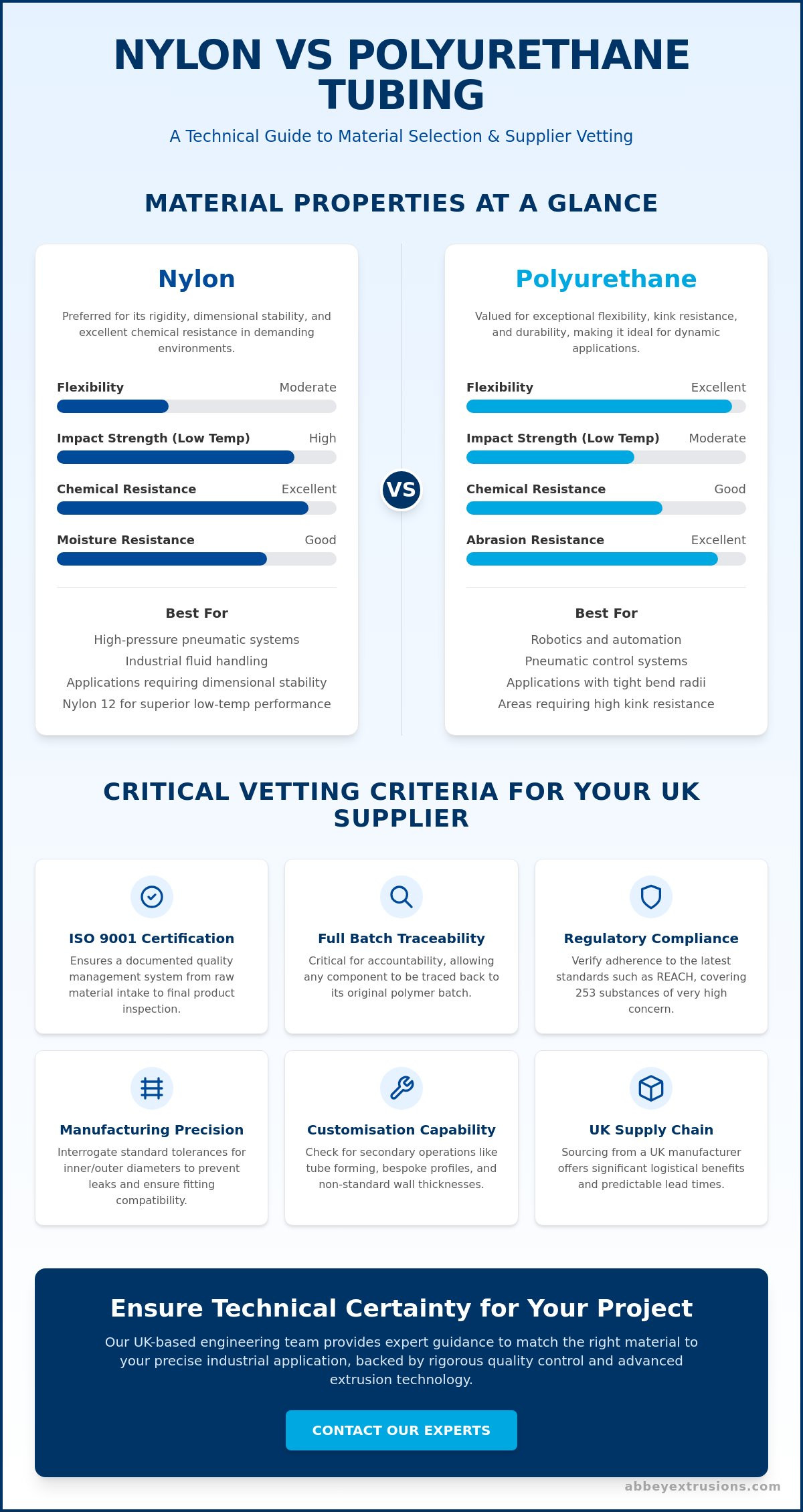
Selecting the correct polymer is a foundational decision that dictates the operational lifespan of your pneumatic or fluid handling system. When comparing nylon vs polyurethane tubing, a professional supplier must demonstrate deep technical knowledge of specific material grades. For instance, you should enquire whether they provide both Nylon 11 and Nylon 12. Whilst both offer excellent Nylon properties such as moisture resistance and dimensional stability, Nylon 12 is often preferred for its superior impact strength at low temperatures. A competent manufacturer will guide you through these nuances to ensure the material matches your environmental stressors.
Beyond standard polymers, verify if the supplier provides high-performance Nylon tube variants or specialised fluoropolymers like PTFE, FEP, and PFA. These materials are essential for applications involving extreme thermal fluctuations or highly aggressive industrial fluids where standard Polyurethane tube might fail. Discussing the thermal stability of materials like LDPE or PU is vital; polyurethane offers exceptional flexibility and kink resistance, but its performance can degrade if exposed to temperatures outside its specified range. We recommend asking for specific data regarding how these materials behave in your unique operating environment.
Polymer Selection and Chemical Resistance
Technical certainty requires more than a cursory glance at a catalogue. You must request comprehensive material data sheets to confirm performance under specific pressure and temperature gradients, especially when handling aggressive industrial chemicals. The choice between nylon vs polyurethane tubing often comes down to the specific chemical environment of your facility. In hazardous areas where flammable vapours are present, determine if the supplier can manufacture anti-static variants to mitigate the risk of electrostatic discharge. There is also a significant difference between flexible and semi-rigid variants; understanding how these affect your assembly's bend radius is critical for avoiding flow restrictions.
Extrusion Precision and Tolerance Standards
Manufacturing precision is what separates a reliable component from a potential point of failure in a complex pneumatic system. Verify the standard manufacturing tolerances for both inner and outer diameters, as even minor inconsistent dimensions can lead to fitting leaks or assembly difficulties. Ask if the supplier has the capacity to produce bespoke wall thicknesses for non-standard pressure ratings or unique flow requirements. Maintaining consistency across high-volume production runs is a hallmark of a professional extrusion facility that understands the cost of downtime. We utilise rigorous monitoring and advanced extrusion technology to ensure every batch meets the strict tolerances required by modern industrial standards, providing you with a predictable and high-specification product every time.
To discuss your specific compliance requirements or request technical documentation, you can reach our team through our enquiry form.
Evaluating Quality Control and Regulatory Compliance
In industrial manufacturing, the integrity of a fluid system depends entirely on the verifiable quality of its components. You must confirm that your supplier operates a facility certified to ISO 9001 standards. This certification ensures that every stage of the extrusion process, from raw material intake to final inspection, follows a documented quality management system. When deciding between nylon vs polyurethane tubing, the physical properties are only half the battle. The other half is the certainty that those properties remain consistent across every metre produced.
Ask your supplier about their specific traceability procedures for raw polymer batches. If a material failure occurs, you need to be able to trace that specific length of tubing back to the original resin delivery. This level of accountability is vital for high-stakes environments, such as those using diesel fuel hose or high-pressure air lines, where a burst could lead to significant equipment damage. Testing protocols must be rigorous. We recommend asking for data on burst pressure testing and long term fatigue analysis to ensure the product meets your safety margins.
Certification and Traceability
Always request certificates of conformity to accompany your delivery. These documents are essential for your internal audits and provide proof that the product meets the agreed technical specifications. Enquire about the frequency of in-process inspections during the extrusion cycle. A professional manufacturer will perform regular checks on wall thickness and diameter to prevent dimensional drift. You should also verify their protocols for handling non-conformance reports. A robust response to material issues is a clear indicator of a reliable partner. It's about technical accountability.
Industry Specific Standards
Regulatory requirements vary significantly depending on your sector. For those in the food and beverage industry, you must discuss compliance with FDA or EU food contact regulations. As of February 2026, the REACH candidate list contains 253 substances of very high concern, and your supplier must confirm that their products are compliant with these evolving standards. This is particularly relevant when selecting a brewery hose for commercial dispense systems, where the material must not leach chemicals or affect the flavour profile of the product.
Environmental factors also play a role in material selection. If your application involves outdoor vehicles or agricultural machinery, ask about UV resistance and weathering standards. Whilst both materials are durable, certain grades of nylon vs polyurethane tubing are better suited to prolonged sunlight exposure without becoming brittle. Ensuring your supplier tests for these specific conditions will prevent premature failure in the field. If you require specific certification for your next project, our technical department can provide the necessary documentation through our technical support portal.
If you require technical advice on custom profile design or wish to discuss bespoke manufacturing requirements, please get in touch with our specialist team via our contact page.
Understanding Customisation and Secondary Operations
Beyond the initial selection of material science, the mechanical utility of your tubing often depends on its physical configuration. You should enquire about tube forming capabilities for complex assembly shapes. This specialised process enables the creation of permanent, repeatable bends that maintain their profile under operational stress. It's an essential service for designers who need to route lines through restricted spaces without risking kinks or flow restrictions. Whilst standard straight lengths of nylon vs polyurethane tubing serve many purposes, high-specification projects often demand more than a generic off-the-shelf solution.
Ask if the supplier can produce bespoke profiles such as specialised industrial components like Kedar cord and fluted hoses. Technical competence in this area indicates a manufacturer who can handle more than just simple circular extrusions. You should also verify the availability of custom colours. This isn't merely an aesthetic choice; it's a practical method for colour-coding complex pneumatic systems or matching corporate branding for OEM equipment. A reliable partner will work with you to ensure the final product integrates perfectly into your existing assembly workflows.
Bespoke Profile Extrusion
Creating a unique plastic profile requires a thorough understanding of the tooling process. You should ask your supplier how they manage the design and manufacture of custom dies, as this determines the precision of the final part. Verify if they can extrude multiple materials together in a co-extrusion process. This allows for different properties within a single profile, such as a rigid carrier with a flexible seal. This technology is frequently utilised when designing curtainsider pelmet sections for the transport industry, where durability and flexibility must coexist.
Post Extrusion Services
The value of a supplier often lies in their ability to simplify your assembly line. Ask about precision cutting to specific lengths, as this reduces your internal labour costs and eliminates on-site waste. Verify if they offer coiling or specialised packaging for long production runs, which is vital for maintaining material integrity during transit. For pneumatic applications, enquire about the production of nylon recoil air hoses. These must be manufactured with specific fittings and retraction memory to ensure they perform reliably in demanding workshop environments. When comparing nylon vs polyurethane tubing for recoil applications, the material's elastic memory is a critical factor you must discuss with your technical partner.
For a detailed discussion regarding our current production schedules or to establish a long term supply agreement, please contact our logistics team via our contact page.
Analysing Lead Times and Supply Chain Reliability
Industrial procurement is as much about logistical certainty as it is about material performance. When you are deciding between nylon vs polyurethane tubing, you must interrogate the supplier's current lead times for both standard stock items and custom extrusions. A failure to account for production windows can stall an entire project, leading to costly downtime. You should ask whether the supplier maintains a rolling stock of common sizes or if every order is manufactured from scratch. For high-frequency repeat requirements, we recommend discussing formal stockholding agreements. This ensures that your specific profiles are always available for immediate dispatch, insulating your operations from sudden market fluctuations.
The ability to handle urgent or small-batch orders is a key indicator of a supplier's flexibility. Whilst large-scale manufacturers often prioritise high-volume runs, a reliable partner understands that small, critical components are often the bottleneck in complex assemblies. Enquire about their protocols for expedited production and how they integrate urgent requests into their existing manufacturing schedule. This transparency allows you to plan your project timelines with greater technical and commercial confidence.
UK Manufacturing Advantages
Sourcing from a UK-based manufacturer provides significant logistical benefits that international supply chains cannot match. Recent trends in 2026 show a strategic shift away from lowest-cost global sourcing towards regionalising supply chains to enhance predictability. Local production drastically reduces your carbon footprint and shipping costs, whilst also eliminating the risks associated with port delays and tariff volatility. Communication is simplified; you can speak directly with the engineers overseeing your extrusion run or arrange technical site visits if required. There is also a distinct reliability in British manufacturing standards. By adhering to domestic quality controls, you ensure that every batch of tubing meets the rigorous safety and performance criteria expected in the UK market.
Production Capacity and Scalability
A professional supplier must be able to scale their output to match your growth. Verify if they have the machine capacity to support large-scale industrial rollouts without compromising on delivery dates. You should also ask about the minimum order quantities for bespoke polymer runs, as this affects the economic viability of custom designs. Given the price volatility seen in early 2026 for resins like Nylon 6 and Nylon 66, ask how they manage raw material shortages. A stable partner will have established relationships with multiple polymer distributors to ensure your supply remains uninterrupted despite global feedstock pressures. To secure your industrial supply chain with a reliable UK partner, request a lead time estimate today.
To discuss bespoke pricing for high-volume hosing orders or to establish a professional credit account, please get in touch with our commercial team via our contact page.
Evaluating Commercial Terms and Technical Support
Technical vetting of a supplier is only complete once you've interrogated the commercial framework and the depth of their technical support. You shouldn't view a manufacturer merely as a source of parts, but as a strategic partner who provides engineering certainty. During the design phase, it's vital to ask about the level of technical guidance available. This is the stage where the final decision between nylon vs polyurethane tubing is solidified, often based on specific pressure calculations and environmental variables that our team can help you verify. We believe that professional support during the specification stage prevents costly errors during the implementation phase.
Volume-based pricing structures are a standard requirement for bulk hosing orders, yet you should also enquire about the flexibility of these terms for long-term partners. Ask about the availability of credit facilities and how they organise payment terms to support your cash flow. Equally important is the supplier's process for handling technical queries or potential field failures. A manufacturer who stands by their technical competency will have a clear, documented procedure for investigating non-conformance, ensuring that any issues are resolved with minimal disruption to your project. This accountability is what separates an average supplier from a reliable industrial partner.
Engineering Consultation and Support
Our engineers are available to help you select a polyurethane tube if your application requires high flexibility and abrasion resistance. We don't expect you to commit to a full production run without technical certainty; therefore, we often provide samples for testing in your specific environment. This allows you to verify performance under real-world conditions before placing a large order. With decades of experience amongst various industrial sectors, from automotive to food processing, we understand the unique stressors your tubing will face and can recommend the most appropriate polymer grade.
Long Term Partnership Value
Choosing a supplier with deep roots in the UK plastic pipe industry provides a level of stability that imported alternatives can't offer. We maintain a strong commitment to environmental sustainability by actively working to reduce material waste during the extrusion process. When you re-order bespoke profiles, you require the guarantee that the specifications will be identical to the previous batch. We achieve this through meticulous record-keeping and rigorous quality control protocols that ensure every run matches your original engineering drawings exactly. This consistency is what builds long-term trust and ensures your assembly lines continue to operate without technical friction. When comparing nylon vs polyurethane tubing for repeat orders, the reliability of the manufacturing process is just as important as the material itself.
If you require further technical information or wish to request a quotation, please reach out to our team via our contact page.
Securing Technical Certainty for Your Next Project
The selection of industrial hosing is a decision that impacts every stage of your manufacturing cycle. By addressing the technical and commercial questions outlined, you ensure that your procurement strategy prioritises long-term reliability over short-term savings. Whether your application requires the specific flexibility of nylon vs polyurethane tubing or a highly specialised bespoke profile, the depth of your supplier's expertise is the ultimate safeguard against project delays.
As a dedicated UK manufacturer since 1985, we've spent decades refining our processes to meet the most exacting industrial standards. Our specialist knowledge of Nylon 11 and 12, combined with our comprehensive bespoke tube forming and profile extrusion services, allows us to deliver components that are ready for immediate integration. We provide the technical certainty you need to maintain operational excellence in a competitive global market.
To discuss your technical specifications or request a bespoke quotation, contact our engineering team today. We look forward to helping you achieve your project goals with precision and efficiency.
Frequently Asked Questions
Why is it important to ask about polymer grades like Nylon 11 or 12
When evaluating nylon vs polyurethane tubing, different grades offer vastly different levels of chemical resistance and moisture absorption. Nylon 11 is often preferred for its renewable origins and superior impact resistance, whilst Nylon 12 is excellent for dimensional stability in fuel lines. Asking this ensures your tubing won't degrade or swell when exposed to specific industrial chemicals or environmental conditions over time.
How do I verify the quality of a UK tubing supplier
You should always ask for their ISO 9001 certification and enquire about their material traceability processes. A reputable manufacturer will be able to provide certificates of conformity and detail their internal inspection routines. This level of transparency ensures that every metre of tubing meets the safety and performance standards required for your specific industrial application.
Can I request custom colours for my plastic tubing
Most specialist manufacturers can produce tubing in a wide range of colours to help you organise complex systems or match your corporate identity. It's important to ask if the colour additives will affect the physical properties of the polymer, especially in food-grade or high-pressure applications where material integrity is the absolute priority. We recommend confirming that the pigments used don't compromise the tube's pressure rating.
What are the typical lead times for custom plastic extrusions
Lead times vary depending on the complexity of the profile and the availability of the specific polymer. Generally, standard items might be available from stock, whilst bespoke runs can take several weeks for tooling and production. Asking this early allows you to plan your project timelines effectively and avoid costly delays in your manufacturing process.
Is it better to source tubing from a UK manufacturer
When comparing nylon vs polyurethane tubing, sourcing locally provides significant advantages in terms of communication, technical support, and reduced logistics costs. It allows for greater flexibility in order sizes and faster response times for bespoke requirements. UK manufacturers must adhere to strict quality and environmental standards, providing peace of mind regarding the reliability of the product.
What questions should I ask about chemical compatibility
You should provide the supplier with a full list of the chemicals, temperatures, and pressures the tubing will encounter. Ask them to confirm if the chosen polymer, such as PTFE or nylon tube, is rated for that specific environment. A knowledgeable supplier will provide chemical resistance charts and may suggest alternative materials if your initial choice is unsuitable.
Do tubing suppliers offer custom tube forming
Many high-quality suppliers offer secondary operations like tube forming, where straight lengths are permanently shaped into specific curves or coils. This is vital for applications with restricted space where standard tubing might kink. You should ask if they have the internal capability to form tubes to your exact CAD drawings to ensure a perfect fit in your assembly.
How do I handle returns or quality issues with a supplier
Ask the supplier about their non-conformance procedure and how they resolve quality disputes. A reliable partner will have a clear process for investigating issues and providing replacements if the material doesn't meet the agreed specifications. Establishing this protocol upfront ensures that any potential problems are handled professionally and quickly to minimise downtime.

Article by
Bryan Cowan
Bryan Cowan is the Founder and Managing Director of Abbey Extrusions Ltd, a leading UK manufacturer of high-quality plastic tubes and hoses. With over 40 years of industry experience, Bryan established the company in 1985, growing it from a startup into a BS ISO9001-registered supplier for global sectors including aerospace, automotive, and pharmaceuticals.
Disclaimer
This article is intended for informational purposes only. Please ensure you seek expert advice or carry out your own research to confirm the information is suitable for your specific needs.