A single material failure in a high-volume production line often costs more in unscheduled downtime than the entire annual procurement budget for fluid transfer components. If you've faced the consequences of corrosive degradation or the persistent difficulty of sourcing non-standard dimensions from global distributors, you know that standard materials frequently fail under pressure. Choosing the correct grade of fluoropolymer tubing is a technical necessity that ensures the long-term reliability of your critical infrastructure.
We recognise that your industrial requirements demand more than just a generic product; they require a precise engineering solution. This guide provides the technical justification for moving towards high-performance polymers that offer unparalleled chemical resistance and thermal stability. We will explore the distinct properties of PTFE, FEP, and PFA, whilst demonstrating how a dedicated UK manufacturer can deliver bespoke profiles and specialised extrusions without the burden of excessive lead times.
Key Takeaways
- Identify the technical distinctions between PTFE, FEP, and PFA to select the optimal material for specific industrial fluid transfer applications.
- Understand the technical justification for using fluoropolymer tubing when standard polymers cannot withstand extreme temperatures or aggressive chemicals.
- Explore the manufacturing advantages of bespoke profiles and custom tube forming that meet precise engineering tolerances for high volume requirements.
- Recognise how partnering with a specialist UK manufacturer improves supply chain security and reduces lead times for complex polymer extrusions.
- Gain a detailed understanding of the engineering principles that make fluoropolymers the definitive choice for critical industrial infrastructure.
To discuss your high volume requirements or request a technical consultation regarding bespoke profiles, please contact our specialist engineering team.
Understanding Fluoropolymer Tubing and its Role in Modern Industry
A Fluoropolymer is a fluorocarbon-based polymer that possesses multiple strong carbon-fluorine bonds. These bonds are amongst the strongest in organic chemistry, which provides the material with its characteristic chemical inertness. For UK manufacturers, fluoropolymer tubing represents the pinnacle of fluid handling technology. Whilst standard industrial plastics serve many purposes, they often fail when exposed to aggressive solvents or extreme thermal cycles. This family of materials includes PTFE, FEP, and PFA, each offering specific benefits for industrial extrusion and complex fluid transfer systems.
The transition from standard plastics to high performance fluoropolymer tubing is a strategic move for many British businesses. When a standard nylon tube cannot meet the demands of a specific environment, these advanced polymers provide the necessary durability. We specialise in extruding these materials to meet the rigorous standards of modern industry, ensuring that every profile we produce handles critical fluid transfer with absolute reliability. This shift is not merely about material choice; it's about safeguarding the entire production process against preventable failures and costly downtime.
Thermal Stability and Chemical Resistance Properties
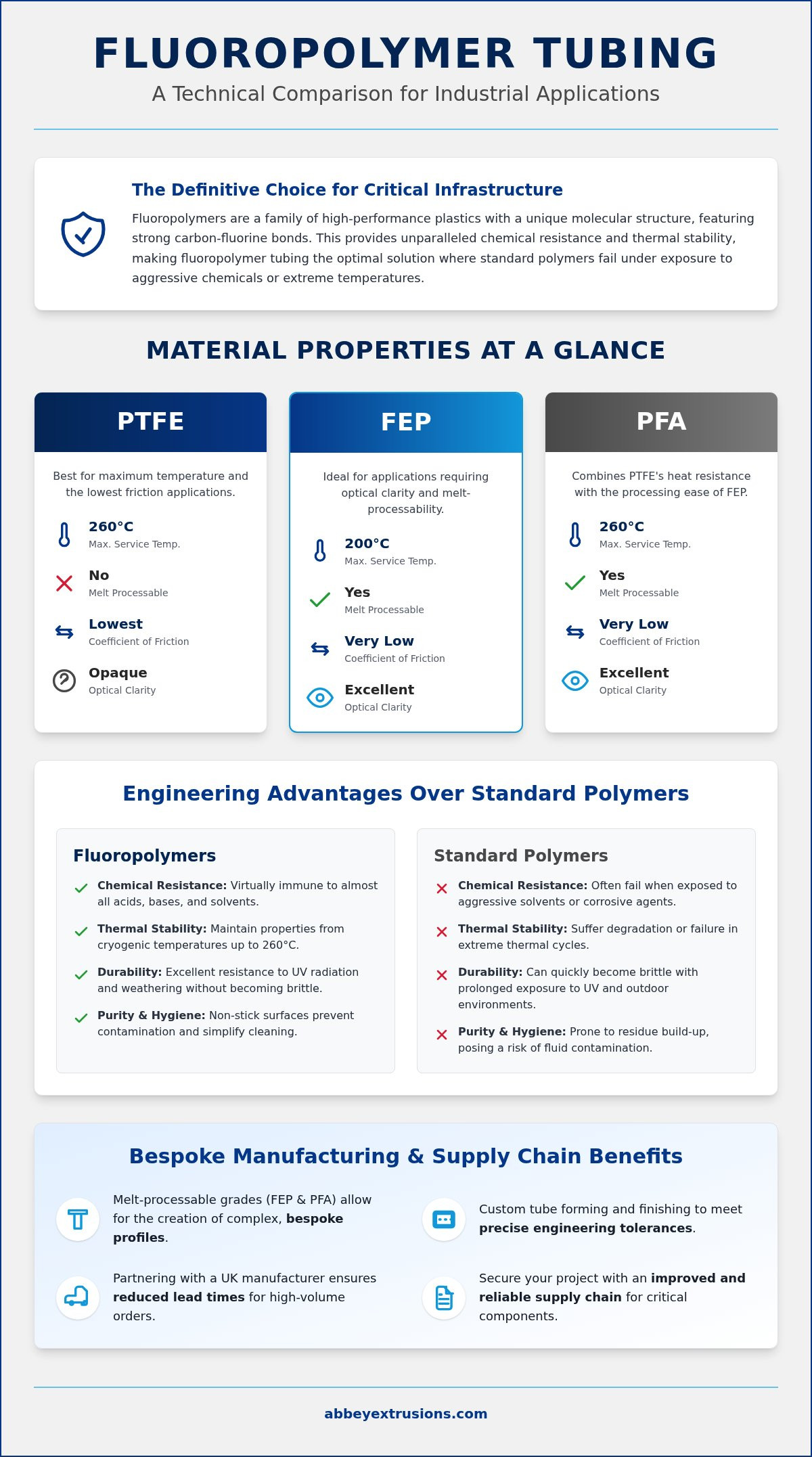
The primary advantage of these materials stems from their unique molecular structure. Because the carbon-fluorine bond is so stable, it effectively shields the carbon backbone from chemical attack. This makes the tubing virtually immune to almost all acids, bases, and solvents. Thermal performance is equally impressive. These materials maintain their physical properties across a vast spectrum, remaining flexible at cryogenic temperatures and resisting degradation at continuous heat levels reaching 260 degrees Celsius. Their inherent resistance to UV radiation and weathering also makes them the preferred choice for outdoor industrial environments where standard polymers would quickly become brittle.
Common Industrial Applications in the United Kingdom
UK manufacturing sectors rely on these tubes for various high stakes applications. In chemical processing and laboratory settings, the high purity of the material prevents contamination of sensitive fluids. The food and beverage industry utilises these tubes because their non stick surfaces prevent residue build up, which simplifies cleaning and ensures hygiene standards are met. We also see significant use in the electrical sector. The excellent dielectric properties of these polymers provide superior insulation for high temperature wiring and sensitive electronic components. Whether it is for laboratory equipment or heavy industrial machinery, the versatility of these materials is unmatched in the current market.
For expert guidance on material selection or to discuss your bespoke extrusion needs, please contact our technical sales department.
Comparative Analysis of PTFE FEP and PFA Materials
Selecting the correct grade of fluoropolymer tubing requires a thorough understanding of both the environmental stressors and the manufacturing process. Whilst all three primary materials share excellent chemical resistance, they differ significantly in their physical properties and how they are formed into final products. For high volume industrial requirements, the choice often hinges on the balance between thermal limits and the need for visual monitoring of fluid flow. We evaluate these factors during the initial design phase to ensure the chosen material meets the long term performance goals of the project.
The manufacturing method is a critical differentiator that impacts the availability of custom shapes. PTFE is not melt-processable; it requires a sintering process that involves compressing powder and heating it. In contrast, FEP and PFA can be extruded using traditional melt processing techniques. This allows for greater precision when creating bespoke profiles or complex geometries. If your application requires a specific profile that goes beyond a standard circular tube, melt-processable grades often provide a more efficient and cost-effective production route for high volume orders.
PTFE for Maximum Temperature and Low Friction
PTFE is frequently the first choice when friction is the primary concern. Its surface is exceptionally slick, which prevents high-viscosity fluids from adhering to the internal walls. It operates reliably at 260 degrees Celsius, making it the industry standard for high-heat environments. However, PTFE is naturally opaque white. This lack of transparency means operators cannot visually inspect the fluid inside the tube. Because it cannot be melted and reshaped like other plastics, it is less suited for certain types of intricate tube forming compared to its melt-processable counterparts.
FEP and PFA for Clarity and Melt Processability
FEP offers a distinct advantage for applications where visibility is paramount. It is almost completely transparent, allowing for easy monitoring of fluid levels or the presence of air bubbles. Whilst its upper temperature limit is lower than PTFE at approximately 200 degrees Celsius, its flexibility is superior. This makes it ideal for laboratory settings and food production lines where tight bends are necessary.
PFA serves as the premium solution for the most demanding scenarios. It combines the high temperature resistance of PTFE with the clarity and melt processability of FEP. It possesses exceptional stress crack resistance and mechanical strength, even at elevated temperatures. For businesses managing highly aggressive chemicals at high volumes, PFA provides the greatest level of security. If you are unsure which grade suits your specific chemical environment, you can consult our engineering team for a detailed material compatibility assessment.
To discuss your bespoke engineering requirements or for assistance with material selection, please contact our technical sales team.
Engineering Advantages of Fluoropolymers over Standard Plastics
Standard polymers such as PVC, polyethylene, or standard grades of nylon tube are perfectly adequate for general-purpose air or water transport. However, they possess inherent molecular limitations that become apparent in demanding industrial environments. When these materials are exposed to aggressive solvents, high temperatures, or constant UV radiation, they begin to degrade, leading to embrittlement or structural failure. Transitioning to fluoropolymer tubing is a strategic engineering decision that addresses these vulnerabilities at the molecular level. For UK manufacturers, this upgrade is often the only way to ensure the long-term reliability of critical fluid transfer systems.
The strategic move towards high-performance materials is also influenced by shifting regulatory landscapes. With the UK government's PFAS Plan and proposed 2026 POPs regulations, there's an increasing need for businesses to justify their material choices through technical performance and safety. Fluoropolymers provide this justification by offering a level of durability and chemical inertness that standard plastics cannot match. This makes them a more sustainable choice for high-volume industrial applications where frequent material replacement is neither economically nor environmentally viable.
When to Upgrade from Nylon or Polyurethane
Identifying the precise failure points of your current system is the first step in material selection. A polyurethane tube is often favoured for its excellent abrasion resistance, yet it can suffer from hydrolysis when exposed to humidity or moisture over time. In contrast, FEP and PFA are entirely hydrophobic, meaning they maintain their dimensional stability and mechanical strength regardless of environmental moisture levels. If your current tubing is swelling, discolouring, or becoming brittle, it's a clear indicator that the chemical or thermal stressors are exceeding the material's capabilities. Fluoropolymers provide a wider operating window, ensuring that high-pressure pneumatic or hydraulic systems remain secure under extreme conditions.
Assessing Cost versus Performance in Harsh Environments
Procurement managers handling high-volume orders must evaluate the total cost of ownership rather than just the initial unit price. Whilst the upfront investment in fluoropolymer tubing is higher than that of standard plastics, the technical justification lies in the reduction of maintenance cycles and unscheduled downtime. A bespoke fluoropolymer profile, manufactured to precise tolerances, can last for years in an environment that would destroy standard plastics in a matter of months. By partnering with a specialist UK extruder for your bespoke profiles, you gain access to technical expertise that ensures the material is perfectly matched to your specific industrial stressors, ultimately protecting your bottom line through improved system longevity.
To discuss your specific manufacturing requirements or to request a quote for a custom profile, please contact our specialist engineering team.
Bespoke Extrusion and Custom Profile Capabilities for Fluoropolymers
While many global distributors focus on high-volume sales of standard pneumatic parts, we position ourselves as a technical partner for complex engineering challenges. Working with a manufacturer that specialises in plastic extrusion allows you to move beyond the limitations of off-the-shelf components. Custom fluoropolymer tubing profiles can be designed to solve integration problems that standard tubes simply cannot address; whether that involves unique internal geometries or specific external ribbing for heat dissipation. Our expertise in handling these high-performance materials ensures that even the most intricate designs maintain their structural integrity during the manufacturing process.
Precision tooling is the foundation of our bespoke service. Because fluoropolymers require high processing temperatures, maintaining tight tolerances is a significant technical challenge. We utilise advanced die designs to ensure that every millimetre of the extrusion meets your exact specifications. This level of control also extends to aesthetic and functional customisation. We offer colour matching services for industrial hoses; this is particularly useful for complex systems where colour-coding is required for safety or fluid identification. By integrating branding or specific markings directly onto the tube, we help you maintain professional standards across your entire installation.
Custom Dimensions and Precision Tolerances
Specifying non-standard internal and external diameters is a common requirement for bespoke industrial fitments. We work closely with your design team to define the optimal dimensions for your specific connectors and housings. Maintaining wall thickness consistency is paramount; especially when the fluoropolymer tubing must withstand high pressures or vacuum conditions. Our quality control measures include continuous monitoring and rigorous testing phases to verify the accuracy of every custom profile before it leaves our Leicestershire facility.
Tube Forming and Secondary Operations
Often, a straight length of tubing is insufficient for modern machinery footprints. The technical process of tube forming allows us to create permanent bends and coils without compromising the material's flow characteristics or chemical resistance. This secondary operation is essential for creating compact systems that fit within tight enclosures. We also provide additional services such as precision cutting to length and specialised assembly work; this reduces the workload on your own production line. If you require a custom-formed solution for a high-volume project, please request a technical consultation with our engineers.
For high volume industrial orders or to discuss a long term supply partnership, please contact our Leicestershire based team.
Sourcing High Volume Fluoropolymer Tubing from a UK Manufacturer
In the current industrial climate, the security of your supply chain is as critical as the quality of the materials you procure. Sourcing fluoropolymer tubing from a domestic manufacturer provides a level of stability that international distributors often struggle to match. With the UK government proposing the Persistent Organic Pollutants (Amendment) Regulations for adoption in October 2026, businesses must ensure their polymer sources are fully compliant and transparent. By maintaining direct communication with our factory floor, you eliminate the risks associated with miscommunicated technical specifications and extended international shipping delays. This direct link ensures that every technical parameter, from internal diameter tolerances to material purity, is verified at the point of production.
Direct collaboration with a UK extruder ensures that large volume orders are handled with consistent batch quality across the entire production run. We understand the nuances of the UK's industrial landscape; from the specific needs of chemical processors to the requirements of the food and beverage sector. Sourcing locally also offers a measurable reduction in your logistics footprint, contributing to broader corporate sustainability goals whilst ensuring your production lines remain operational. This approach allows for a more agile response to market changes and technical challenges as they arise.
Supply Chain Reliability and Volume Capacity
Relying on international imports often leaves manufacturers vulnerable to port congestion and sudden tariff changes. We provide the scalability required for large scale industrial projects, offering the capacity to manage ongoing supply contracts for high performance polymers. Our facility is equipped to handle the demands of automated assembly lines, providing just-in-time delivery options that help you manage inventory levels without risking stockouts. This reliability is essential for national supply chain security, particularly for critical infrastructure projects where downtime is not an option.
Technical Support for Bespoke Enquiries
A long term partnership with a specialist manufacturer offers more than just a product; it provides access to decades of engineering expertise. During the design phase, our team can advise on whether PTFE, FEP, or PFA is the most appropriate choice for your specific stressors. Effectively briefing a manufacturer on complex bespoke requirements is significantly easier when there are no time zone or language barriers. This proximity fosters technical innovation, allowing us to develop new profiles that meet the evolving needs of your industry. If you are ready to secure your supply of high-performance tubing, please enquire about our manufacturing capacity.
If you are ready to discuss your specific manufacturing needs, please contact Abbey Extrusions for bespoke fluoropolymer tubing enquiries.
Securing Technical Excellence for Your Industrial Infrastructure
Establishing a reliable supply of fluoropolymer tubing is a fundamental step in protecting your industrial processes from chemical degradation and thermal failure. By selecting the optimal grade of PTFE, FEP, or PFA, you ensure that your fluid transfer systems operate with maximum efficiency and minimum maintenance. We've demonstrated that bespoke profiles and custom tube forming can overcome the limitations of standard parts, providing a tailored solution that fits your exact machinery footprint.
As a specialist UK manufacturer established in 1985, we possess the deep technical expertise required for complex bespoke profile extrusion and high-volume industrial supply. Our commitment to precision and domestic manufacturing reliability makes us the ideal partner for your next engineering project. We look forward to helping you achieve superior operational performance through our advanced polymer solutions.
Frequently Asked Questions
What are the main differences between PTFE FEP and PFA tubing?
PTFE offers the highest heat resistance and lowest friction but is naturally opaque. FEP provides excellent transparency and flexibility whilst being melt-processable, though it has a lower temperature limit of 200 degrees Celsius. PFA combines the best properties of both materials, offering high clarity and high temperature resistance up to 260 degrees Celsius. These material distinctions dictate the visibility and thermal limits of your fluid transfer system.
Can fluoropolymer tubing be manufactured in custom colours and sizes?
We manufacture fluoropolymer tubing in a wide variety of custom dimensions and colours to meet specific industrial requirements. Unlike standard stockists, our facility can extrude bespoke internal and external diameters to ensure a perfect fit with your existing connectors. Colour matching is also available to assist with fluid identification or to align with your corporate branding standards across high volume production runs.
What is the maximum operating temperature for PFA tubing?
PFA tubing can operate continuously at temperatures up to 260 degrees Celsius. This exceptional thermal stability makes it suitable for the most demanding industrial environments where standard plastics would melt or degrade. It also maintains its mechanical strength and stress crack resistance at these elevated temperatures, providing a reliable solution for high heat fluid transfer applications that require long term durability.
Is fluoropolymer tubing suitable for food grade and brewery applications?
Fluoropolymers are inherently suitable for food and beverage environments due to their non stick surfaces and chemical inertness. They don't leach chemicals into the fluid stream and are resistant to the aggressive cleaning agents used in brewery sanitisation. Their high purity nature ensures that the taste and quality of the product remain untainted during the production process, meeting the highest hygiene standards.
How does the chemical resistance of fluoropolymers compare to nylon?
Fluoropolymers provide a significantly broader range of chemical resistance compared to standard nylon grades. Whilst nylon is susceptible to degradation from strong acids and certain solvents, materials like FEP and PFA are virtually inert to almost all industrial chemicals. This makes them the definitive choice for handling aggressive media that would cause a standard nylon tube to swell or fail prematurely in a corrosive environment.
What are the benefits of using a UK based manufacturer for large volume orders?
Sourcing from a UK manufacturer established in 1985 provides national supply chain security and significantly reduced lead times. You benefit from direct communication with our Leicestershire engineering team, ensuring that high volume orders maintain consistent quality across every batch. This local partnership also eliminates the complexities and risks associated with international shipping, import duties, and potential delays at the border.
Can you provide bespoke profile extrusion for non standard industrial requirements?
We specialise in the extrusion of bespoke profiles that go beyond standard circular tubing. Our engineering team can develop custom geometries to solve specific integration challenges or machinery footprint constraints. This capability allows us to produce high performance components that are tailored to your unique technical specifications, ensuring that every profile meets the precise requirements of your industrial application.
How do I determine the correct wall thickness for high pressure applications?
Determining the correct wall thickness involves calculating the hoop stress based on your maximum operating pressure and temperature. A thicker wall generally increases the burst pressure but reduces the flexibility of the tube. We recommend consulting with our technical experts to ensure your specified dimensions provide an appropriate safety margin for your specific industrial environment, taking into account both pressure and thermal stressors.

Article by
Bryan Cowan
Bryan Cowan is the Founder and Managing Director of Abbey Extrusions Ltd, a leading UK manufacturer of high-quality plastic tubes and hoses. With over 40 years of industry experience, Bryan established the company in 1985, growing it from a startup into a BS ISO9001-registered supplier for global sectors including aerospace, automotive, and pharmaceuticals.
Disclaimer
This article is intended for informational purposes only. Please ensure you seek expert advice or carry out your own research to confirm the information is suitable for your specific needs.