The assumption that all reinforced hoses offer identical performance levels frequently leads to systemic failures in high-pressure environments. As a procurement or engineering professional, you've likely experienced the frustration of inconsistent quality from mass-market suppliers who cannot accommodate bespoke lengths or specific polymer reinforcements. Partnering with a dedicated braided tubing manufacturer ensures that technical specifications are met with precision, rather than approximation.
We understand that reliability is the cornerstone of industrial productivity, and we're committed to helping you find solutions that exceed standard expectations. This article details how specialist engineering and bespoke tube forming solutions address the complexities of modern industrial applications across the United Kingdom. You'll discover the methods used to align custom hose production with rigorous British industrial standards whilst maintaining the capacity for high-volume orders. We'll also outline how direct technical support and material expertise provide the stability your operations demand.
Key Takeaways
- Understand how a specialist braided tubing manufacturer integrates high tensile reinforcement with plastic inner cores to manage demanding industrial pressures.
- Compare the chemical resistance and physical properties of essential polymers including Nylon, Polyurethane, and PVC for specific industrial applications.
- Learn about the precision engineering required to achieve a consistent bond between the braid and plastic layers during the extrusion process.
- Identify specific hose requirements for diverse sectors such as food processing, automotive manufacturing, and pneumatic systems.
- Discover the strategic benefits of sourcing bespoke volume orders and custom profiles directly from a reliable UK production facility.
Contact our technical experts to discuss your bespoke volume requirements for industrial hoses.
The Role of a Specialist Braided Tubing Manufacturer
A specialist braided tubing manufacturer operates at the intersection of polymer science and textile engineering. Their primary role involves the precise extrusion of plastic inner cores followed by the integration of high tensile reinforcement layers. This multi stage process is essential for industrial applications where standard unreinforced tubing would fail under pressure. Industrial systems often require hoses that can withstand significant internal forces whilst remaining flexible enough for complex routing. Without this reinforcement, a standard tube might expand or burst when subjected to the hydraulic or pneumatic stresses common in manufacturing environments.
Relying on a manufacturer with comprehensive in house extrusion capabilities provides a distinct advantage in quality control. It allows for the meticulous monitoring of the bonding process between the polymer and the reinforcement. Abbey Extrusions organises its production cycles to meet rigorous British industrial standards, ensuring that every batch of reinforced PVC tube or Nylon tube delivers consistent performance. This level of oversight is rarely achievable with mass market suppliers who often outsource critical stages of the manufacturing process, leading to potential weak points in the final product.
Understanding Braid Reinforcement in Industrial Hoses
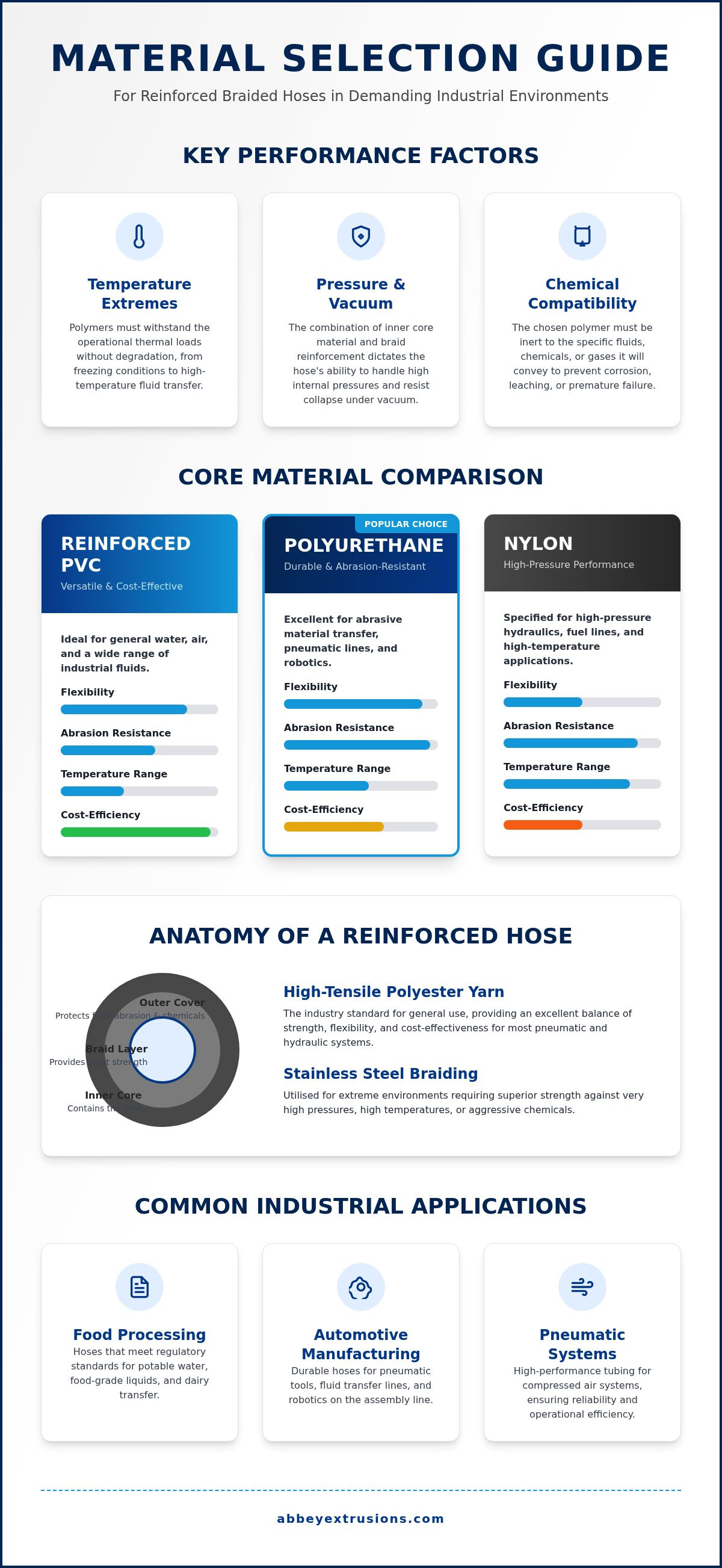
The reinforcement process involves weaving synthetic or metallic fibres in a precise pattern around an already extruded plastic core. Engineers carefully calculate the braid angle and density, as these variables directly dictate the burst pressure and the minimum bend radius of the finished product. High tensile polyester yarn is a common choice for general industrial use, providing an excellent balance of strength and cost effectiveness. In more extreme environments, manufacturers might utilise stainless steel braiding, a configuration frequently utilised in the production of Metal Hoses designed for high temperature or high pressure fluid transfer.
High Pressure Performance and Durability
The relationship between the inner tube material and the outer braid is the primary factor in determining a hose's longevity. A well engineered braid prevents the hose from kinking or over bending, which are common issues in busy factory environments. This structural support allows the hose to maintain its internal diameter even when subjected to vacuum or high pressure pulses. To ensure maximum durability, an outer cover is often extruded over the braid to protect the reinforcement from mechanical abrasion and chemical exposure. This protective layer ensures the structural integrity of the reinforcement remains uncompromised throughout its service life.
Consult our engineers for bespoke material specifications and volume pricing.
Material Selection for Reinforced Braided Hoses
Selecting the correct polymer is the most critical phase in the design of a high performance reinforced hose. As a specialist braided tubing manufacturer, we recognise that material properties must align perfectly with the operational environment to prevent premature failure. Factors such as chemical exposure, pressure fluctuations, and temperature extremes dictate the longevity of the final product. For volume orders, this selection process impacts both the initial capital expenditure and the long term maintenance costs of the industrial system.
Regulatory compliance often guides the material selection for reinforced braided hoses, particularly in hydraulic or marine systems where safety standards are non negotiable. Whilst PVC is suitable for standard temperatures, polymers like Nylon or PTFE are required for higher thermal loads. Choosing the wrong compound can lead to material degradation or leaching, causing system downtime that far outweighs any initial savings on material costs. We work closely with procurement teams to ensure the chosen plastic compound meets the technical demands of the specific application.
Reinforced PVC and Polyurethane Options
Reinforced PVC tube remains the industry standard for general water and air transfer due to its excellent clarity and cost efficiency. It's a versatile material that handles a broad range of industrial fluids without losing structural integrity. However, for pneumatic systems requiring superior abrasion resistance, Polyurethane (PU) is often the preferred choice. PU offers exceptional flexibility and memory, making it ideal for coiled applications or tight routing in confined machinery. Within the PVC family, specific grades are engineered for enhanced compatibility with acids and alkalis, ensuring the hose does not become brittle amongst aggressive industrial cleaners.
Specialist Nylon and Fluoropolymer Tubing
For applications involving fuel lines or high pressure hydraulics, Nylon tube provides the necessary structural integrity and chemical resistance. We specialise in Nylon 11 and 12, which are favoured for their dimensional stability and low moisture absorption. These materials maintain their mechanical properties even in fluctuating humidity, which is vital for precision pneumatic controls. When the environment involves aggressive solvents or extreme temperatures, fluoropolymers like PTFE are utilised. These materials provide a virtually inert inner core, though their higher cost usually limits them to specific technical roles where no other polymer can survive. If you are unsure which polymer suits your specific chemical profile, our technical team can provide detailed compatibility data for your bespoke enquiry.
Discuss your technical specifications for custom extrusion with our engineering team.
The Engineering Behind Plastic Extrusion and Reinforcement
The manufacturing of reinforced hoses begins with the precision extrusion of the inner polymer core. This initial stage requires exact thermal control and screw speed to ensure the material reaches the correct viscosity for the specific polymer being processed. As a specialist braided tubing manufacturer, we understand that the structural integrity of the final product depends entirely on this foundation. One of the primary technical challenges in this field is ensuring a consistent bond between the textile braid and the surrounding plastic layers. If the adhesion is uneven or if the temperature profiles are not managed correctly, the hose may delaminate under pressure. Such failures can lead to significant downtime in industrial systems, which is why we prioritise technical competence over rapid throughput.
Maintaining uniform wall thickness is another critical engineering requirement that we monitor throughout the production cycle. Even minor fluctuations in the wall can significantly reduce the burst pressure rating of the hose, creating potential hazards in high pressure environments. By strictly adhering to the engineering principles of plastic extrusion, we ensure that every metre of tubing maintains the necessary dimensional stability. This methodical approach to manufacturing provides the stability and reliability that high volume industrial partners require for their critical infrastructure.
Extrusion Standards and Quality Control
Quality control is integrated into every stage of our production run. We perform continuous monitoring of diameter tolerances and material purity to ensure compliance with British and international industrial hosing standards. For high volume orders, we utilise measurement systems that provide real time data on the tube's dimensions during the cooling phase. This rigorous oversight prevents the distribution of sub-standard materials and ensures that the finished product performs exactly as specified in the technical data sheet.
Custom Profile and Tube Forming Capabilities
Many industrial applications require bespoke profiles or specific shapes to fit within existing machinery. Our expertise in tube forming allows us to create permanent bends and complex geometries that simplify the installation process for our clients. These custom profiles are often more cost effective for large scale projects because they eliminate the need for additional fittings. By working with an experienced braided tubing manufacturer, you can integrate these bespoke solutions directly into the manufacturing process for complex industrial systems.
Contact our technical team to request a quotation for high volume industrial hose orders.
Industrial Applications for Braided Tubing and Specialist Hoses
Braided tubing serves as the structural lifeline for diverse sectors including automotive assembly, chemical processing, and large scale food production. In these environments, unreinforced lines often fail when subjected to the sudden pressure surges typical of heavy machinery. As an experienced braided tubing manufacturer, we provide the technical assurance that your fluid transfer systems will remain operational under these stresses. Engineers must evaluate several factors when selecting a hose, including the maximum working pressure, the chemical nature of the media, and the ambient temperature of the factory floor. This methodical framework ensures that the chosen hosing matches the specific industrial environment, reducing the risk of catastrophic system failure.
Pneumatic machinery relies on a consistent supply of compressed air, which places unique demands on air lines. In workshop environments, these hoses must be flexible enough to allow for movement whilst resisting the abrasion common on concrete floors. We organise our production to ensure that these lines can handle the rapid cycling of pneumatic tools without losing their structural integrity. By matching the braid density to the expected air pressure, we create a solution that balances durability with ease of use. This attention to detail is what distinguishes a specialist manufacturer from a generalist supplier.
Food Grade and Brewery Hose Requirements
The food and beverage industry demands the highest levels of purity and safety. A brewery hose must be manufactured from non toxic PVC compounds to ensure there is no flavour contamination or leaching into the product. These hoses are designed to withstand the rigorous cleaning and maintenance protocols required in sterile environments, including exposure to hot water and chemical sanitisers. We ensure our food grade hosing complies with all relevant safety standards, providing brewery managers with the confidence that their production lines meet strict hygiene regulations whilst maintaining high throughput.
Diesel Fuel and Chemical Resistant Tubing
In applications involving volatile substances, polymer selection becomes a matter of safety as much as performance. A specialised diesel fuel hose must be engineered to prevent material degradation when in constant contact with hydrocarbons. We provide chemical compatibility charts to assist engineers in selecting the correct inner core for their bespoke enquiries. For flammable fluid transfer, we also consider the role of anti static properties to mitigate the risk of spark ignition. Submit your bespoke enquiry for chemical resistant or food grade hosing today to ensure your system meets these critical safety specifications.
Choosing a Braided Tubing Manufacturer for Bespoke Volume Orders
Sourcing industrial components requires a partner who understands the nuances of polymer science and reinforcement engineering. Whilst many suppliers offer standard catalog items, a dedicated braided tubing manufacturer like Abbey Extrusions provides the technical infrastructure necessary for bespoke volume orders. By eliminating intermediaries, you gain direct access to the engineering team responsible for the extrusion and braiding processes. This direct relationship ensures that technical specifications are translated accurately into the final product, reducing the likelihood of miscommunication that often occurs with generalist distributors. Choosing a specialist partner also stabilises your supply chain, as you're working directly with the source of production rather than a reseller.
Technical support during the design phase is invaluable for complex industrial projects. Our engineers assist in selecting the most appropriate polymer, whether it is Nylon tube for hydraulic stability or Polyurethane tube for pneumatic flexibility. This expertise helps in identifying potential material conflicts or pressure limitations before production begins, ensuring consistent quality across large production runs. Our established history in the industry allows us to offer a level of technical depth that ensures your hosing solutions are engineered for long term reliability in demanding environments.
Advantages of Working Directly with a UK Manufacturer
Working with a domestic manufacturer offers significant logistical benefits, including shorter lead times and reduced transport costs for national deliveries. These advantages are particularly critical for high volume orders where shipping delays can disrupt entire production schedules. Communication is also simplified; discussing complex technical tolerances or material purity requirements is more efficient when working within the same time zone and regulatory framework. Our UK based quality control protocols provide peace of mind, as every batch is tested to meet British industrial standards before leaving our facility. This proximity allows for a more agile response to changing production requirements or urgent bespoke enquiries.
Customisation Options for Industrial Specifications
The scope for customisation extends far beyond standard dimensions. We offer a comprehensive range of options, from precise colour matching to specific branding or marking on the hose exterior. This allows for easier identification within complex industrial systems and supports corporate branding requirements. Our ability to manufacture bespoke lengths significantly reduces waste during installation, as hosing can be supplied to exact system requirements rather than fixed retail increments. For projects requiring unique geometries, our tube forming capabilities allow for the creation of permanent bends in the tubing. To begin the process, clients can provide technical drawings or physical samples, which our team uses to generate accurate quotes for custom profile extrusion.
Contact our manufacturing team to discuss your bespoke industrial hosing requirements.
Securing Reliable Performance for Complex Industrial Systems
Achieving long term operational efficiency in demanding environments requires more than standard off the shelf components. The synergy between precision polymer extrusion and high tensile reinforcement is what defines a high performance hose. By selecting a specialist braided tubing manufacturer, you ensure that every technical parameter, from burst pressure to chemical compatibility, is engineered to your exact specifications. This methodical approach to manufacturing reduces system downtime and extends the service life of critical infrastructure whilst maintaining rigorous safety standards amongst your workforce.
Established in 1985, Abbey Extrusions provides the technical competence and production capacity needed for large volume industrial orders across the United Kingdom. Our expertise in custom tube forming and polymer science allows us to solve complex fluid transfer challenges with precision and reliability. We offer national delivery and comprehensive technical support to ensure your bespoke profiles integrate seamlessly into your existing systems. For technical advice or to discuss your bespoke volume requirements, please contact our manufacturing team. We look forward to partnering with you to deliver durable hosing solutions that exceed your expectations.
Frequently Asked Questions
How is braided tubing manufactured by a specialist extruder?
A specialist braided tubing manufacturer produces these hoses through a multi stage extrusion process. First, we extrude the inner core tube to precise dimensions using the chosen polymer. This core passes through a braiding machine where high strength yarn is woven around the exterior in a specific pattern. Finally, a second extruder applies an outer protective jacket, which encapsulates the braid to ensure structural integrity and environmental resistance.
What materials are most commonly used for industrial braided hoses?
Industrial braided hoses typically utilise polymers such as Polyvinyl Chloride (PVC), Nylon 11, Nylon 12, and Polyurethane (PU). We select these materials based on their inherent flexibility and resistance to specific environmental factors. For instance, reinforced PVC is a staple for general purpose air and water transfer, whilst Nylon variants are preferred for high pressure pneumatic systems and fuel lines due to their superior chemical stability and thermal performance.
Can you manufacture bespoke braided tubing for specific chemical applications?
We specialise in developing bespoke solutions for challenging chemical environments by selecting compatible polymers from our extensive material range. Our technical team works with you to identify the correct base resin, such as LDPE or Nylon, that resists degradation from specific fluids. By adjusting the braid density and outer jacket thickness, we create a customised product that maintains its physical properties even when exposed to aggressive industrial chemicals.
What is the difference between reinforced PVC and standard PVC tubing?
The primary distinction lies in the inclusion of a high tenacity polyester braid between the inner and outer layers of the hose. Whilst standard PVC tubing relies solely on the wall thickness for its pressure rating, reinforced PVC incorporates this textile layer to significantly increase strength. This construction allows the hose to handle much higher working pressures and provides improved resistance to kinking or longitudinal stretching during heavy use.
How does braid reinforcement affect the burst pressure of a plastic hose?
Braid reinforcement acts as a structural skeleton that distributes internal fluid stress across a wider surface area. This mechanical support allows a plastic hose to withstand internal pressures that would otherwise cause a non reinforced tube to expand and eventually fail. By precisely controlling the angle and density of the braid, a braided tubing manufacturer can engineer products with burst pressures significantly higher than those of simple extruded tubes.
What are the typical lead times for high volume bespoke extrusion orders?
Lead times for high volume bespoke extrusion orders vary depending on the complexity of the profile and current raw material availability. Generally, custom production runs for reinforced hoses require several weeks to account for tooling setup, material procurement, and rigorous quality testing. We provide detailed timelines upon receipt of your specific requirements to ensure that your project schedules are met with the reliability expected from a UK based manufacturer.
Do you provide tube forming services for reinforced braided products?
We offer comprehensive tube forming services for our reinforced braided products to meet specific installation requirements. This process involves shaping the hose into permanent curves or coils after the initial extrusion is complete. Such post production techniques are essential for applications with tight space constraints where standard flexible hoses might kink. Our expertise ensures that the structural integrity of the braid is maintained throughout the entire forming process.
How should I choose the right polymer for my industrial braided tubing needs?
Selecting the correct polymer requires a thorough evaluation of the operating environment, including maximum working pressure, temperature fluctuations, and chemical exposure. You should also consider the required flexibility and whether the hose needs food grade or high pressure properties. Our technical specialists assist in this selection process by matching your operational parameters with the performance characteristics of materials like Nylon 11, LDPE, or specialised Polyurethane.

Article by
Bryan Cowan
Bryan Cowan is the Founder and Managing Director of Abbey Extrusions Ltd, a leading UK manufacturer of high-quality plastic tubes and hoses. With over 40 years of industry experience, Bryan established the company in 1985, growing it from a startup into a BS ISO9001-registered supplier for global sectors including aerospace, automotive, and pharmaceuticals.
Disclaimer
This article is intended for informational purposes only. Please ensure you seek expert advice or carry out your own research to confirm the information is suitable for your specific needs.