A published pressure rating is never a static guarantee; it's a variable calculation that shifts the moment your industrial environment changes. You likely recognise that selecting an inadequate specification leads to more than just equipment downtime; it creates significant safety risks for your workforce and infrastructure. Many procurement leads and engineers find themselves frustrated by the lack of clarity regarding how temperature fluctuations or specific braid architectures actually influence the reinforced pvc hose pressure rating in demanding applications.
Abbey Extrusions understands that for high volume industrial requirements, precision is the only acceptable standard. This guide provides a rigorous engineering breakdown of how these ratings are determined, moving beyond surface level marketing to the core physics of hose performance. We'll examine the critical distinction between working and burst pressure, the impact of thermal variables on polymer integrity, and the manufacturing standards that ensure your bespoke volume orders meet strict safety requirements whilst maintaining cost efficiency.
Key Takeaways
- Distinguish between working pressure and burst pressure to establish safe operational thresholds for your industrial equipment.
- Identify how thermal fluctuations and hose diameter impact the reinforced pvc hose pressure rating in real world environments.
- Familiarise yourself with the BS 6066 and ISO 5774 standards that define the manufacturing quality of textile reinforced hoses.
- Master the calculation of safety factors to ensure your hose specifications account for the specific risks associated with pneumatic or fluid media.
- Understand how bespoke manufacturing enables the customisation of reinforcement layers for high volume industrial orders.
If you require technical assistance with bespoke volume orders or specific extrusion requirements, please reach out to our specialist team through our contact page.
Fundamentals of Reinforced PVC Hose Pressure Ratings
At Abbey Extrusions, we recognise that the integrity of a fluid or gas transfer system relies heavily on the technical accuracy of the reinforced pvc hose pressure rating provided by the manufacturer. This rating isn't a single, static value. It's the result of precise material science and structural engineering. The fundamental performance of any reinforced hose is defined by two critical metrics: working pressure and burst pressure. Whilst the burst rating might seem like the most impressive figure, engineers must prioritise the safety factor. This factor ensures that the hose can withstand unforeseen surges or minor environmental stresses without compromising system safety.
Understanding Working Pressure and Burst Pressure
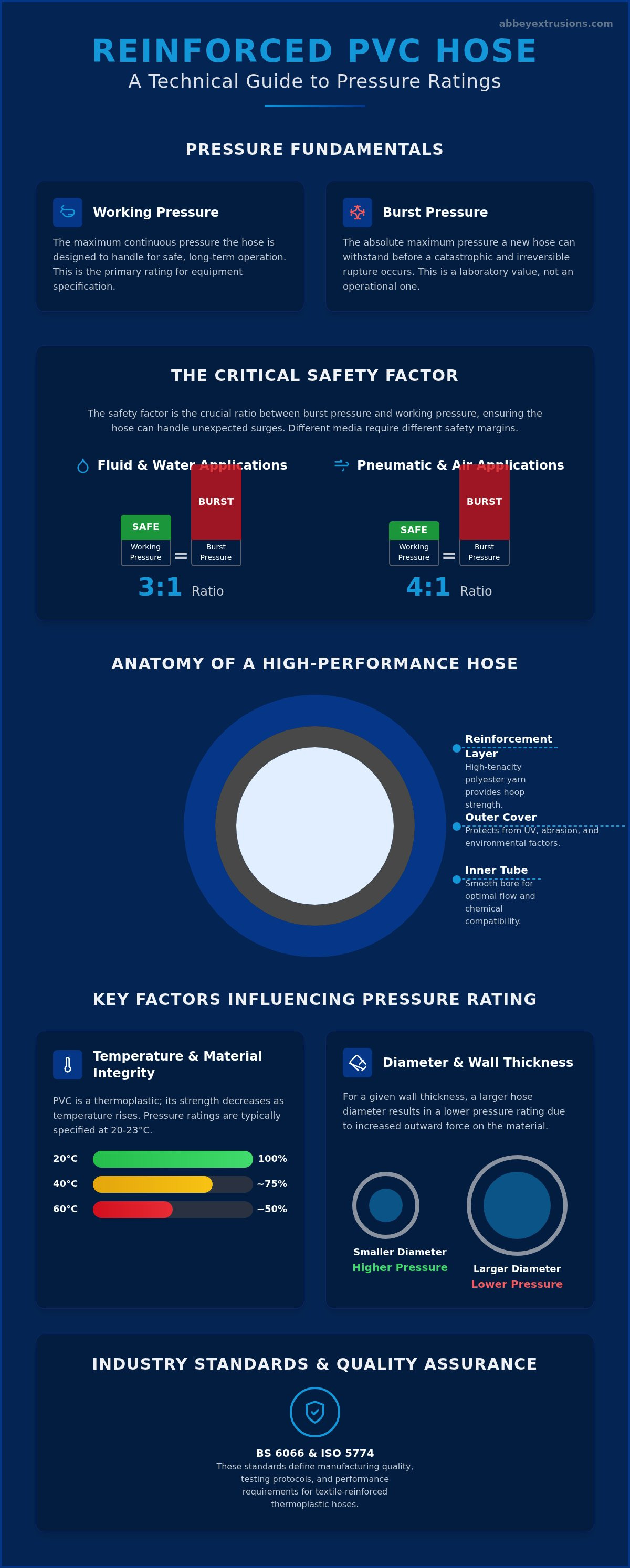
In British manufacturing, Working Pressure is typically calculated as a specific fraction of the Burst Pressure. This ratio is known as the safety factor. For general industrial water transfer, a safety factor of 3:1 is common, whereas pneumatic applications often require a 4:1 ratio to account for the compressible nature of gases. Understanding hose pressure ratings is essential for preventing premature failure in high volume industrial settings. When determining the appropriate reinforced pvc hose pressure rating for a specific industrial application, we apply these safety factors to ensure consistent performance under load. Burst Pressure is defined as the maximum pressure reached before the material structure of the hose experiences a total and irreversible rupture.
The Construction of High Performance Reinforced Hoses
The performance of our reinforced PVC tube products is a direct result of a multi layered extrusion process. Each layer serves a distinct technical purpose. The inner tube is formulated for chemical compatibility with the intended media. It must remain smooth to ensure optimal flow rates and resist degradation from the substances being transported. High tenacity polyester yarn is then braided or spiralled around this inner tube using specialised machinery that ensures consistent tension and coverage. This encapsulation provides the necessary hoop strength to resist internal pressure whilst allowing the hose to maintain its essential flexibility for ease of handling. Finally, an outer cover of PVC is extruded over the reinforcement. This cover protects the polyester cord from environmental factors, UV exposure, and mechanical abrasion during industrial use.
For professional guidance on bespoke volume orders or to discuss specific technical specifications, please contact our specialist team.
Critical Factors Influencing PVC Hose Performance
Whilst the basic construction provides a baseline, the actual reinforced pvc hose pressure rating in a live industrial environment is heavily influenced by external variables. Engineers must account for the synergy between the material's thermoplastic nature and the physical dimensions of the hose itself. These factors are not merely secondary considerations; they are primary drivers of safety and longevity in high volume industrial applications.
Temperature and Pressure Derating Curves
PVC is a thermoplastic material. This means its physical properties, specifically its tensile strength and stiffness, are inherently linked to temperature. As the ambient or fluid temperature increases, the PVC resin begins to soften, which significantly reduces the hose's ability to contain internal pressure. Most standard ratings are calculated at a base temperature of 20 or 23 degrees Celsius. Once the operating temperature reaches 40 or 60 degrees Celsius, the effective pressure capacity can drop by as much as 50 percent or more. Standards like ASTM D1785 provide extensive data on how wall thickness and temperature intersect to dictate these limits. When specifying hoses for high temperature environments, it's vital to select a product with a higher nominal rating to compensate for this thermal derating.
Dimensional Stability and Wall Thickness
The physical dimensions of the hose, particularly the ratio between the internal diameter and the wall thickness, play a decisive role in performance. In a larger diameter pvc tube, the internal surface area is greater, meaning the outward force exerted by the fluid is distributed over a larger section of the material. This is why, for a given wall thickness, a smaller diameter hose will always have a higher pressure rating than a larger one. To maintain high pressure capacity in larger hoses, we must increase the wall thickness or the density of the polyester braiding. The braid angle also influences how the hose reacts under load; an angle of 54 degrees and 44 minutes is often targeted to prevent the hose from either shortening or lengthening when pressurised.
Abbey Extrusions specialises in reinforced pvc tube extrusion where we can adjust these variables, such as braid density and polymer grade, to meet your specific operational needs. If your project demands a non standard wall thickness to achieve a specific reinforced pvc hose pressure rating, you can discuss your bespoke extrusion requirements with us.
For bespoke extrusion enquiries or large volume industrial orders, please contact our team via our contact page.
Industry Standards for Pressure Testing and Safety
A manufacturer's stated reinforced pvc hose pressure rating is only as reliable as the testing protocols used to verify it. In the professional extrusion industry, we adhere to rigorous British and International standards to ensure that every batch of hose performs consistently under stress. These standards provide a universal framework for measuring physical properties, ensuring that safety factors are calculated using uniform methodology rather than arbitrary figures. For procurement officers and engineers, selecting hoses that comply with these benchmarks is the most effective way to mitigate risk in high pressure environments.
Compliance with British and International Standards
The primary standard governing our production processes is BS 6066, which specifies the requirements for thermoplastic hoses reinforced with textile materials. This standard dictates the hydrostatic testing procedures used to determine both the working pressure and the burst pressure. It ensures that the hose can maintain its structural integrity whilst subjected to continuous load. Alongside this, ISO 5774 provides specific guidelines for plastics hoses intended for compressed air applications. These tests measure more than just the point of failure; they assess dimensional stability and the adhesion between the PVC layers and the polyester reinforcement. When we manage large production runs, these standards allow us to provide full traceability, ensuring that the performance of the thousandth metre is identical to the first.
Material Safety and Regulatory Requirements
Modern industrial applications demand more than just physical strength; they require material purity. The chemical composition of the PVC resin and the plasticisers used can significantly impact the safety of the end product. We prioritise the use of phthalate and cadmium free materials to meet current health and environmental expectations. In sensitive sectors such as food processing, compliance with EU No 10 2011 is essential to ensure that no harmful substances migrate into the transported media. Furthermore, ensuring that our products are silicone and heavy metal free is a critical requirement for many of our bespoke clients in the automotive and electronics industries. Our standard reinforced PVC tube specifications are designed to meet these stringent safety criteria whilst providing the robust pressure performance required for heavy duty industrial use. By combining these safety standards with precise engineering, we deliver a product that is both high performing and compliant with modern regulatory landscapes.
If you require technical assistance with bespoke volume orders or specific extrusion requirements, please reach out to our specialist team through our contact page.
Calculating the Correct Working Pressure for Industrial Use
Establishing the correct reinforced pvc hose pressure rating for an industrial system requires more than simply reading a datasheet. It involves a calculated assessment of the operational stressors the hose will encounter throughout its service life. Engineers must determine a safe working limit by applying a rigorous safety factor to the laboratory tested burst pressure. This margin accounts for the unpredictable nature of industrial environments, ensuring that the hose can absorb stresses without failing. Selecting the wrong safety factor is one of the most common causes of premature assembly failure in large volume installations.
Applying Safety Factors in System Design
The standard industry practice for liquid transfer involves a 3 to 1 safety factor. This means if a hose has a burst pressure of 60 bar, its maximum recommended working pressure should not exceed 20 bar. However, pneumatic applications demand a more conservative approach due to the energy stored in compressed gases. For air or gas transfer, a 4 to 1 safety factor is preferred to mitigate the risks associated with the rapid expansion of media in the event of a rupture. The safety factor is defined as the ratio of burst pressure to working pressure. By adhering to these ratios, procurement leads can ensure that their reinforced pvc tube selections provide a robust buffer against operational fluctuations.
Managing Pressure Surges and Environmental Stress
Static pressure ratings don't account for the kinetic energy of moving fluids. Sudden valve closures or pump start ups can trigger a phenomenon known as water hammer, which creates momentary pressure spikes that vastly exceed the nominal system pressure. If your reinforced pvc hose pressure rating is too close to the operating pressure, these surges can cause permanent deformation or immediate failure. Long term environmental exposure also plays a role; UV radiation can gradually degrade the PVC polymer, reducing its elasticity and pressure retention over time. For a deeper analysis of these variables, you should consult our Engineering Guide to Reinforced PVC Hose Selection and Performance.
The integrity of the final assembly also depends on the selection of appropriate fittings. A hose is only as strong as its weakest point, and an incorrectly swaged fitting can compromise the entire rating. We recommend that you request a technical consultation for your specific pressure requirements to ensure your bespoke volume orders are engineered for maximum reliability.
If you require technical assistance with bespoke volume orders or specific extrusion requirements, please reach out to our specialist team through our contact page.
Bespoke Reinforced PVC Solutions from Abbey Extrusions
Abbey Extrusions has built a reputation for technical excellence since 1985, specialising in the production of high volume, bespoke industrial hoses. We understand that a standard reinforced pvc hose pressure rating may not always suffice for specialised machinery or unique environmental conditions. By leveraging our UK based manufacturing capacity, we provide engineers with the ability to customise every technical parameter of their hose or tube requirements. This level of control ensures that the final product doesn't just meet industry standards but exceeds the specific operational demands of your facility. Our process begins with a thorough assessment of your system's needs, considering factors like chemical compatibility, thermal stress, and mechanical wear.
Customising Braid Density and Wall Thickness
Our extrusion experts can precisely adjust the structural architecture of a hose to achieve specific performance goals. This includes modifying the wall thickness and the density of the polyester reinforcement layer to ensure the desired reinforced pvc hose pressure rating is met without sacrificing flexibility. We offer the ability to produce a bespoke PVC tube with tailored shore hardness, ensuring it remains easy to handle whilst maintaining its integrity under load. This manufacturing flexibility is essential for non standard industrial requirements where off the shelf solutions often fail to provide the necessary safety margins or longevity. We can also integrate specific UV stabilisers during the extrusion process to enhance the product's lifespan in harsh environments.
Large Volume Orders and Technical Support
Managing complex industrial projects requires a partner who can provide both technical depth and logistical reliability. Working with a UK manufacturer based in Leicestershire offers significant advantages in terms of lead times and direct quality control. We manage the entire process from initial design and material selection to the final extrusion of large volume orders. This integrated approach allows us to incorporate custom colours and branding into the outer cover without compromising the core technical specifications. Our team provides detailed technical documentation for every production run, ensuring full traceability and compliance with your internal quality standards. If you are developing a new system or looking to optimise an existing one, we encourage you to contact the specialist team to discuss bespoke extrusion profiles. Our collective expertise ensures that your requirements are translated into a high performance solution that delivers long term value and operational safety.
Advancing Industrial Pressure Performance
Selecting the correct reinforced pvc hose pressure rating is a matter of rigorous engineering rather than mere estimation. We have examined how temperature fluctuations, safety factors, and material purity intersect to define the operational limits of your industrial systems. By prioritising precise braid architecture and adherence to BS 6066 standards, you ensure the long term integrity of your fluid and gas transfer infrastructure. Abbey Extrusions remains committed to delivering this level of technical precision through our bespoke manufacturing processes.
As an independent UK manufacturer since 1985, we specialise in bespoke plastic extrusion and tube forming for national high volume industrial orders. Our Leicestershire based production facility is equipped to handle complex specifications that require tailored wall thicknesses and reinforcement densities. We invite you to request a technical consultation for your bespoke reinforced PVC requirements to ensure your project benefits from our decades of manufacturing expertise. We look forward to supporting your next industrial extrusion project with precision and reliability.
Frequently Asked Questions
What is the standard safety factor for reinforced PVC hoses?
The standard safety factor for a high quality reinforced PVC hose is typically 3 to 1 or 4 to 1. This ratio represents the critical relationship between the burst pressure and the maximum recommended working pressure. We ensure that our bespoke extrusions maintain these safety margins to protect operators and equipment from sudden failure. Adhering to these industry standards provides a necessary buffer against unexpected pressure surges during large volume industrial operations.
How does temperature affect the pressure rating of a braided hose?
Temperature has a direct and significant impact on the reinforced pvc hose pressure rating of any thermoplastic product. As the operating temperature rises, the PVC material begins to soften, which naturally reduces the structural integrity and pressure resistance of the hose. Most technical specifications are calculated at a base temperature of 20 degrees Celsius. If your application involves higher temperatures, the working pressure must be derated according to specific manufacturer tables.
Can I use reinforced PVC hose for high pressure compressed air?
You can certainly use reinforced PVC hose for compressed air applications provided the hose's working pressure exceeds your system's requirements. It's a popular choice for pneumatic tools and factory air lines due to its flexibility and durability. However, you must always verify that the specific hose grade is suitable for the intended air pressure. Our custom manufacturing process allows us to adjust the reinforcement density to meet specific pneumatic demands for large volume orders.
What is the difference between working pressure and burst pressure?
Working pressure refers to the maximum pressure that a hose can safely handle during continuous daily operation without risking damage. In contrast, burst pressure is the point at which the hose material or reinforcement physically fails and ruptures during testing. The gap between these two figures is the safety factor. It's vital for engineers to design systems based on the working pressure whilst keeping the burst pressure as a critical safety limit.
Which British Standards apply to reinforced PVC hose manufacturing?
Several British and international standards govern the production of reinforced hoses to ensure consistency and safety. BS EN ISO 5774 is particularly relevant as it specifies the requirements for plastics hoses reinforced with thermoplastics for compressed air applications. We align our UK based production with these rigorous benchmarks to ensure that every batch of custom tubing meets the high expectations of our industrial partners. This commitment to standards reflects our decades of technical expertise.
Does the diameter of the hose change its pressure rating?
The internal diameter of a hose significantly influences its overall pressure capabilities. Generally, as the diameter increases, the reinforced pvc hose pressure rating tends to decrease if the wall thickness and reinforcement remain the same. This happens because a larger surface area is exposed to the internal force, putting more stress on the hose walls. When we design bespoke hoses, we carefully calculate the necessary wall thickness and braiding patterns to compensate for larger diameters.
How can I identify a high quality braided PVC hose?
Identifying a high quality braided hose involves inspecting the uniformity of the polyester reinforcement and the clarity of the PVC layers. The braiding should be even and consistent throughout the length of the hose without any visible gaps or overlapping errors. You should also check for clear markings that indicate the manufacturer and the pressure ratings. High grade hoses feel substantial and resist kinking whilst maintaining the flexibility required for demanding industrial environments.
Why is polyester used as the reinforcement material in PVC hoses?
Polyester is the preferred reinforcement material because it offers an excellent balance of high tensile strength and cost effectiveness. It bonds exceptionally well with PVC during the extrusion process, creating a unified structure that can withstand significant internal forces. This synthetic fibre doesn't rot or degrade easily when exposed to moisture, making it ideal for long term industrial use. Our technical team selects specific polyester grades to ensure the finished hose meets your exact performance criteria.

Article by
Bryan Cowan
Bryan Cowan is the Founder and Managing Director of Abbey Extrusions Ltd, a leading UK manufacturer of high-quality plastic tubes and hoses. With over 40 years of industry experience, Bryan established the company in 1985, growing it from a startup into a BS ISO9001-registered supplier for global sectors including aerospace, automotive, and pharmaceuticals.
Disclaimer
This article is intended for informational purposes only. Please ensure you seek expert advice or carry out your own research to confirm the information is suitable for your specific needs.