Relying on overseas supply chains for critical components often feels like a calculated risk that eventually stops paying off when a production line grinds to a halt. Most industrial engineers understand that even the most advanced robotics or pneumatic systems are only as reliable as the tubing that powers them. You likely recognise the frustration of tubing that kinks in tight spaces or the struggle to source non-standard dimensions for specialised machinery. When these failures occur, the resulting downtime carries a heavy financial burden that standard components simply cannot resolve.
As a dedicated polyurethane tubing manufacturer uk, we believe that technical excellence starts with a deep understanding of material science and local manufacturing reliability. This article demonstrates how high performance polyurethane tubing can optimise your industrial systems through technical precision and bespoke UK manufacturing. We will examine the technical advantages of superior abrasion resistance, the logistical benefits of securing a dependable domestic supply, and how custom extrusion profiles ensure a perfect fit for your specific machinery requirements. By focusing on bespoke solutions rather than mass produced alternatives, you can achieve a level of system longevity that supports long term operational efficiency.
Key Takeaways
- Understand why polyurethane is considered a high performance bridge between rubber and plastic, offering superior abrasion resistance for intensive industrial use.
- Discover how exceptional kink resistance allows for reliable fluid and air transfer within the confined spaces of modern robotic systems.
- Learn the logistical and technical advantages of partnering with a specialist polyurethane tubing manufacturer uk to secure bespoke dimensions and reduced lead times.
- Explore the benefits of custom tube forming to achieve precise profiles that fit complex machinery layouts without compromising flow efficiency.
- Evaluate the specific performance criteria that make polyurethane a more resilient choice than nylon for certain high cycle pneumatic applications.
To discuss your specific technical requirements for bespoke industrial tubing, please visit our contact page.
The Role of Polyurethane Tubing in Modern UK Manufacturing
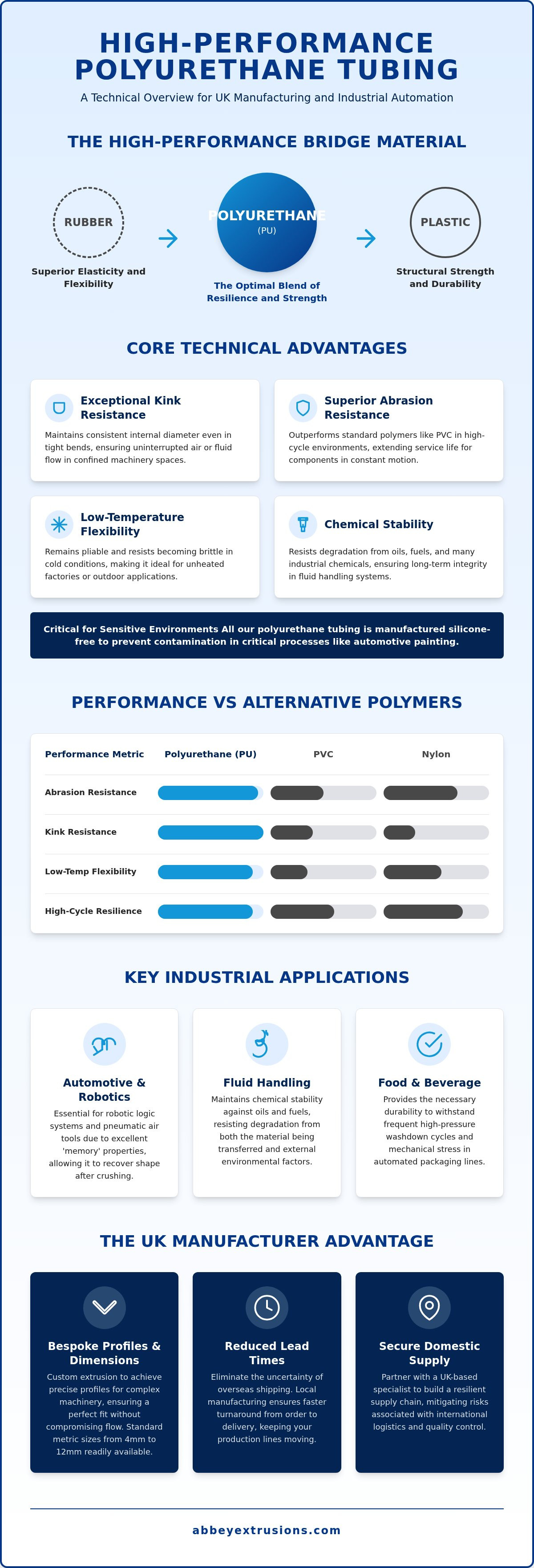
Polyurethane is a versatile polymer that effectively serves as a high performance bridge between the elasticity of rubber and the structural strength of plastic. This unique combination of properties makes it indispensable for modern industrial applications. As a specialist polyurethane tubing manufacturer uk, we observe an increasing shift towards this material due to its exceptional resilience. It offers the flexibility required for high cycle machinery whilst maintaining the toughness needed to withstand abrasive environments.
The rapid expansion of industrial automation and robotics is a significant driver for the adoption of PU tubing. Automated production lines require components that can endure constant motion without fatigue. UK manufacturers increasingly prioritise PU for its superior impact resistance and tear strength compared to traditional PVC or rubber alternatives. Additionally, as a dedicated polyurethane tubing manufacturer uk, we ensure our production processes yield silicone free construction. This is a critical requirement for sensitive environments such as automotive paint shops where silicone contamination can lead to catastrophic finish defects.
The Evolution of Flexible Pneumatic Systems
Modern robotics require tighter bend radii than ever before to accommodate compact machinery footprints. Historically, engineers relied on rigid piping or heavy reinforced hoses, which added unnecessary weight and complexity to the system. The transition to flexible polyurethane solutions has revolutionised pneumatic design. By using high performance PU, designers can reduce the overall weight of moving parts. This change lowers energy consumption and increases cycle speeds across the production floor.
Industrial Sectors Relying on Polyurethane Extrusions
Several key sectors depend on the specific technical parameters of PU to maintain operational uptime. These include:
- Automotive Assembly: Used for robotic logic systems and air tools due to its excellent memory properties and ability to recover from crushing.
- Fluid Handling: Maintains chemical stability against oils and fuels whilst resisting degradation from external environmental factors.
- Food and Beverage: Provides the necessary durability during frequent washdown cycles and mechanical stress in packaging lines.
Whilst we focus on large volume industrial applications, the robustness of PU ensures that tubing remains intact under heavy use. This reliability provides a long service life that significantly reduces maintenance costs for plant operators.
For technical advice on material selection or to request a bespoke quote for your facility, please reach out to our engineering team.
Technical Properties and Performance Standards of Polyurethane
Polyurethane is defined by its exceptional kink resistance. This is a critical factor for engineers designing for confined spaces. Unlike rigid polymers that may crack or collapse under stress, PU maintains a consistent internal diameter even when subjected to tight bends. This ensures that airflow or fluid transfer remains uninterrupted, preventing system pressure drops and potential machinery failure. As a specialist polyurethane tubing manufacturer uk, we focus on providing materials that meet these rigorous mechanical demands.
In high cycle environments, such as robotic arms or pick and place machinery, abrasion resistance is paramount. PU exhibits far greater wear resistance than standard PVC. It also retains its flexibility at low temperatures. Whilst other plastics become brittle and prone to failure when the temperature drops, PU remains pliable. This characteristic makes it ideal for unheated factory environments or outdoor industrial applications where thermal stability is a prerequisite for safety.
Our manufacturing processes prioritises metric dimensions to align with standard UK pneumatic fittings. Typical industrial requirements range from 4mm to 12mm in outside diameter. Achieving a precise tolerance on these sizes is essential for push-in fittings to ensure a leak-proof seal. By maintaining strict control over the extrusion process, we guarantee compatibility with existing pneumatic infrastructure across the UK manufacturing sector.
Shore Hardness and Material Flexibility
Shore hardness is the measure of a material's resistance to indentation. In the context of industrial tubing, this value determines the balance between flexibility and pressure rating. We typically extrude PU in Shore A or Shore D grades depending on the specific application requirements. A significant advantage of PU is that it achieves this flexibility without the addition of plasticisers. According to ongoing UK polymer research, plasticiser-free materials are less likely to leach or become brittle over time. This ensures that the tubing maintains its physical properties throughout its operational lifespan.
Chemical and Environmental Resistance
Polyurethane provides robust protection against a variety of industrial substances. It is highly resistant to hydraulic oils, lubricants, and non-corrosive gases. This chemical stability prevents the tubing from swelling or hardening when exposed to common manufacturing fluids. The inherent UV stability of the material also makes it suitable for environments where exposure to sunlight or industrial lighting might otherwise cause degradation. If you require a specific chemical resistance chart for your application, you can consult with our technical specialists.
To request a technical consultation regarding bespoke material specifications, please visit our contact page.
Selecting Polyurethane Over Alternative Industrial Polymers
Selecting the correct polymer for a specific industrial application requires a detailed understanding of both mechanical limits and environmental factors. Whilst many materials are available, polyurethane often serves as the most resilient choice for dynamic systems. We follow the technical guidelines supported by the British Plastics Federation (BPF) to ensure our extrusions meet the highest industry standards. As a specialist polyurethane tubing manufacturer uk, we find that engineers often struggle to balance cost against performance when choosing between PU, nylon, or PVC.
Polyurethane is the only viable engineering choice in scenarios involving high-frequency cycles and tight installation envelopes. Whilst standard PVC might offer a lower initial cost, its tendency to kink and degrade under mechanical stress often leads to increased downtime. Similarly, whilst LDPE is suitable for static, low-pressure fluid transfer, it lacks the toughness required for heavy industrial environments. By partnering with a dedicated polyurethane tubing manufacturer uk, you can secure a bespoke supply that addresses these specific performance gaps.
Polyurethane versus Nylon 11 and 12
The primary distinction between PU and nylon tube lies in the balance between flexibility and pressure capacity. Nylon 11 and 12 are renowned for their high pressure ratings and excellent chemical resistance, making them ideal for stable pneumatic lines. However, nylon is significantly stiffer than polyurethane. In applications involving constant motion, such as robotic joints, nylon can suffer from fatigue and eventually crack. PU maintains its integrity under continuous bending. Furthermore, whilst nylon can be sensitive to moisture absorption in certain grades, PU offers superior dimensional stability in humid conditions. For a more detailed look at nylon specifications, you can read our guide on nylon tubing properties.
Polyurethane versus Reinforced PVC
When comparing unreinforced PU with reinforced pvc tube, the most significant advantage of PU is its inherent kink resistance. Reinforced PVC relies on an internal braid to handle pressure, but this can make the hose bulky and prone to permanent deformation if bent too sharply. Polyurethane doesn't require such reinforcement for standard pneumatic pressures, allowing for a much smaller bend radius. Additionally, PU provides far superior abrasion resistance for external hose protection. It resists scuffing and tearing when dragged across factory floors or through machinery components, ensuring a longer service life in high-traffic production areas. If your system requires a perfect balance of flexibility and durability, PU is almost always the superior technical investment.
If you require a quotation for a bespoke extrusion project or technical advice on material selection, please visit our contact page.
Sourcing Custom Polyurethane Tubing for Specialised Applications
Standard components often fall short when integrated into specialised industrial machinery. As a specialist polyurethane tubing manufacturer uk, we recognise that off the shelf solutions can lead to inefficient system layouts. Custom extrusions allow engineers to specify exact technical parameters that standard suppliers simply can't match. This precision is essential for maintaining the operational integrity of high value equipment.
One of the most significant advantages of bespoke manufacturing is the ability to utilise tube forming. This process allows for the creation of permanent bends and complex shapes tailored to specific machinery layouts. By forming the tube to a specific geometry, you can reduce the reliance on elbow joints and other pneumatic fittings. It's a method that minimises potential leak points and streamlines the assembly process, ultimately leading to a more robust industrial system.
We provide the capability to manufacture non standard diameters in both metric and imperial scales. Whether your machinery requires a unique wall thickness for pressure management or a specific outside diameter for a custom housing, we can adjust the extrusion process accordingly. Bespoke colours are another critical service we provide. We can match corporate branding or produce tubing in specific safety colours to aid in rapid fault finding and system identification on the factory floor.
The Bespoke Extrusion Process
The journey to a custom solution begins with a detailed technical consultation. We examine your specific profile requirements and environmental constraints to ensure the material grade is correct. Our facility uses specialised dies to create unique tubing shapes that go beyond standard circular profiles. Maintaining precision tolerances is a fundamental part of our manufacturing philosophy. This accuracy ensures that every custom tube integrates perfectly with your existing hardware and pneumatic connectors.
Tailored Lengths and Packaging Solutions
Efficiency on the production line is often determined by how components arrive at the facility. We offer custom cut lengths to save your team time during assembly; alternatively, we can provide long continuous coils for high volume automated systems. Bespoke packaging solutions can be organised to suit your storage and distribution needs. We also offer specialised markings or branding directly on the tube surface. This allows for clear part identification or the inclusion of safety instructions throughout the life of the product.
To begin the design process for your bespoke extrusion project or to discuss large volume orders, enquire with our technical team today.
To discuss your specific technical requirements for bespoke industrial tubing, please visit our contact page.
Benefits of Sourcing from a Specialist UK Manufacturer
Partnering with a domestic specialist provides advantages that extend beyond mere logistics. Since 1985, Abbey Extrusions has operated from our base in the Midlands, establishing a reputation for technical precision in plastic extrusion. As a dedicated polyurethane tubing manufacturer uk, we provide our clients with direct access to the engineers responsible for their products. This proximity eliminates the communication barriers often found when dealing with international brokers or overseas factories. You're speaking directly to the experts who understand the material science behind the extrusion.
One of the most immediate benefits is the significant reduction in lead times. Whilst international shipping can be subject to unpredictable delays at ports, national delivery ensures a stable and predictable supply. This speed is complemented by a lower environmental impact. By sourcing locally, you reduce the carbon footprint associated with long distance logistics, supporting your company's sustainability targets through reduced transport emissions. Choosing a specialist polyurethane tubing manufacturer uk means you're investing in a more responsive and responsible supply chain.
Supply Chain Security and Quality Control
UK manufacturing offers a buffer against global logistics disruptions. We maintain rigorous quality standards within our domestic facility, ensuring that every batch of tubing meets the precise mechanical specifications required for industrial use. Proximity also simplifies the process of conducting site audits or technical reviews. Being able to visit the facility where your tubing is manufactured fosters a level of trust and transparency that's difficult to replicate with distant suppliers. It ensures that the quality control processes remain visible and verifiable at every stage of production.
Supporting the UK Engineering Sector
Bespoke manufacturers play a vital role in driving innovation within British engineering. By providing tailored solutions rather than generic stock, we enable engineers to push the boundaries of machine design. We focus on building long term partnerships for large volume industrial orders, acting as a technical partner rather than just a vendor. For those interested in the technical aspects of the process, we've produced a guide on the engineering principles of plastic extrusion. This document provides deeper insight into how material science and manufacturing precision combine to create high performance components for the most demanding applications.
To discuss your specific technical requirements for bespoke industrial tubing, please visit our contact page.
Optimising Industrial Efficiency with Bespoke Polyurethane Solutions
Choosing the right polymer is a foundational engineering decision that dictates the long term reliability of your pneumatic and fluid systems. High performance polyurethane provides the necessary resilience for high cycle environments whilst ensuring that tight bend radii don't lead to system failure. By moving away from off the shelf components and embracing custom extrusion profiles, you can eliminate unnecessary fittings and reduce potential leak points across your machinery.
As a specialist polyurethane tubing manufacturer uk based in the Midlands since 1985, we provide the technical expertise required for large volume industrial supply. Our specialist bespoke tube forming services allow for the creation of complex geometries that align perfectly with your machinery layouts, ensuring a precise fit every time. Securing a domestic supply chain not only reduces lead times but also provides you with direct access to professional technical support throughout the design and manufacturing process.
We invite you to contact our technical sales team for a bespoke polyurethane tubing quote to discuss your specific operational requirements. Investing in precision manufacturing today ensures the stability of your production lines for years to come.
Frequently Asked Questions
How does polyurethane tubing compare to nylon in pneumatic systems?
Polyurethane tubing offers superior flexibility and kink resistance compared to nylon in pneumatic systems. Whilst nylon provides higher pressure ratings and greater stiffness, polyurethane is better suited for applications requiring tight bend radii or frequent movement. As a polyurethane tubing manufacturer uk, we find that industrial clients prefer the durability and elastic memory of PU for robotic arms and complex pneumatic circuits where vibration damping is essential.
What are the standard temperature limits for industrial polyurethane tubing?
Standard industrial polyurethane tubing typically operates within a temperature range of minus 20 degrees Celsius to plus 60 degrees Celsius. Some specialised formulations can extend this range slightly, but exceeding these limits often leads to a reduction in pressure rating or material degradation. It is vital to consider both the ambient environment and the temperature of the conveyed media to ensure the long term structural integrity of the tubing.
Can I order polyurethane tubing in bespoke colours for my project?
We specialise in producing polyurethane tubing in bespoke colours to meet specific branding or safety requirements. Our manufacturing process allows us to match exact colour specifications for large volume orders, ensuring consistency across your entire production run. This service is particularly beneficial for complex industrial installations where colour coding is used to distinguish between different pneumatic lines or to align with a corporate identity.
What are the main benefits of using a UK based tubing manufacturer?
Partnering with a UK based polyurethane tubing manufacturer uk ensures shorter lead times and more reliable supply chains for your industrial projects. We provide direct access to technical expertise and rigorous quality control standards that are often missing with overseas suppliers. Sourcing locally reduces transport costs and environmental impact whilst allowing for easier communication and faster resolution of custom extrusion requirements or technical enquiries.
Is polyurethane tubing suitable for use as a diesel fuel hose?
Polyurethane is highly resistant to oils and fuels, making it an excellent choice for use as a diesel fuel hose in many industrial settings. It maintains its flexibility even when exposed to hydrocarbons, which prevents the hose from becoming brittle over time. We manufacture custom diesel fuel hoses designed to withstand the rigours of fuel transfer, providing a durable solution that outperforms standard rubber alternatives in terms of abrasion resistance.
What is the minimum bend radius for a standard 6mm polyurethane tube?
The minimum bend radius for a standard 6mm outside diameter polyurethane tube is typically approximately 15mm to 25mm depending on the specific wall thickness. This tight bend radius allows for efficient routing in compact machinery without the risk of kinking or flow restriction. Choosing the correct shore hardness and wall dimensions is critical to maintaining the performance of the tube in high flex applications where space is limited.
Why is silicone free construction important for polyurethane extrusions?
Silicone free construction is essential for polyurethane extrusions used in environments such as automotive paint shops or coating facilities. Even trace amounts of silicone can cause significant surface defects, known as fish eyes, in finishes and adhesives. We ensure our manufacturing processes prevent silicone contamination, providing a clean product that meets the stringent requirements of industries where surface preparation and finish quality are paramount for the final assembly.
How does Shore hardness affect the performance of flexible tubing?
Shore hardness directly influences the flexibility, pressure resistance, and tactile feel of the tubing. A higher Shore A rating, such as 98A, indicates a stiffer tube that can handle higher internal pressures but has a larger minimum bend radius. Conversely, a lower Shore rating results in a more flexible and softer tube. Selecting the appropriate hardness is a fundamental step in designing a bespoke solution that balances mechanical strength with operational flexibility.

Article by
Bryan Cowan
Bryan Cowan is the Founder and Managing Director of Abbey Extrusions Ltd, a leading UK manufacturer of high-quality plastic tubes and hoses. With over 40 years of industry experience, Bryan established the company in 1985, growing it from a startup into a BS ISO9001-registered supplier for global sectors including aerospace, automotive, and pharmaceuticals.
Disclaimer
This article is intended for informational purposes only. Please ensure you seek expert advice or carry out your own research to confirm the information is suitable for your specific needs.