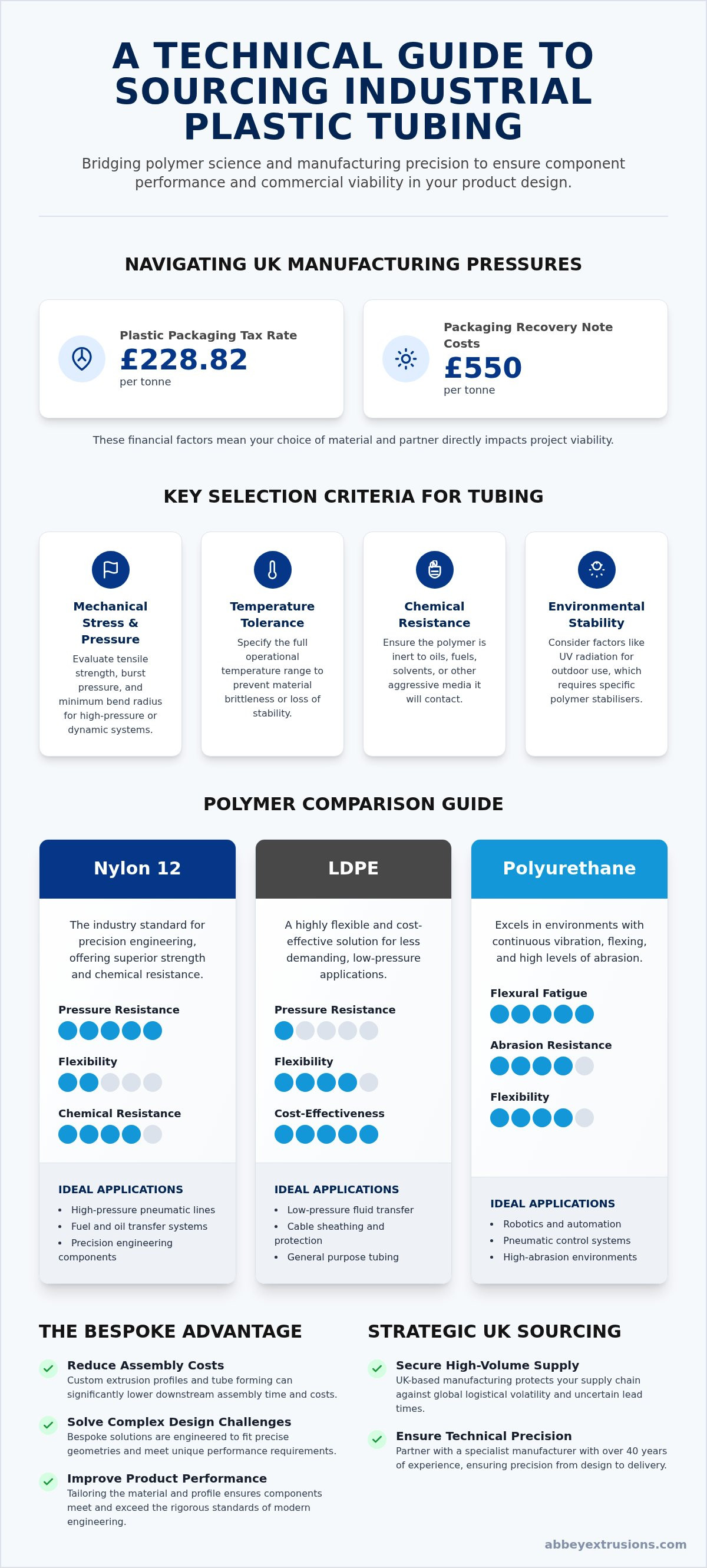
A single millimetre of deviation or an overlooked polymer property can compromise an entire production run; many engineering teams still treat material specification as an afterthought. We understand that sourcing plastic tubing for product design requires more than just finding a supplier. It demands a technical partnership that bridges the gap between polymer science and manufacturing precision. As of August 2026, the UK manufacturing landscape faces new pressures, including a Plastic Packaging Tax rate of £228.82 per tonne and Packaging Recovery Note costs reaching £550 per tonne. These factors mean that your choice of material and manufacturing partner now directly impacts both your technical performance and your project's commercial viability.
You likely recognise that material failure or unreliable overseas lead times are risks your high-volume production cannot afford. This professional guide provides a clear framework for selecting high-performance polymers, such as Nylon 12 or flexible Polyurethane, whilst explaining how bespoke extrusion solutions solve complex design challenges. We will examine how UK-based production and secondary processes like custom tube forming improve product performance and ensure your components meet the rigorous standards of modern engineering.
Key Takeaways
- Learn how to precisely match polymer properties to your application environment to prevent mechanical failure and ensure long term durability.
- Compare the technical advantages of Nylon, LDPE, and Polyurethane to identify the most suitable material for chemical and environmental resistance.
- Discover how sourcing plastic tubing for product design through bespoke extrusion profiles and tube forming can significantly reduce assembly costs.
- Identify the strategic advantages of UK based manufacturing for securing high volume supply chains against global logistical volatility.
- Understand how partnering with a specialist manufacturer with over 40 years of experience ensures technical precision from the design phase to final delivery.
To discuss your specific requirements for high-volume industrial orders, please reach out to our technical team through our contact page.
Evaluating Material Performance for Industrial Product Design
When sourcing plastic tubing for product design, the technical specification must be dictated by the intended application environment. It's a common engineering error to prioritise unit cost over material compatibility, which often leads to premature failure in demanding industrial settings. A thorough evaluation of the plastic extrusion process and the resulting polymer characteristics is essential for any fluid transfer or pneumatic system. We believe that selecting the correct material at the design stage is the most effective way to ensure long-term product reliability.
Technical teams must consider how mechanical stress and internal pressure influence the choice between flexible and rigid profiles. For instance, high-pressure pneumatic lines typically require the superior tensile strength of a Nylon tube. Conversely, low-pressure applications might benefit from the cost-effectiveness and flexibility of LDPE. Chemical resistance is equally critical; if the tubing carries aggressive solvents or fuels, the polymer must remain inert to prevent degradation or leaching that could contaminate the system.
Mechanical Stress and Pressure Ratings
Pressure ratings are not static values. They are heavily influenced by the outer diameter and the specific polymer grade. For example, Nylon 12 offers excellent dimensional stability under pressure, making it a preferred choice for precision engineering. Designers must also evaluate the minimum bend radius. If a tube is forced into a radius tighter than its specification, it creates a stress point that significantly reduces the burst pressure. In high-volume industrial environments where machinery operates continuously, long-term vibration can lead to stress cracking if the material lacks sufficient flexural fatigue resistance, a property where Polyurethane excels.
Temperature Tolerance and Environmental Stability
Environmental factors often dictate the lifespan of a component. UV radiation can cause discolouration and loss of mechanical strength in standard polymers, so we incorporate specific stabilisers for outdoor installations. Temperature also plays a critical role. Whilst some materials maintain flexibility at minus 40 degrees Celsius, others become brittle and susceptible to impact damage. When sourcing plastic tubing for product design, engineers must specify the full range of operational temperatures to ensure the chosen profile remains stable throughout its service life. Identifying these constraints early prevents costly field failures and ensures your product meets its performance benchmarks.
For technical advice on polymer selection or to request a quote for high-volume extrusion, please visit our contact page.
Selecting Polymers Based on Chemical and Environmental Resistance
Sourcing plastic tubing for product design necessitates a rigorous comparison of polymer characteristics against the intended chemical environment. Whilst mechanical specifications provide the baseline for performance, chemical compatibility often determines the operational lifespan of the component. Industrial systems frequently expose tubing to oils, fuels, and aggressive solvents that can cause swelling, softening, or environmental stress cracking in unsuitable materials. Consulting a technical guide to plastic pipe materials is a vital first step in ensuring that your chosen profile maintains its integrity under chemical load.
Nylon, LDPE, and Polyurethane each offer distinct advantages. A Nylon tube is typically specified for its superior resistance to hydrocarbons and oils, making it the industry standard for fuel lines and high-pressure pneumatic systems. For applications where flexibility and abrasion resistance are the primary requirements, a Polyurethane tube provides a resilient solution that resists mechanical wear amongst moving parts. In contrast, LDPE serves as a cost-effective choice for low-pressure fluid transfer where chemical inertness is required but high mechanical strength is less critical.
High Performance Nylon 11 and 12 Solutions
Nylon 12 is highly regarded for its low moisture absorption, which ensures the tube remains dimensionally stable even in humid or wet conditions. This precision is essential for fittings and connectors where tolerances are tight. Nylon 11 is often favoured for its bio-based origins, derived from castor oil, and its exceptional impact resistance at low temperatures. Both materials perform reliably in high-pressure and high-temperature environments. To understand the manufacturing nuances behind these materials, we recommend reviewing The Engineering Principles of Plastic Extrusion for Industrial Applications for deeper technical insights.
Versatile Polyurethane and LDPE Applications
Polyurethane is the preferred material for pneumatic control systems due to its extreme flexibility and kink resistance. It's particularly effective in coiled or dynamic applications where the tubing must endure constant movement without fatigue. When the application involves water or basic chemical transfer at lower pressures, a low-density polythene tube offers the best balance of economy and performance. The choice between these materials should always be based on the specific fluid being transported and the mechanical duty cycle. If you require assistance with material compatibility testing, our engineers can provide guidance through our technical support team.
For bespoke design consultations and high-volume extrusion enquiries, please contact our technical department through our contact page.
Design Considerations for Bespoke Extrusion Profiles and Tube Forming
Sourcing plastic tubing for product design often moves beyond standard circular profiles. In complex technical engineering, standard off-the-shelf components frequently fail to meet the spatial or functional requirements of a sophisticated assembly. Bespoke extrusion profiles allow engineers to consolidate multiple parts into a single, multifunctional component. This approach not only improves the final product aesthetics but also significantly reduces assembly time on the production line. Working with a manufacturer that possesses over 40 years of experience ensures that technical tolerances are maintained with precision. This is critical for components that must interface perfectly with existing hardware or housing units.
Custom extrusions allow for the integration of multiple functions into a single profile, such as internal chambers for separate fluid paths or external features for mounting. This level of integration simplifies the final assembly and reduces the risk of part failure. We believe that a collaborative approach between the designer and the manufacturer is essential to ensure that the profile is optimised for both performance and manufacturability.
Advantages of Bespoke Profile Extrusion
When sourcing plastic tubing for product design, engineers often find that custom shapes can be engineered to replace several standard parts. This directly reduces production costs by simplifying the supply chain and assembly process. In the transport and event sectors, bespoke profiles provide the design freedom to create aerodynamic or structural sections like curtainsider pelmet sections. Developing a custom die is a methodical process where we translate your CAD designs into a viable extrusion profile. This allows for unique industrial applications that standard tubing cannot accommodate, such as profiles with specific fluting or unique wall thicknesses.
Precision Tube Forming for Complex Assemblies
Standard tubing often requires elbow joints or connectors to navigate tight spaces. These connectors introduce potential leak points and increase assembly complexity. Through professional tube forming, we use heat forming techniques to create permanent bends in materials like Nylon and Polyurethane. These pre-shaped components offer significant space saving benefits in compact product designs, such as engine compartments or industrial control cabinets. Additionally, pre-formed tubes ensure consistent flow rates by maintaining the internal diameter through specific angles. This prevents the kinking that often occurs when flexible tubing is forced into tight radii. By integrating formed sections, designers achieve a more reliable and streamlined fluid or air transfer system.
To discuss how our UK manufacturing facility can support your high-volume production requirements, please get in touch with our team via our contact page.
Sourcing Strategies for UK Based Plastic Extrusion Manufacturing
Sourcing plastic tubing for product design involves a critical transition from theoretical engineering to high-volume reality. Choosing a UK manufacturer provides a level of logistical security that overseas suppliers often cannot match. With the current volatility in polymer markets and the complexity of domestic regulations like the Plastic Packaging Tax, having a partner within the same regulatory framework is a significant advantage. This proximity allows for tighter quality control and absolute material traceability, which is increasingly important for industrial compliance and supply chain transparency.
Technical support is vital during the prototyping and scale-up phases. It's the stage where initial design assumptions are tested against manufacturing constraints. A domestic partner can facilitate rapid adjustments to a profile or material blend, ensuring that the transition to high-volume production is seamless. Shorter lead times directly impact the overall product development lifecycle, allowing your engineering team to move from concept to market with greater speed and precision.
Assessing Technical Competence and Quality Standards
Technical expertise in polymer science is essential for bespoke design projects. A manufacturer should do more than simply follow a drawing; they should provide guidance on whether a Nylon tube or a Polyurethane tube is best for your specific pressure and environmental requirements. We believe that a partner with over 40 years of experience, established in 1985, offers the stability required for long-term industrial supply. This depth of knowledge ensures that the technical tolerances required for your product are consistently met across every production run.
Navigating Lead Times and Production Scalability
When evaluating sourcing plastic tubing for product design, the total cost of ownership must be considered. Whilst overseas unit prices might appear lower, the hidden costs of long lead times and shipping delays can be catastrophic for a high-volume industrial supply chain. Local manufacturing reduces the risk of stockouts and supply chain disruptions significantly. Shorter lead times allow for leaner inventory management and a more responsive development cycle. If a design change is required mid-production, a UK manufacturer can react with a level of flexibility that global logistics don't allow. We invite you to enquire about our manufacturing capacity to secure your high-volume requirements.
To discuss your high-volume manufacturing requirements with our engineering team, please visit our contact page.
Partnering with Abbey Extrusions for Technical Design and High Volume Supply
Since 1985, Abbey Extrusions has functioned as a specialist partner for technical engineering firms across the United Kingdom. Our 40 years of manufacturing experience allow us to offer more than just production; we provide a deep understanding of polymer science that is essential for complex assemblies. Sourcing plastic tubing for product design through an independent UK manufacturer ensures that your project benefits from direct technical oversight and a commitment to quality that is often diluted in global supply chains. We maintain a comprehensive range of polymers, including Nylon 11, Nylon 12, LDPE, and Polyurethane, to meet the diverse needs of modern industrial applications.
A partnership with us ensures that your product is backed by decades of technical competence. We don't view ourselves as a mere supplier but as a technical extension of your design team, offering insights into how specific polymer blends will behave during high-volume production cycles. This relationship is built on long-term trust and the consistent delivery of high-performance components that meet rigorous industrial standards. By choosing a partner with a proven track record, you mitigate the risks associated with material specification and logistical instability, ensuring your project remains on schedule and within budget.
Technical Support for Custom Product Development
Our engineering team excels at transforming complex technical drawings into manufactured reality. We understand that every project is unique. This is why our services are entirely bespoke from the initial enquiry to the final delivery. Whether you require standard PVC tube or highly specialised items like Kedar cord and curtainsider pelmet sections, we provide the necessary technical guidance to ensure your design is optimised for the extrusion process. This collaborative approach reduces the risk of material failure and ensures that the final profile meets your exact functional requirements.
Ensuring Consistency in High Volume Industrial Supply
Maintaining precision across high-volume orders is a core business norm at Abbey Extrusions. Our UK-based facility is equipped to support national supply chains with significant high-volume capacity, ensuring that every metre of extruded product matches the master sample. We don't believe in compromising on quality for the sake of speed. Instead, we utilise our decades of expertise to streamline the production process whilst maintaining strict tolerances. We invite designers and procurement specialists to discuss their specific requirements for Nylon tube, Polyurethane tube, or custom profiles. This level of manufacturing stability provides the technical precision required to bring sophisticated industrial products to market with absolute confidence.
To discuss your specific manufacturing requirements for high-volume orders, please reach out to our team through our contact page.
Securing Technical Precision for Your Next Engineering Project
Successful product development relies on the seamless integration of material science and manufacturing capability. We've examined how selecting high-performance polymers like Nylon 11 and 12, combined with bespoke tube forming, can eliminate design bottlenecks and reduce assembly costs. Sourcing plastic tubing for product design is a technical decision that impacts the entire lifecycle of your industrial equipment. By prioritising UK-based production, you ensure shorter lead times and absolute material traceability in an increasingly volatile global market.
Abbey Extrusions has operated as a specialist manufacturer since 1985, providing the expertise required to translate complex CAD designs into reliable extruded profiles. Our comprehensive range of high-performance polymers and expertise in bespoke profile extrusion ensures that your specifications are met with absolute precision. We invite you to contact our technical team for your bespoke extrusion enquiry to begin optimising your product's performance. We look forward to supporting your manufacturing goals.
Frequently Asked Questions
What are the primary factors to consider when sourcing plastic tubing for a new product?
Primary factors include the operating environment, pressure requirements, and chemical compatibility of the materials used. When sourcing plastic tubing for product design, engineers must evaluate the mechanical properties of polymers such as Nylon 12 or LDPE to ensure long term performance. Dimensional tolerances and flexibility also play a critical role in the selection process. Our team recommends assessing durability against UV exposure and temperature fluctuations to guarantee the final product remains reliable.
How does Nylon 12 compare to LDPE for industrial fluid transfer?
Nylon 12 provides superior mechanical strength and resistance to high pressures whilst LDPE offers excellent chemical resistance and greater flexibility at a lower cost. We typically recommend Nylon 12 for demanding applications involving fuel or hydraulic fluids because of its low moisture absorption and excellent dimensional stability. LDPE remains the preferred choice for low pressure water systems and general purpose industrial applications where cost effectiveness and chemical inertness are the priority for the design.
Can bespoke plastic profiles be manufactured to meet specific technical tolerances?
We manufacture bespoke plastic profiles to meet rigorous technical tolerances required for complex engineering applications. Our facility uses advanced extrusion technology to ensure consistent wall thickness and diameter across high volume production runs. This level of precision is essential for components that must interface perfectly with standard industrial fittings or internal housings. By collaborating with our technical experts, designers can achieve the exact specifications needed for their assemblies without compromising on the material integrity of the part.
What are the benefits of using a UK based plastic extrusion company for high volume orders?
Using a UK based manufacturer like Abbey Extrusions provides significant advantages regarding supply chain reliability and technical support. Local production eliminates the risks of international shipping delays and fluctuating lead times often associated with overseas suppliers. Our clients benefit from direct communication with the engineering team and the ability to conduct quality audits easily. This proximity ensures that high volume orders are delivered on schedule whilst maintaining the highest standards of manufacturing excellence and material quality.
How does the tube forming process improve the functionality of a product design?
The tube forming process allows for the creation of permanent bends and complex geometries that facilitate space saving designs in technical products. This technique removes the need for additional elbow fittings, which reduces potential leak points and simplifies the final assembly process. Custom formed tubes ensure fluid paths are optimised for maximum flow efficiency. Our specialist forming services help engineers integrate tubing into compact or intricate housings where standard straight lengths would simply be impractical for the application.
Is it possible to source food grade or chemical resistant tubing for specialised applications?
We offer a variety of specialised materials including food grade hoses and chemical resistant tubing designed for demanding industrial environments. Our custom LDPE and Nylon products are manufactured to meet specific safety and performance standards for fluid transfer. When sourcing plastic tubing for product design, it is vital to identify the specific chemicals and temperatures the material will encounter. This information allows us to provide a durable polymer solution that ensures long term operational safety and performance.
What information is required to receive a quote for a custom extrusion profile?
To provide a formal quote for custom extrusion profiles, we require technical drawings that specify all dimensions, tolerances, and material preferences. It is also helpful to understand the intended application and the projected annual volume for the order. Please specify if secondary services like tube forming or specific colours are required for the project. This detailed information allows our engineering team to assess manufacturing feasibility and provide a precise commercial proposal tailored to your specific technical requirements.
How do lead times for UK manufactured tubing compare to overseas suppliers?
Lead times for UK manufactured tubing are generally much shorter and more reliable than those from overseas suppliers. By avoiding long distance sea freight and potential customs complications, we can offer a more responsive service to our partners. Our UK facility focuses on efficient production schedules that support high volume requirements and just in time delivery strategies. This reliability allows our clients to manage their inventory more effectively whilst ensuring a steady supply of high quality technical components.

Article by
Bryan Cowan
Bryan Cowan is the Founder and Managing Director of Abbey Extrusions Ltd, a leading UK manufacturer of high-quality plastic tubes and hoses. With over 40 years of industry experience, Bryan established the company in 1985, growing it from a startup into a BS ISO9001-registered supplier for global sectors including aerospace, automotive, and pharmaceuticals.
Disclaimer
This article is intended for informational purposes only. Please ensure you seek expert advice or carry out your own research to confirm the information is suitable for your specific needs.