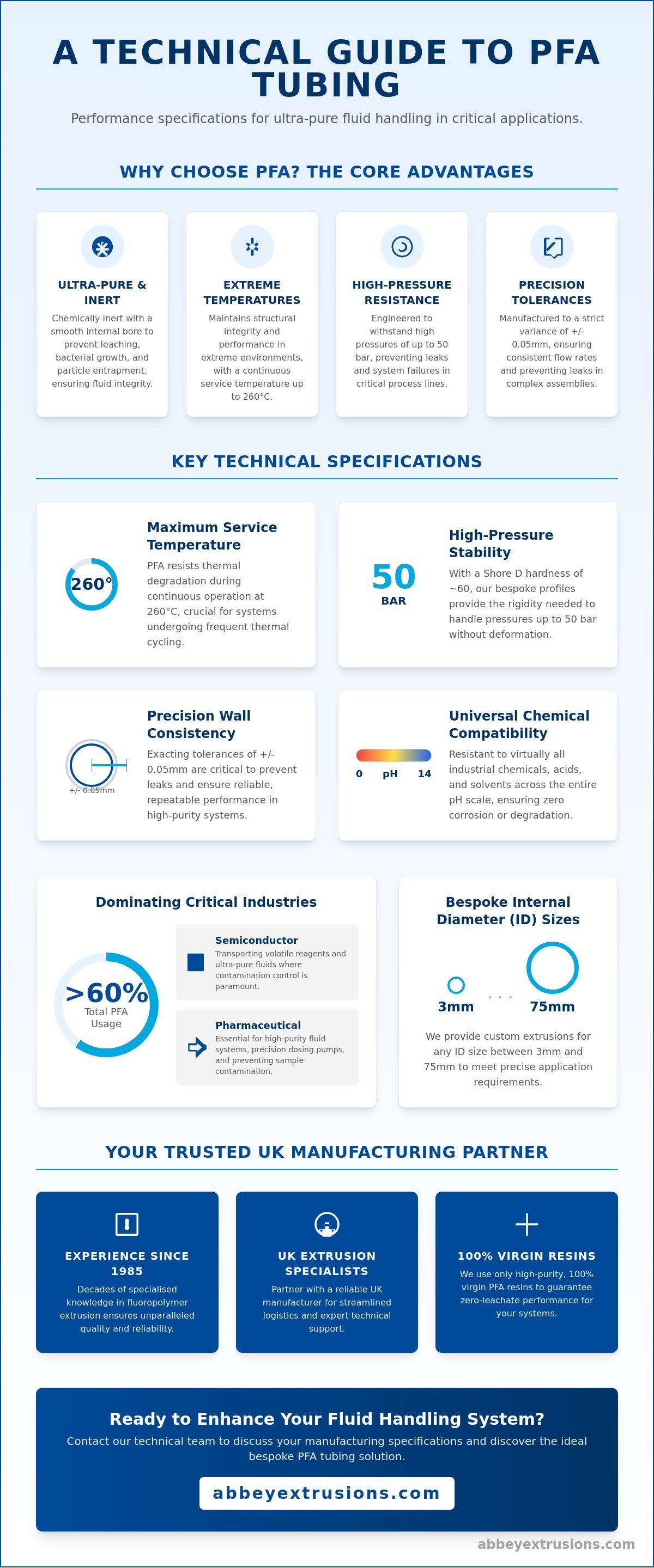
The semiconductor and pharmaceutical sectors now account for over 60% of total PFA tubing usage globally, driving the demand for PFA tubing for ultra-pure applications requiring 0.05mm tolerances.
Experience since 1985 shows that maintaining a smooth internal bore with a 0.05mm wall consistency is essential to prevent bacterial growth and particle entrapment.
This guide provides a technical analysis of PFA extrusion standards to help you specify components that withstand high pressures of 50 bar.
You'll gain insights into chemical compatibility across the pH scale and the importance of bespoke ID sizes ranging from 3mm to 75mm.
As UK extrusion specialists, we advocate for these fluoropolymers to maintain fluid integrity in extreme environments reaching 260°C.
Inconsistent tolerances exceeding 0.1mm from generic suppliers often lead to leaks in critical lines where a precise variance of +/- 0.05mm is the absolute requirement.
Precision-engineered PFA profiles offer the chemical inertness and thermal stability necessary to eliminate contamination in high-purity fluid systems.
Key Takeaways
- Identify how to prevent leaching in high-purity systems by utilising smooth internal surfaces with ID sizes from 3mm to 75mm.
- Discover why PFA tubing for ultra-pure applications is the preferred choice for fluid handling at extreme temperatures reaching 260°C.
- Review the technical criteria for selecting bespoke profiles that withstand high pressures of 50 bar whilst maintaining chemical inertness.
- Learn how precision tolerances of +/- 0.05mm ensure consistent flow rates in complex UK manufacturing assemblies.
- Evaluate the logistical benefits of partnering with a reliable UK manufacturer established in 1985 for your fluid handling requirements.
Contact the technical team at Abbey Extrusions to discuss your manufacturing specifications.
Ultra-Pure Fluid Handling Challenges in Modern Industry
UK manufacturing output in high-tech sectors requires rigorous fluid purity standards to maintain +/- 0.05mm tolerances. Contamination in fluid systems often stems from porous material surfaces or leaching where particles larger than 5 microns accumulate.
Experience since 1985 shows that standard polymers often fail in aggressive chemical environments. Standard Flexible PVC or Nylon 12 components may degrade when exposed to corrosive solvents at temperatures exceeding 60 °C.
As UK extrusion specialists, we advocate for Perfluoroalkoxy alkane (PFA) to ensure zero-leaching performance. PFA tubing for ultra-pure applications provides a non-stick surface that is essential for maintaining laminar flow.
In the context of pharmaceutical manufacturing, even a 0.01mm deviation in wall thickness can disrupt the precision of dosing pumps. We ensure that every bespoke extrusion meets the strict criteria required for high-purity fluid handling.
This material remains stable across a wide temperature range, preventing the structural deformation that leads to system failure. Its chemical inertness makes it the primary choice for transporting volatile reagents in semiconductor fabrication.
The Problem of Permeability in Fluid Systems
Gas and liquid permeability can compromise ultra-pure environments over time. Small molecules can migrate through the walls of standard LDPE tubing, leading to oxidation or contamination of the process fluid.
Whilst LDPE is suitable for standard water transport, its permeability to oxygen makes it unsuitable for anaerobic chemical processes. Our PFA extrusions provide a near-absolute barrier against gas migration, protecting the purity of the medium.
PFA offers superior resistance compared to standard thermoplastics. It maintains its structural integrity and chemical barrier properties even in temperatures reaching 260 °C.
In our view, this thermal stability is critical for systems undergoing frequent thermal cycling. It ensures that the ID sizes, ranging from 3mm to 75mm, remain consistent throughout the service life of the component.
Mechanical Stress and Material Fatigue
Tubing must withstand high pressures whilst maintaining its physical shape to prevent flow restriction. Fatigue often occurs in systems where vibration or pulsating flow is present.
Best practice involves using PFA because it resists stress cracking better than many other fluoropolymers. Our bespoke profiles are engineered to handle pressures up to 50 bar when correctly specified for the application.
The Shore D hardness of PFA, typically around 60, provides the necessary rigidity for high-pressure stability whilst allowing for required flexibility. This balance is vital for routing lines through the tight internal geometries of modern manufacturing equipment.
Contact the technical team at Abbey Extrusions to discuss your manufacturing specifications.
Technical Properties of PFA Tubing for High Performance
Melt-processable PFA resin combines the thermal resilience of PTFE with the processing flexibility of FEP. This molecular structure allows for the creation of PFA tubing for ultra-pure applications that remain stable under 50 bar pressure.
In our view, the thermal stability of PFA makes it the favourite for semiconductor fabrication where process consistency is paramount. We ensure that every bespoke profile maintains its physical properties at 260 °C, which is the maximum service temperature for high-purity fluid handling.
As UK extrusion specialists, we advocate for using 100% virgin resins to ensure zero-leachate performance. This high-purity resin is essential for fluid systems where even parts-per-billion contamination can disrupt sensitive chemical processes.
Thermal Resistance and Chemical Inertness
PFA remains durable at 260 °C, ensuring safety in high-temperature chemical dosing. This material resists thermal degradation during continuous operation at 260 °C, unlike standard Polyurethane Tube which suits different industrial needs up to 80 °C.
Compatibility with aggressive acids and solvents with a pH range of 0 to 14 is a standard feature of our fluoropolymer range. It manages universal chemical resistance whilst maintaining a Shore D hardness of 60 to prevent structural deformation.
Surface Smoothness and Porosity
Ultra-smooth ID surfaces prevent particle entrapment and bacterial growth in sensitive fluid lines. Experience since 1985 shows that smooth finishes with an Ra value of 0.1 microns reduce friction and energy loss in fluid systems.
Precise ID sizes from 3mm to 75mm ensure exact flow calculations for engineers. We maintain tight tolerances of +/- 0.05mm across every bespoke section in lengths up to 100 metres to guarantee system reliability.
Contact the technical team at Abbey Extrusions to discuss your manufacturing specifications.
Comparing PFA with FEP and PTFE for Pure Environments
Selecting the correct fluoropolymer requires an understanding of how melt-processable resins behave under extreme thermal loads. Whilst PTFE provides universal chemical resistance, its opaque nature preventing light transmission stops engineers from performing visual fluid inspections during active production.
Best practice involves selecting PFA when visual flow monitoring is required in the system. This translucent property, allowing 90% light transmission, is a primary reason why PFA tubing for ultra-pure applications is specified for high-value chemical dosing in semiconductor plants.
Whilst FEP is a cost-effective alternative for 200 °C environments, it cannot match the 260 °C thermal limit of PFA. PFA remains structurally stable at 260 °C, which is essential for systems undergoing high-temperature steam cleaning cycles.
Experience since 1985 shows that PFA provides a smoother internal surface with an Ra value of 0.1 microns. This reduces the risk of particle entrapment compared to the more porous 0.5 micron Ra surface found in standard PTFE components.
Transparency and Visual Inspection
PFA is translucent, allowing engineers to spot blockages or colour changes in fluid without breaking the system's sterile seal. This optical clarity is maintained even at wall thicknesses of 2mm or greater, ensuring the tube remains robust under 50 bar pressure.
Compare this to Nylon tube, which is often opaque or tinted for 10 bar pneumatic circuit identification. Our PFA resins are fully compliant with FDA regulations for PFA, ensuring safety in food-contact applications.
Flexibility and Bend Radius
PFA offers a better flex-life than PTFE, which can be prone to stress cracking after 500,000 cycles. This durable material survives 1,000,000 flex cycles, which is vital for moving parts within compact UK factory centres where space is at a premium.
As UK extrusion specialists, we advocate for PFA in dynamic applications because it maintains a Shore D hardness of 60. This rigidity prevents the tube from collapsing whilst allowing a tight bend radius of 30mm for a 10mm OD tube.
We maintain Abbey Extrusions tolerances of +/- 0.05mm to ensure consistent wall thickness throughout every bespoke profile. This precision ensures that the flow characteristics remain uniform, even when the tubing is routed through complex 90-degree bends.
Our manufacturing process accommodates ID sizes from 3mm to 75mm to suit varied industrial flow requirements. This versatility allows us to supply PFA tubing for ultra-pure applications that must operate at 50 bar.
Contact the technical team at Abbey Extrusions to discuss your manufacturing specifications.
Manufacturing Standards and Tolerances for PFA Extrusion
Achieving high purity requires a controlled extrusion environment to prevent airborne contamination. We maintain strict clean-room standards to ensure that PFA tubing for ultra-pure applications remains free from 5-micron particles that could compromise semiconductor yields.
Experience since 1985 shows that precision tooling is the key to maintaining +/- 0.05mm tolerances. This level of accuracy is essential for 3mm ID tubes where even a minor variance could disrupt the precision of 12-litre-per-minute flow systems.
In our view, bespoke profiles are often required to integrate PFA tubing for ultra-pure applications into existing fluid systems. We specialise in tailored requirements for ID sizes from 3mm to 75mm that match the specific 50 bar pressure ratings of your high-purity industrial assemblies.
As UK specialists, we ensure that every 100-metre coil meets the rigorous standards required by the 260 °C thermal environments found in chemical processing plants.
The Extrusion Process for Fluoropolymers
Melt-processing PFA requires specialised equipment to handle high temperatures of 350 °C. The corrosive nature of molten fluoropolymers at 350 °C demands nickel-alloy tooling to prevent metallic contamination in the 100% virgin resin.
You can review the detailed mechanics in our guide on The Engineering Principles of Plastic Extrusion. This technical background is essential for understanding how we maintain a consistent Shore D hardness of 60 across all profiles.
Consistent cooling in a 20 °C water bath ensures the tube remains durable for 50 bar applications. Without controlled thermal management, the polymer structure could develop internal stresses that lead to failure at 260 °C.
Quality Control and Testing Procedures
Each batch must be inspected for ID/OD accuracy and surface defects using high-resolution digital imaging. We verify the +/- 0.05mm tolerance across the entire manufacturing run to guarantee absolute system reliability.
The use of laser micrometres allows us to verify tolerances in real-time during manufacture. This continuous monitoring ensures that the wall thickness remains a constant 1.5mm for predictable burst pressure performance in 50 bar systems.
We also apply Tube Forming to PFA for custom shapes like 90-degree elbows or helical coils. These bespoke forms maintain the 0.1 micron Ra surface finish required for zero-contamination fluid handling in UK laboratories.
Contact the technical team at Abbey Extrusions to discuss your manufacturing specifications.
Sourcing Bespoke PFA Tubing Solutions in the UK
Sourcing from a UK manufacturer reduces lead times by 60% and ensures direct technical communication regarding +/- 0.05mm tolerances. We provide tailored requirements for ID sizes ranging from 3mm to 75mm to ensure a precise fit in 75mm connectors.
As UK extrusion specialists, we advocate for early involvement in the design phase to optimise costs by 15%. This collaborative approach allows us to refine PFA tubing for ultra-pure applications to meet specific 50 bar pressure requirements.
In our view, the proximity of our Leicestershire facility allows for rapid prototyping of 100mm samples. This speed is essential for UK manufacturers who must meet tight project deadlines of 14 days or less.
Best practice involves using stable extrusions that match the exact thermal limits of 260 °C. We ensure every profile maintains a consistent Shore D hardness of 60 for long-term reliability.
Benefits of UK Based Manufacturing
Direct engineering access ensures that specifications are met with a +/- 0.05mm tolerance. Abbey Extrusions was established in 1985 and remains a specialist in Leicestershire, providing technical support for projects requiring 260 °C resistance.
Contrast this bespoke service with generic Low-Density Polythene Tube suppliers. Whilst LDPE suits 10 bar water lines, PFA is required for aggressive chemical handling at 50 bar.
Technical Support and Bespoke Profiles
We can organise custom packaging to suit cleanroom protocols, including double-bagging to prevent 5-micron particle contamination. This service ensures that components arrive ready for immediate installation in Grade A environments.
We manufacture non-standard wall thicknesses for unique pressure needs up to 50 bar. Our custom wall profiles provide a 30mm bend radius for compact 10mm OD assemblies.
Our tooling allows for custom profiles that fit 75mm connectors perfectly with a zero-gap seal. This precision ensures PFA tubing for ultra-pure applications maintains laminar flow at 12 litres per minute.
Contact the technical team at Abbey Extrusions to discuss your manufacturing specifications.
Optimising Fluid Integrity with Precision PFA Extrusions
Precision-engineered PFA profiles ensure that high-purity fluid lines remain free from contamination whilst operating at temperatures of 260 °C. Maintaining a tolerance of +/- 0.05mm is essential for the 50 bar pressure systems used in modern semiconductor manufacturing.
As UK extrusion specialists, we advocate for the use of 100% virgin resins to guarantee 90% light transmission for visual flow monitoring. Experience since 1985 shows that bespoke ID sizes from 3mm to 75mm provide the most reliable fit for complex industrial connectors.
Specifying PFA tubing for ultra-pure applications allows your facility to achieve the zero-leachate performance required for 0-14 pH chemical handling. This material provides the necessary Shore D hardness of 60 to prevent tube collapse in high-vacuum environments where standard polymers rated for 80 °C fail.
You can contact the technical team at Abbey Extrusions to discuss your bespoke manufacturing requirements. Choosing a UK specialist established in 1985 guarantees a level of quality and service that standard suppliers cannot match.
We look forward to helping you achieve the highest standards of fluid purity in your manufacturing operations.
Contact the technical team at Abbey Extrusions to discuss your manufacturing specifications.
Frequently Asked Questions
Temperature limits of PFA tubing
PFA tubing maintains its structural integrity at temperatures reaching 260 °C, ensuring that the material does not soften or lose its 50 bar pressure rating during high-temperature processing. Experience since 1985 shows that this 260 °C limit is significantly superior to standard thermoplastics like LDPE which soften at 80 °C.
This thermal ceiling allows for continuous operation in the most demanding UK industrial environments without compromising the +/- 0.05mm tolerance of the profile.
Chemical resistance of PFA
PFA offers universal chemical resistance across the entire 0 to 14 pH scale, making it the primary choice for handling concentrated 48% hydrofluoric acid or volatile solvents. This inertness prevents leaching in PFA tubing for ultra-pure applications where zero-contamination fluid handling is a non-negotiable requirement.
As UK extrusion specialists, we ensure that every 100-metre coil maintains this chemical barrier without any degradation of the 1.5mm wall thickness.
Standard tolerances for PFA extrusion
Best practice involves maintaining precision tolerances of +/- 0.05mm for all bespoke profiles to ensure that the 1.5mm wall thickness remains consistent throughout the production run. Laser micrometres verify these +/- 0.05mm limits in real-time, providing the accuracy needed for 50 bar pressure systems.
This level of precision prevents flow disruption and ensures the integrity of high-purity connectors in complex fluid handling assemblies.
Minimum ID sizes for ultra-pure tubing
We specialise in manufacturing ID sizes starting from 3mm up to 75mm to suit varied industrial flow requirements in semiconductor and pharmaceutical plants. These 3mm ID tubes are specifically engineered to maintain laminar flow at 12 litres per minute whilst keeping the internal surface Ra value below 0.1 microns.
Our tooling allows for these small dimensions with a +/- 0.05mm tolerance to guarantee exact dosing in high-purity environments.
PFA tubing vs PTFE tubing
PFA is a melt-processable fluoropolymer that offers 90% light transmission, providing a significant advantage over opaque PTFE when visual flow monitoring is required. In our view, PFA is the superior choice for dynamic systems because it survives 1,000,000 flex cycles without developing stress cracks.
This durability at 260 °C makes it more versatile for complex UK manufacturing assemblies than standard Nylon 12 or Polyurethane components.
Cleaning and sterilisation of PFA
PFA tubing for ultra-pure applications is fully compatible with repeated steam sterilisation at 121 °C and aggressive CIP chemicals without losing its Shore D hardness of 60. The ultra-smooth internal surface with an Ra value of 0.1 microns prevents bacterial growth and particle entrapment during these rigorous cycles.
Experience shows that the 260 °C thermal limit allows for frequent sterilisation without degrading the polymer structure or affecting the 50 bar pressure capacity.

Article by
Bryan Cowan
Bryan Cowan is the Founder and Managing Director of Abbey Extrusions Ltd, a leading UK manufacturer of high-quality plastic tubes and hoses. With over 40 years of industry experience, Bryan established the company in 1985, growing it from a startup into a BS ISO9001-registered supplier for global sectors including aerospace, automotive, and pharmaceuticals.
Disclaimer
This article is intended for informational purposes only. Please ensure you seek expert advice or carry out your own research to confirm the information is suitable for your specific needs.