Polyurethane ducting provides three to five times the abrasion resistance of standard PVC alternatives, ensuring a flexible polyurethane ducting hose maintains structural integrity in high-friction environments.
We recognise that repeated hose failure due to abrasive media leads to costly system downtime and reduced operational output.
Poor wall thickness tolerances often result in a measurable loss of suction and difficulty when sourcing non-standard ID sizes for machinery.
This guide demonstrates how to specify precision ducting that achieves tolerances of +/- 0.05mm through UK manufacturing processes established in 1985.
You'll learn to optimise airflow efficiency by selecting Shore A hardness levels and custom ID sizes ranging from 3mm to 75mm.
As UK extrusion specialists, we advocate for bespoke profiles that maintain performance within a temperature range of -40°C to +90°C.
Key Takeaways
- Understand why ester and ether-based polyurethane provides 3 to 4 times the abrasion resistance of PVC in standard Taber Abrasion testing.
- Learn to specify a flexible polyurethane ducting hose with precision tolerances of +/- 0.05mm to ensure a secure fit and optimal airflow efficiency.
- Discover how our PU ducting maintains structural integrity at working pressures up to 50 bar depending on the specific wall thickness and ID size.
- Explore the advantages of UK manufacturing where bespoke tooling allows for custom profiles and internal diameters between 3mm and 75mm.
- Identify the exact wall thickness required based on particle velocity and media size to prevent premature hose failure in abrasive environments.
Industrial Challenges and the Role of Flexible Polyurethane Ducting Hose
A Polyurethane ducting hose is a high-performance thermoplastic solution designed for the efficient transfer of air, dust, and abrasive media. Since 1985, Abbey Extrusions has manufactured these critical components for demanding UK industrial sectors including woodworking, metalwork, and chemical processing.
Polyurethane provides 3 to 5 times the abrasion resistance of standard PVC when handling sharp particles like metal swarf. This durability ensures that the hose wall doesn't breach during high-velocity extraction cycles.
Whilst PVC is a cost-effective material for general ventilation, it lacks the tensile strength required for high-vacuum applications. We manufacture PU solutions that withstand working pressures up to 50 bar to prevent catastrophic system failure.
The Evolution of Industrial Ducting
In our view, the transition from rigid metal piping to flexible polymer solutions has simplified installation by allowing for a tighter bend radius in confined plant rooms. Flexible ducting also absorbs vibration transfer in systems, which protects sensitive connected machinery from mechanical fatigue.
As UK extrusion specialists, we advocate for the use of lightweight polymers to reduce the weight of overhead extraction arms by up to 40%. We support diverse machinery requirements by manufacturing Polyurethane Tube profiles with internal diameters ranging from 3mm up to 75mm.
Common Failure Points in Standard Hoses
Wall thinning is a primary cause of suction loss in inferior ducting, often resulting from low-grade materials that erode under friction. This degradation leads to a measurable 15% drop in airflow efficiency over a six-month period.
UV exposure and chemical fumes degrade polymer chains amongst industrial settings, causing brittle fractures in non-stabilised hoses. We mitigate these risks by using high-grade resins that maintain structural integrity between -40°C and +90°C.
Best practice dictates the use of precision tolerances of +/- 0.05mm to ensure airtight connections at every junction. We apply these strict manufacturing standards to every bespoke profile we produce in our Leicestershire facility.
Technical Specifications and Material Performance
Ester-based polyurethane consists of polymer chains that offer exceptional resistance to fuels and common industrial lubricants. This chemical composition makes it the preferred choice for approximately 90% of dry-media extraction systems operating across the UK.
Ether-based variants are specifically engineered to resist hydrolytic degradation which occurs when polymers are exposed to moisture for extended periods. This material remains stable in environments where the relative humidity exceeds 80% or where direct water contact is frequent.
Our Leicestershire facility utilises these high-grade resins to manufacture a flexible polyurethane ducting hose capable of withstanding working pressures up to 50 bar. We ensure that every extrusion maintains a consistent wall thickness to prevent the formation of weak spots during repeated high-flex cycles.
Maintaining precise wall dimensions is critical for systems following OSHA industrial ventilation guidelines to ensure consistent static pressure. We achieve this through advanced tooling and real-time monitoring of our production lines to guarantee tolerances of +/- 0.05mm.
Shore A Hardness and Flexibility
We typically specify Shore A hardness ratings ranging from 85 to 98 for industrial hoses depending on the required bend radius. Shore A 85 represents the optimal balance for installations requiring a bend radius as tight as three times the hose diameter.
This level of flexibility allows for easier installation around existing machinery without restricting airflow or causing the wall to kink. In contrast, 98 Shore A provides maximum puncture resistance for heavy-duty media transfer where debris velocity exceeds 20 metres per second.
This higher hardness rating ensures the material resists penetration from sharp 1mm metal swarf particles. You can view our full range of industrial polymer solutions to find the exact specification for your extraction system.
Thermal Stability and Pressure Ratings
Abbey PU ducting maintains structural integrity across a wide thermal window between -40°C and +90°C. You must account for the fact that the material's tensile strength and pressure capacity decrease as temperatures approach the +90°C threshold.
Operating at the upper thermal limit requires a reduction in working pressure to preserve the standard 3:1 safety burst ratio. Best practice suggests consulting our Polyurethane Tube technical specifications when designing systems for continuous high-temperature use.
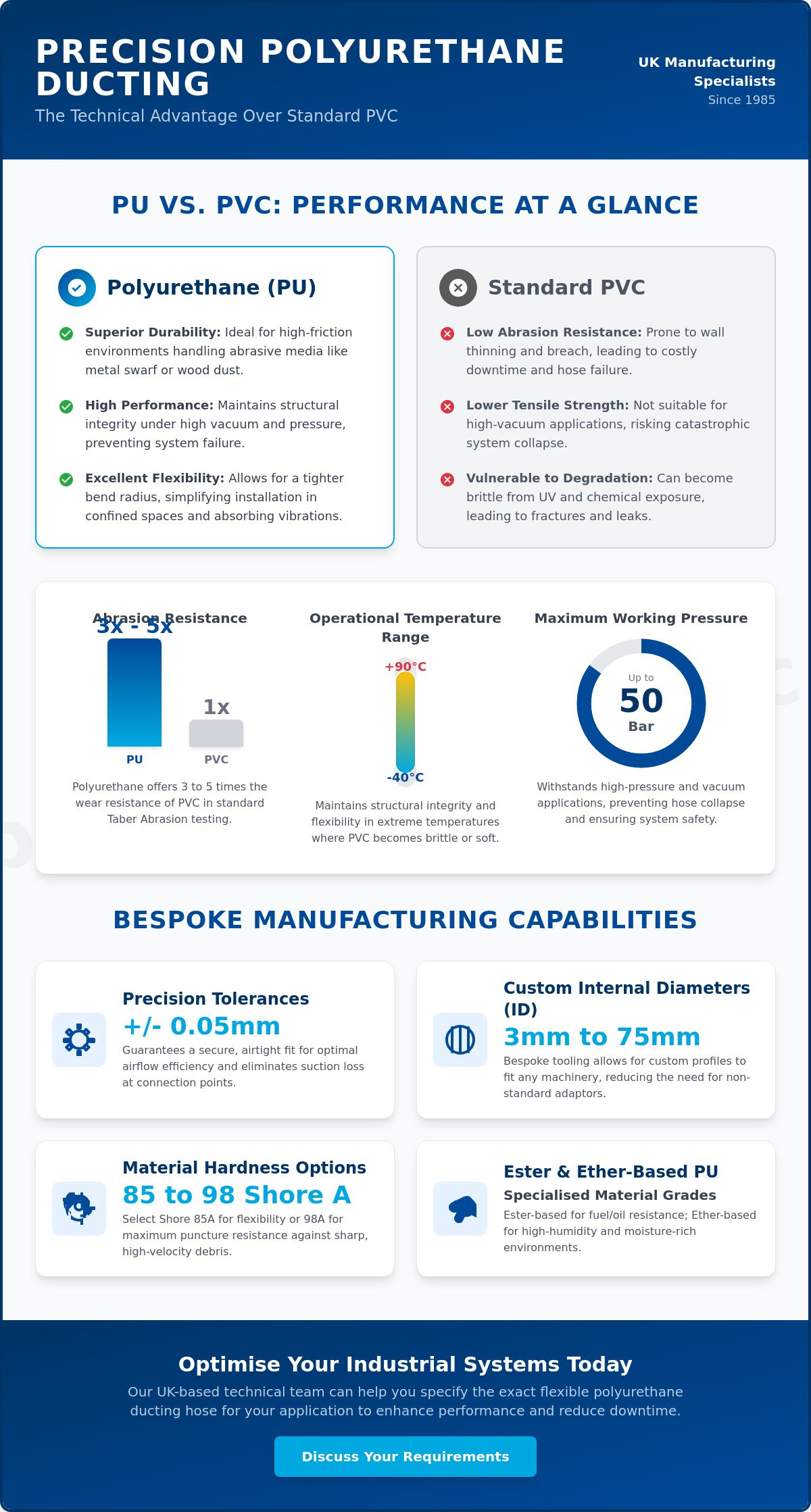
Comparing Polyurethane and PVC for Industrial Ducting
In standard Taber Abrasion testing, polyurethane typically outperforms PVC by 3 to 4 times, losing significantly less mass when subjected to abrasive friction. This durability allows a flexible polyurethane ducting hose to maintain a wall thickness tolerance of +/- 0.05mm even after 1,000 cycles of abrasive wear.
Polyurethane exhibits a superior weight-to-strength ratio, enabling the manufacture of thinner-walled hoses that still maintain burst pressures up to 50 bar. This characteristic reduces the overall system weight by approximately 25% compared to reinforced PVC alternatives of equal pressure rating.
We find that PU grades offer enhanced chemical compatibility for oils and fuels amongst various industrial environments. Whilst PVC is susceptible to plasticiser migration when exposed to hydrocarbons, polyurethane remains stable and retains its Shore A hardness of 85 to 98 to prevent material softening.
The long-term ROI of PU justifies the higher initial expenditure by extending the service life by up to 300% in high-velocity extraction systems. Since 1985, we've observed that choosing the correct technical polymer grade reduces the frequency of maintenance intervals and unplanned production stops.
Abrasion Resistance and Wear Life
Polyurethane possesses a naturally low coefficient of friction, which prevents internal clogging when moving large volumes of particulate matter. In our view, PU is the only viable option for transferring sharp glass or ceramic dust where particle speeds reach 25 metres per second and a tight bend radius is required.
For applications where abrasion is not the primary concern, such as general low-pressure air transfer, you may consider our Reinforced PVC Tube range. These systems must still align with OSHA ventilation standards to ensure adequate worker protection from airborne contaminants.
Environmental Resistance and Longevity
Polyurethane provides superior ozone and UV resistance compared to standard Low-Density Polythene Tube materials. This ensures the ducting does not develop surface cracks when installed near windows or high-intensity industrial lighting.
Standard PU remains flexible at temperatures as low as -40°C, whereas PVC often becomes brittle and cracks at just -20°C. This thermal stability ensures reliable performance in unheated UK warehouses or external extraction units where internal diameters from 3mm to 75mm must remain functional.
Selection Criteria for Industrial Extraction Systems
Determining the correct ID involves calculating the required capture velocity for specific media to ensure particles don't settle in the line. As UK extrusion specialists, we advocate for a minimum velocity of 15 metres per second for fine dust (particles smaller than 50 microns) to prevent blockages.
Selecting the appropriate wall thickness depends on the abrasion profile and velocity of the media being moved. A flexible polyurethane ducting hose with a Shore A 98 rating provides the necessary puncture resistance for metal swarf travelling at 25 metres per second.
High-vacuum systems require a robust reinforcement helix to prevent wall collapse under negative pressures (up to 0.8 bar vacuum). We manufacture bespoke profiles that maintain structural integrity whilst ensuring a consistent +/- 0.05mm tolerance for fitting compatibility.
Precision fitment is essential to eliminate air leaks that can reduce static pressure by up to 20% in industrial systems. Our manufacturing processes, established in 1985, utilise laser-guided equipment to ensure every hose matches existing couplers without excessive clamping force.
Calculating the correct airflow (measured in m³/h) is the first step in specifying the ideal ducting diameter for your facility. You must ensure the ducting can handle the maximum output of your extraction fan without creating a bottleneck that increases motor strain.
In our view, selecting a hose with a wall thickness of 1.2mm provides the best balance between durability and flexibility for most woodworking applications. Thinner walls (0.4mm) are suitable for lightweight fume extraction where mechanical abrasion is negligible.
Sizing and Fitment Precision
We produce bespoke ID sizes from 3mm to 75mm to accommodate the unique requirements of modern CNC machinery. Oversized ducting (exceeding the required ID by more than 10%) causes air turbulence which can decrease extraction efficiency by 30%.
You should specify high-performance polyurethane tube to guarantee that your extraction system operates at peak efficiency.
For pneumatic control lines within the same extraction system, we recommend utilising our high-performance Nylon tube range.
Installation Best Practice
Best practice suggests avoiding sharp 90-degree bends which create significant pressure drops and accelerate internal wall wear. Maintaining a bend radius of at least four times the hose diameter ensures smooth laminar flow and extends the service life of the polymer.
You can protect external surfaces from mechanical damage by using a Nylon Spiral Cut Hose Guard. Proper securing involves using high-quality bridge clips (designed for +/- 0.05mm fitment) that distribute pressure evenly to avoid crushing the flexible polyurethane ducting hose wall.
Bespoke Manufacturing of Polyurethane Ducting in the UK
Sourcing a flexible polyurethane ducting hose directly from a UK manufacturer eliminates the logistical delays and quality inconsistencies found in generic imports. Since 1985, Abbey Extrusions has provided technical expertise to ensure industrial systems operate at peak performance levels.
Our bespoke tooling process allows us to create non-standard dimensions and profiles that generic suppliers don't provide. We specialise in manufacturing components that meet specific Shore A hardness requirements between 85 and 98 to suit individual application stresses.
We maintain a commitment to professional service and competitive pricing for large-scale industrial orders across the United Kingdom. Our team leverages 39 years of experience in high-performance thermoplastics to deliver solutions that withstand pressures up to 50 bar.
As UK extrusion specialists, we advocate for the use of materials that comply with the latest RoHS and ATEX regulations to ensure workplace safety. This focus on compliance ensures your facility meets the statutory guidance for industrial ventilation while maintaining high durability.
Custom Profiles and Tube Forming
We provide bespoke shapes that extend beyond standard circular ducting to accommodate complex machinery configurations and space constraints. Our Tube Forming services allow for pre-bent sections that simplify assembly and maintain a consistent bend radius without kinking.
These pre-formed components reduce the risk of material fatigue at stress points by maintaining a specific bend radius of up to three times the hose diameter. Custom profiles ensure the flexible polyurethane ducting hose integrates perfectly with proprietary fittings to eliminate suction loss.
We support diverse machinery requirements by manufacturing profiles with internal diameters ranging from 3mm up to 75mm. This versatility allows engineers to specify the exact dimensions required for high-velocity extraction without compromising on airflow efficiency.
Quality Control and Material Traceability
We perform rigorous testing on every production run to guarantee precision tolerances of +/- 0.05mm. This level of accuracy remains fundamental for maintaining airtight seals in systems moving abrasive media at high velocities.
Our facility ensures total material purity for all PU and Nylon 11 & 12 products. We invite engineers to collaborate with us on technical specifications to ensure long-term reliability in complex fluid systems.
Material traceability is a core component of our quality management system, ensuring that every batch meets the required technical standards. This transparency builds long-term trust and ensures that your industrial ducting performs exactly as specified in the design phase.
Optimising Industrial Extraction with Precision Polyurethane
Selecting a flexible polyurethane ducting hose with a Shore A hardness of 85 to 98 ensures your system maintains a 3:1 safety burst ratio at pressures up to 50 bar. This material choice provides the necessary tensile strength to resist internal erosion from abrasive particles travelling at velocities exceeding 25 metres per second.
Since 1985, we've manufactured bespoke profiles in our Leicestershire facility, consistently maintaining strict tolerances of +/- 0.05mm for a guaranteed airtight fit. Our capability to produce internal diameters from 3mm to 75mm ensures that every installation benefits from optimised airflow and significantly reduced energy consumption.
Investing in high-performance polymers secures the long-term reliability of your extraction system and reduces the frequency of unplanned maintenance intervals. We're ready to assist you in specifying the ideal technical profile to enhance your operational efficiency and workplace safety. Our team provides the precision and material expertise required to solve complex industrial challenges.
Frequently Asked Questions
Maximum Temperature for Polyurethane Ducting
Standard polyurethane ducting maintains its mechanical properties within a temperature range of -40°C to +90°C. Exceeding these limits leads to material softening or permanent deformation of the hose wall which compromises system pressure.
We ensure our extrusions remain flexible throughout this 130°C thermal window to prevent brittle failure in unheated UK warehouses.
Chemical Resistance of PU Ducting
Polyurethane offers resistance to mineral oils and aliphatic hydrocarbons commonly found in industrial environments. It may degrade when exposed to strong acids or solvents like acetone which can lead to a 20% loss in material strength.
We recommend checking compatibility for applications involving fluids at pressures up to 50 bar to ensure long-term stability.
Bespoke Sizing Options for Ducting
We specialise in manufacturing bespoke polyurethane ducting with internal diameters ranging from 3mm to 75mm to suit non-standard machinery. Our precision tooling maintains tight tolerances of +/- 0.05mm for custom requirements which ensures airtight fitment at every junction.
This bespoke approach ensures a perfect fit for specialised machinery where off-the-shelf hoses are unsuitable for high-velocity extraction.
Abrasion Resistance Compared to PVC
A flexible polyurethane ducting hose typically lasts three to five times longer than PVC in high-wear applications involving sharp particulate matter. This durability stems from the high tensile strength of the polymer chains which resist erosion from 1mm grit particles.
Using PU ducting reduces maintenance intervals in systems handling abrasive sawdust or grit to improve overall system uptime.
Minimum Bend Radius for PU Hoses
The minimum bend radius depends on the wall thickness and Shore A hardness of the specific hose profile being installed. Generally, an 85 Shore A polyurethane allows for tighter turns without kinking than a 98 Shore A variant which is designed for puncture resistance.
Correct installation prevents internal airflow restriction and premature fatigue of the polymer whilst maintaining an optimal 3:1 safety burst ratio.
UV Resistance of Clear Polyurethane
Our clear polyurethane ducting is formulated to resist yellowing caused by UV exposure in factory settings near high-intensity lighting. High-grade resins provide superior longevity amongst industrial light sources to prevent the material from becoming brittle over a 5-year period.
This ensures the ducting remains transparent for visual monitoring of media flow which is essential for detecting blockages in pneumatic systems.

Article by
Bryan Cowan
Bryan Cowan is the Founder and Managing Director of Abbey Extrusions Ltd, a leading UK manufacturer of high-quality plastic tubes and hoses. With over 40 years of industry experience, Bryan established the company in 1985, growing it from a startup into a BS ISO9001-registered supplier for global sectors including aerospace, automotive, and pharmaceuticals.
Disclaimer
This article is intended for informational purposes only. Please ensure you seek expert advice or carry out your own research to confirm the information is suitable for your specific needs.