Why does a standard industrial fluid system often fail at the precise moment of peak operational demand? The answer usually lies not in the machinery itself, but in the selection of an inadequate conduit that cannot withstand the rigours of high-pressure environments. For many plant managers and engineers, a hose failure due to kinking or material degradation isn't just a technical setback; it's a costly disruption to the entire production line.
We understand that reliability in fluid transfer is non-negotiable. This professional guide offers a comprehensive technical analysis of reinforced pvc hose, detailing how the integration of high-tensile polyester braiding transforms a standard polymer into a high-performance engineering component. By reading this article, you'll gain the expertise needed to identify the correct reinforcement types for your specific pressure requirements whilst ensuring full compliance with UK safety and material standards. We'll explore the critical engineering properties, diverse industrial applications, and the essential selection criteria for bespoke hosing solutions manufactured to the highest specifications.
Key Takeaways
- Understand how the multi-layered construction of reinforced pvc hose provides superior pressure resistance and durability for demanding industrial environments.
- Identify the critical selection criteria for your engineering projects, including precise internal diameter measurements and specific wall thickness requirements.
- Discover the technical advantages of high-tensile polyester braiding for pneumatic air lines and water supply systems in manufacturing plants.
- Learn how bespoke extrusion profiles and specialist tube forming can be tailored to meet unique industrial configurations and performance needs.
- Recognise the importance of sourcing directly from an established UK manufacturer to ensure material compliance and long-term reliability for large-volume orders.
If you require technical advice regarding hosing specifications for a specific industrial project, please contact the Abbey Extrusions team for professional assistance.
The Fundamentals of Reinforced PVC Hose Construction
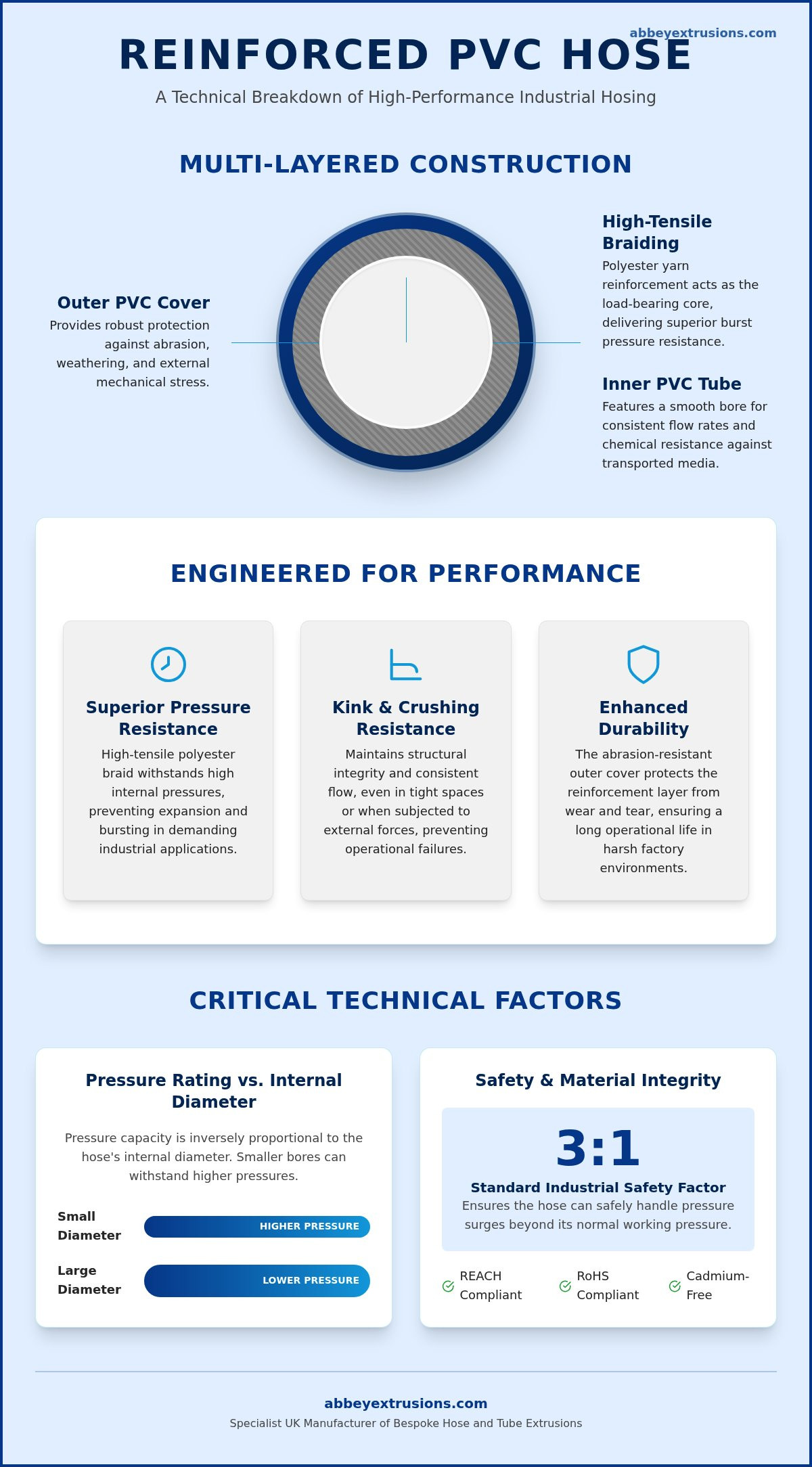
A reinforced pvc hose is far more than a simple plastic conduit; it's a precisely engineered multi-layered component designed for rigorous industrial duty. Unlike standard PVC tube, which relies solely on the wall thickness of the polymer for its strength, a reinforced variant integrates a structural core to handle elevated pressures. The construction typically begins with a high-quality inner PVC tube. This layer is critical as it must maintain consistent flow rates whilst providing the necessary chemical resistance against the specific media being transported.
During the manufacturing process, this inner core is wrapped in a high-tensile polyester yarn reinforcement. This braiding acts as the primary load-bearing element, preventing the hose from expanding or bursting under internal pressure. This design principle is similar to that of a Reinforced Thermoplastic Pipe (RTP), where the synergy between flexible polymers and rigid reinforcements creates a superior product. Finally, an outer PVC cover is extruded over the braiding. Through a controlled thermal process, these three layers are permanently bonded into a single, cohesive unit that resists delamination even under heavy mechanical stress.
Material Composition and Safety Standards
At Abbey Extrusions, we prioritise material integrity by utilising cadmium-free and low-toxicity PVC formulations. Using high-quality polyester fibres is essential for ensuring consistent tensile strength across the entire length of the hose. This attention to detail ensures that our reinforced PVC tube products meet stringent UK and international regulations. We ensure full compliance with REACH and RoHS standards, which is a vital requirement for partners in the food processing and pharmaceutical sectors who demand high-purity materials.
Understanding Braiding Density and Patterns
The operational life of a reinforced pvc hose depends heavily on the specific braiding pattern and the angle at which the yarn is applied. A tighter braiding density generally increases the burst pressure but can reduce the overall flexibility of the conduit. For standard industrial hosing, a safety factor of 3 to 1 is typically maintained to ensure the product can handle pressure surges without failure. Heavy-duty reinforcement options are available for configurations where the hose must resist collapsing in vacuum applications or kinking in tight industrial spaces.
To discuss bulk orders or specific performance requirements for your facility, you can get in touch with our specialists today.
Key Performance Advantages of Braided PVC Tubing
The primary reason engineers specify a reinforced pvc hose over unreinforced alternatives is the significant increase in operational safety. Whilst a standard PVC tube is excellent for low-pressure fluid transfer, the addition of a polyester braid provides the structural integrity needed for demanding industrial environments. This reinforcement allows the hose to maintain its shape even when subjected to high internal pressures or external mechanical stress. It prevents the tube from bulging, ensuring that flow rates remain consistent throughout the production cycle.
In dynamic configurations, where equipment moves or vibrates, braided tubing exhibits superior structural memory. It's designed to resist kinking, which is a common cause of flow restriction and potential pump failure in industrial systems. The smooth outer cover is also engineered for abrasion resistance. It protects the structural braid from surface wear when the hose is dragged across factory floors or mounted in high-friction areas. For applications requiring visual verification, transparent variants enable operators to monitor fluid flow and identify contaminants or air pockets instantly.
Pressure Ratings and Burst Strength
The integration of high-tensile yarn significantly elevates the burst strength of the assembly. As a general rule in fluid dynamics, the maximum pressure capacity of a hose is inversely proportional to its internal diameter. Smaller hoses can typically withstand higher pressures than larger ones with the same reinforcement density. For precise technical data on working and burst pressures, you should consult the specifications on our Abbey Extrusions reinforced PVC tube product page. This ensures that the selected component operates within a safe margin, typically maintaining a 3 to 1 safety factor for industrial use.
Environmental and Chemical Resistance
The performance of industrial hosing isn't solely dependent on pressure. Environmental factors like UV radiation and chemical exposure can degrade poor-quality polymers over time. High-grade PVC compounds are inherently resistant to many common industrial chemicals, including diluted acids and alkalis. The safety and stability of these materials are well-documented, as seen in the EPA Risk Evaluation for Vinyl Chloride, which assesses the primary building blocks of PVC. This chemical resilience ensures that the hose doesn't become brittle or lose its structural integrity whilst conveying aggressive fluids or being used in outdoor settings. If you need help discussing your bespoke technical requirements for a specific chemical application, our engineering team is available to assist.
For bespoke hosing solutions tailored to your specific industry application, please reach out to our technical department.
Critical Industrial Applications for Reinforced PVC
The versatility of a reinforced pvc hose makes it a fundamental component across the UK manufacturing landscape. Its primary strength lies in its ability to balance extreme flexibility with the structural integrity required for pressurised systems. In most factory environments, these hoses serve as the backbone for pneumatic air lines and general water supply systems. They are designed to withstand constant mechanical movement and the vibrations of heavy machinery without fatigue. This durability ensures that production lines remain operational with minimal downtime for maintenance or component replacement.
Beyond general manufacturing, the agricultural sector relies heavily on these conduits for irrigation and the delivery of fertilisers or pesticides. In these settings, the hose must resist outdoor degradation from UV exposure whilst remaining light enough for operators to handle across large areas. The clear variants are particularly valued in laboratory and chemical processing facilities where visual monitoring of the fluid flow is essential for safety and process control. By allowing operators to see the media moving through the system, air pockets or blockages can be identified and rectified before they cause equipment damage.
Food Grade and Brewery Solutions
The food and beverage sector requires hosing that is both non-toxic and odourless to prevent the contamination of consumable products. Our specialist brewery hose is engineered with a smooth internal bore to ensure that no residues or bacteria can settle in the line during transfer. This smooth surface is vital for maintaining hygiene standards during the cleaning-in-place (CIP) processes used in modern bottling and brewing plants. We utilise cadmium-free and low-toxicity PVC compounds to ensure that all materials meet the stringent safety requirements of the food industry.
Fuel and Specialist Fluid Transfer
For applications involving hydrocarbons, a standard PVC formulation is often insufficient. We produce a dedicated diesel fuel hose designed specifically for vehicle refuelling and generator supply lines. These hoses are formulated to resist the softening and degradation that typically occurs when PVC is exposed to oils and fuels over long periods. Whilst these products offer excellent resistance to many chemicals, it's important to note that PVC has limitations when dealing with certain aggressive solvents. In such cases, our technical team can advise on the most suitable material from our extensive range of extrusions to ensure your system remains safe and efficient.
If you are unsure which specification is right for your project, please contact Abbey Extrusions for expert guidance.
Essential Selection Criteria for Engineering Projects
Selecting a reinforced pvc hose for an industrial system requires a disciplined approach to technical data. Engineers must look beyond the surface and evaluate how the hose will perform under specific mechanical loads. The relationship between internal diameter (ID) and the fittings used is the first point of failure if tolerances aren't strictly managed. A mismatch of even a millimetre can lead to leaks or blow-offs at high pressures, which can compromise the safety of the entire facility.
Calculating the maximum working pressure is equally vital. Whilst the burst pressure indicates the point of catastrophic failure, the working pressure is what the hose can safely handle during daily operations. We always recommend a safety factor of at least 3 to 1 for industrial hosing. This ensures that sudden pressure spikes don't compromise the system. Additionally, the minimum bend radius must be considered. If a hose is forced into a tighter curve than it's designed for, the reinforcement can become stressed, leading to premature kinking or wall collapse.
Sizing and Dimensional Accuracy
Precise tolerances are non-negotiable in industrial fluid transfer. The wall thickness of a reinforced pvc hose directly correlates to its durability and pressure rating. Thicker walls provide better abrasion resistance but can make the hose less flexible. In the UK, we often see a mix of metric and imperial sizing conventions. Whilst metric is the modern standard, many legacy systems still require imperial dimensions. Our manufacturing process allows us to produce bespoke profiles that match these specific requirements exactly, ensuring a perfect seal with your existing hardware.
Temperature and Pressure Interdependence
Temperature is a silent factor that significantly alters the performance of PVC. As the temperature of the fluid or the surrounding environment rises, the PVC polymer softens. This softening reduces the effective working pressure the hose can sustain. PVC typically performs best between -20°C and +55°C. If your application involves temperatures at the higher end of this scale, selecting a higher reinforcement density is essential to compensate for the loss of material rigidity. High-temperature fluid transfer requires a careful balance between polymer grade and braiding tension.
If you have a complex installation that requires a specific pressure rating or custom dimensions, you can request a technical consultation with our engineering team to ensure your project meets all safety standards.
To discuss a custom extrusion profile or a specialist tube forming project, please contact our Leicestershire facility.
Specialist Manufacturing and Custom Extrusion by Abbey Extrusions
Abbey Extrusions has operated as a specialist manufacturer within the UK plastic extrusion sector since 1985, building a reputation for reliability and technical excellence. Whilst many competitors act solely as stockists of standard products, we maintain the manufacturing capacity to produce reinforced pvc hose tailored to specific industrial requirements. This capability is vital for B2B partners who require large volume orders or bespoke profiles that aren't available through traditional retail channels. Our facility in Leicestershire serves as a hub for innovation where material science and engineering precision converge to solve complex fluid transfer challenges.
Custom Profiles and Tube Forming
The journey from a technical drawing to a finished component is a collaborative process between our engineering team and our clients. This often involves our specialist tube forming services, which allow for the creation of intricate configurations that standard hoses cannot accommodate. For unique industrial machinery, we can develop bespoke reinforced hosing with specific wall thicknesses, internal diameters, and reinforcement densities. Every extrusion we produce is subject to rigorous quality control protocols. This ensures full material traceability and adherence to the high standards expected in technical manufacturing environments.
Why Sourcing from a UK Manufacturer Matters
Sourcing your hosing from a domestic manufacturer offers clear advantages in terms of supply chain stability. We provide reduced lead times and dependable national delivery across the UK, which is essential for maintaining production schedules in fast moving industrial sectors. Beyond logistics, our partners benefit from direct access to technical expertise; you can consult with our specialists to troubleshoot specific application issues or refine a product specification. By choosing a UK based manufacturer, you're supporting the national industrial base whilst ensuring that your components meet the strict safety and quality regulations required for high performance engineering projects.
If you require a custom extrusion quote or technical support for your industrial facility, please contact our engineering department for assistance.
Advancing Industrial Efficiency with Custom Extrusion Solutions
The successful implementation of a fluid transfer system relies on the precise alignment of material science and mechanical requirements. As we've explored, the structural integrity of a reinforced pvc hose is defined by the synergy between its high-tensile braiding and its polymer core. Selecting a component that meets specific pressure ratings and safety standards is essential for maintaining operational uptime and ensuring long term reliability in demanding factory environments.
At Abbey Extrusions, we've refined our manufacturing processes since 1985 to provide engineers with more than just a standard product. Our expertise in bespoke plastic extrusion and specialist tube forming allows us to develop custom solutions for unique industrial configurations. We offer comprehensive technical support to ensure every specification meets the highest quality standards and material traceability requirements.
View our full range of reinforced PVC hosing and technical specifications by contacting our team today. We look forward to partnering with you on your next engineering project and delivering the precision your facility requires.
Frequently Asked Questions
What is the difference between braided and reinforced PVC hose?
Braiding is a specific type of reinforcement. A reinforced pvc hose usually refers to a multi-layered structure containing high-tensile polyester braiding between two PVC layers. Whilst other reinforcement types exist, such as spiral wire, braiding is the industry standard for balancing flexibility with high-pressure resistance in pneumatic and hydraulic applications. This construction ensures the hose maintains its shape whilst under pressure.
Can reinforced PVC hose be used for drinking water?
Yes, provided the hose is manufactured using food-grade, low-toxicity materials that comply with relevant safety standards. Standard industrial hosing may contain additives not suitable for potable water. You should always verify that the specific product is certified as food-grade and phthalate-free before using it in any application involving drinking water or beverage transfer to avoid chemical leaching and ensure compliance with hygiene regulations.
How do I calculate the burst pressure for a reinforced hose?
Burst pressure is typically determined through controlled hydrostatic testing where the internal pressure is increased until the hose fails. For engineering calculations, the working pressure is generally set at one-third of the burst pressure to maintain a 3 to 1 safety factor. Factors such as braiding density, yarn tensile strength, and the operating temperature must be accounted for in these technical assessments.
Is reinforced PVC hose suitable for use with petrol or diesel?
Standard PVC is generally unsuitable for fuels, but specialist formulations like our diesel fuel hose are specifically engineered for this purpose. Normal PVC can become brittle and crack when exposed to hydrocarbons over time. If your application involves diesel or oil transfer, it's essential to use a hose with a nitrile-blended liner or a dedicated fuel-resistant PVC compound to ensure long term safety.
What is the standard temperature range for reinforced PVC tubing?
The standard operating range for reinforced PVC hosing typically falls between -20°C and +55°C. Performance outside these limits can vary significantly; cold environments may cause the polymer to become brittle, whilst excessive heat reduces the effective working pressure. For applications reaching the upper thermal limit, engineers must account for the reduction in material rigidity and pressure capacity to prevent premature component failure.
How does UV exposure affect the lifespan of a PVC hose?
Prolonged exposure to UV radiation can lead to the degradation of the PVC polymer, causing it to discolour or lose its flexibility. High-quality hoses often include UV stabilisers to mitigate these effects in outdoor settings. Regular inspections are recommended for hosing used in external environments to identify any surface cracking or hardening that could indicate the end of the component's service life or potential safety risks.
Can I get custom lengths and sizes for industrial projects?
Abbey Extrusions specialises in providing bespoke lengths and custom dimensions for reinforced pvc hose used in large-volume industrial orders. As a UK manufacturer, we can adjust the extrusion parameters to meet specific internal diameters or wall thicknesses required for unique machinery. This level of customisation ensures that the hosing integrates perfectly with your existing systems without the need for unnecessary adapters or modifications during the installation.
What fittings are best suited for braided PVC hosing?
Serrated hose tails combined with high-quality worm-drive clips or crimped ferrules are usually the most effective fittings for braided PVC. The reinforcement provides the structural strength needed for the fitting to grip the hose securely under pressure. It's vital to ensure that the fitting diameter matches the internal diameter of the hose exactly to prevent leaks or premature failure at the connection point.

Article by
Bryan Cowan
Bryan Cowan is the Founder and Managing Director of Abbey Extrusions Ltd, a leading UK manufacturer of high-quality plastic tubes and hoses. With over 40 years of industry experience, Bryan established the company in 1985, growing it from a startup into a BS ISO9001-registered supplier for global sectors including aerospace, automotive, and pharmaceuticals.
Disclaimer
This article is intended for informational purposes only. Please ensure you seek expert advice or carry out your own research to confirm the information is suitable for your specific needs.