Selecting the wrong thermoplastic grade for a fluid handling system often leads to premature fatigue or chemical degradation; however, many engineers still overlook the specific advantages of low density polyethylene tubing. You likely face the constant challenge of finding a material that balances high flexibility with robust chemical resistance whilst ensuring it meets strict regulatory standards like the UK Plastic Packaging Tax. It's a delicate trade-off that requires a deep understanding of polymer science and manufacturing precision.
This guide provides an expert technical overview of LDPE tubing properties, industrial applications, and manufacturing specifications tailored for the UK engineering sector. We'll help you identify if this material is the correct choice for your application by examining critical limits such as pressure ratings and temperature thresholds. You'll also learn how sourcing directly from a specialist UK manufacturer can streamline your supply chain and provide access to bespoke tube forming services for complex industrial layouts.
Key Takeaways
- Understand the fundamental mechanical properties of low density polyethylene tubing and why its molecular structure provides superior flexibility for industrial applications.
- Identify the diverse sectors, from laboratories to large scale factories, that utilise LDPE for reliable fluid handling and robust chemical resistance.
- Learn to distinguish between PE grades across the density spectrum to ensure your selected material meets specific pressure and temperature limits.
- Discover how bespoke tube forming and custom extrusion services can solve complex layout challenges within your existing industrial systems.
- Recognise the strategic benefits of sourcing high volume components from an established UK manufacturer to ensure consistent quality and shorter lead times.
To discuss your specific requirements for bespoke industrial components, please contact our technical team through our contact page.
Key Properties of Low Density Polyethylene Tubing
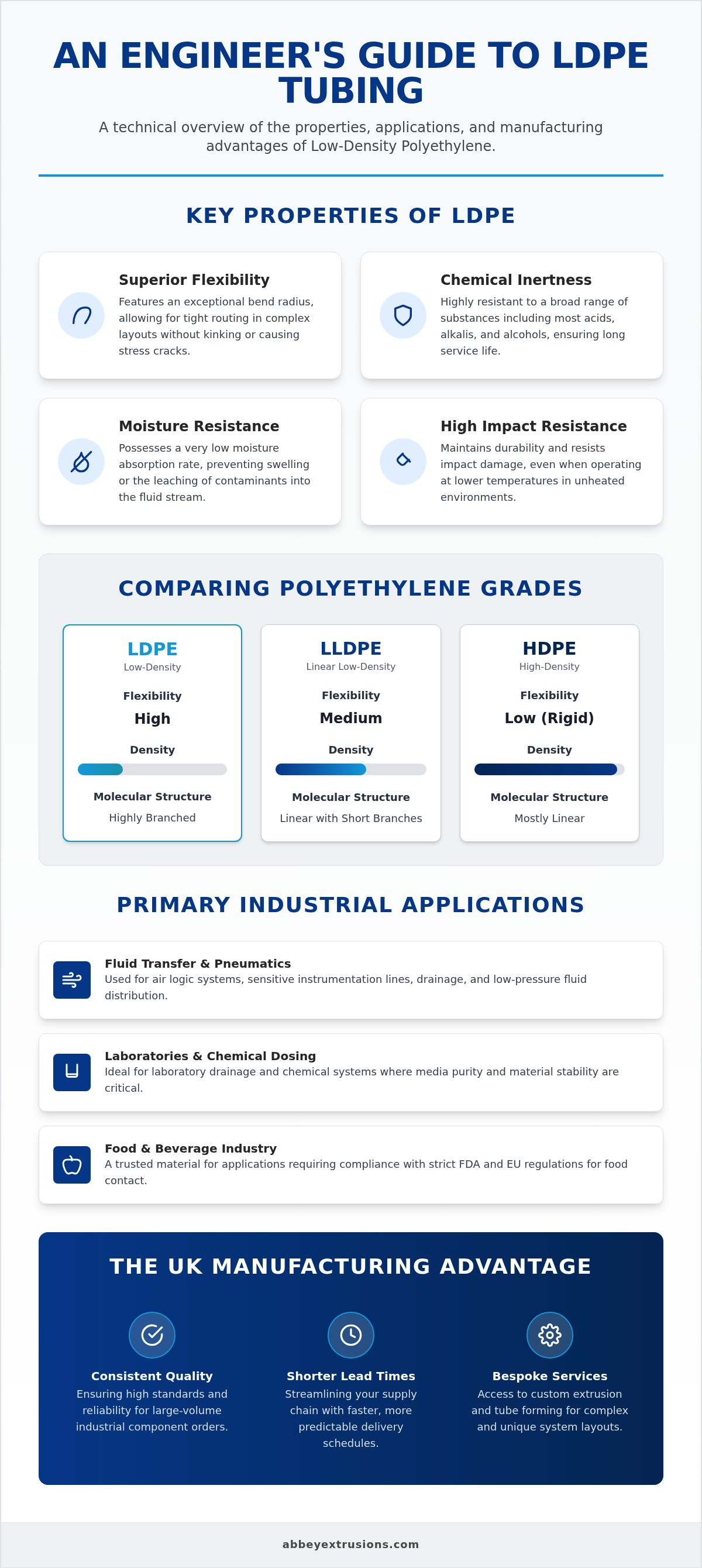
Low-density polyethylene (LDPE) is a versatile thermoplastic polymer that has remained a cornerstone of industrial fluid handling for decades. Unlike its higher density counterparts, its molecular structure is characterised by significant long and short-chain branching. This branching prevents the polymer chains from packing closely together in a crystalline structure, resulting in a material that's inherently more flexible and lower in density. For engineers, this translates to a tubing solution that's easy to manipulate during installation whilst maintaining reliable structural integrity under standard operating conditions.
We often recommend low density polyethylene tubing for non-pressurised fluid transfer applications because it strikes an excellent balance between cost-effectiveness and performance. Its natural moisture resistance and chemical inertness make it an ideal candidate for environments where contamination or material degradation could compromise a system's output. It's a favourite amongst engineers who require a dependable, lightweight solution that doesn't sacrifice chemical stability for ease of use.
Material Flexibility and Structural Integrity
The defining characteristic of LDPE is its exceptional bend radius. It allows for tight routing in cramped industrial enclosures without the risk of kinking or stress cracking. Whilst more rigid polymers like HDPE or Nylon offer higher pressure ratings, they often require additional mechanical fittings for directional changes. In contrast, LDPE can often be routed around obstacles manually, reducing the number of joints and potential leak points in a system. This flexibility doesn't come at the cost of durability; the material exhibits high impact resistance even when operating at lower temperatures, making it suitable for unheated factory environments or outdoor installations.
Chemical Inertness and Moisture Resistance
Chemical compatibility is a primary concern for any B2B procurement process involving fluid systems. This low density polyethylene tubing is resistant to a broad range of aggressive substances, including most acids, alkalis, and alcohols. Because it has a very low moisture absorption rate, the tubing won't swell or leach contaminants into the fluid stream over time. This makes it particularly effective for laboratory drainage, chemical dosing, and water purification systems where maintaining the purity of the media is critical. It's a stable, predictable material that provides a long service life in challenging chemical environments without the need for frequent replacement.
If you require technical assistance with material selection or wish to discuss a large volume order, please get in touch with our team.
Primary Industrial Applications for LDPE Tubing
Whilst many domestic applications for polyethylene are limited to simple irrigation or packaging, professional engineers recognise low density polyethylene tubing as a vital component in sophisticated industrial systems. Its versatility allows it to bridge the gap between sterile laboratory environments and heavy manufacturing plants. The material's inherent flexibility and resistance to environmental stress cracking make it a preferred choice for diverse sectors where reliability is paramount. We specialise in providing these components for high volume industrial needs, ensuring consistent quality across every metre produced.
Fluid Transfer and Pneumatic Systems
In the field of pneumatics, LDPE is frequently utilised for air logic systems and sensitive instrumentation lines. It's an ideal conduit for low pressure air because it doesn't suffer from the brittleness that can affect other polymers over time. Engineers often select this material for drainage and low pressure fluid distribution because it's cost effective whilst maintaining high performance. The installation process is notably efficient; the tubing integrates seamlessly with standard push fit or compression fittings. This compatibility ensures a secure, leak free connection without the need for complex tools or specialised training for your maintenance staff.
Food and Beverage Industry Requirements
Maintaining strict hygiene standards is essential within the beverage and hospitality industries. It's vital to use materials that are fully compliant with FDA and EU regulations for food contact to prevent contamination. Our low density polyethylene tubing is engineered to meet these rigorous demands, ensuring that no harmful chemicals leach into the product. These solutions are commonly found in drinks dispense systems and brewery hose applications where easy cleaning and chemical stability are required. The mechanical properties of Polyethylene (PE) Plastic ensure that the flavour and quality of the liquid remain unchanged during transfer. For complex factory layouts, our bespoke tube forming services allow for precise routing that minimises waste and optimises flow rates. If you're planning a new facility or upgrading an existing line, contacting a technical specialist early in the design phase can help prevent costly material mismatches.
To discuss technical specifications or request a quote for large volume orders, please visit our contact page.
Comparing LDPE with LLDPE and HDPE Grades
Selecting the appropriate polymer grade requires a precise understanding of the polyethylene density spectrum. This range extends from low density materials to high density variants, with each offering distinct mechanical advantages for specific industrial environments. Whilst some suppliers may push a single solution as a universal fix, we recognise that low density polyethylene tubing serves a unique purpose that more rigid or specialised grades cannot always replicate. It's a balance of performance versus cost that dictates the long term success of your fluid handling system. For a more comprehensive breakdown of these material choices, please refer to our Polyethylene Tubing technical guide.
Distinguishing Between Density Levels
The primary difference between these grades lies in their molecular branching. High Density Polyethylene (HDPE) consists of linear chains that pack closely together, creating a dense, opaque, and rigid structure with high tensile strength. In contrast, LDPE features significant branching that prevents this close packing. This results in a more translucent material with a lower surface hardness but significantly higher flexibility. This translucency is particularly beneficial in laboratory settings where visual confirmation of fluid flow or presence is required. Whilst HDPE is excellent for structural pipes, it lacks the tactile pliability needed for intricate machinery routing.
Performance Differences in Industrial Settings
Industrial environments demand specific tolerances for temperature and pressure. HDPE typically offers higher pressure ratings and better heat resistance, yet it's often prone to brittleness and environmental stress cracking in certain chemical conditions. Low density polyethylene tubing provides superior environmental stress crack resistance (ESCR) when compared to standard HDPE, making it more resilient for long term use in flexible applications. Whilst Linear Low Density Polyethylene (LLDPE) offers higher tensile strength and puncture resistance, it often lacks the ease of manipulation and lower cost profile found in traditional LDPE. Choosing the correct grade depends entirely on whether your system requires structural rigidity or the ability to navigate complex, tight bend radii without material failure. It's about matching the material's molecular strengths to the physical demands of the factory floor.
For technical advice regarding specific pressure ratings or bespoke dimensions, please reach out to our engineering team via our contact page.
Technical Specifications and Environmental Resistance
Industrial low density polyethylene tubing operates within a defined window of thermal and mechanical stability. It's typically rated for use between -40°C and +60°C, making it an exceptionally versatile choice for various factory environments. We manufacture these components in a comprehensive range of standard metric and imperial sizes, with outside diameters usually spanning from 4mm up to 25mm. Whilst standard sizes meet most needs, our facility specialise in high volume, bespoke extrusions for projects with unique dimensional requirements. Every batch undergoes rigorous quality checks to ensure wall thickness consistency, which is the primary factor in determining the tube's burst pressure and longevity.
Temperature Limits and Pressure Ratings
LDPE is best suited for ambient or low temperature applications because its mechanical strength is temperature dependent. It's vital to recognise that as the operating temperature rises toward the 60°C limit, the polymer chains become more mobile and the material softens. This transition causes a significant drop in the maximum allowable working pressure. We always advise engineers to incorporate a safety factor of at least 3 to 1 when designing pressurised systems to account for these thermal fluctuations. If your application involves higher temperatures or significant pressure surges, it's worth considering a more robust material like polyurethane tube, though LDPE remains the most cost effective solution for standard fluid transfer.
UV Stability and Outdoor Longevity
Standard natural grade LDPE is susceptible to photo-degradation if it's left in direct sunlight for extended periods. UV radiation triggers a chemical reaction that breaks the polymer bonds, eventually leading to surface crazing and material failure. To mitigate this risk, we utilise additives such as carbon black during the extrusion process. This additive acts as a highly effective UV stabiliser by absorbing the radiation before it can damage the polymer matrix. Whilst natural or translucent tubing is excellent for internal monitoring of fluid levels, we strongly recommend black or other opaque colour options for any outdoor or exposed installation. These stabilised variants ensure that your system remains operational for years without the risk of premature embrittlement.
Our manufacturing process ensures that every metre of low density polyethylene tubing meets strict industrial standards for performance and reliability. If your project involves complex environmental challenges, contact our technical specialists to ensure you select the correct material specification for your system.
To discuss a high volume project or request a sample of our bespoke industrial components, please contact our technical department via our contact page.
Bespoke Manufacturing of LDPE Tubing in the UK
Since 1985, Abbey Extrusions has operated as a leading UK manufacturer specialising in technical plastic components for B2B industrial partners. Sourcing low density polyethylene tubing directly from a domestic facility ensures a level of quality control and material traceability that is often absent in imported stock. Our Leicestershire based operation allows for direct communication between your engineering team and our production specialists, ensuring that every specification is met with precision. This collaborative approach helps to mitigate the risks associated with global supply chain delays whilst providing access to decades of manufacturing expertise.
Custom Extrusion and Tube Forming
We recognise that standard off the shelf dimensions don't always meet the requirements of complex machinery or specialised fluid systems. Our facility is equipped to produce non-standard outside diameters and wall thicknesses tailored to your specific application. Beyond simple extrusion, we offer specialised tube forming services which allow us to set permanent bends and shapes into the polymer. This process significantly reduces installation time and eliminates the need for extra mechanical fittings, which are often the primary points of failure in a system. Whether you require multi-bore configurations for complex routing or specific colour coding for line identification, our custom plastic extrusion processes are designed to solve unique engineering challenges.
Quality Standards for Industrial Supply
Reliability in industrial supply chains is built on the foundation of consistent manufacturing standards. At our Leicestershire facility, we implement rigorous quality control protocols that monitor every stage of the extrusion process. This focus on detail ensures that our low density polyethylene tubing maintains tight dimensional tolerances, which is critical for compatibility with push fit and compression fittings. We maintain full material traceability for all our technical polymers, providing our partners with the confidence that their components meet all relevant safety and performance criteria. Our collective expertise allows us to support large volume orders whilst maintaining the bespoke flexibility that modern industrial engineering demands.
We encourage engineers and procurement managers to discuss their specific project requirements with our technical team during the design phase. By understanding the unique stresses and environmental factors of your application, we can recommend the optimal material grade and extrusion profile to ensure long term system integrity. Our commitment to excellence is not merely a promise; it's a fundamental business norm that has defined our reputation for over four decades.
Optimising Industrial Systems with Bespoke Polyethylene Solutions
Selecting the correct material grade is a critical decision that directly impacts the long term efficiency and safety of your fluid handling infrastructure. We've explored how low density polyethylene tubing provides a unique combination of flexibility and chemical inertness that more rigid polymers simply cannot replicate. By understanding specific thermal limits and pressure ratings, you can ensure your system remains operational under demanding conditions whilst meeting all necessary food-grade and industrial standards.
Sourcing directly from an established UK manufacturer since 1985 provides the technical assurance of material traceability and consistent tolerances. Our specialised tube forming and bespoke extrusion services are designed to solve your most complex engineering challenges by reducing installation time and eliminating unnecessary fittings. We're ready to apply our decades of expertise to your next high volume project.
To discuss your specific material requirements or to request a bespoke quotation, please contact the Abbey Extrusions technical team. We look forward to partnering with you to deliver high quality, custom engineered solutions for your facility.
Frequently Asked Questions
Is low density polyethylene tubing suitable for high pressure applications?
Low density polyethylene tubing is primarily designed for low pressure fluid transfer and pneumatic logic systems rather than high pressure applications. Its mechanical strength is lower than that of Nylon or reinforced hoses. When designing a system, you must account for the burst pressure and include a safety factor of at least 3 to 1. If your application involves significant pressure surges, it's best to consult our technical team for a more robust material recommendation.
Can LDPE tubing be used for drinking water and food contact?
Yes, LDPE is an excellent choice for drinking water and food contact provided it's manufactured to meet FDA or EU regulatory standards. Its chemical inertness ensures that it won't leach contaminants or alter the flavour of the liquid being transported. We frequently supply food grade variants for brewery systems and drinks dispense applications where hygiene and material stability are paramount for maintaining product quality across the entire hospitality sector.
What is the main difference between LDPE and LLDPE tubing?
The primary distinction lies in the molecular branching of the polymer chains. LDPE features long chain branching that provides superior flexibility and a translucent appearance, making it easier to route through complex machinery. LLDPE has shorter branches which result in higher tensile strength and better puncture resistance. Whilst LLDPE is tougher, many engineers prefer traditional LDPE for its ease of manipulation and lower cost profile in standard industrial environments.
How does temperature affect the performance of LDPE tubing?
Temperature has a direct impact on the material's mechanical stability and its ability to hold pressure. LDPE typically operates between -40°C and +60°C; however, as you approach the upper thermal limit, the polymer softens significantly. This softening leads to a marked reduction in the maximum allowable working pressure. It's essential to evaluate the ambient and media temperatures of your environment to prevent premature fatigue or failure of the tubing.
Is LDPE tubing resistant to UV light and outdoor conditions?
Standard natural grade LDPE will degrade and become brittle if it is exposed to direct sunlight for extended periods. To ensure outdoor longevity, we manufacture UV-stabilised versions that incorporate carbon black or other protective additives. These opaque variants absorb ultraviolet radiation and protect the polymer matrix from photo-degradation. We strongly recommend using these stabilised colours for any installation located outside or in areas with high exposure to artificial UV light.
What sizes of LDPE tubing are standard in the UK?
We manufacture a wide range of standard sizes of low density polyethylene tubing in the UK, typically ranging from 4mm to 25mm outside diameter. Our production lines are set up to provide both metric and imperial dimensions to ensure seamless compatibility with existing pneumatic and fluid systems. For large volume industrial projects, we can also produce bespoke outside diameters and wall thicknesses that are tailored to meet your specific engineering requirements and pressure tolerances.
Can LDPE tubing be recycled after its industrial lifespan?
Yes, LDPE is a thermoplastic material that can be successfully recycled at the end of its industrial service life. It can be reprocessed and used to manufacture new plastic products, which supports circular economy initiatives within the UK manufacturing sector. This recyclability is increasingly important for businesses navigating the UK Plastic Packaging Tax and Extended Producer Responsibility fees, as it reduces the overall environmental impact of their industrial fluid handling systems.
How do I connect LDPE tubing to existing industrial fittings?
You can connect LDPE tubing to existing systems using standard push-fit or compression fittings. Our extrusion process ensures tight dimensional tolerances and a smooth surface finish, which are critical for creating a secure and leak-free seal. Because the material is inherently flexible, it's easy to push into fittings without the need for specialised tools. This compatibility helps to reduce installation time and simplifies maintenance tasks across your entire factory facility.

Article by
Bryan Cowan
Bryan Cowan is the Founder and Managing Director of Abbey Extrusions Ltd, a leading UK manufacturer of high-quality plastic tubes and hoses. With over 40 years of industry experience, Bryan established the company in 1985, growing it from a startup into a BS ISO9001-registered supplier for global sectors including aerospace, automotive, and pharmaceuticals.
Disclaimer
This article is intended for informational purposes only. Please ensure you seek expert advice or carry out your own research to confirm the information is suitable for your specific needs.