The integrity of an entire industrial pneumatic system often rests upon a single millimetre of polymer wall thickness. Selecting the incorrect grade of nylon tubing can lead to catastrophic failure during high pressure cycles, especially when chemical compatibility with industrial oils is overlooked. We understand that engineers frequently face uncertainty when navigating the nuanced differences between Polyamide 11 and Polyamide 12, particularly when standard off the shelf sizes fail to meet the requirements of specialised machinery.
This technical guide provides the clarity required to specify the perfect tubing for your fluid systems, ensuring your components withstand demanding thermal and mechanical stresses. We'll examine the critical engineering distinctions between nylon grades, verify thermal limits, and demonstrate how UK-based bespoke manufacturing provides the security your supply chain requires in 2026. By the end of this article, you'll possess the data necessary to verify the correct polyamide grade for any application and identify a reliable partner for bulk or custom supply.
Key Takeaways
- Learn the technical distinctions between PA11 and PA12 to ensure your material selection matches the environmental demands of your system.
- Understand how the relationship between wall thickness and burst pressure dictates the safety margins of your nylon tubing installations.
- Master the process of specifying precise outside diameters and wall thicknesses to ensure perfect compatibility with industrial fittings.
- Discover the advantages of bespoke tube forming for complex machinery layouts that standard straight lengths cannot accommodate.
- Identify the supply chain benefits of partnering with a UK manufacturer for custom profiles and guaranteed material traceability.
Enquire about our technical nylon tubing range for your next project.
Understanding Nylon Tubing and Polyamide Grades
Abbey Extrusions has manufactured high-performance polymers for decades, observing how nylon tubing has become the definitive industrial standard for pneumatic and fluid transfer systems. These components are technically classified as polyamides, a family of Nylon synthetic polymers known for an exceptional strength to weight ratio that frequently surpasses traditional metallic alternatives. Whilst various flexible plastic tubing options exist, the mechanical properties of nylon make it a versatile alternative to rigid piping, providing the necessary compliance for complex machinery layouts without sacrificing pressure ratings.
Selecting the correct grade amongst the numerous polyamides available in the UK market is a critical engineering decision. Performance in industrial environments is largely dictated by the specific molecular structure of the polymer, which influences everything from burst pressure to chemical resilience. In the UK, manufacturing standards such as BS 5409-1:1976 provide a framework for these specifications, ensuring that the material can withstand the rigorous demands of modern production lines. Our collective expertise at Abbey Extrusions ensures that every length of tubing we produce meets these exacting requirements.
The Difference Between Nylon 11 and Nylon 12
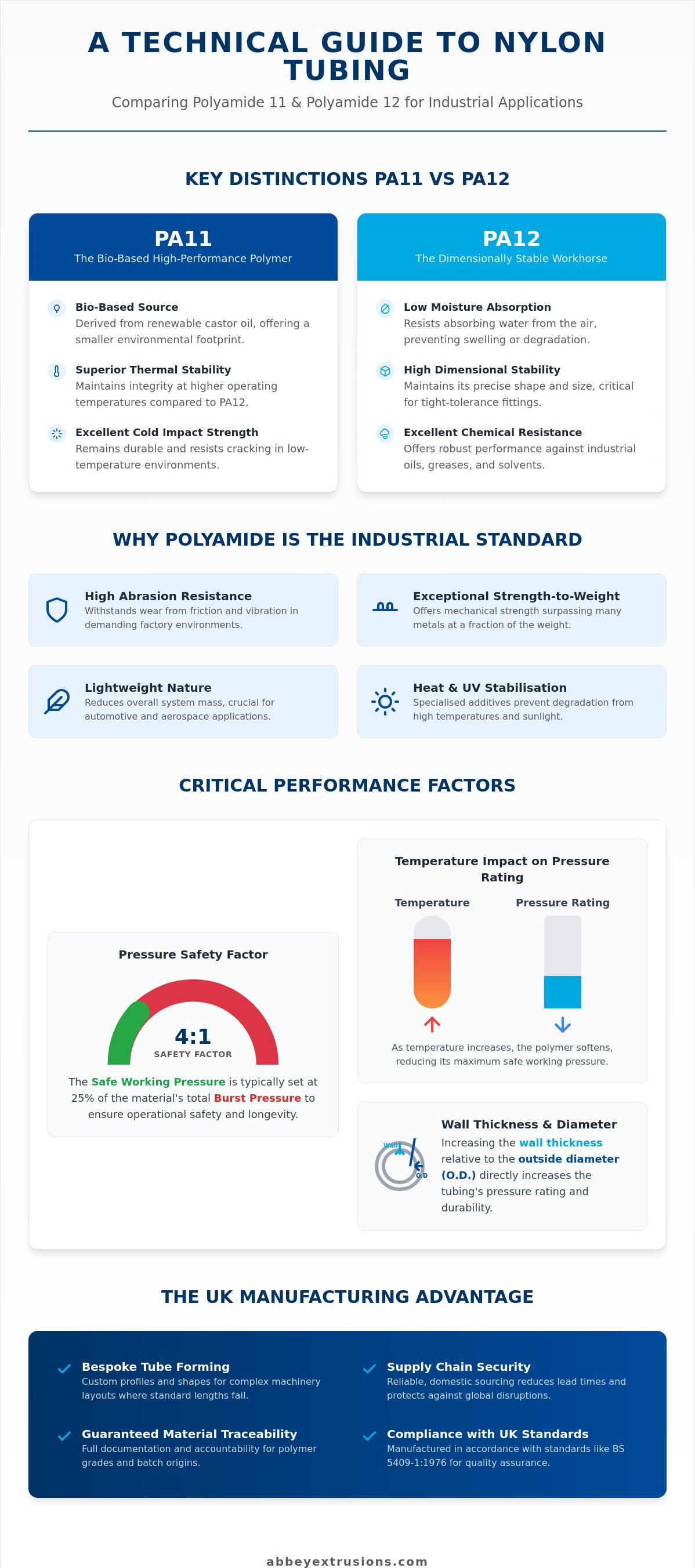
Engineers must distinguish between Nylon 11 (PA11) and Nylon 12 (PA12) to ensure long term system reliability. Nylon 11 is a bio-based polymer derived from castor oil, offering superior thermal stability and a smaller environmental footprint. It's often selected for applications requiring higher temperature resistance and excellent impact strength in cold weather environments. Conversely, Nylon 12 is frequently preferred for its exceptionally low moisture absorption. This characteristic ensures high dimensional stability, meaning the tubing won't swell or lose its mechanical properties when exposed to humid conditions. Both grades provide excellent flexibility, yet their performance under high pressure cycles can vary depending on the specific additives used during the extrusion process.
Why Polyamide is the Preferred Industrial Polymer
Polyamides offer a natural resistance to abrasion and mechanical wear that few other polymers can match. This durability is essential in factory environments where tubing may rub against machinery or be subjected to constant vibration. To extend service life, we incorporate heat and UV stabilisation into our nylon tube formulations. These additives prevent the polymer chains from breaking down when exposed to sunlight or elevated operating temperatures. The lightweight nature of these materials also reduces the overall mass of the pneumatic system, which can be a significant advantage in automotive and aerospace applications where weight reduction is a primary design objective.
Contact our engineering team to discuss chemical compatibility requirements.
Technical Performance and Chemical Resistance
The mechanical integrity of nylon tubing depends on the precise calculation of wall thickness relative to the intended operating pressure. In industrial pneumatic systems, our engineers account for the burst pressure, which represents the point of catastrophic failure. We apply a rigorous safety factor, typically 4 to 1, to determine the safe working pressure for any given environment. Specifying a high quality nylon tube is essential for critical applications where failure could result in significant industrial downtime or safety hazards. Our manufacturing process ensures that every batch of nylon tubing maintains consistent wall thickness to support these engineering requirements.
Precision manufacturing is the hallmark of our Leicestershire facility, where we monitor the extrusion process to ensure the polymer retains its structural properties. We ensure that the safety factors used in your design are not just theoretical but grounded in rigorous testing and decades of production experience. This focus on technical competency allows us to provide components that withstand the high pressure cycles common in modern automated machinery.
Working Pressures and Temperature Ranges
Temperature fluctuations significantly alter the mechanical behaviour of polyamides. As the ambient or fluid temperature rises, the polymer chains become more mobile, leading to a reduction in tensile strength and an increased flexibility. This thermal sensitivity means that a tube rated for a specific pressure at 20 degrees Celsius will have a reduced capacity at 60 degrees Celsius. Industrial nylon grades generally operate within a window of minus 40 to plus 80 degrees Celsius. It's vital to distinguish between short term burst pressure and long term working pressure to ensure the longevity of the system. Heat weakens the polymer. This necessitates careful planning during the specification phase.
Chemical Compatibility with Industrial Fluids
Nylon 11 and 12 exhibit exceptional resistance to a broad spectrum of industrial chemicals. This includes hydraulic oils, greases, and petroleum-based fuels. Because of this resilience, the material is the primary choice for a diesel fuel hose in plant machinery and automotive systems. However, engineers must avoid exposure to strong mineral acids, phenols, or certain alcohols, as these substances cause the material to degrade or swell. If you are unsure about a specific substance, reaching out for technical advice can prevent premature component failure and ensure your fluid transfer system remains secure.
Request a bespoke quote for custom tubing dimensions.
Selecting the Right Specifications for Your Project
Specifying the correct dimensions for a pneumatic system requires more than a cursory glance at a standard catalogue. Engineers must ensure the outside diameter of the nylon tubing aligns perfectly with the tolerances of push-in or compression fittings to prevent leakages. Whilst a distributor might provide a generic range, we produce bespoke specifications that cater to the unique requirements of specialised machinery. For applications where high pressure isn't a primary concern and weight reduction is essential, a low-density polythene tube might serve as a suitable, lighter alternative. However, for most industrial fluid and air transfer tasks, the mechanical properties of nylon remain the superior choice for long term reliability.
Our manufacturing expertise allows us to maintain tight tolerances that ensure a secure fit every time. This precision is particularly important in automated environments where vibration is constant. We understand that a fraction of a millimetre can be the difference between a secure seal and a system failure. By specifying exact wall thicknesses, you can balance the need for pressure resistance with the physical constraints of your equipment housing.
Wall Thickness and Bend Radius Considerations
Bend radius refers to the minimum curve a tube can achieve before its cross-section begins to deform. Exceeding this limit leads to kinking. This restricts flow and creates stress points that may eventually fail under pressure. A thicker wall naturally increases the burst pressure capacity of the nylon tubing, yet it simultaneously reduces the flexibility of the line. As a general rule of thumb, the minimum bend radius for flexible nylon is approximately six times the outside diameter. Careful planning of the system layout ensures that all connections remain within these physical limits, maintaining optimal flow rates across the entire circuit.
Colour Coding and UV Stabilisation
Organising complex pneumatic circuits becomes significantly simpler through the use of colour coding. We manufacture tubing in a variety of standard colours, including blue, red, green, and natural. This allows engineers to identify different pressure lines or fluid types at a glance. This practice improves maintenance efficiency and reduces the risk of incorrect connections during system assembly. When tubing is installed in outdoor environments or areas with high light exposure, UV stabilisation becomes a critical factor. Black nylon is typically the most UV resistant option because it contains carbon black additives that absorb harmful radiation. This prevents the polymer from becoming brittle over time. Consistent colour schemes also provide an aesthetic professionalism that reflects the quality of the underlying engineering.
Learn more about our tube forming services for unique system layouts.
Specialised Applications and Custom Tube Forming
Nylon tubing serves a vast array of sectors, extending from heavy automotive engineering to the precision requirements of food processing plants. Whilst standard straight lengths suffice for many applications, modern industrial design often demands more sophisticated solutions. We specialise in providing components that meet these unique challenges, including the nylon spiral cut hose guard, which offers essential abrasion protection for existing lines in high wear environments. This protective layer ensures that your primary fluid systems remain intact even when they're subjected to constant external friction.
The versatility of polyamides allows for advanced customisation that generic distributors simply can't provide. For example, a nylon recoil air hose is an indispensable tool on assembly lines, providing a self-retracting solution that keeps work areas clear and safe. By sourcing these specialised components directly from a manufacturer, you ensure that the material grade and dimensions are precisely matched to your specific operational needs. This direct relationship eliminates the uncertainty often found when dealing with third party suppliers who lack technical manufacturing depth.
Pneumatic Systems and Air Brake Lines
In the commercial vehicle sector, nylon is the industry standard for air brake systems due to its exceptional fatigue resistance. These systems must endure constant vibration and pressure fluctuations without risk of failure. Compliance with international standards such as DIN 73378 or SAE J844 is non-negotiable in these applications. Our production processes ensure that every millimetre of tubing meets these rigorous criteria, preventing the fatigue failure that often plagues inferior materials. The inherent vibration damping properties of the polymer help maintain system integrity over millions of cycles, ensuring safety across the lifespan of the vehicle.
Bespoke Tube Forming and Coiled Solutions
When machinery layouts involve tight corners or complex internal housings, standard tubing often falls short. This is where tube forming becomes essential. We use a precise heat setting process to mould the nylon into permanent, custom shapes that fit perfectly within your equipment. This eliminates the need for extra fittings and reduces the potential for leakages. Sourcing these bespoke shapes directly from our Leicestershire facility provides a level of supply chain security and technical accuracy that off the shelf parts can't match. It's a method that streamlines assembly and improves the overall aesthetic of the finished machine.
If your system requires a unique profile to navigate a restricted space, contact our Leicestershire facility to discuss your custom profile requirements.
Speak with a UK manufacturer for reliable supply and expert advice.
Sourcing High Quality Nylon Tubing from UK Manufacturers
Procuring technical polymers for industrial systems requires a strategic choice between general distributors and specialist manufacturers. Whilst a distributor might offer rapid despatch for standard stock, they frequently lack the technical manufacturing depth required to support complex engineering designs. We believe that buying direct from a UK manufacturer provides a level of supply chain security and material traceability that is increasingly vital in 2026. Our Leicestershire based facility has specialised in nylon tubing since 1985, allowing us to offer technical support that begins at the design phase and continues through to final delivery.
A direct relationship with the production team ensures that the technical specifications of your tubing are never compromised. We provide the expertise needed to verify material grades against specific industrial environments, preventing the uncertainty that often accompanies third party sourcing. This collaborative approach fosters a long term partnership built on technical competence and mutual trust. It's a level of service that purely commercial suppliers cannot match.
The Benefits of Direct Manufacturer Supply
Removing the middleman from your procurement process introduces significant cost efficiencies and operational flexibility. Direct supply allows for the production of bespoke lengths and non-standard diameters that simply don't exist in a distributor's warehouse. We can tailor specific material blends to meet unique chemical or thermal requirements, ensuring the polymer performs exactly as intended in its final application. This capability is essential for businesses operating specialised machinery where off the shelf components are insufficient. Our ability to manage the entire extrusion process means we can accommodate custom profile requests and unique tube forming requirements with precision. Access to the factory floor also allows for faster prototyping and a more agile response to changing project requirements.
Quality Control and Compliance Standards
Rigorous quality control is the foundation of our manufacturing philosophy. We employ precise testing procedures during the extrusion process to monitor dimensional tolerances, which is critical for ensuring leak free connections with industrial push-in fittings. A UK based manufacturer provides the assurance that all materials comply with current regulations, such as the Restriction of the Use of Certain Hazardous Substances in Electrical and Electronic Equipment Regulations 2012. We ensure that every batch of tubing meets the necessary safety standards, including the current BS 5409-1:1976 specification for pneumatic installations. This commitment to compliance protects your business from the risks associated with untraceable or inferior imported materials. Our documentation provides full material traceability, giving you confidence in the integrity of your industrial supply chain.
For those requiring a deeper exploration of material science and polymer behaviour, we recommend our sibling article, A Comprehensive Guide to Nylon Tubing Properties and Industrial Applications. This resource provides further technical analysis to assist in your specification process.
Speak with our engineering specialists about your specific system requirements.
Engineering Reliability into Every Connection
Successful industrial design in 2026 relies on the precise alignment of material properties with operational demands. We've discussed how the nuanced differences between nylon grades and the implementation of rigorous safety factors prevent catastrophic failure in pneumatic systems. Selecting the correct nylon tubing is a critical step in ensuring that your fluid transfer lines remain resilient under thermal stress and chemical exposure.
Abbey Extrusions has served as a specialist UK manufacturer since 1985, offering a level of technical expertise that generic distributors cannot replicate. Our capacity for bespoke tube forming and custom extrusion profiles allows us to solve complex layout challenges whilst maintaining the highest standards of dimensional accuracy. By sourcing directly from our facility, you gain the assurance of material traceability and the support of a partner dedicated to your long term success.
Contact Abbey Extrusions for a Technical Quote and discover how our manufacturing precision can enhance your next project.
Frequently Asked Questions
What is the main difference between Nylon 11 and Nylon 12 tubing
Nylon 11 is a bio-based polymer derived from castor oil that offers superior thermal stability and impact resistance in cold environments. Nylon 12 is preferred for applications requiring exceptionally low moisture absorption and high dimensional stability. Whilst both grades are suitable for industrial use, the choice depends on whether your system prioritises environmental sustainability or the prevention of material swelling in humid conditions.
Can nylon tubing be used for compressed air systems
Nylon tubing is the primary industrial standard for compressed air and pneumatic installations due to its high burst pressure and mechanical strength. It provides a reliable alternative to rigid metallic piping, allowing for easier routing within complex machinery. Our production process ensures that every length of tubing meets the rigorous demands of high pressure air transfer, maintaining system integrity over millions of operating cycles.
Is nylon tubing UV resistant for outdoor use
UV resistance depends largely on the additives used during the extrusion process. Black nylon tubing is the most resistant to ultraviolet radiation because it contains carbon black, which absorbs harmful rays and prevents the polymer from becoming brittle. Natural or clear grades are less suitable for prolonged outdoor exposure. We recommend specifying black tubing for any application where the lines are subjected to direct sunlight or high intensity light.
What is the maximum temperature nylon tubing can withstand
Standard industrial nylon grades generally operate effectively within a temperature window of minus 40 to plus 80 degrees Celsius. It's vital to remember that as the temperature rises, the safe working pressure of the tube decreases. Operating at the upper limit of this range requires a careful recalculation of the safety factor to ensure the material retains sufficient tensile strength to manage the internal fluid pressure without deforming.
How do I calculate the minimum bend radius for my nylon tube
A reliable rule of thumb is to ensure the bend radius is at least six times the outside diameter of the tube. For example, a 10mm tube should not be bent tighter than a 60mm radius. Exceeding this limit creates stress points that lead to kinking and flow restriction. For tighter spaces, we offer bespoke tube forming services that set the polymer into permanent shapes, eliminating the risk of mechanical failure.
Is nylon tubing flexible enough for moving parts in machinery
Polyamide is highly flexible and durable, making it ideal for use in automated machinery with moving components. Its natural resistance to abrasion ensures that the tubing can withstand the friction associated with constant motion. For applications requiring extreme range of movement, we manufacture nylon recoil air hoses that expand and retract as needed, preventing the lines from becoming entangled or damaged during operation.
Can I get nylon tubing in custom colours or sizes
Direct manufacturers like Abbey Extrusions can produce nylon tubing in bespoke colours and non-standard dimensions that are unavailable through general distributors. This allows engineers to organise complex systems using a specific colour coding scheme or to specify precise wall thicknesses for unique fittings. We maintain tight dimensional tolerances across all custom orders to ensure a secure, leak free fit within your specialised industrial equipment.
Is nylon tubing compatible with diesel and other fuels
Nylon 11 and 12 are exceptionally resistant to diesel, hydraulic oils, and petroleum based fuels. This chemical resilience makes them the preferred choice for fuel lines in commercial vehicles and plant machinery. However, it's important to avoid contact with strong mineral acids or certain alcohols, as these can cause the polymer to degrade. Always verify the specific chemical environment before finalising your material specification.

Article by
Bryan Cowan
Bryan Cowan is the Founder and Managing Director of Abbey Extrusions Ltd, a leading UK manufacturer of high-quality plastic tubes and hoses. With over 40 years of industry experience, Bryan established the company in 1985, growing it from a startup into a BS ISO9001-registered supplier for global sectors including aerospace, automotive, and pharmaceuticals.
Disclaimer
This article is intended for informational purposes only. Please ensure you seek expert advice or carry out your own research to confirm the information is suitable for your specific needs.