A coiled air hose that fails to return to its original form after only a few weeks of service represents a significant failure in material engineering rather than a mere operational nuisance. We recognise that for many British manufacturers, it's the persistent challenge of trailing lines and kinking in low temperature environments that creates unnecessary safety risks. Selecting high performance coiled air hoses requires an understanding of the relationship between polymer science and the precision of the extrusion process. Precision matters.
In this guide, we'll demonstrate how superior recoil memory is achieved through exact heat setting and the use of premium materials such as Nylon 12 and Polyurethane. You will gain a clear understanding of the engineering principles that differentiate standard products from bespoke industrial solutions. This knowledge helps you reduce workspace clutter and improve long term reliability. We provide a comprehensive comparison of material performance and the technical criteria necessary for procuring hoses that can withstand the specific chemical and thermal rigours of your workshop.
Key Takeaways
- Understand the technical distinctions between Polyurethane and Nylon 11 or 12 to ensure your pneumatic lines withstand specific industrial pressures and chemical exposures.
- Learn how high performance coiled air hoses eliminate trip hazards and reduce workspace clutter by maintaining superior recoil memory over extended service cycles.
- Master the calculations for effective working lengths and pressure ratings to prevent premature hose failure in high demand manufacturing environments.
- Discover the advantages of sourcing bespoke tube forming and extrusion services directly from a specialist UK manufacturer to meet unique machinery requirements.
- Identify how selecting the correct hose material and profile increases tool longevity by minimising abrasion and dragging across workshop floors.
For technical enquiries or bespoke manufacturing requirements, please contact our engineering team to discuss your specific needs.
Understanding the Fundamentals of Coiled Air Hoses
Coiled air hoses represent a specialised category of pneumatic delivery systems, engineered specifically to provide a compact and self-retracting solution for air-powered tools and machinery. Whilst standard straight hoses often lead to cluttered workspaces and increased wear through surface abrasion, these helical structures maintain a consistent retracted length. In industrial terminology, these are frequently referred to as recoil air hoses. Their primary role is to bridge the gap between fixed pneumatic outlets and mobile equipment, ensuring that the line remains taut and elevated from the floor.
The distinction between a high quality industrial component and a standard retail alternative lies in the manufacturing precision. We ensure that the polymer is subjected to specific thermal cycles during the forming process. This creates a permanent memory within the material, allowing it to return to its original shape even after repeated extension to its full working length. Without this rigorous technical approach, a hose will quickly lose its structural integrity, leading to sagging lines and potential safety hazards.
The Mechanics of Recoil Memory
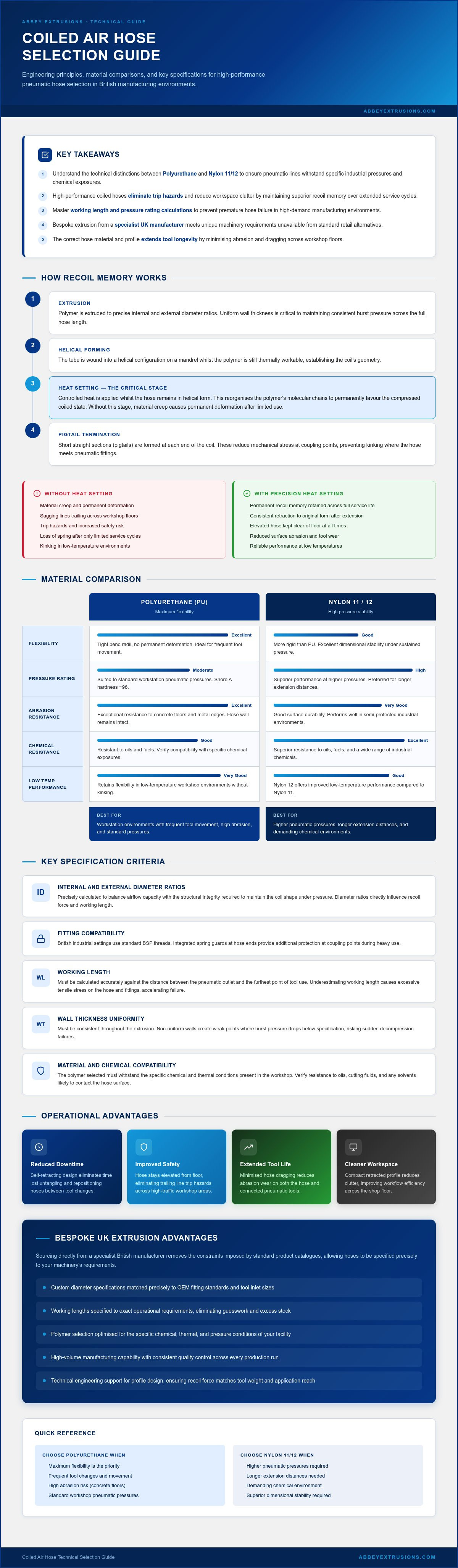
The durability of the recoil action is determined during the extrusion and subsequent tube forming stages. By applying controlled heat to the polymer whilst it is held in a helical configuration, the molecular structure is reorganised to favour this compressed state. This process, known as heat setting, aligns the polymer chains to ensure consistent retraction forces. Poor quality hoses often skip this rigorous tempering, leading to material creep where the polymer permanently deforms and loses its spring after only limited use.
Core Components of a Recoil Hose Assembly
A technically sound nylon recoil air hose assembly consists of more than just the coiled section. One critical feature is the pigtail, which refers to the short straight sections at either end of the coil. These tails are essential for reducing mechanical stress at the coupling point, preventing the hose from kinking or failing where it meets the pneumatic fitting. Industrial specifications typically focus on several critical parameters to ensure performance.
- Internal and External Diameter Ratios: These are precisely calculated to balance airflow capacity with the structural integrity required to maintain the coil shape under pressure.
- Fitting Compatibility: Most British industrial settings utilise standard BSP threads, often with integrated spring guards to further protect the hose ends during heavy use.
- Wall Thickness: This must be uniform throughout the extrusion to ensure the burst pressure remains consistent across the entire length of the coiled air hoses.
For guidance on material selection for high-volume industrial orders, please contact our technical department to discuss your requirements.
Comparing Polyurethane and Nylon Recoil Hose Materials
Selecting the appropriate polymer for coiled air hoses is a decision that directly impacts the longevity of pneumatic systems. It's essential to match the material properties to the specific operational environment of the facility. Whilst both Polyurethane and Nylon are common in British manufacturing, their mechanical behaviours under pressure and temperature vary significantly. Making an informed choice prevents premature material fatigue and ensures the recoil memory remains effective throughout the service life of the component.
Polyurethane for Flexibility and Kink Resistance
Polyurethane (PU) is frequently specified for workstation environments where operators require maximum range of motion and frequent tool movement. Its inherent elasticity allows for tight bend radii without the risk of permanent deformation or kinking. In harsh workshop settings, PU demonstrates exceptional resistance to surface abrasion, ensuring the hose wall remains intact despite constant contact with concrete floors or metal edges. Industrial-grade PU hoses typically exhibit a Shore A hardness of approximately 98 to ensure a balance between flexibility and structural integrity.
Nylon 11 and 12 for High Pressure and Stability
For applications involving higher pneumatic pressures or longer extension distances, Nylon 11 and 12 offer superior performance characteristics. Unlike standard Nylon 6, which can absorb moisture and lose dimensional stability, Nylon 12 remains virtually unaffected by humidity. This makes it the preferred choice for consistent recoil performance in varying workshop climates. By reviewing our technical data on nylon tube, engineers can appreciate the material's high tensile strength and resistance to fatigue. These polymers provide the necessary stiffness for long-span recoil applications where a softer hose might sag or tangle.
Temperature stability is another critical factor in material selection. Whilst PU remains flexible at lower temperatures, it may soften significantly when exposed to heat above 60°C. In contrast, Nylon 12 maintains its mechanical properties across a broader range, typically from -40°C to +80°C. Chemical compatibility also dictates the choice of polymer. Nylon provides excellent resistance to oils, fuels, and many solvents commonly found in automotive and aerospace manufacturing centres. PU is highly resistant to ozone and general weathering, making it suitable for outdoor pneumatic lines. If you require a bespoke material profile for a specific chemical environment, our Leicestershire facility can produce custom extrusions to meet those exact standards.
To discuss bespoke hose requirements for your manufacturing facility, please enquire with our technical team.
Operational Advantages of Self Retracting Hose Designs
The integration of coiled air hoses into a production line offers immediate improvements to the physical layout and safety profile of a manufacturing facility. Standard flat lines are prone to meandering across walkways, creating significant trip hazards that directly conflict with Health and Safety Executive (HSE) guidelines for workplace safety. By utilising the self-retracting nature of helical hoses, the pneumatic line remains elevated or tightly contained within the immediate work area. This reduction in floor clutter is not merely an aesthetic choice; it's a fundamental requirement for maintaining a compliant and hazard-free industrial environment.
Improving Workplace Safety and Organisation
The adoption of these hoses supports the 5S lean manufacturing methodology, particularly the 'Set in Order' and 'Standardise' pillars. When air lines automatically retract, the workspace remains organised without manual intervention from the operator. This prevents accidental damage to the hose itself, as trailing lines are frequently crushed by forklifts or heavy machinery. We recommend the use of high visibility colours to ensure that the pneumatic infrastructure is clearly identifiable within the workshop, further reducing the risk of accidental snagging or contact amongst staff and equipment.
Efficiency in Pneumatic Tool Operation
Operational efficiency is significantly enhanced when tools are paired with a high quality nylon recoil air hose. Unlike standard lines that require constant untangling and manual reeling, a self-retracting design ensures the tool is always ready for immediate use. This minimises non-productive downtime and allows for a more fluid workflow on assembly lines. From an ergonomic perspective, suspended recoil lines take the weight of the hose off the operator's wrist and arm, reducing fatigue during long shifts. It's a simple change that yields measurable gains in daily throughput.
Space optimisation is particularly critical in compact workstations where every centimetre of bench space matters. Coiled designs allow for a long reach whilst occupying minimal storage volume when the tool is at rest. This resistance to tangling, combined with the reduced surface abrasion from not being dragged across concrete floors, ensures a longer service life for both the hose and the pneumatic fittings. Investing in a properly engineered recoil system is a strategic move towards a more professional and efficient manufacturing centre.
For technical support in defining your specific hose parameters, please contact our Leicestershire based team for professional guidance.
Key Specifications for Choosing Coiled Air Hoses
Procurement of coiled air hoses requires more than just selecting a nominal length. One must distinguish between the total material length and the effective working length. Total length refers to the absolute measurement of the extruded tube before it undergoes the forming process. The effective working length is typically between 60% and 75% of this total measurement. Exceeding this limit causes permanent deformation of the coils and leads to premature mechanical failure. Precision in these calculations ensures that the pneumatic system remains efficient without over-stressing the material.
Pressure Ratings and Temperature Factors
Pressure performance is intrinsically linked to both ambient and operational temperatures. As the temperature increases, the tensile strength of the polymer decreases, which necessitates a calculated reduction in the maximum working pressure. Engineers must maintain a significant safety margin, often a 3 to 1 or 4 to 1 ratio between the burst pressure and the working pressure. For a deeper analysis of how different polymers react to environmental stressors, refer to our comprehensive guide to nylon tubing properties. Environmental factors such as UV exposure and specific chemical contact in the workshop also dictate material choice, as these can embrittle the hose wall over time if not correctly specified.
Sizing for Pneumatic Performance
Matching the internal diameter (ID) to the cubic feet per minute (CFM) requirements of the pneumatic tool is vital for operational success. An undersized hose creates a restrictive pressure drop, effectively starving the tool of the energy required for efficient performance. Conversely, an oversized hose adds unnecessary weight and increases the physical force needed to extend the coil. The diameter of the coil itself influences this extension force. Tighter coils provide a stronger retraction but require more effort from the operator to pull. Selecting fittings that don't compress the straight pigtails or distort the helix is essential for maintaining the integrity of the recoil memory.
If you require assistance in matching your tool specifications to the correct hose profile, please enquire about our custom extrusion services to ensure your facility operates at peak efficiency.
For large-volume orders or custom technical specifications, please contact our production team to discuss your project.
British Manufacturing Excellence in Custom Air Hose Extrusion
Sourcing coiled air hoses directly from a UK manufacturer provides a level of technical oversight that resellers simply cannot match. Abbey Extrusions has been operating from Leicestershire since 1985; we maintain strict control over the entire polymer extrusion and forming process. This vertical integration allows us to implement rigorous quality control standards at every stage, from raw material selection to the final heat-setting of the helical coils. For British manufacturers, this translates to a product that meets exact industrial tolerances and performs reliably in high-pressure environments. We don't just supply components; we provide engineered solutions backed by decades of experience.
Custom Tube Forming and Bespoke Profiles
Whilst standard sizes meet many needs, specialist machinery often requires unique configurations that off-the-shelf products cannot satisfy. Our tube forming capabilities allow us to produce bespoke coiled air hoses with specific pigtail lengths, tailored coil diameters, and unique material blends. We work closely with engineers to develop custom profiles that integrate perfectly with existing pneumatic systems. This bespoke approach ensures that the hose does not just fit the space; it enhances the overall mechanical efficiency of the equipment. We can adjust the wall thickness and polymer hardness to address specific challenges such as chemical exposure or extreme vibration.
Sustainable and Reliable British Supply Chains
Domestic sourcing significantly reduces lead times compared to international procurement, allowing for more agile inventory management in lean manufacturing settings. By choosing a British supplier, companies also reduce their carbon footprint associated with long-distance logistics. Beyond the physical product, our partners benefit from direct access to technical expertise. If a specific industrial application presents a challenge, our engineers are available to provide guidance on polymer behaviour and pressure ratings. This collaborative relationship builds long-term trust and ensures that the pneumatic infrastructure of your facility is always optimised for performance.
To begin a technical consultation or to request a quote for bespoke extrusions, please reach out to our engineering department today.
For technical support or to discuss large-volume bespoke orders, please contact our specialist team.
Future Proofing Your Industrial Pneumatic Infrastructure
Selecting high quality coiled air hoses is a strategic decision that directly impacts the safety and efficiency of your manufacturing centre. By understanding the technical distinctions between polymers such as Nylon 12 and Polyurethane, engineers can ensure that their pneumatic lines maintain consistent recoil memory and pressure integrity. We have detailed how precise calculations of working length and flow rates prevent premature failure whilst supporting lean manufacturing principles across the workshop.
As a UK manufacturer since 1985, Abbey Extrusions provides the technical competence required for complex industrial applications. Our technical specialists in Nylon 11 and 12 offer bespoke tube forming services to meet the unique requirements of your machinery. We focus on delivering the durability and precision that mass produced alternatives cannot provide, ensuring your facility operates with maximum reliability.
For technical advice or a bespoke quote on industrial hoses contact our specialist team today. We look forward to supporting your next manufacturing project.
Frequently Asked Questions
What is the difference between a coiled air hose and a recoil hose?
Technically, there is no functional difference between a coiled air hose and a recoil hose as both terms describe a tube formed into a permanent spiral. The term recoil specifically highlights the ability of the material to return to its original retracted shape after being extended. In industrial environments, these terms are used interchangeably to describe hoses that provide a compact storage solution whilst maintaining a tidy workspace during pneumatic operations.
Can I use a coiled air hose for water or chemical transfer?
Whilst our primary focus involves pneumatic applications, certain materials used in these hoses can accommodate specific fluids or chemicals. Nylon 12 offers excellent chemical resistance to oils and fuels, but you must consult technical data sheets for compatibility with specific substances. We specialise in bespoke extrusions, so we can manufacture hoses from materials tailored to your specific industrial transfer requirements to ensure safety and long term performance.
How do I prevent my coiled air hose from losing its shape?
Preventing a hose from losing its shape requires adhering to the recommended working length and avoiding overextension beyond its elastic limit. High quality materials like Nylon 12 possess superior memory properties compared to cheaper alternatives. It's also vital to ensure the hose is stored at moderate temperatures, as excessive heat can permanently deform the polymer structure and reduce the effectiveness of the recoil action over time.
Which is better for my workshop Nylon or Polyurethane?
The choice between Nylon and Polyurethane depends on your specific workshop environment and pressure requirements. Nylon 12 is a harder material that offers higher pressure ratings and better chemical resistance, making it ideal for heavy duty industrial use. Polyurethane is significantly more flexible and offers better kink resistance, which is often preferred for handheld tools where ease of movement is the primary concern for the operator during daily tasks.
How do I calculate the working length of a coiled air hose?
You should typically calculate the effective working length of coiled air hoses as approximately 60% to 75% of the total manufactured length. Stretching a hose beyond this point puts unnecessary stress on the material and may lead to permanent deformation or failure at the fittings. Our technical team can provide precise measurements for our custom extrusions to ensure your pneumatic system operates within safe and efficient parameters at all times.
Are coiled air hoses compatible with all pneumatic tools?
These hoses are compatible with most pneumatic tools provided the internal diameter and fittings match the tool's air consumption requirements. High flow tools might require a larger bore to prevent pressure drops that could affect performance. We manufacture a range of diameters to ensure that your specific equipment receives the consistent air volume necessary for reliable operation in a professional manufacturing setting, regardless of the tool's complexity.
What safety standards should industrial air hoses meet in the UK?
Industrial hoses in the United Kingdom should adhere to relevant BS EN ISO standards regarding pressure testing and material quality. It's essential that every hose is rated for the maximum operating pressure of your compressor system with an appropriate safety factor. As a UK manufacturer since 1985, we ensure our production processes meet rigorous quality controls to provide reliable products that stand up to the most demanding industrial environments.
Can coiled air hoses be repaired if they kink or leak?
If a leak occurs near the end of the hose, it's often possible to trim the damaged section and reattach the fitting. However, if the hose develops a permanent kink or a hole in the main body, we recommend a full replacement to maintain safety standards. Repairing the middle of a hose often compromises its recoil ability and creates a weak point that could fail under pressure, leading to potential safety hazards.

Article by
Bryan Cowan
Bryan Cowan is the Founder and Managing Director of Abbey Extrusions Ltd, a leading UK manufacturer of high-quality plastic tubes and hoses. With over 40 years of industry experience, Bryan established the company in 1985, growing it from a startup into a BS ISO9001-registered supplier for global sectors including aerospace, automotive, and pharmaceuticals.
Disclaimer
This article is intended for informational purposes only. Please ensure you seek expert advice or carry out your own research to confirm the information is suitable for your specific needs.