The enforcement of EU Regulation 2026/245 and the stringent PFAS restrictions introduced in August 2026 have fundamentally altered the landscape of material compliance for British food manufacturers. We recognise that maintaining a sterile, high pressure production environment is a constant challenge where the margin for error has effectively vanished. You likely understand that a single hose failure or a minor regulatory oversight can halt an entire production line, leading to significant downtime and potential contamination risks. At Abbey Extrusions, we believe that technical precision in the selection of food grade hoses is the only reliable safeguard against these operational threats.
This technical guide provides the comprehensive clarity required to navigate the latest safety standards whilst ensuring your fluid transfer systems deliver the longevity your industrial applications demand. We promise to equip you with the knowledge to achieve 100 percent regulatory compliance and optimise your production efficiency through informed material selection. Throughout this article, we will examine critical polymer specifications, the impact of updated 3-A Sanitary Standards, and the specific advantages of partnering with a specialist UK manufacturer for bespoke extrusion requirements tailored to your unique machinery and volume needs.
Key Takeaways
- Identify the most appropriate polymer for your facility by assessing how PVC, Nylon, and Polyurethane interact with different fat and oil concentrations.
- Ensure your production line meets the latest 2026 safety standards, including WRAS and EC 1935/2004, to maintain absolute regulatory compliance.
- Learn why high performance food grade hoses must be migration resistant to prevent chemical leaching and protect the integrity of your consumables.
- Optimise the longevity of your industrial components by selecting materials that are chemically compatible with your specific Clean in Place sanitising agents.
- Discover the operational benefits of sourcing bespoke extrusion profiles from a UK manufacturer to meet the precise technical demands of modern automated lines.
If you require technical assistance with material selection for bespoke production lines or high volume orders, please speak with our manufacturing experts.
Understanding Food Grade Hoses and Safety Standards
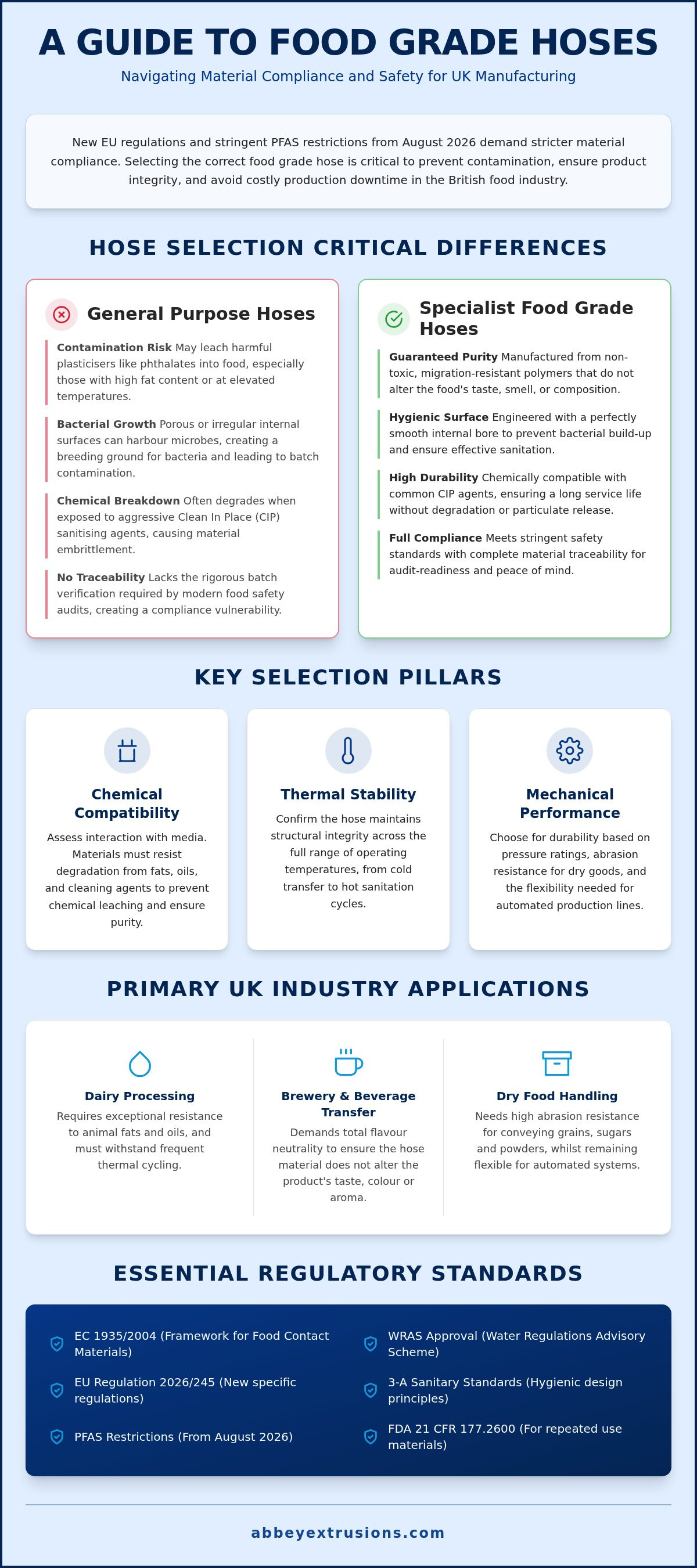
We define food grade hoses as specialised transfer components manufactured from non-toxic, migration-resistant polymers. Unlike standard industrial tubing, these products are engineered to maintain high levels of purity during the transport of liquids, powders, and viscous consumables. The fundamental requirement for these materials is that they do not alter the organoleptic properties of the food or pose a risk to human health through chemical leaching. This concept is central to the wider regulation of Food Contact Materials, where every component in a production line must be verified for its intended use and environment.
As a UK manufacturer with over three decades of experience, we focus on the technical integrity of every extrusion. Our facility manages large volume orders for the national food supply chain, ensuring that every metre of hose meets the stringent requirements of current legislation. Using general purpose industrial hoses in a food environment introduces significant contamination risks. Many standard hoses contain phthalates or other plasticisers that can migrate into fatty or oily foods, especially at elevated temperatures. We ensure that our food grade hoses are free from these harmful substances, providing a stable and compliant solution for rigorous manufacturing schedules.
Primary Applications in the British Food Industry
The UK food manufacturing sector relies on specific polymer characteristics to ensure product integrity across different categories. Our production processes allow us to tailor the flexibility and durability of food grade hoses to match these varied demands:
- Dairy processing: Requires materials with exceptional resistance to animal fats and oils whilst maintaining structural integrity during thermal cycling.
- Brewery and beverage transfer: Demands total flavour neutrality to prevent tainting. Our brewery hose solutions are specifically designed to handle these sensitive fluids without impacting the final product.
- Dry food handling: Materials must offer high abrasion resistance to withstand the friction of grain or sugar transport whilst remaining flexible enough for automated systems.
Why General Purpose Hoses Fail in Food Environments
Technical failure in food environments often stems from the use of non-specialised materials. General purpose hoses frequently possess a slightly porous or irregular internal bore. These microscopic imperfections provide a breeding ground for bacterial growth, which can lead to widespread batch contamination. These hoses often suffer from rapid chemical breakdown when exposed to aggressive Clean In Place sanitising agents. This degradation results in material embrittlement or the release of particulate matter into the food stream. Finally, non-certified materials lack the rigorous batch traceability required by modern safety audits, leaving manufacturers vulnerable during regulatory inspections.
To discuss technical specifications for large volume orders or custom extrusion profiles, please contact our engineering team.
Choosing the Right Material for Your Application
Selecting food grade hoses requires a methodical assessment of the media being transported and the environmental stresses of the production line. We categorise selection criteria into three primary pillars: chemical compatibility, thermal stability, and mechanical performance. A common error in industrial procurement is over-specifying pressure ratings whilst neglecting the specific chemical interaction between the polymer and the foodstuff. Aqueous foods require different considerations compared to those with high fat or alcohol content, as these substances can act as solvents on certain materials.
Compliance with FDA 21 CFR 177.2600 ensures that materials intended for repeated use are safe, but technical suitability remains a separate engineering challenge. Temperature fluctuations significantly impact structural integrity. A hose that performs at 20°C may suffer from plasticiser migration or structural softening at 60°C. We work closely with partners to ensure the chosen polymer maintains its molecular stability under these specific thermal cycles, preventing premature failure or batch contamination.
Reinforced PVC for Pressure Applications
Our reinforced PVC tube represents a versatile solution for high pressure liquid transfer. By embedding high-tensile polyester fibres within the wall, we achieve a significant increase in working pressure without sacrificing the clarity of the material. This transparency is vital in food production. It allows for visual monitoring of flow rates and the immediate detection of air pockets or blockages. These tubes are particularly effective for suction and delivery applications where vacuum resistance is as critical as burst pressure.
Nylon and Polyurethane for Specialist Needs
When your application involves aggressive cleaning chemicals or higher operating temperatures, specifying Nylon tube provides superior chemical stability. Nylon 11 and 12 variants offer excellent resistance to stress cracking and maintain their dimensions under varying humidity levels. For dry food handling where friction is a primary concern, Polyurethane (PU) is the preferred choice due to its exceptional abrasion resistance. PU also provides superior kink resistance compared to LDPE or standard PVC. This makes it ideal for tight-radius installations in modern automated machinery where space is limited.
If you need a custom profile developed for a specific automated line, contact our Leicestershire facility to discuss your technical requirements.
If you require a detailed Certificate of Conformity for your next audit or wish to discuss high volume bespoke hosing requirements, please contact our technical sales team.
Compliance and Regulatory Requirements in 2026
Operating within the British food manufacturing sector in 2026 requires a rigorous approach to material traceability and chemical safety. The implementation of EU Regulation 2026/245 on February 23, 2026, has updated the authorised list of substances permitted in plastic food grade hoses. This regulatory shift, combined with the stringent PFAS restrictions that came into force on August 12, 2026, means that legacy hosing solutions may no longer meet modern audit requirements. We ensure that every component manufactured in our Leicestershire facility adheres to these updated frameworks, providing the technical documentation necessary to prove compliance during industrial safety inspections.
For applications involving drinking water or liquid consumables, WRAS approval remains a critical benchmark for safety in the UK. This certification confirms that the hose material will not contaminate the water supply or encourage bacterial growth through nutrient leaching. When designing hygienic transfer systems, we frequently refer to the 3-A Sanitary Standards to ensure our products support effective clean in place (CIP) processes. These standards, particularly the foundation updates released in February 2026, provide the essential framework for equipment design that minimises contamination risks in high volume production environments.
European and British Standards for Food Contact
The framework regulation EC 1935/2004 sets the general safety requirements for all food contact materials, stipulating that components must not transfer their constituents to food in quantities that endanger human health. Regulation EU 10/2011 provides more specific rules for plastic materials, including migration limits that we strictly observe during the extrusion process. Whilst the UK has retained these standards, we also monitor domestic updates to ensure our products remain compliant with the latest UK Food Standards Agency guidelines.
Identifying Compliant Hoses in the Supply Chain
Compliant food grade hoses should feature clear markings indicating their suitability for food contact, often symbolised by the glass and fork icon. We provide a comprehensive Certificate of Conformity with every order, which serves as essential evidence for food safety audits. Avoiding uncertified imports is vital, as these products often lack the batch-level traceability required to identify the raw polymer source. Our facility maintains a transparent supply chain, guaranteeing the provenance of every bespoke profile we produce.
For technical guidance on the chemical compatibility of your transfer systems or to request a quote for high volume replacements, please enquire with our manufacturing team.
Maintenance and Cleaning Protocols for Industrial Hoses
The operational lifespan of food grade hoses depends heavily on the rigour of your sanitisation regime. Clean in place (CIP) procedures are the industry standard for maintaining hygiene in automated lines, yet these processes subject polymers to significant chemical and thermal stress. We find that many industrial failures occur because the cleaning agents are incompatible with the hose material or because the temperature exceeds the polymer stability threshold. Ensuring chemical compatibility between your sanitising agents and the internal bore is essential to prevent material leaching or structural embrittlement.
Biofilm accumulation remains a primary concern in food processing. Proper drainage and storage are as critical as the cleaning cycle itself. If hoses are left with standing liquid, bacteria can colonise the internal surface, leading to batch contamination. We recommend a structured maintenance schedule that includes thorough drying and vertical storage where possible. This methodical approach reduces the risk of microbial growth and extends the intervals between necessary replacements.
Sterilisation Methods and Temperature Limits
Steam cleaning provides an effective thermal kill for pathogens but can cause rapid degradation in standard PVC hoses. For high temperature sterilisation, we often suggest Nylon or specialised reinforced profiles that can withstand thermal cycling without losing flexibility. You must observe the maximum temperature ratings provided in our technical data sheets. Exceeding these limits is dangerous. It alters the molecular structure of the polymer. This makes it prone to stress cracking. Whilst chemical sanitisation is often gentler on the material, you must verify that the concentration of acids or alkalis does not exceed the recommended parameters for the specific hose grade.
Routine Inspection and Replacement Cycles
Preventative maintenance requires a keen eye for subtle changes in the appearance of food grade hoses. Discolouration or a loss of transparency in clear tubing often indicates internal bore degradation. You should also inspect the external wall for signs of abrasion. This is especially true in high traffic areas where components may rub against machinery. Proper storage is equally vital. Spare components should be kept in a cool, dark environment to prevent UV damage. UV light causes surface crazing and premature failure. We suggest establishing a replacement cycle based on your specific production intensity to avoid unscheduled downtime.
If you need to establish a preventative maintenance schedule for a large facility, request a technical consultation with our specialists today.
If you would like to discuss a bespoke extrusion project or a high volume order for your facility, please enquire with our technical team.
Sourcing Bespoke Food Grade Hosing Solutions
Standard components often fall short in the high pressure, high speed environments of modern automated food lines. These complex systems require food grade hoses that fit precise geometric layouts without kinking or stressing the connection points. We specialise in managing large volume orders where absolute consistency across every unit is a non-negotiable requirement for operational safety. Working with a domestic manufacturer ensures that your unique technical specifications are translated accurately into the final extrusion profile, reducing the risk of installation errors or premature component wear that often occurs with generic alternatives.
Sourcing from a UK manufacturer provides significant logistical and technical advantages for British industrial facilities. Lead times for critical replacement parts are drastically reduced, which is essential for maintaining production uptime in the national food supply chain. You gain direct access to our engineering support team, which facilitates more accurate polymer selection based on the specific media and pressure requirements of your facility. We've maintained these high quality standards in our Leicestershire facility since 1985, ensuring that every bespoke order adheres to the rigorous safety protocols discussed in previous sections.
The Benefits of UK Manufactured Tubing
The reliability of your supply chain is as important as the quality of the hose itself. By choosing a UK based partner, you eliminate the uncertainties of international shipping and customs delays. This proximity allows for a more collaborative approach to engineering, where technical support is available in your time zone. Supporting British manufacturing also ensures that the products you install meet the highest local safety standards, providing peace of mind for your quality assurance teams and external auditors.
Custom Profiles and Tube Forming Capabilities
Complex routing issues within compact machinery often require more than just flexible tubing. Our tube forming service allows us to create permanent, repeatable directional changes through advanced heat forming techniques. This process ensures that food grade hoses maintain their structural integrity and internal diameter whilst navigating tight spaces that would cause standard hoses to fail. We also offer the capability to develop bespoke extrusion profiles for unique sealing or transfer needs. This includes providing technical drawings and prototypes for new production lines, allowing you to test the performance of a component before committing to a high volume manufacturing run. Integrating specialist products like our brewery hose into existing beverage systems becomes a much more efficient process when the components are engineered to match your specific infrastructure and volume needs.
To discuss your high volume production requirements or to request a technical consultation, please contact our specialist engineering team.
Ensuring Operational Excellence in Food Manufacturing
The technical integrity of your production environment depends on the precise alignment of material science with current safety regulations. We have examined how selecting the correct polymer and maintaining rigorous sanitisation protocols are essential for preventing contamination and ensuring component longevity. As a UK based manufacturing facility with over 40 years of polymer expertise, we understand that standard solutions often fail to meet the complex routing requirements of modern automated machinery. By prioritising bespoke extrusion and tube forming, you can eliminate the risks associated with generic hosing and achieve total regulatory compliance.
Maintaining a safe and efficient fluid transfer system is a continuous engineering commitment. Our specialists are ready to support your facility with technical polymer selection and the development of custom profiles that match your specific volume needs. For expert advice on polymer selection or to request a quote for bespoke food grade hoses please contact the Abbey Extrusions team today. We look forward to helping you optimise your production efficiency with precision engineered components.
Frequently Asked Questions
What makes a hose food grade?
A hose is classified as food grade if it is manufactured from non-toxic, migration resistant polymers that do not leach harmful constituents into consumables. These materials must comply with specific safety standards such as EC 1935/2004 or FDA regulations. We ensure that our food grade hoses are formulated to maintain the organoleptic properties of the food whilst providing a durable transfer solution for high volume industrial environments.
Can I use standard PVC hose for food products?
You should never use standard industrial PVC for food products because it typically contains plasticisers that can migrate into the food stream. These additives, such as certain phthalates, pose health risks and can alter the taste of the product. Our food grade PVC is specifically engineered without these harmful substances, ensuring your production line remains compliant with current UK safety legislation and audit requirements.
What is the difference between FDA and WRAS approval?
FDA compliance refers to U.S. Food and Drug Administration standards for materials in repeated contact with food, whereas WRAS approval is a British certification for drinking water applications. WRAS ensures that the hose will not contaminate the water supply or encourage microbial growth. We manufacture hosing that meets both sets of criteria, allowing for safe integration into global and domestic water and food systems.
How do I clean food grade hoses without damaging them?
Cleaning should be performed using compatible sanitising agents whilst strictly adhering to the maximum temperature limits of the polymer. Clean in place procedures are effective; however, you must verify that the concentration of acids or alkalis will not cause material embrittlement. We suggest a methodical approach that includes thorough drainage and drying after each cycle to prevent biofilm accumulation and maintain the structural integrity of the internal bore.
Are all food grade hoses suitable for hot liquids?
Not all materials are suitable for high temperature applications as different polymers have varying thermal stability thresholds. Whilst Nylon can handle elevated temperatures and steam cleaning, materials like standard LDPE may soften or lose structural integrity if exposed to hot liquids. You should always consult the technical specifications of your specific food grade hoses to ensure they are rated for your intended operating temperature range.
What is the lifespan of an industrial food grade hose?
The lifespan of an industrial hose depends on the intensity of use, the chemicals transported, and the frequency of thermal cycling. Preventative maintenance schedules often suggest replacement cycles based on visual inspections for discolouration or internal bore degradation. In high volume production environments, a hose might require replacement within several months, whilst in less demanding applications, it may provide reliable service for several years.
Can you manufacture bespoke food grade profiles for unique machinery?
We specialise in the manufacture of bespoke extrusion profiles and tube forming to meet the unique routing requirements of modern machinery. Our Leicestershire facility is equipped to handle large volume orders and custom designs that standard off the shelf components cannot accommodate. We work directly with your engineering team to develop prototypes and technical drawings that ensure a precise fit for your specific automated production lines.
Do you supply food grade hoses for microbreweries and distilleries?
We supply specialised brewery hose solutions that are engineered for the specific demands of microbreweries and distilleries across the UK. These products are designed to be flavour neutral and resistant to the aggressive cleaning cycles required in alcohol production. Whether you require standard lengths or bespoke profiles for a new installation, our hosing ensures the purity and integrity of your beverages remains protected throughout the transfer process.

Article by
Bryan Cowan
Bryan Cowan is the Founder and Managing Director of Abbey Extrusions Ltd, a leading UK manufacturer of high-quality plastic tubes and hoses. With over 40 years of industry experience, Bryan established the company in 1985, growing it from a startup into a BS ISO9001-registered supplier for global sectors including aerospace, automotive, and pharmaceuticals.
Disclaimer
This article is intended for informational purposes only. Please ensure you seek expert advice or carry out your own research to confirm the information is suitable for your specific needs.