What if the most expensive component in your fluid handling system isn't the high-pressure pump or the control valve, but the failure of a single metre of tubing? In demanding industrial environments, you already know that even a minor degradation in material integrity can lead to catastrophic system downtime and significant safety risks. Chemical resistant ptfe tubing is often the final line of defence against aggressive reagents and extreme thermal cycles, yet selecting the correct specification remains a complex engineering challenge for many technical teams.
We'll help you navigate the process of selecting and specifying PTFE tubing that maintains its performance whilst exposed to the harshest industrial conditions. By understanding the nuances of ASTM D1710 standards and the advantages of bespoke UK manufacturing, you can ensure long-term reliability and full compliance with hazardous fluid transport regulations. This article provides a technical overview of how to secure high-quality extrusions that protect your equipment and your bottom line, moving beyond standard off-the-shelf solutions to find a partner that understands the precision required in modern manufacturing.
Key Takeaways
- Identify why the high molecular weight of fluoropolymers is vital for maintaining system integrity when transporting aggressive industrial reagents.
- Compare the thermal and mechanical properties of PTFE with FEP and PFA to determine the most suitable material for specific temperature ranges.
- Learn the precise methods for specifying chemical resistant ptfe tubing to ensure full compliance with safety standards and operational longevity.
- Evaluate the benefits of sourcing bespoke extrusion profiles from a UK manufacturer to achieve tighter tolerances and customised tube forming.
- Gain insights into the manufacturing standards and material certifications necessary for high performance fluid handling in hazardous environments.
If you require technical assistance or a quotation for bespoke fluoropolymer profiles, please contact our engineering team to discuss your specific requirements.
The Role of Chemical Resistant PTFE Tubing in Modern Industry
Industrial systems handling aggressive reagents face constant material stress. Standard polymers often lack the molecular stability to withstand prolonged exposure to concentrated acids or volatile solvents. When a material fails, the resulting downtime and maintenance costs can be extensive. This is why chemical resistant ptfe tubing has become an essential component in high performance fluid handling. It provides a level of inertness that other materials simply cannot match. At Abbey Extrusions, we recognise that the choice of material is not merely a procurement decision but a critical safety factor for your entire operation.
Polytetrafluoroethylene (PTFE) is a synthetic fluoropolymer that offers near-total chemical resistance. In modern manufacturing, maintaining the purity of the medium is as critical as preventing leaks. We see this material used as the premier choice in environments where temperature fluctuations and chemical aggression occur simultaneously. Unlike standard plastics, it doesn't leach contaminants into the fluid stream, ensuring the integrity of the end product. Common alternatives like PVC tube or LDPE might suffice for basic water transport, but they quickly degrade when exposed to the corrosive substances found in industrial processing.
Industrial Applications for Fluoropolymer Tubing
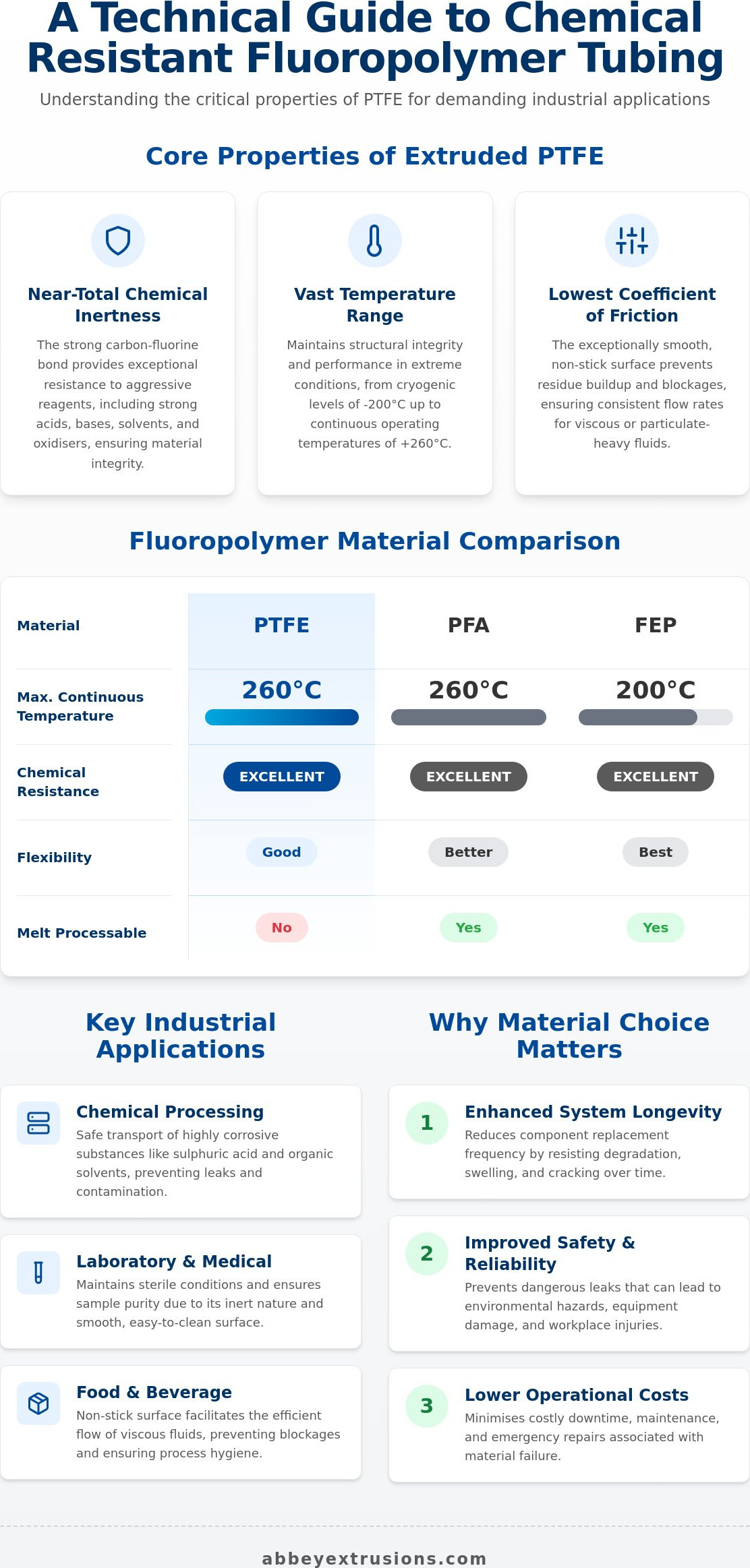
In chemical processing plants, these tubes are indispensable for the safe transport of sulphuric acid and organic solvents. Laboratory settings also rely on fluoropolymer solutions to maintain sterile conditions. The material's smooth surface prevents bacterial growth and residue buildup. For the food and beverage sector, the non-stick nature of the material ensures that viscous fluids move efficiently through the system without causing blockages. This versatility makes it a staple across diverse manufacturing sectors in the UK and abroad.
In these demanding sectors, the tubing is often part of a larger assembly involving high-grade metalwork. For instance, Donewright Stainless provides the specialist metal fabrication required for tanks and piping systems that rely on these chemical resistant polymers to ensure safe and efficient fluid handling.
Why Chemical Resistance Matters for System Longevity
Reliability is the cornerstone of any industrial operation. Using high quality chemical resistant ptfe tubing reduces the frequency of component replacement. When standard tubes swell or degrade, they restrict flow rates and increase pressure on pumps. By selecting a material that remains stable, you prevent leaks that could lead to environmental hazards or workplace injuries. This long-term stability translates directly into lower operational costs and enhanced safety for the entire facility. Our experience shows that investing in superior materials at the outset prevents the high costs of emergency repairs later.
To ensure your fluid handling system meets the necessary performance criteria, you may discuss your technical specifications with our manufacturing experts.
Technical Properties and Performance of Extruded PTFE
PTFE is a fluorocarbon solid that possesses an exceptionally high molecular weight. This molecular structure is held together by the unique carbon to fluorine bond, which is widely regarded as the strongest in organic chemistry. This specific atomic arrangement provides the foundation for chemical resistant ptfe tubing, as the fluorine atoms effectively shield the carbon backbone from external reagents. Consequently, the material remains unaffected by almost all industrial chemicals, maintaining its purity and strength in environments where other polymers would fail.
Beyond its chemical stability, extruded PTFE is renowned for its impressive thermal performance. It maintains its structural integrity across a vast temperature range, from cryogenic levels below -200 degrees Celsius to continuous operating temperatures exceeding 250 degrees Celsius. This thermal stability is paired with a remarkably low coefficient of friction, which is often cited as being lower than almost any other solid material. This property is essential for preventing the buildup of deposits or blockages within the tube, ensuring a consistent flow rate even when transporting viscous or particulate-heavy fluids.
Chemical Inertness and Material Stability
The material demonstrates total resistance to strong acids such as sulphuric and hydrofluoric acid, along with concentrated bases. It performs reliably in the presence of aggressive oxidisers and organic solvents that would typically dissolve or degrade standard elastomers. In the context of PTFE tubing, chemical inertness refers to the material's ability to maintain its structural and chemical integrity when in direct contact with highly reactive substances. This stability is why technical teams often research Bespoke PTFE Tubing Solutions to address specific engineering challenges in volatile environments.
Thermal and Mechanical Advantages
Even at extremely low temperatures, the tubing retains sufficient flexibility for dynamic applications without becoming brittle. Its high dielectric strength makes it an excellent choice for electrical insulation in high temperature environments. The material also shows exceptional resistance to UV radiation and weathering, which makes it suitable for outdoor industrial installations where environmental degradation is a concern. If you are unsure about the compatibility of a specific medium with our extrusions, please contact our Leicestershire facility for professional guidance.
If you require technical guidance on material compatibility or wish to request a bespoke extrusion profile, please get in touch with our specialist team for professional support.
Comparing PTFE with FEP and PFA Tubing Options
The fluoropolymer family consists of several high-performance materials, each offering distinct advantages depending on the industrial environment. Whilst Polytetrafluoroethylene (PTFE) remains the most widely recognised member due to its exceptional inertness, FEP (Fluorinated Ethylene Propylene) and PFA (Perfluoroalkoxy) provide alternative characteristics that may be more suitable for specific fluid handling tasks. Understanding these subtle differences is essential when specifying chemical resistant ptfe tubing or its counterparts for complex systems. Each material has a unique molecular structure that dictates its transparency, thermal limits, and manufacturing method.
One of the most immediate differences is optical clarity. PTFE is naturally opaque or milky white, which can make it difficult to monitor fluid flow visually. In contrast, both FEP and PFA are significantly more transparent, allowing operators to inspect the medium for bubbles or contaminants. From a manufacturing perspective, the methods of production vary greatly. PTFE requires a paste extrusion and sintering process because it does not truly melt. FEP and PFA are melt-processable. This allows for the creation of longer continuous lengths and more complex profiles through traditional extrusion techniques, often resulting in a smoother internal surface finish.
When to Choose FEP Over PTFE
FEP is often selected when visual flow monitoring is a primary requirement for the operator. Because it is melt-processable, we can produce much longer coils without the joints sometimes required in sintered PTFE. However, FEP has a lower maximum operating temperature of approximately 200 degrees Celsius, compared to the 260 degrees Celsius limit for PTFE. It remains a cost-effective solution for applications where the extreme thermal resistance of PTFE is not strictly necessary but chemical integrity is still vital.
The Benefits of PFA for High Purity Systems
PFA combines the best attributes of both PTFE and FEP. It matches the high-temperature resistance and chemical inertness of Polytetrafluoroethylene (PTFE) whilst offering the melt-processability of FEP. This results in a tube with a very high-purity internal surface, which is critical for applications in the semiconductor and pharmaceutical industries. PFA also exhibits superior mechanical strength and stress crack resistance at elevated temperatures. It's the premier choice for the most demanding hazardous fluid transport where system failure is not an option.
For technical assistance with dimensioning or to request a sample of our extrusions, please contact our Leicestershire production facility.
Specifying the Right Dimensions for Industrial Tubing
Accurate specification of internal diameter (ID) and external diameter (OD) is the foundation of any successful fluid handling installation. When selecting chemical resistant ptfe tubing, technical teams must ensure the ID is sufficient to maintain the required flow rate whilst the OD remains compatible with standard push-fit or compression fittings. Wall thickness acts as the critical variable between these two measurements. It directly influences both the mechanical strength of the tube and its ability to bend around tight radii. Precision is non-negotiable; even a minor deviation in tolerances can lead to system leaks or assembly failures in high-pressure environments. For more complex layouts where straight runs are impractical, specialised tube forming techniques allow for the creation of permanent, pre-set bends that maintain the material's integrity without introducing stress points.
Pressure Ratings and Safety Factors
Calculating the burst pressure of a fluoropolymer tube requires a thorough understanding of the material's tensile strength at specific temperatures. As the operating temperature rises, the pressure handling capability of PTFE decreases significantly. We recommend that engineers always apply a robust safety factor, typically four times the working pressure, to account for potential surges or thermal cycling. This conservative approach ensures that the chemical resistant ptfe tubing performs reliably throughout its intended service life, even under fluctuating conditions. Factors such as the concentration of the medium and the duration of exposure should also be considered when determining the appropriate wall thickness for hazardous applications.
Flexibility and Bend Radius Considerations
Whilst PTFE offers unmatched chemical resistance, it behaves differently to more elastic materials like nylon tube under mechanical stress. If a tube is bent beyond its minimum bend radius, it may kink, restricting flow and creating a permanent weak spot in the conduit. Standard PTFE is generally stiffer than nylon, which means installation in confined spaces requires careful planning. We often advise customers to consider the wall thickness carefully; a thinner wall may offer better flexibility but at the cost of lower pressure resistance. Achieving the correct balance is essential for maintaining consistent flow without compromising the safety of the transport system. If your project requires non-standard dimensions or specific wall thicknesses, please submit your technical drawings to our team for a feasibility review.
If you require a tailored quotation or technical consultation for your next project, please speak with our technical sales department.
Bespoke PTFE Tubing Solutions from Abbey Extrusions
Abbey Extrusions stands as a specialist UK manufacturer with a legacy dating back to 1985. By sourcing chemical resistant ptfe tubing directly from our Leicestershire facility, you eliminate the complexities of international supply chains and gain direct access to engineering expertise. Our production processes are governed by rigorous quality control standards, ensuring that every extrusion meets the exact mechanical and chemical specifications required for hazardous fluid transport. We maintain a focus on precision that only a dedicated manufacturer can provide, allowing for tighter tolerances and superior material consistency throughout every production run.
In addition to the primary conduit, we provide secondary protection solutions to enhance system longevity. For instance, the application of nylon spiral cut hose guards provides essential abrasion resistance for tubes operating in dynamic or abrasive environments. This holistic approach to fluid handling ensures that your entire assembly remains resilient against both internal chemical attack and external physical wear. It's often these additional details in the specification phase that prevent premature system failure and reduce long-term maintenance costs for your facility.
Custom Extrusion and Profile Capabilities
We specialise in the manufacture of non-standard sizes and bespoke profiles that off-the-shelf suppliers often cannot provide. Whether your application requires a specific wall thickness for high-pressure compliance or a unique internal diameter for precise flow control, our facility is equipped to deliver. We accommodate both small-batch prototype runs and large-scale production schedules with equal precision. Our central UK location allows us to support national supply chains with reliable lead times, ensuring that your maintenance schedules or production timelines are never compromised by avoidable delays. Every profile is checked against your specific technical drawings to ensure a perfect fit within your existing infrastructure.
Technical Support and Expert Guidance
Choosing the correct polymer is a critical engineering decision. We leverage decades of manufacturing experience to guide our clients through the material selection process, providing comprehensive technical data sheets and compatibility advice. We encourage collaboration from the initial design phase through to final product delivery. By working closely with our engineers, you can ensure that your chemical resistant ptfe tubing is perfectly matched to the thermal, chemical, and mechanical demands of your specific industrial application. This partnership approach fosters long-term trust and guarantees that the final solution meets all relevant safety and performance standards for your specific sector.
Securing Long Term System Integrity with Specialist Extrusions
Selecting the correct chemical resistant ptfe tubing is a critical engineering decision that impacts the safety and efficiency of your entire fluid handling operation. By understanding the distinct thermal advantages of PTFE and comparing them with the clarity of FEP or PFA, you can specify a system that withstands aggressive reagents whilst maintaining high purity levels. Precise dimensioning and the consideration of safety factors in wall thickness are essential to prevent leaks and ensure mechanical reliability under pressure.
Abbey Extrusions has been a specialist UK manufacturer since 1985, providing the technical expertise required for high performance fluoropolymers. We support national delivery across the United Kingdom, ensuring that bespoke extrusion profiles reach your facility with reliable lead times and consistent quality standards. Our team is ready to assist you in translating your technical drawings into high quality components that protect your industrial infrastructure. Please contact Abbey Extrusions for a bespoke PTFE tubing quotation to discuss your specific requirements. We look forward to helping you achieve a more reliable and compliant fluid transport solution.
Frequently Asked Questions
What makes PTFE the most chemical resistant tubing material
The exceptional resistance of Polytetrafluoroethylene stems from its unique molecular structure, specifically the strength of the carbon to fluorine bond. This atomic arrangement is almost entirely inert, meaning the material does not react with aggressive acids, bases, or volatile solvents. This characteristic makes chemical resistant ptfe tubing the industry standard for transporting hazardous or highly reactive fluids without risk of degradation.
Can PTFE tubing be used for high temperature applications
PTFE maintains its mechanical integrity at continuous operating temperatures of up to 260 degrees Celsius. It also remains flexible at cryogenic temperatures, providing a wider functional range than almost any other polymer used in industrial extrusion. This thermal stability ensures that the tubing does not soften or lose its pressure rating when exposed to extreme heat cycles.
Is PTFE tubing suitable for use with food and beverages
Pure virgin PTFE is inherently non-toxic and complies with FDA 21 CFR 177.1550 regulations for food contact applications. Its non-stick surface prevents the accumulation of residues and bacterial growth, which is essential for maintaining hygiene standards. We frequently supply these solutions to the brewery and food processing sectors where material purity is a primary concern.
What is the difference between PTFE and FEP tubing
The primary difference lies in their optical clarity and manufacturing processes. PTFE is opaque and produced via paste extrusion, whilst FEP is transparent and melt-processable. FEP offers better visual monitoring of the fluid stream but has a lower maximum temperature limit of 200 degrees Celsius compared to the 260 degrees Celsius limit provided by chemical resistant ptfe tubing.
How do I choose the correct wall thickness for my PTFE tube
Choosing the correct wall thickness requires a balance between the required burst pressure and the necessary flexibility for your installation. Thicker walls provide higher pressure ratings and better resistance to gas permeation, whilst thinner walls allow for a tighter bend radius. Engineers must also account for a safety factor, typically four times the working pressure, to ensure long term operational safety.
Can PTFE tubing be formed into specific shapes for my machinery
We offer specialised tube forming services that allow the material to be permanently set into specific configurations and coils. This process ensures that the tubing fits complex machinery layouts perfectly without creating mechanical stress or restricting the flow of the medium. Formed tubes maintain their shape even under fluctuating thermal conditions.
Does Abbey Extrusions provide custom sizes for PTFE tubing
Abbey Extrusions specialises in the manufacture of bespoke sizes and profiles to meet unique engineering requirements. As a UK based manufacturer, we can produce custom internal and external diameters with precise tolerances. This flexibility allows technical teams to source exact dimensions that standard off the shelf products cannot provide.
Is PTFE tubing resistant to UV light and outdoor weathering
PTFE exhibits total resistance to UV radiation and environmental weathering. It does not become brittle or degrade when exposed to sunlight or moisture over long periods, which makes it an ideal choice for outdoor industrial installations. The material retains its chemical and mechanical properties even in the most demanding atmospheric conditions.

Article by
Bryan Cowan
Bryan Cowan is the Founder and Managing Director of Abbey Extrusions Ltd, a leading UK manufacturer of high-quality plastic tubes and hoses. With over 40 years of industry experience, Bryan established the company in 1985, growing it from a startup into a BS ISO9001-registered supplier for global sectors including aerospace, automotive, and pharmaceuticals.
Disclaimer
This article is intended for informational purposes only. Please ensure you seek expert advice or carry out your own research to confirm the information is suitable for your specific needs.