The assumption that all static-control materials offer the same level of protection is a dangerous oversight in high-precision manufacturing. A single spark caused by improper material selection can jeopardise an entire production line or compromise safety in an ATEX-rated hazardous zone. Many engineers find that the biggest risk to their operations isn't a lack of static control, but rather the failure to distinguish between conductive and dissipative properties when specifying anti-static tubing. At Abbey Extrusions, we recognise that navigating these technical nuances is essential for protecting sensitive electronic components and ensuring reliable fluid transfer without the accumulation of electrostatic discharge.
You likely understand that maintaining compliance with UKCA marking and RoHS regulations is a non-negotiable aspect of modern industrial procurement. This guide provides a comprehensive technical overview of how to select and specify the correct anti-static tubing for your specific application, whether you require the flexibility of polyurethane or the chemical resistance of Nylon 12. We'll explore the critical differences in surface resistivity, examine the impact of current UK safety standards, and explain how bespoke manufacturing can solve the challenges of unique profiles and lengths.
Key Takeaways
- Identify the mechanisms of static accumulation during fluid transfer and why specifying the correct anti-static tubing is essential for hazardous zones.
- Master the technical parameters of surface resistivity and environmental variables to ensure your equipment remains compliant with safety standards.
- Evaluate the performance trade-offs between flexible Polyurethane and high-pressure Nylon 11 or 12 variants for your specific operational needs.
- Discover how static dissipative solutions protect sensitive automotive paint lines and prevent the ignition of fine combustible particulates.
- Learn the advantages of sourcing bespoke extrusion profiles directly from a specialist UK manufacturer to meet precise technical specifications.
If you require technical guidance on material selection for hazardous environments, please reach out to our engineering team for assistance.
Understanding the Necessity of Anti-Static Tubing
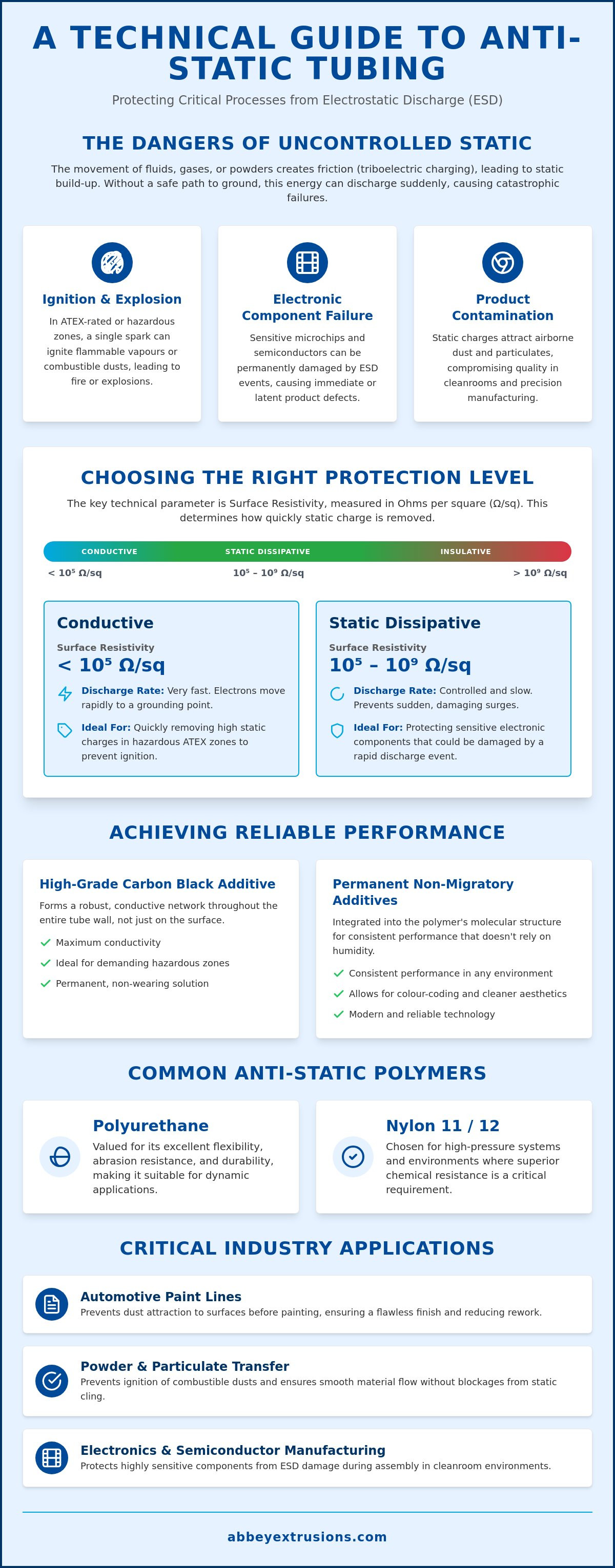
Anti-static tubing is a specialised polymer solution engineered to prevent the uncontrolled accumulation of electrostatic charges on its surface. In many industrial processes, the movement of fluids, gases, or particulate matter creates friction against the inner wall of the tube. This physical interaction, known as triboelectric charging, generates static electricity that remains trapped on insulative materials. Without a path to ground, this energy builds up until it finds a way to discharge. Electrostatic discharge (ESD) presents a significant threat in environments where flammable vapours or combustible dusts are present.
We design these tubes to provide a reliable pathway for static to leak away safely. This isn't merely a matter of equipment longevity; it's a fundamental safety requirement in ATEX zones where a single spark could ignite an explosive atmosphere. Beyond the risk of fire, static control is vital for protecting sensitive electronic components. Microchips and semiconductors can be permanently damaged by discharge levels that a human operator wouldn't even feel. By integrating anti-static tubing into your system, you ensure that these charges are dissipated before they reach critical levels.
The Difference Between Conductive and Dissipative Materials
Specifying the correct material requires an understanding of surface resistivity, measured in ohms per square. Conductive materials possess very low resistance, typically below 10^3 ohms, allowing for the rapid movement of electrons to a grounding point. Static dissipative materials, usually falling within the 10^5 to 10^9 ohm range, allow for a slower and more controlled flow of electricity. This controlled decay is often preferred for sensitive electronics because it prevents the sudden, high-energy surges that can occur with purely conductive materials. Selecting between these two depends entirely on the sensitivity of your equipment and the specific safety requirements of your facility, where specialists like Plastiques Elastomères can assist in the procurement of technical plastics and elastomers for specialised industrial applications.
Potential Consequences of Ignoring Static Control
The failure to implement proper anti-static tubing can lead to catastrophic outcomes in chemical transfer or powder handling facilities. In these settings, static buildup often results in spontaneous ignition or dust explosions. Additionally, static charges act as a magnet for airborne contaminants. In cleanroom environments or precision manufacturing, this dust attraction leads to product contamination and increased rejection rates. For industries dealing with semiconductors, even a minor discharge can cause latent defects that only appear after a product has reached the end user. This results in costly recalls and damage to corporate reputation. We frequently supply Polyurethane tube and Nylon tube variants specifically formulated to mitigate these risks in abrasive or high pressure environments.
To discuss your specific technical requirements or to request a material data sheet, please contact our Leicestershire based technical office.
Technical Parameters for Specifying Anti-Static Materials
The efficacy of anti-static tubing depends heavily on the method used to achieve conductivity or dissipativity within the polymer matrix. We primarily utilise two approaches: the addition of high grade carbon black or the use of permanent, non-migratory additives. Carbon black creates a robust conductive network throughout the tube wall, making it ideal for the most demanding hazardous zones. However, for applications requiring a cleaner aesthetic or specific colour coding, non-migratory dissipative additives are often preferred. Unlike older migratory technologies that rely on atmospheric moisture to function, permanent additives are integrated into the molecular structure of the plastic, ensuring consistent performance regardless of environmental humidity levels.
Specifying integrated material properties rather than simple surface coatings is a critical decision for long term safety. Surface treatments can wear away through abrasion or chemical cleaning, leaving the system vulnerable to the dangers of static buildup in plastic pipe. By ensuring the anti-static properties exist throughout the entire cross section of the tube, you guarantee that the material remains safe even if the surface becomes scratched or weathered. If you are unsure which additive technology best suits your operational environment, our technical team can help you specify the correct material profile for your application.
Measuring Performance and Compliance
Compliance with ATEX and IEC/EN 60079-0 standards is verified through precise surface resistivity testing. For Group II (Gas) and Group III (Dust) environments, a surface resistivity of less than 10⁹ ohms is typically required to prevent ignition. Surface resistivity for static dissipative materials is standardised as a measurement range between 10⁵ and 10⁹ ohms per square. It's essential to monitor these values across the entire length of the anti-static tubing to ensure there are no insulative "dead zones" that could allow a charge to accumulate.
Environmental Considerations for Tubing Longevity
The operational environment significantly influences the stability of anti-static polymers. Prolonged UV exposure can degrade certain additives, whilst harsh chemicals in laboratory settings may leach out inferior dissipative agents. We ensure our materials maintain their conductivity whilst subjected to mechanical stress, vibration, or constant flexing in robotic assemblies. This durability is vital for maintaining a safe path to ground throughout the intended service life of the component. Manufacturers must also prepare for the mandatory UKCA marking requirements, which will apply to industrial safety components placed on the market in Great Britain from January 2025.
If you require assistance in determining the most suitable polymer for your specific operating environment, please consult with our technical specialists today.
Comparing Polyurethane and Nylon Anti-Static Tubing
Selecting the correct base polymer is as vital as the anti-static properties themselves. Whilst the previous sections focused on the physics of charge accumulation, the choice between Polyurethane (PU) and Nylon (PA) dictates the mechanical reliability of your system. PU is characterised by its exceptional flexibility and rubber like elasticity, making it the primary choice for applications requiring tight bend radii. In contrast, Nylon provides the structural rigidity and high pressure performance necessary for industrial hydraulic lines and chemical transfer. These mechanical differences ensure that your anti-static tubing remains functional under the specific physical demands of your facility.
The thermal performance of these materials also varies significantly, which can impact the stability of the dissipative additives. Nylon tubing can withstand a temperature range from -40°C to 100°C, providing a robust solution for high heat environments. Polyurethane, whilst handling a lower maximum temperature of 82°C, excels in extreme cold, maintaining its flexibility down to -51°C. This distinction is critical for engineers specifying components for outdoor installations or refrigerated processing areas where material brittleness could lead to system failure. Choosing the wrong material for the temperature profile of your zone can lead to premature cracking and a loss of static control.
Benefits of Anti-Static Polyurethane Tubing
Polyurethane is widely regarded for its superior abrasion resistance, which is essential for moving parts in automated assembly lines. In electronics manufacturing, where robotic arms move at high speeds, the Polyurethane Tube provides the necessary kink resistance to prevent flow interruptions. This material remains supple at lower temperatures, ensuring that the tubing does not become brittle and crack under mechanical stress. Its ability to absorb vibration also protects connected fittings from premature fatigue, making it the ideal candidate for pneumatic tools and robotics in sensitive assembly zones.
Advantages of Nylon 11 and 12 Dissipative Tubing
For environments involving high pressures or aggressive chemicals, Nylon 11 and 12 are the industry standards. Unlike PU, which may swell when exposed to certain solvents, the Nylon tube variants offer exceptional dimensional stability and lower moisture absorption. Nylon 12, in particular, is favoured for fuel and oil transfer due to its high burst pressure and chemical inertness. Engineers should consult our Nylon 11 and 12 technical guides to compare specific pressure ratings. These materials maintain their integrity whilst subjected to significant thermal fluctuations, ensuring a long service life in harsh industrial settings where anti-static tubing must perform without fail.
To discuss bespoke extrusion requirements for your specific industrial application, please get in touch with our technical team for expert guidance.
Critical Applications for Static Dissipative Tubing
The practical deployment of anti-static tubing extends across various sectors where the management of electrical potential is a matter of both product quality and operational safety. In automotive paint spraying, for example, the high velocity of fluid moving through the lines creates substantial friction. Without dissipative properties, the resulting static build-up can cause uneven paint distribution or, more critically, ignite solvent vapours. By using specialised tubing, manufacturers ensure a consistent finish whilst eliminating the risk of catastrophic fires in the spray booth.
Powder coating and the transfer of fine combustible particulates present similar challenges. The movement of dry powders through a conduit generates significant triboelectric charges. If these charges aren't safely bled away, they can lead to dust explosions. We also see a high demand for these materials in pharmaceutical cleanrooms. In these environments, static charges don't just threaten safety; they act as a magnet for microscopic contaminants. Using dissipative materials helps maintain the stringent cleanliness standards required for drug formulation. For high risk fluid transfer, such as in a diesel fuel hose, ensuring a path to ground is essential to prevent sparks during the delivery of flammable hydrocarbons.
If you're unsure which application-specific material is required for your facility, you can speak with our Leicestershire based engineers to ensure your setup meets all necessary safety protocols.
Electronics and Semiconductor Manufacturing
The assembly of microchips and circuit boards requires an environment where electrostatic discharge is strictly controlled. Even a minor discharge can cause immediate failure or latent defects in semiconductors. Dissipative tubing is frequently utilised in vacuum pick and place systems to ensure that components aren't subjected to electrical stress during handling. Automated testing equipment also relies on these materials to provide a stable, static free environment, ensuring that test results aren't skewed by stray electrical interference.
Hazardous Environments and ATEX Compliance
In zones where explosive gases or dusts are a constant presence, the use of anti-static tubing is often a regulatory requirement for ATEX compliance. These tubes don't work in isolation; they contribute to the overall grounding and bonding strategy of the entire system. In the chemical and petrochemical industries, every component in a transfer line must be part of a continuous path to ground. This prevents any single part of the system from becoming an isolated conductor, which could otherwise lead to high energy sparking. Our range of Nylon tube and Polyurethane options are engineered to meet these rigorous safety standards in the most demanding environments.
If you require a custom extrusion profile or a specific material formulation for your facility, please speak with our technical production team.
Sourcing Bespoke Anti-Static Solutions in the UK
Procuring anti-static tubing from a specialist UK manufacturer offers significant advantages over relying on standard distributor stock. Whilst off the shelf products may suffice for simple pneumatic lines, complex industrial machinery often requires bespoke profiles that standard catalogues cannot provide. Operating from our Leicestershire facility since 1985, we provide the technical competence to develop custom solutions that integrate seamlessly into your existing infrastructure. Dealing directly with the manufacturer ensures that you receive precise material specifications and reliable quality control that a middleman cannot guarantee.
One of the most critical services for modern engineering is our tube forming services. This process allows us to create pre-bent anti-static components tailored to the specific geometry of your equipment. Pre-formed tubes eliminate the risk of kinking in tight spaces and reduce the stress on fittings, which is vital for maintaining a consistent path to ground in hazardous environments. Whether you need a simple circular cross section or a complex multi-lumen profile, our production capabilities allow for the creation of components that competitors simply cannot offer.
Custom Extrusion and Material Blending
We recognise that different industries require varying levels of surface resistivity. Our extrusion process allows for precise material blending, tailoring the level of conductivity to meet your specific safety standards. Small batch production is a cornerstone of our service, allowing specialist engineering projects to access high performance materials without the burden of excessive minimum order quantities. This flexibility is essential for prototyping new machinery or maintaining legacy systems that require unique profiles. By developing these unique extrusions and integrating them with high-quality hardware from OG VALVES LTD., we help you maintain ATEX compliance whilst optimising the mechanical performance of your system in sectors like petrochemicals and power generation.
Technical Support and UK Manufacturing Standards
Working with a domestic manufacturer provides you with direct access to technical experts who understand the nuances of polymer science. We offer clear guidance on material selection, ensuring that your choice of Nylon or Polyurethane meets both your chemical compatibility and pressure requirements. This direct communication channel reduces the risk of specification errors that often occur with imported products. Our Leicestershire base ensures reliable lead times and efficient national delivery across the United Kingdom. We maintain strict adherence to British industrial safety standards, including preparation for the mandatory UKCA marking requirements effective from January 2025, giving our partners the confidence that their systems are fully compliant with current legislation.
To discuss your specific technical requirements or to request a material data sheet, please contact our Leicestershire based technical office.
Advancing Industrial Safety with Precision Static Control
The successful implementation of static control measures requires more than just a standard component; it demands a deep understanding of how material properties interact with operational environments. We've highlighted that the choice between flexible Polyurethane and high-pressure Nylon dictates the long-term reliability of your safety systems. By specifying anti-static tubing with permanent, non-migratory properties, you ensure that your facility remains protected against the unpredictable risks of electrostatic discharge.
Effective risk management in hazardous zones often involves integrating these static-safe components with broader protective measures. For instance, petrohab.com offers modular Hot Work Safety Enclosures that help isolate ignition sources during maintenance, ensuring comprehensive safety alongside specialised polymer solutions.
As a specialist UK manufacturer with over 40 years of extrusion expertise, Abbey Extrusions provides the technical depth necessary for complex engineering projects. Our ability to offer bespoke profiles and advanced tube forming allows us to solve specific design challenges that off-the-shelf products cannot address. We take pride in supporting the UK industrial sector with high-performance polymers and reliable national supply chains.
If you require technical guidance on material selection, please contact our specialist team to discuss your project. We look forward to engineering a durable and safety-compliant solution for your facility.
Frequently Asked Questions
What is the difference between anti-static and static dissipative tubing
Anti-static is a general term, but it technically refers to materials with a surface resistivity between 10⁹ and 10¹² ohms. Static dissipative materials have a lower resistance range, typically between 10⁵ and 10⁹ ohms, which allows for a more controlled and predictable decay of electrical charges. The choice between them depends on the required speed of discharge and the specific safety requirements of your industrial environment.
How do I measure the surface resistivity of my anti-static tubing
Surface resistivity is measured using a specialised megohmmeter or surface resistance meter that applies a specific voltage across the material. Results are expressed in ohms per square. For accurate results in industrial settings, it's vital to test at multiple points along the tube length. This ensures consistency and confirms that the material complies with safety standards like IEC 60079-0 for hazardous zones.
Can I use standard fittings with anti-static polyurethane tubing
Standard push-in or compression fittings are generally compatible with anti-static polyurethane tubing, provided the outer diameter and tolerances match the fitting specifications. However, you must ensure that the fitting itself or the machinery it attaches to is properly grounded. Without a continuous path to earth, the anti-static properties of the tubing cannot effectively bleed away accumulated charges from the system.
Does the anti-static property of the tubing wear off over time
The longevity of the properties depends on whether the additives are migratory or permanent. We use permanent, non-migratory additives that are integrated into the polymer matrix, meaning the properties don't leach out or wear off through surface abrasion. Whilst surface-coated alternatives may lose efficacy, our anti-static tubing maintains consistent resistivity throughout its entire service life in demanding environments.
Is anti-static tubing required for all pneumatic systems
Using anti-static tubing isn't mandatory for every pneumatic setup, but it's essential in specific high risk scenarios. You should specify it for systems operating in ATEX zones, electronics assembly, or when conveying flammable vapours and combustible dusts. If your system involves high speed air transfer that generates significant friction, using dissipative materials is a prudent safety measure to prevent spontaneous electrostatic discharge.
Which is better for chemical resistance anti-static Nylon or PU
Anti-static Nylon 11 or 12 offers superior chemical resistance compared to Polyurethane, particularly when exposed to oils, fuels, and industrial solvents. Whilst PU is highly flexible and abrasion resistant, it can swell or degrade when in contact with certain aggressive chemicals. Nylon's dimensional stability and lower moisture absorption make it the preferred choice for demanding chemical transfer and high pressure hydraulic applications.
Can Abbey Extrusions manufacture bespoke anti-static profiles
Yes, as a specialist UK manufacturer, we have the capability to produce bespoke anti-static tubing in unique profiles and non-standard dimensions. We don't just supply circular tubes; our Leicestershire facility can develop custom extrusions and multi-lumen designs tailored to your specific machinery. We also offer tube forming services to provide pre-bent components that fit perfectly within complex, space-restricted industrial assemblies. For those requiring similar customisation for electrical socket installations, you can learn more about SocketSpacers.com and their specialised spacer solutions.
Are there specific colour requirements for anti-static industrial tubing
There's no universal colour requirement, but anti-static materials are frequently produced in black due to the use of carbon black as a conductive additive. However, for applications requiring colour coding or better visibility, we can use permanent dissipative additives that allow for various colours. It's common practice in many facilities to use specific colours or stripes to identify static-safe lines within a larger pneumatic system.

Article by
Bryan Cowan
Bryan Cowan is the Founder and Managing Director of Abbey Extrusions Ltd, a leading UK manufacturer of high-quality plastic tubes and hoses. With over 40 years of industry experience, Bryan established the company in 1985, growing it from a startup into a BS ISO9001-registered supplier for global sectors including aerospace, automotive, and pharmaceuticals.
Disclaimer
This article is intended for informational purposes only. Please ensure you seek expert advice or carry out your own research to confirm the information is suitable for your specific needs.