Could a single millimetre of non-compliant tubing jeopardise your entire production line's legal standing under the July 2026 EU safety regulations? For many industrial engineers, the primary challenge involves more than just maintaining flow. It's about ensuring that every component, including your bespoke food grade plastic tubing, survives the rigours of chemical cleaning and thermal stress without compromising food safety. We recognise that navigating the recent ban on Bisphenol A (BPA) and the tightening restrictions on PFAS in food contact materials creates significant pressure on procurement and engineering teams alike.
Finding a manufacturer willing to produce custom sizes or complex shapes is often the final hurdle in maintaining a compliant and efficient facility. This guide explains how to specify bespoke food grade plastic tubing that meets strict safety standards whilst optimising your production efficiency. We will examine the technical properties of polymers such as LDPE and Nylon, clarify the intricacies of the bespoke extrusion process, and provide the criteria necessary to secure a reliable UK manufacturing partner for long term supply.
Key Takeaways
- Understand how to navigate the latest 2026 food safety regulations, including the specific bans on BPA and PFAS within production components.
- Identify the ideal polymer for your application, such as Nylon tube for mechanical strength or LDPE for flexibility and chemical resistance.
- Learn how to specify bespoke food grade plastic tubing with custom wall thicknesses to withstand thermal stress and increase production longevity.
- Explore specialised applications for food grade hoses, including the unique durability and purity standards required for a brewery hose.
- Discover the logistical and quality control benefits of collaborating directly with a technical UK manufacturer for your custom extrusion needs.
If you require technical guidance on material specifications or compliance documentation, please contact our specialist team to discuss your project requirements.
Regulatory Compliance and Safety Standards for Food Grade Tubing
Food grade plastic tubing refers to materials specifically engineered and rigorously tested to maintain safety during direct or indirect contact with consumables. These polymers must demonstrate non-toxic and non-leaching characteristics under standard operational stresses, including pressure fluctuations and temperature shifts. For high volume industrial production, selecting the correct bespoke food grade plastic tubing is essential to prevent chemical migration that could alter the taste, odour, or safety of the final product. We ensure that every custom profile we manufacture adheres to the strict purity standards required by modern processing facilities.
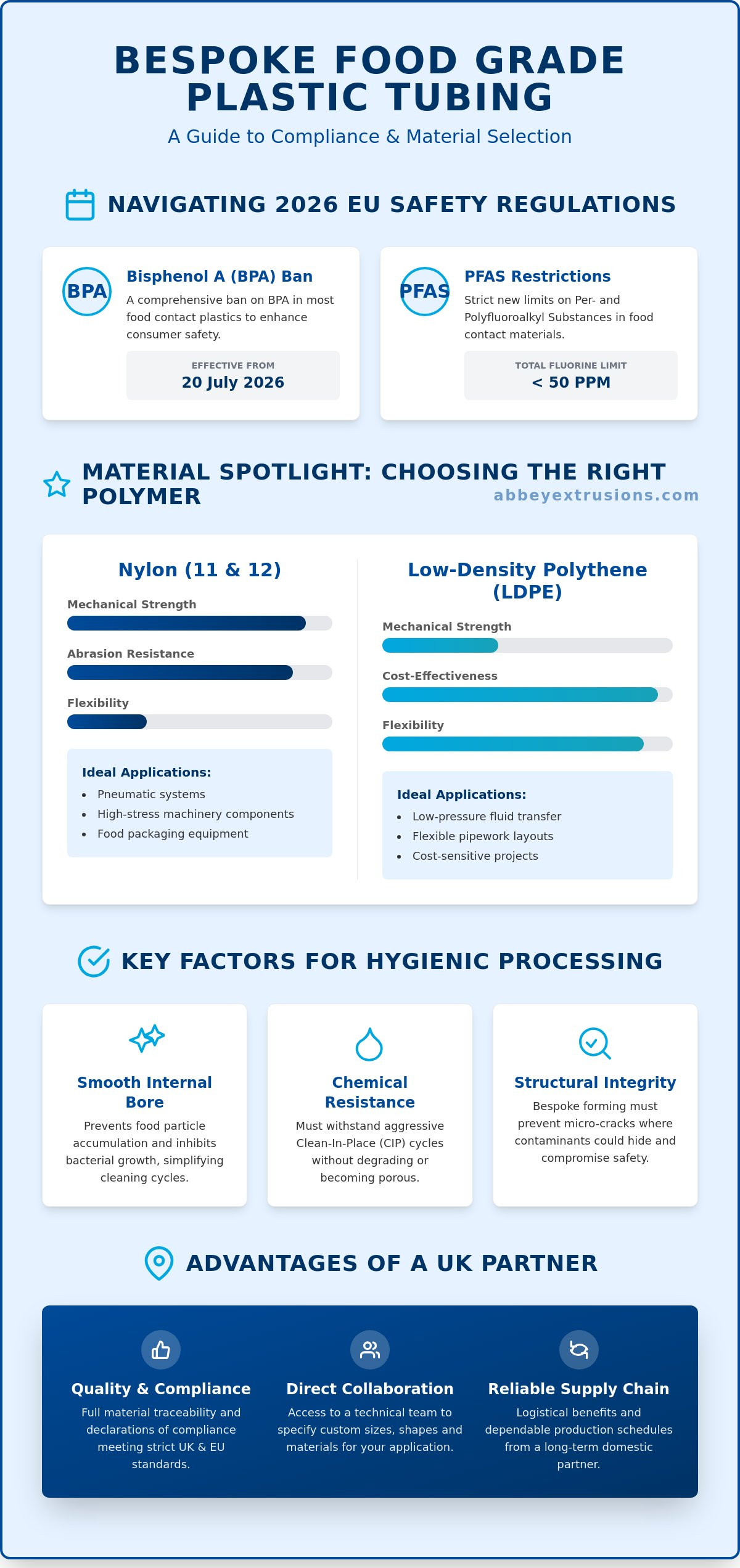
Global food contact material regulations provide the necessary framework for these safety assessments. Since 20 July 2026, the European Union has implemented a comprehensive ban on Bisphenol A (BPA) in most food contact plastics, with very limited exceptions for essential applications. As of 12 August 2026, strict limits on Per and Polyfluoroalkyl Substances (PFAS) are in effect, requiring manufacturers to prove that total fluorine levels remain below 50 parts per million. Staying ahead of these regulatory shifts is a core component of our technical manufacturing process at Abbey Extrusions.
FDA Approval and UK Food Safety Regulations
The US Food and Drug Administration (FDA) sets global benchmarks through Title 21 of the Code of Federal Regulations, specifically Part 177, which governs indirect food additives. Our manufacturing processes align with these international standards whilst also meeting domestic requirements set by the UK Food Standards Agency (FSA). The FSA is currently developing a new national food regulation system for large businesses, with proposals expected in March 2026. We provide full material traceability and declarations of compliance to ensure your bespoke food grade plastic tubing meets every audit requirement, from initial polymer sourcing to the final extruded product.
Avoiding Contamination in Food Processing
The surface finish of extruded tubing plays a vital role in hygiene management. A high quality, smooth internal bore prevents the accumulation of food particles and inhibits bacterial growth, which is critical during high volume runs. Chemical resistance is equally important; the tubing must withstand aggressive Clean In Place (CIP) cycles without degrading or becoming porous. When we perform tube forming for complex machinery layouts, we maintain the structural integrity of the polymer to ensure no micro cracks develop where contaminants could hide. The specific migration limit defines the maximum amount of a substance that can legally transfer from a polymer into food to ensure consumer safety remains uncompromised.
For technical assistance in selecting the correct polymer for your system, please speak with our engineering department.
Material Selection for Custom Food Grade Applications
Selecting the right material is a precise engineering task. It requires balancing temperature, pressure, and chemical exposure. Choosing the wrong material can lead to premature failure or, more critically, breach the FDA safety concerns for food-contact plastics. When we manufacture bespoke food grade plastic tubing, we consider how these factors interact to ensure the mechanical integrity of the system remains intact over thousands of operational hours. The distinction between flexible and semi-rigid polymers often dictates the machinery configuration and the ease of installation within tight production layouts.
Nylon and LDPE Tubing for Food Contact
Nylon 11 and Nylon 12 are frequently selected for applications requiring high dimensional stability and superior mechanical strength. A Nylon tube provides excellent resistance to crushing and abrasion, making it suitable for pneumatic systems within food packaging machinery. In contrast, low density polythene tube is the industry standard for low pressure fluid transfer due to its high degree of flexibility and cost effectiveness. LDPE remains inert when in contact with a wide variety of chemicals, which is why it is often chosen for beverage dispensing systems. For a more comprehensive look at the chemical resistance profiles of these materials, you may refer to our technical guide on polyethylene tubing.
High Performance Fluoropolymers and Polyurethane
When production environments involve extreme thermal stress, fluoropolymers such as PTFE, FEP, or PFA become necessary. These materials maintain their physical properties at temperatures that would cause standard polymers to fail, ensuring that high heat sterilisation processes do not damage the tubing. For dry food handling or systems involving abrasive particulates, Polyurethane (PU) is the preferred choice. PU offers exceptional tear resistance and flexibility, which is vital for machinery with complex, moving parts. We also offer options for visual flow monitoring; clear materials allow operators to verify the presence of fluid or detect blockages instantly, whilst opaque materials provide protection for light sensitive ingredients. If you require a specific material sample or technical datasheet, our technical team is available to provide detailed specifications.
For a detailed consultation on custom profile development and specific manufacturing tolerances, please get in touch with our technical sales team.
Bespoke Extrusion and Tube Forming Capabilities
Standard industrial tubing often fails to meet the exact spatial or hydraulic requirements of specialised food processing machinery. By choosing bespoke food grade plastic tubing, engineers can specify dimensions that align perfectly with existing fittings and flow rate calculations. Our precision tooling allows us to maintain the tight tolerances required by the FDA regulations for food-contact polymers, ensuring that every millimetre of the extrusion meets safety and performance criteria. We move beyond simple circular profiles to create custom shapes and sections that integrate seamlessly into complex production environments.
The advantage of custom extrusion lies in the ability to optimise a component for its specific task. Whilst off the shelf products require compromises in layout or pressure handling, a bespoke solution is engineered from the ground up to handle the specific stressors of your facility. This methodical approach to manufacturing reduces the risk of premature tube failure and ensures that your production line remains both compliant and efficient over the long term.
Custom Sizes and Wall Thicknesses
Tailoring internal and external diameters allows for precise control over fluid velocity and pressure drop. This level of customisation often eliminates the need for expensive adaptors or reducers, which can become points of failure or bacterial traps in a food environment. By adjusting wall thicknesses, we can significantly improve the pressure ratings and durability of the tubing without changing the material itself. For organisations engaged in new product development, we offer prototype runs that allow for real world testing and validation before committing to large scale production volumes.
Advanced Tube Forming and Coiling Services
The secondary process of tube forming is what truly sets custom manufacturing apart from stock supply. By applying controlled heat and precision jigs, we create permanent bends and complex geometries that retain their shape throughout the tube's service life. Pre-formed tubing reduces the mechanical stress placed on connections and fittings, as the material is not being forced into position during installation. Additionally, our custom coiling options provide significant space saving advantages for compact food processing units where traditional straight lengths would be impractical. This structured approach to design ensures that the final assembly is robust, hygienic, and easy to maintain.
To receive a technical specification for your specific food processing application, please request a consultation with our manufacturing specialists.
Industrial Applications for Specialised Food Grade Hoses
Industrial manufacturing landscapes are varied and demanding. Bespoke food grade plastic tubing is a fundamental component in sectors ranging from confectionery production to automated bottling plants. These systems frequently transport volatile liquids, including hot fats, vegetable oils, and highly acidic fruit concentrates. If the material selection is incorrect, these substances can cause the polymer to swell or become brittle, leading to catastrophic line failure. Our extrusion process ensures that the finished product maintains its chemical resistance across a wide range of pH levels, supporting the integrity of the entire supply chain and ensuring a hygienic transfer in automated packaging lines.
The choice of hosing affects more than just the flow of ingredients; it impacts the safety and longevity of the entire machinery setup. By utilising custom-engineered solutions, facilities can avoid the common pitfalls of off-the-shelf products that aren't designed for specific chemical or thermal stressors. This methodical approach to component selection is what allows high-volume producers to maintain consistent output whilst adhering to the most stringent safety audits.
This degree of customisation is also essential for mobile food businesses and delivery fleets that require integrated processing equipment; for those looking to adapt vehicles for such specialised industrial roles, check out Auto Industries Factory LLC.
Brewery and Beverage Transfer Solutions
Flavour neutrality isn't just a preference; it's a quality control necessity. In the distillery and brewery sectors, any interaction between the liquid and the hose wall can ruin entire batches. A brewery hose must be specifically formulated to resist the absorption of aromas and colours whilst managing high-pressure washdown procedures. For engineers needing to calculate the specific safety margins for their systems, our technical overview of nylon tubing offers comprehensive pressure rating information. Utilising a high-grade Nylon tube provides the necessary mechanical strength to handle these cyclic stresses without compromising the purity of the beverage.
Dairy and Liquid Food Processing Systems
Dairy processing requires materials that inhibit the adhesion of proteins and fats. If these biological materials accumulate, they can bypass standard cleaning protocols and lead to bacterial harbourage. We manufacture specialised hoses that utilise materials with low surface energy to ensure a clean sweep during every cycle. For heavy-duty suction and delivery tasks, reinforced hoses provide the necessary collapse resistance. These components must also remain functional in cold storage areas where temperatures can drop significantly. By selecting polymers that retain their elastic properties in sub-zero conditions, we prevent the brittleness that often leads to leaks in refrigerated environments. For more information on our specific material capabilities, speak with our technical team today.
To discuss your specific production requirements with a UK based extrusion specialist, please contact our technical team for a detailed consultation.
Choosing a UK Manufacturer for Bespoke Tubing Requirements
Sourcing critical components for food production requires a partner who understands the nuances of the UK industrial landscape and the specific demands of local safety audits. Choosing a domestic specialist for your bespoke food grade plastic tubing ensures that quality control is handled on-site, with direct oversight of every extrusion run from the initial material feed to the final inspection. Since 1985, we've focused on delivering technical excellence from our UK facility, allowing us to maintain the rigorous standards expected by the food and brewery sectors. Sourcing locally eliminates the vulnerabilities associated with international logistics, such as extended lead times or fluctuating shipping costs, which can disrupt a tightly managed production schedule and inflate operational budgets.
The stability provided by a domestic manufacturer is vital for maintaining high volume output. When you work with a UK based extrusion specialist, you gain the advantage of transparent communication and a shared understanding of the regulatory environment. This proximity allows for more frequent quality audits and a faster response to any technical queries that may arise during the specification phase. By keeping the supply chain short, we help you maintain a leaner inventory whilst ensuring that your bespoke components are always available when needed.
Technical Support and Material Expertise
Engineers often face significant design challenges when integrating new machinery or upgrading existing lines to meet modern safety benchmarks. Direct access to a manufacturer's material expertise allows for a collaborative approach to problem solving, ensuring that the chosen polymer is perfectly suited to the application's unique chemical and thermal profile. We provide detailed guidance on navigating complex material compatibility charts, drawing on decades of experience in the plastic extrusion industry to solve hurdles that off the shelf suppliers cannot address. This technical partnership provides a level of security that is essential when specifying components for high volume food contact applications.
Reliable Supply Chains for British Manufacturing
For British manufacturing to remain competitive and resilient, a stable supply of bespoke components is essential for long term production continuity. We focus our expertise on technical manufacturing and tube forming, rather than diverting resources to on-site installation, to ensure our production capacity remains dedicated to high precision extrusion. This focus allows us to provide a reliable supply of bespoke food grade plastic tubing that supports continuous production without the threat of component shortages or quality drift. Bespoke food grade plastic tubing provides a high performance solution that integrates precision dimensions, verified polymer purity, and custom geometries to eliminate process bottlenecks whilst ensuring total regulatory compliance. Working with a UK based specialist allows for more agile responses to design changes, ensuring your facility remains at the forefront of industrial efficiency.
If you require technical guidance on polymer selection or custom profile specifications, please contact our technical team for your bespoke tubing requirements.
Engineering a Compliant and Efficient Production Future
Achieving long term production integrity relies on the precise alignment of material science and custom engineering. Throughout this guide, we've detailed how adhering to the latest safety standards and selecting the correct polymer can safeguard your facility against contamination and mechanical failure. Integrating bespoke food grade plastic tubing into your machinery allows for a level of precision and durability that standard components simply cannot match, ensuring your flow systems are optimised for their specific environment.
Our role as a specialist UK manufacturer since 1985 is to provide the technical support and manufacturing capacity needed for high performance industrial applications. With our extensive bespoke tube forming and extrusion capabilities, we specialise in high performance polymers that meet the most demanding safety audits. We invite you to contact our technical team for your bespoke tubing requirements to ensure your next project is built on a foundation of quality and expertise. We look forward to supporting your production goals with reliable, British manufactured solutions.
Frequently Asked Questions
What makes plastic tubing food grade
Plastic tubing is classified as food grade when it's manufactured from polymers that have been verified as safe for contact with consumables. These materials must be non-toxic and demonstrate that they won't leach harmful chemicals into the food product under operational conditions. We ensure all our extrusions meet the specific migration limits set by international safety bodies to maintain the purity of your production line.
Which materials are best for brewery hoses
Flavour neutrality is the most critical factor when selecting a brewery hose to ensure the final product remains untainted. We recommend using high grade Nylon 11 or Nylon 12 because these materials don't absorb odours or colours from the liquids they transport. These polymers also provide the mechanical strength needed to handle the high pressure washdown cycles that are common in commercial brewing environments.
Can food grade tubing handle high temperatures
Yes, specific polymers are engineered to maintain their integrity at extreme temperatures without degrading. Fluoropolymers such as PFA and FEP are frequently used in thermal food processing because they don't lose their physical properties when exposed to intense heat. This makes them the ideal choice for systems that require high heat sterilisation or the transfer of boiling liquids during production.
Is bespoke tubing available in small production runs
We provide prototype runs for organisations engaged in new product development to allow for real world testing. This service ensures that your bespoke food grade plastic tubing meets every technical requirement before you commit to full scale production. Our UK based facility is equipped to handle both specialised small batches for development and high volume industrial orders for long term supply.
How do you ensure FDA compliance for custom extrusions
Ensuring compliance for custom extrusions involves using raw materials that appear on the FDA's authorised safe list. We maintain strict documentation and material traceability throughout the entire manufacturing process at our UK site. This provides a clear audit trail from the initial polymer source to the final finished product, ensuring your facility passes every safety audit with ease.
What is the difference between food grade PVC and standard PVC
Food grade PVC is manufactured without certain phthalates and heavy metal stabilisers that are often found in standard industrial grades. These specialised variants are formulated to be inert and safe for liquid transfer without risking chemical migration. Using standard PVC in a food environment is a significant risk that could lead to product contamination and a breach of safety regulations.
Do you offer custom tube forming for pre bent shapes
We offer advanced tube forming services to create permanent bends and complex geometries for specific machinery layouts. This process involves using precision jigs and controlled heat to set the tube into a permanent shape that won't revert during its service life. Pre formed tubing reduces mechanical stress on fittings and simplifies the installation process in compact food processing units.
Can food grade tubing be made anti static
Specific formulations allow bespoke food grade plastic tubing to be made anti static for handling dry powders or volatile ingredients safely. We integrate conductive additives into the polymer that prevent the buildup of static electricity whilst maintaining full compliance with food safety regulations. This is a vital safety feature for preventing dust explosions in processing plants that handle fine, dry particulates.

Article by
Bryan Cowan
Bryan Cowan is the Founder and Managing Director of Abbey Extrusions Ltd, a leading UK manufacturer of high-quality plastic tubes and hoses. With over 40 years of industry experience, Bryan established the company in 1985, growing it from a startup into a BS ISO9001-registered supplier for global sectors including aerospace, automotive, and pharmaceuticals.
Disclaimer
This article is intended for informational purposes only. Please ensure you seek expert advice or carry out your own research to confirm the information is suitable for your specific needs.