Why should your high-specification machinery be forced to accommodate "standard" dimensions when your engineering requirements demand absolute precision? We understand that many procurement teams struggle with the confusion between metric and imperial measurements or the inconsistent tolerances often found in retail-grade supplies. Selecting the correct flexible plastic tubing sizes is not merely a matter of checking a catalogue; it is a technical decision that impacts the efficiency and safety of your entire operation. At Abbey Extrusions, we have observed how even minor deviations in diameter can lead to significant performance issues in high-pressure or critical fluid transfer systems.
This article provides a comprehensive framework for specifying dimensions for industrial applications and explains the significant benefits of opting for bespoke extrusion for volume orders. You will discover how different polymers, such as Nylon 12 or Polyurethane, affect final wall thickness and how our Leicestershire-based facility maintains the precise tolerances necessary for critical systems. We shall also address how recent shifts in resin availability and new technical standards for polyethylene piping systems, such as the ISO updates published in March 2026, influence the procurement process for large-scale industrial projects.
Key Takeaways
- Learn how to accurately specify flexible plastic tubing sizes by understanding the relationship between internal and external diameters for proprietary machinery.
- Understand how material density and polymer choice affect manufacturing tolerances to ensure reliable performance in critical industrial settings.
- Discover the methodology for securing bespoke dimensions when standard metric or imperial retail sizes fail to meet your specific engineering requirements.
- Identify the economic and logistical benefits of sourcing large volume orders directly from a specialist UK manufacturer for improved supply chain stability.
- Review the importance of British Standards for wall thickness and dimensional consistency across extensive production cycles.
To discuss your specific volume requirements for custom extrusions, please contact our technical sales team.
Standard Dimensions for Flexible Plastic Tubing in Industrial Environments
Industrial systems rely on precise measurements to ensure leak-free connections and operational safety. Flexible plastic tubing sizes are fundamentally defined by the interaction between the outer diameter (OD) and the inner diameter (ID). Whilst metric dimensions are the standard in modern UK manufacturing, imperial sizes remain prevalent in specific sectors like pneumatics or when maintaining legacy equipment. For a broader understanding of material standards, one can review the Standard Dimensions for Flexible Plastic Tubing used across various engineering disciplines. Proper specification ensures that the tubing integrates seamlessly with push-fit or barbed fittings, preventing costly downtime caused by improper seals.
Common Metric and Imperial Size Ranges
Most UK industrial applications utilise a standard metric range spanning from 3mm to 30mm outside diameter. Common increments like 4mm, 6mm, 8mm, and 12mm are frequently used for Nylon tube and Polyurethane tube in automated assembly lines. Imperial sizes, often expressed in fractions such as 1/4 inch or 1/2 inch, are still widely required for export markets or legacy machinery. Precision engineering demands an accurate translation of these fractions into decimal millimetres to maintain tight tolerances. Different industries favour specific size increments; for instance, the brewery and food sectors often require bespoke internal diameters to manage flow rates for specific liquids. We provide a wide variety of PVC tube options that can be manufactured to these precise requirements.
The Relationship Between ID OD and Wall Thickness
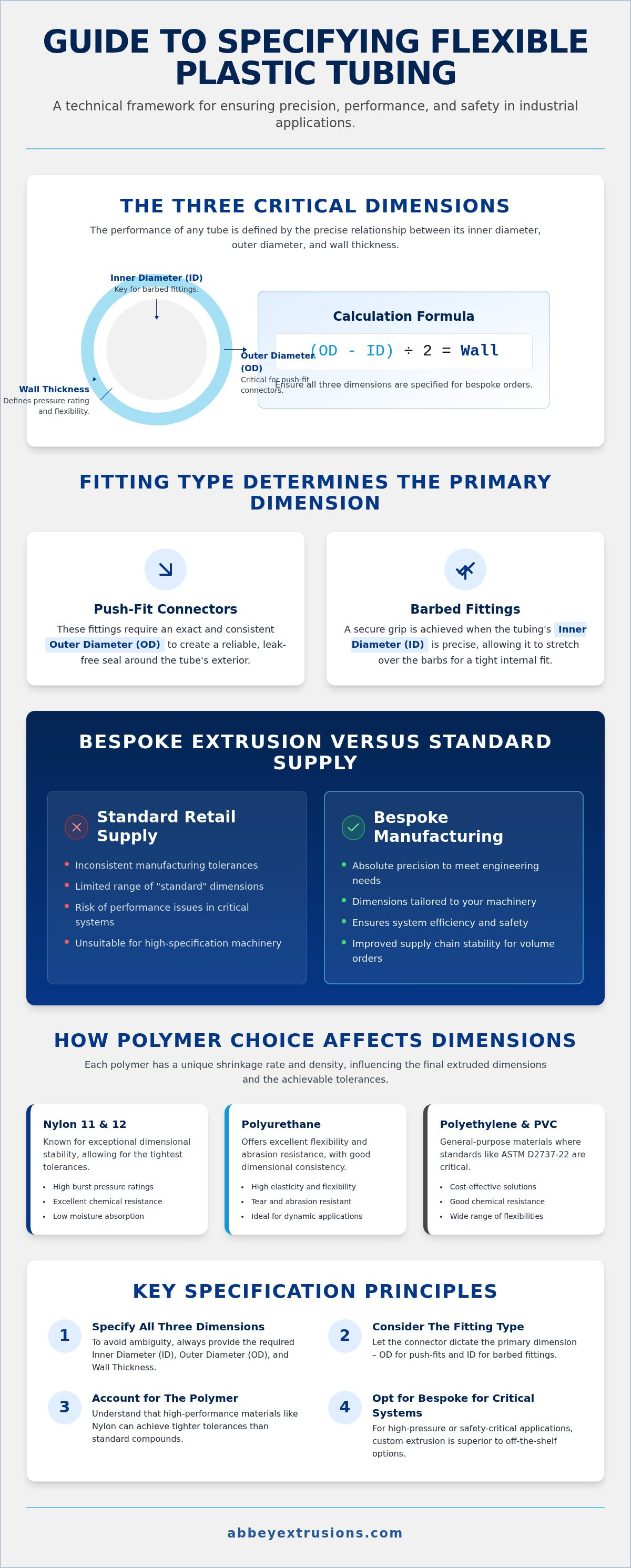
The performance of a tube is largely determined by its wall thickness, which is the difference between the OD and the ID. Fittings usually dictate which dimension is primary. Push-fit connectors require a precise OD, whilst barbed fittings depend on a consistent ID for a secure grip. Wall thickness is a critical dimension for pressure ratings and structural integrity. A thicker wall generally increases the pressure capacity but also makes the tube stiffer and more prone to kinking if bent too tightly. Conversely, a thinner wall provides greater flexibility but may collapse under vacuum or fail under high pressure. When requesting custom extrusion projects, it is vital to specify all three dimensions. This clarity allows us to organise the production process to meet your exact engineering needs. We understand that standard retail options often fail to provide the necessary balance of these three factors for specialised machinery.
To discuss your specific requirements for bespoke polymer extrusions, please contact our technical specialists.
Dimensional Variations Across Different Polymer Materials
Material density and molecular structure play pivotal roles in determining how a polymer behaves during the cooling phase of the extrusion process. High-performance plastics like Nylon 11 and 12 exhibit superior dimensional stability, which allows our production team to achieve tighter tolerances than those possible with standard PVC compounds. When procurement teams specify flexible plastic tubing sizes, they must account for the specific shrinkage rates inherent to each resin. For example, Polyethylene extrusions must strictly adhere to the ASTM D2737-22 standard to ensure that wall thickness and outer diameters remain within the exact parameters required for industrial fluid handling. These variations are not merely technical details; they dictate the long-term reliability of the component in a working environment.
Nylon 11 and 12 Tubing Specifications
Nylon extrusions are widely respected for their high burst pressure ratings and exceptional resistance to chemical degradation. We manufacture Nylon tube with a level of precision that serves the demanding requirements of the automotive and pneumatic sectors. These industries rely on consistent diameters for fuel lines and air brake systems where a failure in measurement could lead to system collapse. The technical requirements for these materials are distinct from other options; for a comparison of how different constructions behave, you can refer to our engineering guide to reinforced PVC hose. This resource explains how internal reinforcement layers can affect the final dimensional footprint and flexibility of the hose, providing a useful benchmark for material selection.
LDPE and Polyurethane Dimensional Traits
low density polythene tube remains a staple in laboratory and chemical transfer settings due to its inert nature and cost-effectiveness for large-volume orders. Whilst LDPE provides a reliable standard for many flexible plastic tubing sizes, it lacks the elastic memory found in Polyurethane. In contrast, polyurethane tube is the preferred choice for installations requiring a tight bend radius without the risk of kinking. The Shore hardness rating of the polyurethane resin is a critical factor; softer polymers may exhibit slight compression during the fitting process, whereas harder grades provide a more rigid and predictable outer diameter for push-fit connectors. If your application involves non-standard dimensions or specific polymer blends, we suggest you speak with our engineering department to ensure the final product meets your operational criteria.
Physical size is never static in industrial environments. Thermal expansion can cause a tube to expand or contract, potentially loosening a fitting or restricting flow. Polyurethane, whilst flexible, is more sensitive to temperature fluctuations than Nylon. Engineers must consider the operating environment when specifying dimensions to ensure a secure fit throughout the machinery's thermal cycle. By selecting the correct material from the outset, you can mitigate the risks associated with dimensional instability and ensure a longer service life for your equipment.
To discuss your volume orders and bespoke dimensional requirements, please enquire about our custom extrusion services.
How to Correctly Specify Sizes for Custom Plastic Extrusion
Specifying bespoke flexible plastic tubing sizes requires a methodical approach to ensure the final product integrates perfectly with your proprietary machinery. The initial consultation focuses on the critical interface between the tube and its connectors. It's essential to identify whether the internal diameter (ID) or outside diameter (OD) is the primary dimension for your application. For example, pneumatic systems using push-fit connectors rely on a precise OD, whereas fluid transfer systems using barbed fittings require a consistent ID to maintain a secure seal. We work closely with your engineering team to define these parameters, accounting for the natural manufacturing tolerances that occur during high-volume extrusion.
Validating non-standard dimensions often involves the production of samples. This stage is vital for critical applications where a fraction of a millimetre determines the success of a connection. By testing a physical sample within your specific assembly, you can confirm kinking resistance and fitting compatibility before we commence full-scale production. This structured approach reduces the risk of costly errors and ensures that the final volume order meets every technical requirement. We don't simply manufacture to a list; we manufacture to a specific engineering purpose.
Step by Step Specification Process
The process begins by identifying the medium being transported, as this dictates the necessary wall thickness and material choice. You should then measure the connection points carefully to ensure compatibility with either standard or bespoke fittings. It's also important to define the required delivery format. Whether you need specific straight cut lengths for immediate assembly or continuous coiled sections for your own processing, we can organise the production to align with your requirements. Clear communication regarding the operating pressure and temperature range is also necessary to determine if the specified wall thickness is sufficient for the intended load.
Tube Forming for Specific Geometry
For applications requiring complex routing within a chassis or machinery housing, tube forming provides a significant advantage. This process allows the flexible plastic tubing sizes to be maintained even through intricate bends, preventing the collapse of the internal diameter. Pre-formed sections are particularly beneficial for large orders, as they drastically reduce assembly time and eliminate the stress that manual bending places on the material. However, technical limitations regarding bending radii must be considered. The minimum radius is typically determined by the tube diameter and wall thickness to avoid structural failure. Our team provides guidance on these limits during the design phase to ensure the longevity of the component within your system.
To ensure your project meets the necessary British Standards for dimensional precision, please request a technical consultation with our engineering team.
The Importance of Wall Thickness and Tolerances in Tube Performance
In the manufacturing of extruded profiles, absolute precision is a theoretical ideal rather than a constant reality. Whilst we strive for perfection, all flexible plastic tubing sizes are produced within specific tolerance bands defined by international norms and British Standards. These variations occur due to fluctuations in melt temperature, haul-off speed, and the cooling characteristics of different polymers. For engineers, understanding these deviations is critical. A tube that's slightly oversized may not fit into a standard pneumatic connector, whilst an undersized tube could fail to seal against a barbed fitting. Environmental exposure also alters these dimensions over time. UV radiation can cause PVC to become brittle and shrink, whilst Nylon, being hygroscopic, may expand slightly as it absorbs moisture from the atmosphere.
Understanding Tolerance Classes
We categorise tolerances based on the material and the diameter of the tube. High-performance polymers like Nylon 11 allow for much tighter control, often within +/- 0.1mm, due to their stable molecular structure. In contrast, softer materials like LDPE require wider tolerance bands to account for their greater elasticity when determining flexible plastic tubing sizes for non-critical uses. Abbey Extrusions maintains consistency across large-volume production runs by employing advanced monitoring systems that adjust extrusion parameters in real-time. This level of control ensures that every metre of tubing delivered to your facility meets the agreed specifications, regardless of the order size.
Calculating Pressure Ratings Based on Dimensions
Wall thickness is the primary factor determining the burst pressure of a tube. A simplified version of Barlow's Formula illustrates that as the wall thickness increases, the internal pressure capacity grows proportionally. However, industrial applications must also account for safety factors, typically ranging from 3:1 to 4:1, to accommodate pressure spikes and material fatigue. When dealing with a reinforced pvc tube, the internal fibre braid changes the effective wall thickness and significantly enhances the pressure rating without sacrificing external flexibility. We assist our clients in calculating these ratings to ensure that the chosen dimensions provide a safe and efficient solution for their specific operating conditions.
For assistance in calculating the optimal wall thickness for your high-pressure application, please contact our Leicestershire manufacturing facility.
To discuss your large volume production requirements with a UK based manufacturer, please contact our technical sales department.
Sourcing Bespoke Flexible Tubing Sizes for Large Volume Projects
Procurement for major industrial contracts requires a partner capable of maintaining absolute consistency over thousands of metres of material. Whilst many retail suppliers focus on immediate dispatch of standard stock, Abbey Extrusions specialises in the technical demands of large scale manufacturing. Choosing a UK based partner for your flexible plastic tubing sizes ensures that every batch adheres to the same rigorous tolerances established during the initial design phase. This reliability is essential for automated assembly lines where even a minor deviation in diameter can cause significant mechanical failure. Our Leicestershire facility has been providing this level of stability to industrial partners since 1985, focusing on long term trust rather than simple transactions.
Bespoke manufacturing also allows for aesthetic and functional customisation that stockists cannot provide. We offer precise colour matching to align with your corporate branding or to facilitate colour coded identification within complex machinery. Additionally, we can apply custom printing or branding directly onto the surface of the tube. This service is particularly valuable for volume orders of Nylon tube or polyurethane tube, where clear identification of fluid lines or safety warnings is a technical requirement. Quality assurance remains at the centre of our process, with every production run subjected to strict testing to ensure compliance with relevant British Standards and international norms.
The Advantages of UK Manufacturing
Sourcing your flexible plastic tubing sizes from a national manufacturer offers distinct logistical advantages. Local production significantly reduces lead times compared to international shipping, allowing your procurement team to maintain leaner inventory levels. Communication is also streamlined; discussing complex technical specifications or requesting adjustments to a profile is much simpler when working with a team in the same time zone. The environmental impact of your supply chain is also reduced through shorter transport distances. We pride ourselves on the transparency of our production, inviting industrial partners to discuss their requirements directly with the engineers responsible for the extrusion process.
Enquiring for Large Volume Bespoke Orders
To provide a comprehensive manufacturing quote for multi-kilometre requirements, we require detailed technical data. This includes the primary dimensions, such as the internal and external diameters, the specific polymer required, and the total volume of the order. Our extrusion processes are highly scalable, allowing us to support long term supply chain stability for our partners. Whether you require continuous lengths of low density polythene tube or specific straight cut sections, we can organise the production and logistics to meet your schedule. By choosing a specialist manufacturer, you secure the technical competence necessary for critical industrial applications whilst benefiting from the economic advantages of direct supply.
To discuss your bespoke flexible plastic tubing requirements and volume enquiries, please contact our technical sales team.
Securing Engineering Precision for Your Industrial Supply Chain
Successfully specifying flexible plastic tubing sizes requires a detailed understanding of how material choice, wall thickness, and manufacturing tolerances influence the performance of your machinery. Throughout this guide, we have highlighted the importance of identifying primary dimensions and the benefits of using high-performance polymers like Nylon 11 and 12 for critical systems. By moving beyond standard retail options and embracing bespoke extrusion, you secure a solution that is tailored to your exact engineering parameters. This approach minimises the risk of system failure and ensures long-term operational efficiency for your facility.
Abbey Extrusions has been a specialist UK manufacturer since 1985, providing the technical expertise necessary for complex industrial projects. Our comprehensive bespoke extrusion and tube forming services are designed to support large-volume orders with absolute consistency. We encourage you to speak with our engineering department to discuss your specific requirements. Our commitment to quality and technical competence ensures that your project benefits from the stability and precision that only a decades-established manufacturer can provide.
Frequently Asked Questions
What are the most common flexible plastic tubing sizes used in the UK
Standard metric outside diameters of 4mm, 6mm, 8mm, 10mm, and 12mm are the most prevalent in the UK industrial landscape. These flexible plastic tubing sizes are typically used for pneumatic control and low pressure fluid transfer. Whilst these dimensions satisfy general engineering requirements, we frequently manufacture larger sizes up to 30mm or specific non-standard dimensions for clients with proprietary equipment that requires an exact fit for secure operation.
How do I measure the internal and external diameter of a flexible tube correctly
Accurate measurement requires the use of calibrated vernier calipers at multiple points along the section. You must measure the outside diameter carefully to identify any ovality that might have occurred during storage. To determine the internal diameter, measure the opening at a clean, square cut end. It's essential to ensure the tube has not been compressed or distorted by the cutting tool, as this will result in an inaccurate reading for your records.
Can you manufacture flexible tubing in non-standard or bespoke sizes
We specialise in the manufacture of bespoke dimensions for large volume industrial requirements. Our Leicestershire facility is equipped to produce non-standard flexible plastic tubing sizes when standard retail options are incompatible with your machinery. During the consultation process, we analyse your technical drawings to ensure the extruded profile meets your exact engineering criteria. This service is particularly beneficial for proprietary systems where off the shelf components fail to provide a reliable and safe seal.
How does wall thickness affect the flexibility and pressure rating of the tubing
Wall thickness is the primary determinant of both the burst pressure rating and the bend radius of a tube. Increasing the wall thickness provides greater structural integrity for high pressure applications but significantly reduces the flexibility of the material. Conversely, a thinner wall allows for easier routing through tight spaces whilst being more susceptible to kinking or collapsing under vacuum. We help you calculate the optimal balance for your specific industrial load and environment.
What is the difference between metric and imperial tubing sizes for industrial fittings
Metric sizes are expressed in millimetres and are the standard for modern European machinery, whilst imperial sizes are measured in fractions of an inch. It's vital not to interchange these dimensions, as a 6mm tube will not seal correctly in a 1/4 inch fitting. Imperial dimensions are generally reserved for maintaining legacy equipment or for projects destined for export markets where US standards remain the primary engineering norm for fluid systems.
What tolerances should I expect when ordering custom extruded plastic tubing
Tolerances vary based on the polymer chosen and the overall diameter of the profile. For high performance materials like Nylon 11 or 12, we can maintain tight tolerances of +/- 0.1mm across a production run. Softer materials such as LDPE or certain Polyurethane grades may require slightly wider tolerance bands due to their natural elasticity. We document these tolerances clearly in our manufacturing quotes to ensure transparency and reliable performance for your critical systems.
Do different materials like Nylon and Polyurethane have different standard sizes
Different materials often adhere to distinct industry standards based on their primary use. Nylon tubing is typically manufactured to pneumatic standards that prioritise precise outside diameters for push-fit connectors. In contrast, LDPE and Polyurethane may be produced to different dimensional norms depending on whether they are intended for laboratory use, chemical transfer, or flexible air lines. We provide technical guidance on selecting the correct material and size for your specific working environment and application.
Is there a minimum order quantity for bespoke flexible plastic tubing sizes
Our manufacturing facility is specifically organised to handle large volume industrial orders and multi kilometre production runs. Whilst we don't supply small retail quantities, the minimum order quantity for bespoke dimensions depends on the material type and the complexity of the extrusion profile. We recommend contacting our technical team with your specific project requirements so we can provide a tailored quote that reflects the economic benefits of volume manufacturing and long term supply stability.

Article by
Bryan Cowan
Bryan Cowan is the Founder and Managing Director of Abbey Extrusions Ltd, a leading UK manufacturer of high-quality plastic tubes and hoses. With over 40 years of industry experience, Bryan established the company in 1985, growing it from a startup into a BS ISO9001-registered supplier for global sectors including aerospace, automotive, and pharmaceuticals.
Disclaimer
This article is intended for informational purposes only. Please ensure you seek expert advice or carry out your own research to confirm the information is suitable for your specific needs.