The most expensive component of your pneumatic system isn't the compressor; it's the downtime caused by a single length of failing plastic tubing. Selecting the right tubing for compressed air systems requires a deep understanding of how specific polymers react to the unique stressors of an industrial environment. If you've dealt with the frustration of kinking in tight spaces or lines that degrade rapidly under chemical exposure, you know that a generic hose is rarely a sufficient solution.
We recognise that maintaining a reliable production line depends on technical precision at every level. This guide provides a detailed framework for choosing the optimal material for your pneumatic applications, focusing on pressure resistance, flexibility, and environmental compatibility. By matching the correct polymer grade to your specific operational needs, you can significantly reduce system failures and ensure a safer workplace.
We will examine the technical specifications of Nylon 11 and 12, Polyurethane, and LDPE tubing to help you establish a robust and efficient UK supply chain for your facility.
Key Takeaways
- Learn why Nylon 11 and 12 remain the industry standard for high pressure pneumatic applications whilst maintaining essential flexibility.
- Discover how to calculate the correct pressure ratings and sizing specifications to avoid flow restrictions and system downtime.
- Master the process of selecting the right tubing for compressed air systems by assessing chemical compatibility with modern synthetic compressor lubricants.
- Identify the advantages of sourcing technical tubing directly from a UK manufacturer to ensure consistency and specialist technical support.
For expert advice on selecting the right tubing for your systems please contact our technical team today.
The Importance of Selecting the Right Tubing for Compressed Air Systems
The final stage of air distribution is often where efficiency is won or lost. Whilst heavy duty metal pipes handle the primary transport of air from the compressor, flexible polymer tubing manages the critical "last metre" connection to machinery and hand tools. Selecting the right tubing for compressed air systems is not merely a matter of convenience; it's a technical requirement for maintaining system pressure and ensuring operational safety. Incorrectly specified materials can lead to significant pressure drops, which forces the compressor to work harder and increases energy costs across the facility.
Safety remains a paramount concern in any pressurised environment. Using under-specified tubing that cannot handle the peak surge pressures or environmental temperatures of a factory can lead to catastrophic failure. Within a typical industrial air line, the flexible components are often the most vulnerable points. Our range of polymer based solutions, including Nylon tube and Polyurethane tube, is designed to provide a reliable interface between rigid infrastructure and precision pneumatic tools. By prioritising materials with proven burst pressure ratings, engineers can mitigate the risks of sudden decompression and potential injury to operators.
Flexible Tubing versus Rigid Piping
Rigid piping is ideal for main distribution headers, but it lacks the versatility needed for modern manufacturing cells. Flexible tubing excels in applications involving vibration dampening, where rigid connections would eventually fatigue and crack under the constant motion of the machinery. In tight enclosures or complex robotic arms, the ability of polymer tubing to bend without kinking is essential. This flexibility allows for faster installation and easier maintenance without the need for the complex threading or welding required by metal alternatives. It also enables the use of moving parts that require a constant air supply whilst in motion.
The Impact of Tubing Choice on System Efficiency
Efficiency is directly linked to the internal surface finish of the material. High quality extrusions feature a mirror smooth internal bore that minimises turbulent flow and friction. This ensures that the pneumatic energy generated at the source reaches the tool with minimal loss. Choosing materials with high dimensional stability prevents the tubing from expanding under pressure. Such expansion often leads to subtle but costly air leaks at fitting connections, which are difficult to detect but expensive to ignore. Proper material selection also protects downstream components. By ensuring a clean, consistent flow without internal degradation, you extend the working life of delicate pneumatic valves and actuators. Ultimately, selecting the right tubing for compressed air systems ensures that your facility operates at peak performance without unnecessary overheads.
For more information on our range of high performance materials you can get in touch with us directly.
Comparing Nylon Polyurethane and Polyethylene for Air Distribution
Selecting the right tubing for compressed air systems involves evaluating the specific physical properties of the polymer against the operational demands of the factory floor. Whilst many general suppliers treat all plastic hoses as interchangeable, professional engineers recognise that the molecular structure of the material dictates its long term performance. The choice between Nylon, Polyurethane, and Polyethylene isn't just about cost; it's about matching burst pressure, bend radius, and environmental resistance to your specific application. Using the wrong material can lead to premature failure or inefficient flow, which is why adhering to best practices for piping material is essential for any industrial installation.
The Technical Advantages of Nylon 11 and 12
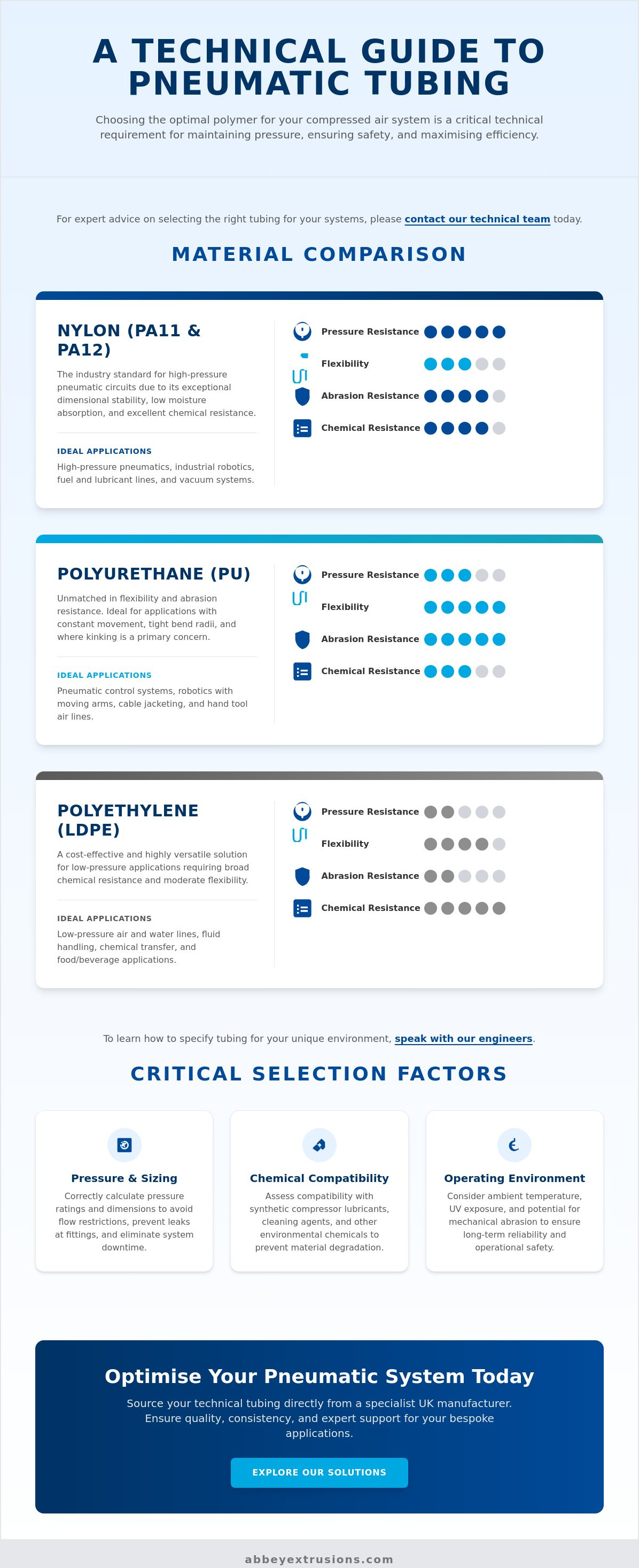
Nylon remains the industry standard for high pressure pneumatic circuits due to its exceptional dimensional stability. We specifically focus on Nylon tube variants such as Nylon 11 and Nylon 12, which offer superior performance compared to standard Nylon 6. Nylon 12 is particularly valued in the UK manufacturing sector for its incredibly low moisture absorption. This ensures the tubing maintains its physical size and strength even in humid environments. It also provides high impact resistance, which is vital in busy workshops where lines might be stepped on or struck by equipment. For a more detailed breakdown of these materials, you can read our sibling article on Nylon tubing properties and their specific industrial uses.
Polyurethane and Polyethylene Options
When your application requires extreme flexibility or tight routing, Polyurethane tube is the optimal choice. It possesses a high degree of kink resistance and can be bent around sharp corners without restricting airflow. This makes it the favourite for robotic arms and moving machinery where constant motion would fatigue a stiffer material. In contrast, Low Density Polythene tube provides a cost effective solution for low pressure tasks. While it doesn't offer the high pressure ratings of Nylon or the extreme flex of Polyurethane, its chemical resistance is excellent, making it suitable for simpler pneumatic layouts where cost control is a priority.
The trade-off often comes down to Shore hardness. A harder Nylon tube handles higher pressures but requires a larger bend radius, whereas a softer Polyurethane is easier to route but has lower burst limits. If you're unsure which material fits your pressure requirements, our team can help you specify the correct polymer grade for your specific machinery.
To discuss your specific sizing requirements and pressure ratings please contact our sales office now.
Determining Correct Sizing and Pressure Specifications
Selecting the right tubing for compressed air systems requires a precise balance between geometric dimensions and mechanical strength. Engineers often focus on the external diameter (OD) because it determines compatibility with push-in fittings and manifold ports. However, the internal diameter (ID) is the most critical metric for actual system performance. The ID dictates the volume of air that can pass through the line at any given time. A tube with a wall that is too thick may offer excellent pressure resistance but will restrict flow, leading to tool starvation and reduced torque in pneumatic actuators. Accurate specification prevents the compressor from cycling too frequently, which saves energy and reduces wear on expensive machinery.
Understanding Diameter and Flow Rates
The relationship between tubing length and diameter directly impacts the pressure drop across your system. If you select a diameter that is too small for the required distance, friction losses will consume the energy your compressor has worked hard to generate. In the UK, most industrial systems follow metric standards such as 4mm, 6mm, 8mm, and 12mm OD, although imperial sizes remain common in older installations. Choosing the correct ID ensures that your pneumatic tools receive the necessary Cubic Feet per Minute (CFM) to function as intended. For those seeking further technical data, this comprehensive guide to pneumatic tubing provides a detailed material comparison table that assists in these calculations.
Pressure Ratings and Safety Margins
Reliability in a pressurised environment depends on respecting the difference between working pressure and burst pressure. Working pressure is the maximum sustained load the tubing can handle safely under normal conditions. Burst pressure is the point of physical failure. We maintain strict safety ratios, typically 3 to 1 or 4 to 1, to account for unexpected surges or mechanical stress. You must also consider that these ratings are usually calculated at 20 degrees Celsius. As the ambient temperature rises, the polymer softens, which significantly reduces its pressure-bearing capacity. Always consult the specific pressure charts for the material grade you are using to ensure the system remains within safe limits. Exceeding these maximum ratings, even for a few seconds, can cause microscopic damage to the polymer structure. This leads to an eventual failure that results in costly downtime and potential safety hazards for your staff.
If you require tubing for a challenging or specialised environment please message our technical team for guidance.
Assessing Environmental Durability and Chemical Compatibility
Selecting the right tubing for compressed air systems involves more than just calculating pressure; it requires a thorough assessment of the surrounding environment. In many industrial settings, tubing is exposed to more than just clean air. External factors like temperature fluctuations can fundamentally change the physical behaviour of polymers. For instance, extreme cold can make standard tubing brittle and prone to cracking, while high heat significantly reduces the maximum safe working pressure. We ensure that our materials are tested against these environmental stressors to provide a reliable service life even in harsh conditions. Understanding these external variables is as important as the internal air pressure for long term system integrity.
Chemical Resistance and Oil Compatibility
Pneumatic systems often contain trace amounts of compressor oils or synthetic lubricants that can be aggressive toward certain plastics. Polyurethane is particularly susceptible to swelling and loss of tensile strength when in contact with specific oil types. Conversely, certain chemicals can cause Nylon to lose its plasticisers and become brittle over time. It's vital to check compatibility charts before installation, especially in systems with heavy lubrication. For heavy duty applications where oil resistance is a priority, our Air 60 Air Hose offers a robust alternative designed for demanding industrial needs. Matching the polymer to the specific lubricant used in your compressor is a step that prevents many common system failures and unexpected maintenance costs.
External Protection and Static Management
In environments where tubing is exposed to direct sunlight, UV stabilisation is necessary to prevent the polymer from degrading and losing its structural integrity. Beyond chemical and UV threats, mechanical wear is a common cause of premature failure on the factory floor. Implementing a Nylon Spiral Cut Hose Guard provides essential abrasion resistance in high traffic areas or on machinery with moving parts. This protection prevents the outer wall from thinning due to constant friction against metal frames or other lines.
Static management is another critical safety consideration, particularly in spray booths, clean rooms, or areas with combustible dust. Anti-static tubing prevents the build up of electrical charges that could ignite volatile vapours or damage sensitive electronic components. Many UK manufacturing sectors also require fire retardant grades to meet specific health and safety regulations. If your facility manages volatile chemicals or extreme heat, we recommend that you consult our technical department to ensure your material specification is fit for purpose. Choosing the correct grade from the outset avoids the risk of catastrophic failure in sensitive production environments.
For bespoke extrusion projects or custom formed tubing please reach out to us to discuss your needs.
Sourcing Custom Solutions from Specialist UK Manufacturers
Sourcing directly from a specialist manufacturer provides a level of technical precision that generic distributors simply cannot match. When selecting the right tubing for compressed air systems, off the shelf components often fall short of specific engineering requirements, particularly in complex or high volume production environments. By working with a UK based extrusion partner, engineers gain access to bespoke material blends and exact dimensional tolerances that are tailored to their specific machinery. This direct relationship ensures that the final product is perfectly suited to the unique pressures and temperatures of the application, whilst providing a more robust and reliable supply chain.
Beyond standard straight lengths, the ability to develop custom profiles allows for the integration of pneumatic lines into unique industrial housings where space is at a premium. We work closely with design engineers from the initial prototyping phase through to full scale production. This collaborative approach ensures that every technical parameter, from shore hardness to chemical resistance, is verified before the final extrusion process begins. This level of customisation is essential for Original Equipment Manufacturers (OEMs) who require consistent quality and specific performance characteristics to maintain their own product warranties.
The Value of Bespoke Tube Forming
A significant advancement in pneumatic circuit design is the use of professional tube forming. This process transforms standard polymer lengths into precise, pre bent components that maintain their shape under pressure. These formed tubes eliminate the need for numerous elbow fittings, which are frequently the primary source of air leaks and turbulent pressure drops. By reducing the number of connection points, you naturally increase the overall integrity of the system. Formed tubes also help to organise internal machinery layouts. This creates a much cleaner and more professional finish for finished products, whilst also providing maintenance teams with easier access to critical components without the clutter of loose hosing.
Working with a UK Extrusion Partner
Partnering with a local manufacturer offers significant logistical advantages, including shorter lead times and direct access to technical expertise. We can produce specialised items like the Nylon Recoil Air Hose to specific length and diameter requirements, ensuring that the hose fits the designated workspace without excessive slack or dangerous tension. This bespoke approach is also beneficial for circuit identification. In large systems, we can provide tubing in a variety of custom colours. This allows for clear visual differentiation between various pneumatic lines, which simplifies troubleshooting and reduces the risk of operator error during maintenance. Selecting the right tubing for compressed air systems is ultimately about ensuring long term reliability through precise material specification and expert manufacturing.
To discuss your specific project requirements or to request a technical data sheet, please contact our sales office.
Optimising Your Pneumatic System Performance
Selecting the right tubing for compressed air systems is a fundamental engineering decision that directly impacts the safety and efficiency of your industrial facility. It's essential to match your material choice to the specific environmental stressors of your factory floor, as we've discussed regarding chemical resistance and temperature fluctuations. By prioritising technical specifications over generic alternatives, you ensure that your pneumatic circuits remain robust and leak free whilst maintaining peak operational pressure.
Since 1985, we've operated as a specialist UK manufacturer, providing the technical expertise required to solve challenging extrusion requirements. Whether you need standard high performance polymers like Nylon 11 and 12 or bespoke tube forming for unique applications, our team is ready to assist with your specifications. Contact Abbey Extrusions for technical advice and high-performance compressed air tubing to ensure your systems are built for longevity and precision. We look forward to supporting your next engineering project with reliable, British made solutions.
Frequently Asked Questions
What is the best tubing material for high pressure compressed air
Nylon 11 and Nylon 12 are the superior choices for high pressure applications due to their exceptional dimensional stability and high burst pressure ratings. These technical polymers maintain their structural integrity under constant load and offer excellent resistance to environmental stress cracking. Whilst other materials may suffice for low pressure tasks, Nylon remains the industry standard for robust pneumatic circuits.
How does temperature affect the pressure rating of plastic air tubing
Ambient temperature is a decisive factor when selecting the right tubing for compressed air systems because heat naturally softens the polymer structure. Most technical specifications are calculated at a baseline of 20 degrees Celsius; as the temperature rises above this point, the safe working pressure of the tubing decreases significantly. Failure to account for these fluctuations can lead to premature tube expansion and fitting failure.
Can I use standard PVC tubing for compressed air systems
Standard unreinforced PVC is generally unsuitable and potentially hazardous for compressed air due to the risk of brittle failure and shattering under pressure. It's safer to use Reinforced PVC Tube or Nylon variants which are specifically engineered to manage the stored energy of pressurised air. Specialist hoses like our Air 60 range provide the necessary durability for industrial environments where standard PVC would fail.
What is the difference between Nylon 11 and Nylon 12 for pneumatics
Nylon 12 exhibits lower moisture absorption compared to Nylon 11, which ensures better dimensional stability in humid factory environments. Nylon 11 is often preferred for its slightly higher impact resistance and its production from renewable castor oil sources. Both materials are high performance polymers, but Nylon 12 is frequently the first choice for precision pneumatic fittings where tolerances are critical.
Why is my air tubing kinking and how can I prevent it
Kinking typically occurs when the minimum bend radius of the material is exceeded or when a material with insufficient Shore hardness is used in a dynamic application. You can prevent this by switching to Polyurethane Tube for tight bends or utilising custom tube forming to create permanent, stress free curves. Proper routing and the use of spiral cut hose guards also provide mechanical support to prevent flow restrictions.
Do I need anti-static tubing for my pneumatic system
Anti-static tubing is essential in environments where combustible dust, volatile vapours, or sensitive electronic components are present. These specialised tubes prevent the build up of static electricity that could otherwise lead to an incendiary spark or equipment damage. This is a critical safety requirement in spray booths and clean rooms where static discharge poses a significant operational risk.
How do I calculate the correct diameter for my air hose
Calculating the correct diameter involves matching the Internal Diameter (ID) to the flow requirements of your pneumatic tools to avoid energy wasting pressure drops. When selecting the right tubing for compressed air systems, you must also ensure the External Diameter (OD) is compatible with your specific push-in fittings. A larger ID reduces friction over long distances, ensuring the compressor doesn't have to work harder to maintain tool performance.
What are the benefits of using pre-formed plastic tubing
Pre-formed tubing organises complex internal machinery layouts and eliminates the need for elbow fittings that can become potential leak points. This provides a more professional aesthetic finish and simplifies maintenance by ensuring all lines are consistently routed and easy to identify. Formed tubes also reduce assembly time on the production line, as they arrive ready to fit into specific geometric spaces.

Article by
Bryan Cowan
Bryan Cowan is the Founder and Managing Director of Abbey Extrusions Ltd, a leading UK manufacturer of high-quality plastic tubes and hoses. With over 40 years of industry experience, Bryan established the company in 1985, growing it from a startup into a BS ISO9001-registered supplier for global sectors including aerospace, automotive, and pharmaceuticals.
Disclaimer
This article is intended for informational purposes only. Please ensure you seek expert advice or carry out your own research to confirm the information is suitable for your specific needs.