Relying on generic plastic tubing for complex industrial configurations often results in costly system failures when standard coils lose their shape or kink in restricted spaces. We understand that high-performance systems require bespoke tube bending and coiling that respects the unique polymer memory of every material, from Nylon 12 to specialised fluoropolymers. You've likely experienced the frustration of finding a UK manufacturer that can provide a perfectly formed tube which maintains its integrity whilst fitting a specific, tight footprint. It's a common challenge that often leads to unnecessary joints and reduced system reliability.
This article explains how expert plastic tube forming can optimise your industrial systems through precision engineering and the selection of high-performance polymers. We'll examine the technical nuances of material behaviour, the benefits of reducing joint count for improved reliability, and how our manufacturing process ensures your components meet the exact specifications required for your machinery. By understanding the systemic compatibility of your chosen materials, you can ensure your operations remain efficient and compliant with evolving standards such as BS EN 1329-1.
Key Takeaways
- Understand how transitioning from metal to high-performance plastic components can reduce system weight whilst improving corrosion resistance.
- Discover the technical precision of bespoke tube bending and coiling through thermal setting processes that guarantee permanent shape retention.
- Identify why Nylon 11 and 12 are considered the gold standard for applications requiring superior polymer memory and chemical durability.
- Learn how to balance tube wall thickness with minimum bend radius to prevent kinking in restricted industrial footprints.
- Explore the benefits of partnering with a UK-based specialist to secure reliable technical advice and consistent production quality for your machinery.
Please contact our technical team to discuss your specific engineering requirements for custom formed components.
The Role of Bespoke Tube Bending and Coiling in Modern Industry
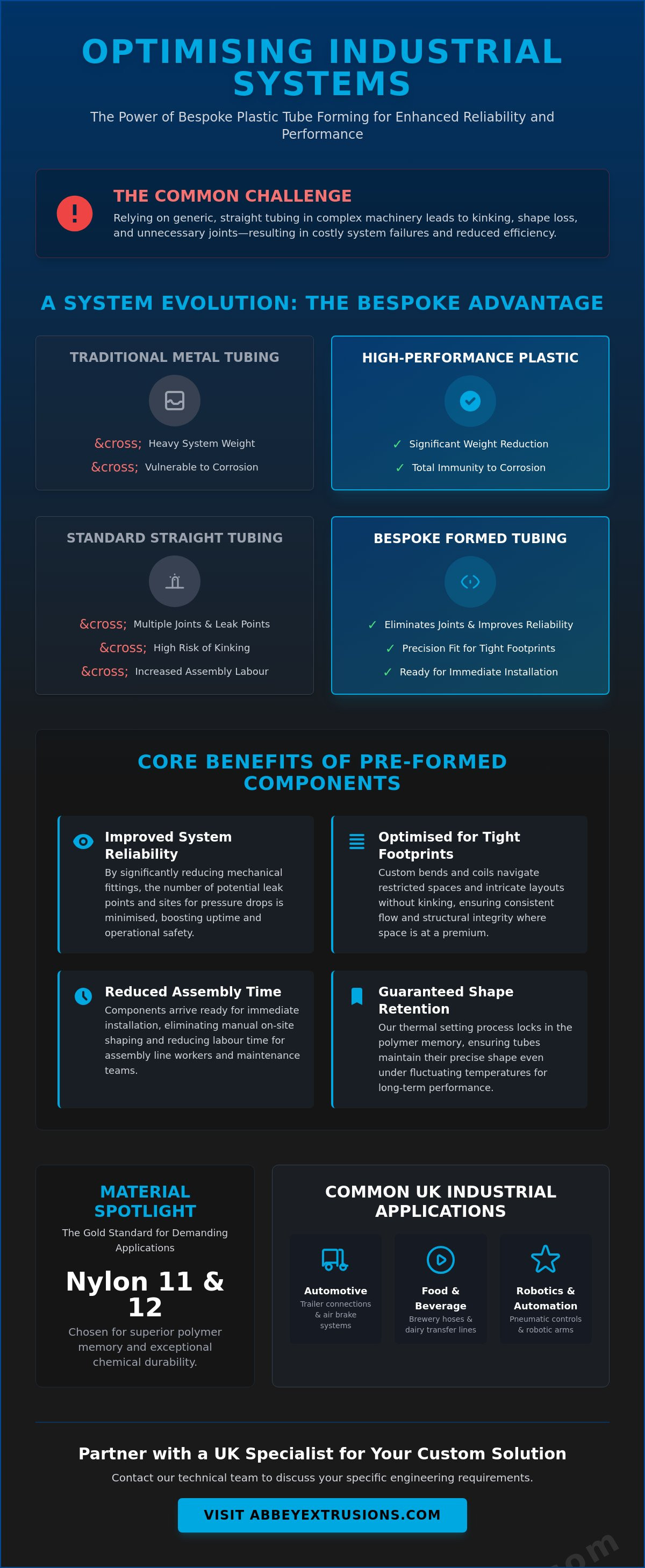
Standard straight tubing often fails to meet the rigorous demands of modern industrial design. High density layouts and intricate machinery footprints require components that can navigate tight radii without compromising flow or structural integrity. Whilst traditional tube bending processes were once the exclusive domain of metal fabrication, advanced polymers have revolutionised fluid and gas handling. Transitioning from metal to high performance plastics like Nylon tube or Polyurethane tube provides significant weight reductions and total immunity to corrosion, which is vital in harsh environments.
System reliability is a primary concern for any plant manager or design engineer. By utilising bespoke tube bending and coiling, you can significantly reduce the number of mechanical fittings required in a system. Every joint represents a potential leak point and a site for pressure drops; eliminating these through pre-formed coils directly improves uptime and operational safety. This approach is particularly effective in pneumatic and hydraulic assemblies where space is at a premium and every millimetre of the footprint must be optimised. Sourcing these components from a UK manufacturer ensures that quality control remains rigorous and national supply chains stay resilient against global logistics disruptions.
Advantages of Pre-Formed Plastic Components
Assembly lines benefit immensely from components that arrive ready for immediate installation. Pre-formed parts reduce the labour time for assembly line workers and eliminate the risk of kinking that occurs when straight tubes are manually forced into position during maintenance. This precision engineering also provides a professional finish that reflects the quality of the overall equipment. Because the polymer memory is set during the manufacturing process, the tubes maintain their shape even under fluctuating temperatures, ensuring long-term performance without the sagging associated with inferior products.
Common Applications Across UK Industrial Sectors
The versatility of these services is evident across diverse fields. In the automotive sector, Nylon recoil air hoses are essential for trailer connections and air brake systems where flexibility is paramount. Meanwhile, the food and beverage industry relies on custom bends for brewery hose and dairy transfer lines to maintain hygiene and flow efficiency. Robotic arms and pneumatic control panels also utilise these bespoke profiles to manage complex movements within a compact work envelope, ensuring that cables and hoses don't interfere with moving parts.
For technical guidance on specific polymer behaviours, please speak with our engineering department to ensure your design is optimised for production.
Technical Processes for Precision Plastic Tube Forming
Bespoke tube forming is the controlled process of permanently reshaping thermoplastic materials using a combination of heat, specialised mandrels, and precision jigs. Unlike cold-forming methods sometimes used in metal fabrication, high-performance polymers require a strictly monitored thermal cycle to ensure the structural integrity of the component remains intact. This process transforms a standard extrusion into a complex geometry tailored to a specific industrial application. By using heat to reach the material's glass transition phase, we can achieve bespoke tube bending and coiling that meets exact tolerances whilst maintaining the physical properties of the original polymer.
The Science of Polymer Memory
Thermoplastics possess a characteristic known as polymer memory. When we heat the material, the molecular chains become mobile, allowing the tube to be manipulated into new shapes. If a tube is simply bent whilst cold, it will eventually return to its original straight form due to internal stresses. To achieve permanent plastic deformation, the material must be heated uniformly. Once the desired shape is achieved, the tube must be cooled whilst held securely on a mandrel. This thermal setting locks the molecules into their new configuration, ensuring the part doesn't creep or lose its profile over time, even under operational stress.
Precision Mandrel Bending for Plastics
Maintaining the internal diameter of a tube is critical for consistent flow rates in pneumatic or fluid systems. Without internal support, a plastic tube will often collapse or ovalise during the bending process, especially when engineers require tight radii. We utilise precision mandrels that support the tube walls from the inside. This technique ensures that even complex multi-axis forming doesn't lead to the wall thinning or kinking often found in inferior manufacturing methods. High-quality tube forming ensures that the cross-sectional area remains round, which is vital for maintaining pressure and flow efficiency.
Our manufacturing facility adheres to rigorous safety and quality protocols. Whilst our production focuses on polymer integrity, we maintain high standards of operational safety, mirroring the principles found in international machine guarding standards to ensure consistent and reliable output. Whether your project requires a simple 90-degree bend or a complex helical coil, our precision tooling guarantees repeatability across large production runs. If you need assistance with a prototype design, you can request a technical consultation with our team to explore the best forming options for your application.
Please contact our specialist team to discuss the material requirements for your bespoke project.
Material Suitability for Custom Bends and Coils
Selecting the correct polymer is fundamental to the success of any industrial system. At our Leicestershire facility, we evaluate the thermal and mechanical properties of each material to ensure it's suitable for the intended application. Whilst some materials excel in high-pressure environments, others are chosen for their chemical inertness or extreme flexibility. Compliance with evolving plastic pipeline regulations and safety standards is a critical consideration during the material selection phase. Our expertise in bespoke tube bending and coiling allows us to manipulate a wide range of high-performance polymers to meet these rigorous criteria, ensuring that each component integrates perfectly with your existing machinery.
Nylon 11 and 12 for High Performance
Nylon 11 and 12 are widely regarded as the gold standard for formed components. Their exceptional memory retention makes them the preferred choice for recoil air hoses that must return to their original shape after repeated extension. These polymers offer superior resistance to vibration and mechanical stress, which is why they're frequently specified for vehicle air brake systems and heavy-duty industrial machinery. The molecular stability of these materials ensures that the formed bends don't degrade over time, even when exposed to oils or fuels. You can find detailed technical specifications on our Nylon tube page to help determine the best grade for your specific operating environment.
Polyurethane and Polyethylene Options
Polyurethane (PU) provides a level of flexibility that Nylon cannot match. It's ideal for high-flexibility coils that require excellent abrasion resistance and a tight bend radius in confined spaces. In contrast, Low Density Polyethylene (LDPE) is often utilised for simpler formed shapes where cost-effectiveness is the priority. LDPE is particularly useful for low-pressure applications requiring bespoke routing through electrical enclosures or control panels. When choosing between PU and Nylon for pneumatic recoil applications, engineers must consider the trade-off between the superior recoil force of Nylon and the extreme kink resistance of Polyurethane.
For environments involving aggressive chemicals or extreme temperatures, fluoropolymers such as PTFE, FEP, or PFA are essential. These materials maintain their structural integrity whilst providing the necessary bespoke bends for complex fluid transfer in laboratory or chemical processing settings. Our technical advisors can provide professional guidance on whether a reinforced PVC tube or a high-performance fluoropolymer is better suited for your specific chemical footprint. This ensures your system remains reliable whilst meeting all relevant safety and performance standards.
To ensure your design meets all technical requirements, you can contact our engineering consultants for a detailed review of your specifications.
Design Considerations for Engineering Bespoke Coils
Engineers must balance several physical variables when specifying custom formed components to ensure long-term system reliability. The relationship between tube wall thickness and the minimum bend radius is the most critical factor in this process. A wall that's too thin relative to the diameter may collapse during forming, whilst a wall that's too thick can lead to excessive internal stress. Working temperature also plays a vital role; a coil that retains its shape at 20 degrees Celsius might lose its tension if the ambient environment reaches 60 degrees. Therefore, selecting a material with the correct thermal profile is essential for permanent shape retention. Pressure ratings must also be adjusted for formed assemblies, as the bending process can subtly alter the burst pressure of the polymer at the outer radius of the bend.
When designing coiled air hoses, specifying straight tails at each end is a practical necessity. These tails allow for easier fitting of couplings and prevent unnecessary stress on the connection points during operation. Additionally, we can produce these components in a variety of custom colours. This allows engineers to organise complex pneumatic systems visually, making maintenance and troubleshooting significantly more efficient. By integrating these design elements early, bespoke tube bending and coiling becomes a tool for both functional excellence and system safety.
Calculating Bend Radius and Tolerances
Selecting an appropriate radius is the best way to avoid stress cracking over the lifecycle of the part. As a general guideline, the minimum bend radius should typically be at least three to five times the outside diameter of the tube, depending on the specific polymer. Specifying tight tolerances is also necessary for components that must fit into pre-defined machinery footprints. We work closely with clients to ensure that the final coil dimensions, including the pitch and outside diameter of the coil itself, align perfectly with the available space in the final assembly.
Environmental Factors and Material Behaviour
The longevity of a formed tube is often dictated by its operating environment. UV exposure can cause some polymers to become brittle, which may lead to the failure of a bespoke bend if the material isn't correctly stabilised. In high-vibration environments, using Nylon spiral cut hose guards provides an essential layer of protection against external abrasion. It's also important to consider chemical contact, as certain fluids can cause polymers to swell or soften, potentially altering the bespoke shape. By accounting for these factors during the design phase, you can ensure your system remains reliable and efficient. If you require assistance with these calculations, please request a design consultation with our technical team.
To begin your technical consultation, please contact our Leicestershire facility to discuss your specific production requirements.
Partnering with a Specialist UK Manufacturer for Custom Solutions
Partnering with a specialist UK manufacturer ensures that your engineering requirements are met with the highest level of technical competence. When you choose a direct manufacturer for bespoke tube bending and coiling, you eliminate the communication gaps that often occur when dealing with subcontractors or third-party distributors. We provide a seamless transition from the initial design concept to the final component, offering the flexibility to handle small prototype batches or extensive production runs for national supply chains. Our commitment to precision is reflected in every project, ensuring that each formed part performs reliably within its intended industrial system. We don't just bend tubes; we engineer solutions that last.
Technical support is the cornerstone of our service. From the moment you present a challenge, our team works to identify the most efficient manufacturing route. This involves a thorough review of your machinery footprints and pressure requirements to ensure the final product is fit for purpose. By maintaining a transparent production process, we build long-term trust with our partners across the automotive, pneumatic, and fluid handling sectors. Quality is never an afterthought; it's a fundamental business norm that dictates every stage of our workflow.
From Extrusion to Formed Component
Sourcing both the raw extrusion and the secondary forming service from a single supplier provides significant advantages in quality control. Our tube forming services are integrated directly into our manufacturing workflow, which allows for complete material traceability from the resin stage to the finished coil. Unlike generalist manipulators who work primarily with metals, we understand the specific thermal requirements of high-performance polymer grades such as Nylon 11 and Nylon 12. This deep material knowledge ensures that the polymer memory is correctly set, maintaining the structural integrity of the component throughout its entire service life. Consistency across bespoke orders is guaranteed through our rigorous testing protocols.
National Supply and Technical Expertise
Based in the heart of Leicestershire, we support the UK industrial sector by providing high-quality components that meet rigorous national standards. As a leading plastic pipe manufacturer, we possess the technical expertise to interpret complex engineering drawings or physical samples with absolute accuracy. To obtain an accurate quotation for your project, we encourage clients to provide detailed specifications regarding bend radii, tail lengths, and expected operating pressures. Our technical team is always available to guide you through the material selection process. This ensures your bespoke solutions are both cost-effective and engineered for excellence, providing a reliable foundation for your industrial applications.
Please get in touch with our team to request a quotation or technical guidance for your custom project.
Optimising Industrial Systems with Precision Engineering
Achieving a reliable fluid or gas handling configuration requires more than just standard components. By integrating specialised thermal setting techniques and precise material selection, engineers can significantly improve system reliability whilst reducing the risk of failures in restricted footprints. The correct application of polymer memory ensures that formed parts maintain their shape under operational stress, which leads to more efficient and durable machinery assemblies.
As a UK based manufacturer established in 1985, we provide the technical competence required for complex bespoke tube bending and coiling projects. Our expertise in high performance polymers, particularly Nylon 11 and 12, allows us to deliver components that meet the most demanding industrial specifications. If you require technical advice for your next project, please contact our expert team to discuss your requirements. We're ready to help you achieve a perfectly engineered solution for your specific industrial application.
Frequently Asked Questions
How does plastic tube coiling differ from metal coiling
Plastic coiling utilizes thermal setting to rearrange molecular chains, whilst metal coiling relies on mechanical force to deform the material. This results in a lightweight, corrosion resistant component that retains its shape through polymer memory rather than structural tension, which is a key advantage of bespoke tube bending and coiling for plastic applications.
What materials are best for retaining a formed shape
Nylon 11 and Nylon 12 are the industry standards for permanent shape retention due to their superior polymer memory. These materials ensure that formed components maintain their exact geometry even after repeated mechanical stress or exposure to temperature fluctuations in demanding industrial environments.
Can bespoke bends be achieved without kinking the tube
Yes, we utilize internal mandrels and precision jigs during the heating phase to prevent wall collapse and kinking. This technical approach ensures the internal diameter remains consistent throughout the bend, which is vital for maintaining flow rates and pressure in pneumatic or fluid systems.
What is the minimum bend radius for nylon tubing
The minimum bend radius is generally three to five times the outside diameter of the tube. This ratio varies based on the specific wall thickness and the grade of Nylon used, so we recommend consulting our technical team for precise calculations during the design phase of your project.
Are custom coiled hoses suitable for food grade applications
We manufacture several products specifically for these environments, including food grade hoses and LDPE tubing that comply with relevant safety standards. These materials are processed to meet the hygiene requirements for fluid transfer in brewery and dairy applications without compromising on the bespoke form required for the machinery.
Do you offer on site installation for bespoke tube systems
No, our expertise lies strictly in the manufacturing and thermal forming of high performance plastic components within our own facility. We supply precision engineered tubes and coils directly to your site for installation by your own technical staff or assembly line workers.
Can you provide custom colours for bespoke formed tubes
We can produce formed components in a wide range of colours to assist with system organisation and identification. This is a practical solution for complex pneumatic panels where colour coding helps maintenance engineers identify different lines quickly, reducing the risk of errors during repair work.
What information is needed to request a quote for tube bending
To provide an accurate quotation, we require technical drawings or physical samples that specify the tube dimensions, material grade, and the required geometry. Details regarding the intended operating temperature and pressure are also helpful for ensuring the chosen polymer is fit for your specific purpose.

Article by
Bryan Cowan
Bryan Cowan is the Founder and Managing Director of Abbey Extrusions Ltd, a leading UK manufacturer of high-quality plastic tubes and hoses. With over 40 years of industry experience, Bryan established the company in 1985, growing it from a start-up into a BS ISO9001-registered supplier for global sectors including aerospace, automotive, and pharmaceuticals.
Disclaimer
This article is intended for informational purposes only. Please ensure you seek expert advice or carry out your own research to confirm the information is suitable for your specific needs.