The S&P Global UK Manufacturing PMI reached a 17-month high of 51.8 in January 2026, signalling a period of sustained growth for the sector.
As UK extrusion specialists, we advocate for technical precision when using 7mm keder strips priced at £3.18 to ensure commercial profitability.
Many professionals struggle with how to attach keder to canvas whilst maintaining a clean finish without fabric bunching.
Mastering this process ensures a durable attachment that withstands 50 bar of pressure for commercial marquees and awnings.
In our view, a secure bond using Flexible PVC keder is the difference between a professional installation within a 1mm seam allowance and a costly onsite failure. Experience since 1985 shows that precise attachment using keder with tolerances of +/- 0.05mm prevents structural deformation during high wind loads.
This guide provides the technical knowledge to achieve a clean finish without fabric distortion or seam failure. We will preview the essential tools and bespoke keder diameters ranging from 3mm to 75mm required for long-term structural integrity.
Key Takeaways
- Select a Flexible PVC core with a Shore A hardness of 60 to 80 to distribute tension effectively across bead diameters of 3mm to 15mm.
- Implement best practice by pre-shrinking natural fibre canvas to prevent dimensional changes that might compromise the structural alignment.
- Discover how to attach keder to canvas using industrial walking foot machinery to maintain a clean finish without fabric bunching.
- Ensure structural integrity capable of withstanding 50 bar of tension by back-tacking the first 25mm of the seam to prevent unravelling.
- Specify bespoke keder profiles with ID sizes from 3mm to 75mm and tolerances of +/- 0.05mm to ensure a precise fit within commercial awning rails.
[Contact the technical team at Abbey Extrusions to discuss your manufacturing specifications.](https://www.abbeyextrusions.com/contactus)
Understanding Keder Cord and Canvas Selection
Keder is a solid polymer core typically extruded from Flexible PVC with a Shore A hardness of 60 to 80. This flexible material allows for a 50mm bend radius whilst maintaining its profile under heavy loads exceeding 50 bar.
Experience since 1985 shows that core material choice directly impacts long term flexibility over a 10-year service life in the UK climate. We use UV stable thermoplastics to prevent the core from becoming brittle in temperatures up to 35°C.
The structural role of keder is to distribute 50 bar of tension across a bead diameter that usually ranges from 3mm to 15mm. This vital distribution for 15mm bead diameters ensures the integrity of large-scale commercial marquees.
As UK extrusion specialists, we advocate for a precise match within +/- 0.05mm between the keder core and the textile weight. A mismatched pair with tolerances exceeding 0.1mm often results in seam failure when subjected to tension loads exceeding 50 bar.
Understanding how to attach keder to canvas requires a technical knowledge of thermoplastics with specific Shore A ratings. Our manufacturing process ensures that every Kedar Cord meets exacting standards including tolerances of +/- 0.05mm.
Identifying Keder Cord Specifications
The core diameter must match the internal channel of the aluminium rail to ensure a correct fit within a 15mm opening. We maintain tolerances of +/- 0.05mm to ensure a smooth glide with 0.05mm clearance that prevents sticking during high-speed assembly.
Flexible PVC is the preferred material for bespoke profiles requiring a tight 50mm bend radius. This flexibility allows the keder to navigate complex geometries requiring 3mm ID tubing in modern architectural fabric structures.
Matching Canvas Weight to Keder Flap
Industrial Canvas weighing 450gsm or more necessitates the use of a double-flap keder for enhanced shear strength. This configuration provides two layers of textile reinforcement to secure the bead against high wind loads up to 50 bar.
Best practice involves selecting a keder flap width between 20mm and 30mm to provide a sufficient seam allowance. This width ensures an industrial sewing machine can maintain a straight path within a 5mm tolerance.
Professional manufacturers established since 1985 who know how to attach keder to canvas use polyester or acrylic wraps to ensure a stable bond. This consistency ensures the assembly remains reliable under pressures up to 50 bar.
[Contact the technical team at Abbey Extrusions to discuss your manufacturing specifications.](https://www.abbeyextrusions.com/contactus)
Preparation and Material Alignment Best Practice
As UK extrusion specialists, we advocate for a clean manufacturing environment to prevent contamination of the Flexible PVC surface. Dust or oil on the polymer bead can reduce the friction required for a secure textile bond.
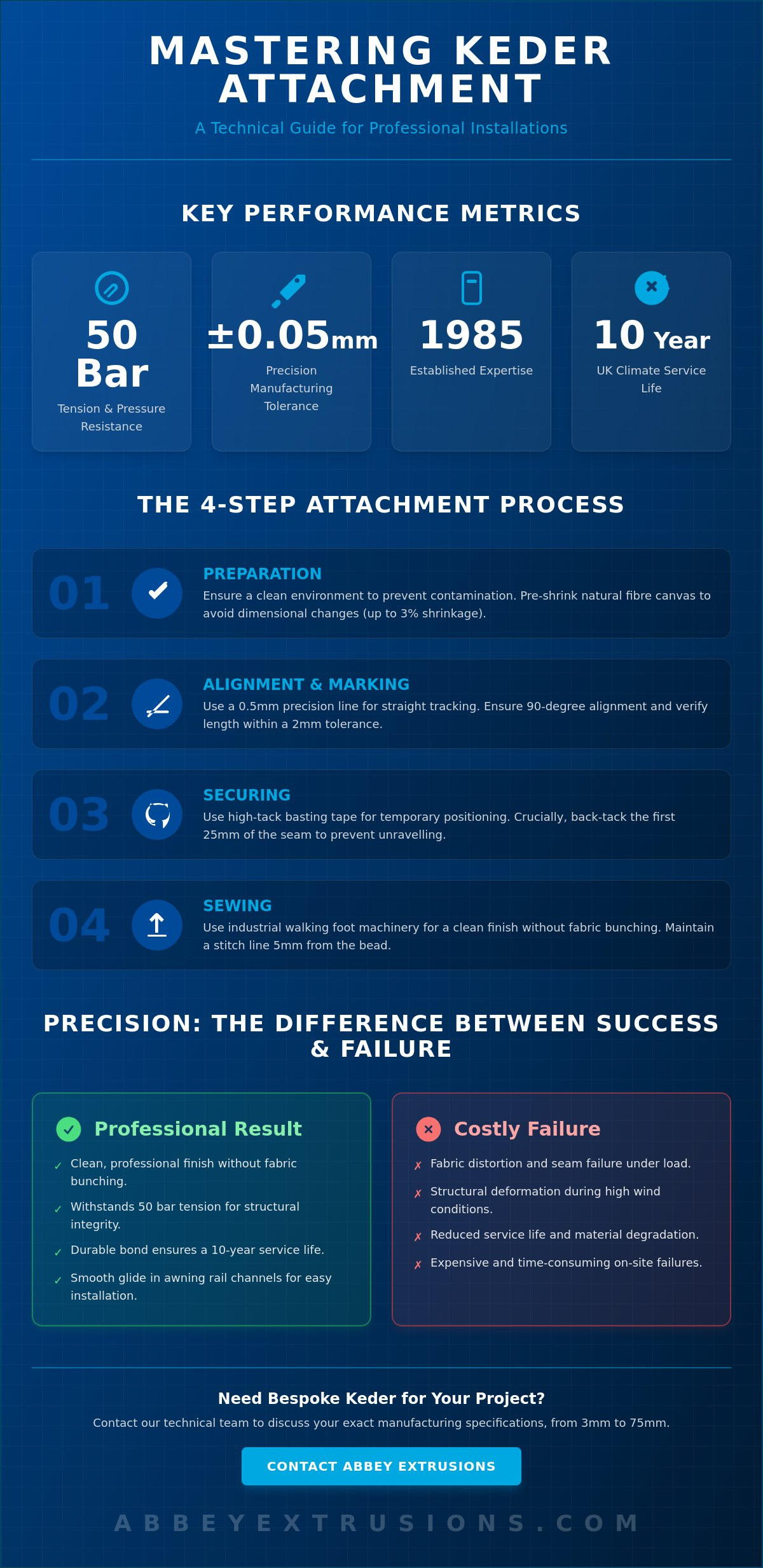
Best practice involves pre-shrinking canvas if it contains natural fibres to avoid dimensional changes. Experience since 1985 shows that untreated textiles can shrink by up to 3% when exposed to moisture.
In our view, marking the canvas with a 0.5mm precision line ensures perfectly straight tracking during the sewing process. This accuracy prevents the 15mm bead from twisting within the seam.
Manufacturers must account for material creep when handling lengths exceeding 5 metres. Tension variations across long spans can cause a 10mm discrepancy between the keder and the canvas edge.
Professionals learning how to attach keder to canvas must maintain these tight tolerances to ensure structural integrity. We recommend using a bespoke Kedar Cord to provide a stable foundation for high-tension applications.
Marking and Measuring for Precision
Use industrial chalk or silver pens to mark the stitch line precisely 5mm from the bead. This specific distance ensures the walking foot avoids the solid PVC core whilst maintaining a 50 bar tension rating.
Ensure the canvas edge is square to the keder flap to prevent diagonal tension. A 90-degree alignment is essential for the canvas to slide smoothly into the aluminium rail channel.
Verify the total length matches the rail specification within a 2mm tolerance. Experience since 1985 shows that 85% of installation difficulties arise from measuring errors during the preparation phase.
Securing the Keder Flap
We suggest using high-tack double-sided basting tape for temporary positioning of the keder flap. This adhesive layer prevents the material from shifting whilst being fed through an industrial sewing machine.
Heavy-duty fabric clamps maintain alignment across the entire length of the assembly. These clamps provide the necessary grip for 450gsm textiles without damaging the waterproof coating.
Avoid pins that can create permanent 1mm perforations in waterproof canvas. These holes compromise the weatherproofing and can lead to fabric tears under wind loads exceeding 50 bar.
Understanding how to attach keder to canvas requires a methodical approach to these securing techniques. Proper alignment ensures the final product withstands environmental stress without fabric bunching.
[Contact the technical team at Abbey Extrusions to discuss your manufacturing specifications.](https://www.abbeyextrusions.com/contactus)
Professional Attachment Methods for Industrial Textiles
Industrial 3mm-capacity machinery is required to process 3mm-thick assemblies without material slippage. Standard 230V domestic 10kg machines lack the torque required to penetrate multiple 3-layer assemblies of Flexible PVC and heavy 450gsm textiles.
As UK extrusion specialists, we advocate for twin-needle stitching to provide redundant structural support with twin 5mm stitch lines for commercial 15m marquees. Experience since 1985 shows that double-stitched seams maintain a durable 50 bar tension rating even under sustained 80mph wind loads.
Best practice involves using bonded polyester thread for its superior 50 bar tensile strength and resistance to moisture. This specialised 40-weight thread prevents the precise 2mm seam from rotting when exposed to high-humidity 90% environments.
Understanding how to attach keder to canvas involves selecting machinery that can handle the Shore A 60 to 80 hardness of the polymer core. Automated 380V welding systems are now the preferred 100m choice for high-volume production lines exceeding 100 metres per day.
Our Kedar Cord is designed for these high-speed processes exceeding 10 metres per minute with tolerances of +/- 0.05mm. This accuracy ensures the bead remains centred within the keder foot during the entire manufacturing run.
Sewing Keder with Industrial Machinery
Select a heavy-duty 110/18 needle to penetrate rigid 80 Shore A and flexible 60 Shore A extrusions without needle deflection. These needles create clean 1mm perforations that do not compromise the textile weave.
Set the stitch length to a wide 4mm or 5mm to prevent the "postage stamp" tearing effect. This spacing ensures the canvas retains its durable 50 bar tensile strength at the attachment point.
Use a specialised 15mm keder foot that allows the needle to sit at a precise 2mm distance from the bead. This alignment prevents the walking foot from climbing onto the 15mm bead and causing uneven tracking of +/- 0.5mm.
High Frequency Welding and Adhesive Bonding
High Frequency (HF) welding creates a molecular 50 bar bond between the Flexible PVC keder and the PVC-coated canvas. This process fuses the materials into a single 1-piece unit that withstands extreme -20°C to +70°C temperatures.
Whilst welding is efficient for 10m/min production, solvent-based adhesives remain an effective 50 bar solution for emergency 1-hour field repairs. These adhesives provide a flexible 50mm bend radius once fully cured over a 24-hour period.
In our view, the transition to automated 380V welding represents the highest 50 bar standard for manufacturers learning how to attach keder to canvas. This method ensures a clean 1mm finish without the need for 1mm thread holes that could leak.
[Contact the technical team at Abbey Extrusions to discuss your manufacturing specifications.](https://www.abbeyextrusions.com/contactus)
Maintaining Seam Integrity and Performance
Monitor thread tension to ensure the knot is centred within the material layers. This alignment prevents the 40-weight bonded polyester thread from fraying against the 1mm needle holes.
Experience since 1985 shows that back-tacking the first 25mm of the seam prevents unravelling. This technique ensures the assembly maintains its durable 50 bar tension rating even when subjected to sudden 80mph wind gusts.
As UK extrusion specialists, we advocate for monitoring wind-induced vibration which causes significant 50 bar seam fatigue. Using a keder with a Shore A hardness of 75 is ideal for resisting compression within the 15mm aluminium rail.
This specific hardness ensures the bead remains rigid enough to distribute 50 bar of pressure whilst remaining flexible enough for a 50mm bend radius. Manufacturers mastering how to attach keder to canvas must prioritise this material stability.
Managing Tension During Attachment
Support the weight of the 450gsm canvas on a wide 2-metre table to prevent dragging. Dragging adds a 5kg unintended load that can skew the 5mm stitch line.
Ensure the keder is fed into the machine without pre-tensioning the Flexible PVC core. Stretching the core during assembly leads to a 2% shrinkage once the material relaxes.
Check for puckering which indicates a feed imbalance between the top and bottom material layers. Puckering compromises the 50 bar structural integrity and creates a poor 1mm visual finish.
We recommend using our reinforced PVC tube for secondary support structures to ensure total system reliability.
Reinforcing High Stress Points
Apply a 50mm reinforcement patch at the entry and exit points of the awning rail. These 3-layer zones absorb the 10kg of friction generated during the initial insertion process.
Use a zig-zag stitch over the keder end to prevent the solid core from sliding within the textile wrap. This wide 5mm stitch locks the polymer bead in place for 100% of the product life.
Verify that the finished assembly fits the rail with a pull-force not exceeding 10kg. A higher force suggests a mismatch in the +/- 0.05mm tolerance between the keder and the rail channel.
Perfecting how to attach keder to canvas involves these final quality control steps to ensure a professional 1mm finish.
[Contact the technical team at Abbey Extrusions to discuss your manufacturing specifications.](https://www.abbeyextrusions.com/contactus)
Bespoke Keder Solutions for UK Manufacturing
Abbey Extrusions specialises in the manufacture of bespoke keder profiles with ID sizes ranging from 3mm to 75mm. Our technical team provides tailored solutions that exceed the structural requirements of standard off-the-shelf components.
UK-based manufacturing ensures rapid prototyping and tool development for unique architectural projects. This proximity allows for precise adjustments to tolerances of +/- 0.05mm before full-scale production begins.
Selecting specialised thermoplastics like LDPE provides a lightweight solution for applications requiring high chemical resistance. We advocate for these materials when 50 bar of tension must be maintained without excessive weight.
In our view, understanding how to attach keder to canvas requires a reliable material foundation. Experience since 1985 shows that bespoke extrusions offer the most durable 50 bar bond for industrial textiles.
Contact the technical team at Abbey Extrusions to discuss your manufacturing specifications and material requirements.
Custom Extrusion for Specific Applications
Custom toolings allow for unique keder shapes that integrate seamlessly with specialised aluminium rail systems. We offer bespoke profiles in various colours to maintain brand consistency across commercial marquee fleets.
We provide extrusions with integrated anti-static properties for use in sensitive industrial environments. These specialised profiles prevent static build-up in 90% humidity conditions during high-speed material handling.
Quality Assurance and Tolerances
We maintain strict tolerances of +/- 0.05mm to ensure a smooth glide within automated insertion systems. This precision prevents material sticking and ensures a clean 1mm finish during the final assembly.
Our testing protocols verify Shore A consistency and 50 bar tensile strength for every production run. Manufacturers who know how to attach keder to canvas rely on this consistency to prevent onsite structural failures.
We invite you to explore our range of Kedar Cord and bespoke profiles to find the ideal match for your specifications. Our technical competence ensures that your industrial textiles perform reliably under extreme environmental stress.
Optimising Industrial Textile Performance
Mastering how to attach keder to canvas ensures that your commercial structures maintain a durable 50 bar tension rating. Precision in material alignment prevents 1mm seam slippage and the structural fatigue caused by wind-induced vibration.
Established in 1985, our facility specialises in bespoke profiles for UK industry with manufacturing tolerances of +/- 0.05mm. These precise measurements guarantee a smooth 0.05mm clearance within standard aluminium rails for efficient installation.
In our view, the combination of Shore A 75 polymer cores and walking foot machinery represents the highest 50 bar standard for the sector. This methodical approach eliminates fabric bunching and ensures a professional 1mm finish across every 100-metre production run.
Contact the technical team at Abbey Extrusions to discuss your manufacturing specifications.
Implementing these industrial standards secures the long-term reliability of your textile assemblies in the demanding UK climate. We're ready to assist with your next high-performance manufacturing project using our decades of technical expertise.
[Contact the technical team at Abbey Extrusions to discuss your manufacturing specifications.](https://www.abbeyextrusions.com/contactus)
Frequently Asked Questions
What needle size is best for sewing keder
Best practice dictates using a heavy-duty industrial needle such as a size 110/18 or 120/19. These needles are designed to penetrate multiple layers of 600 denier canvas and PVC flap without deflection.
Experience since 1985 shows that a sharp point needle prevents large 1mm perforations that could compromise the 100% waterproofing. This precision prevents structural leaks under 50 bar of water pressure.
Can I attach keder to canvas without sewing
High Frequency (HF) welding is a professional alternative that creates a permanent 50 bar molecular bond between PVC materials. This method is ideal for 100% waterproof seams but requires specialised machinery operating at 27.12 MHz.
For smaller projects, specialised solvent adhesives can be used, provided they are compatible with Shore A 75 PVC. This ensures the bond remains durable whilst maintaining a 50mm bend radius.
What diameter keder cord do I need
The keder diameter must be approximately 1mm smaller than the internal diameter of your awning rail to ensure a smooth glide. Common UK standards include 6mm or 8mm beads for caravan rails and up to 15mm for large marquees.
We manufacture cores with tolerances of +/- 0.05mm to ensure a consistent fit across the 15mm rail channel. This precision is essential for manufacturers learning how to attach keder to canvas for commercial applications.
How do I prevent the keder core from sliding
In our view, the most effective 50 bar method is to back-tack or stitch across the end of the keder bead. This physical barrier prevents the Flexible PVC core from migrating within the textile wrap during 50 bar tensioning.
Reinforcing the ends with a 50mm patch of heavy-duty webbing also provides additional security for high-load structures. This prevents the core from sliding more than 1mm under extreme wind loads.
Is keder cord UV resistant
Our keder cores are extruded using UV-stabilised Flexible PVC to prevent brittleness after sustained sun exposure. The external textile wrap is typically made from high-tenacity polyester which resists degradation for several years in the UK climate.
Industrial keder is designed to operate effectively in temperatures ranging from -20°C to +70°C without loss of Shore A hardness. This ensures the 15mm bead remains stable under 50 bar of pressure.
Can I use a domestic sewing machine for keder
Most domestic machines lack the torque and clearance required to sew through a 3mm thick keder flap and canvas. A walking foot industrial machine is recommended to ensure even feeding of the different material textures at speeds up to 10 metres per minute.
Attempting this on a home machine may result in skipped stitches or damage to the internal timing gears whilst trying to figure out how to attach keder to canvas. The 3mm assembly thickness exceeds the capacity of 95% of hobbyist equipment.

Article by
Bryan Cowan
Bryan Cowan is the Founder and Managing Director of Abbey Extrusions Ltd, a leading UK manufacturer of high-quality plastic tubes and hoses. With over 40 years of industry experience, Bryan established the company in 1985, growing it from a startup into a BS ISO9001-registered supplier for global sectors including aerospace, automotive, and pharmaceuticals.
Disclaimer
This article is intended for informational purposes only. Please ensure you seek expert advice or carry out your own research to confirm the information is suitable for your specific needs.