Industrial keder performance is determined by the synergy between polymer Shore hardness and fabric weight rather than diameter alone. Professional engineers understand that even a millimetre of deviation in a canvas keder profile can lead to catastrophic seam failure under high wind loads. You've likely recognised the frustration caused by fabric bunching or inconsistent diameters when a supplier fails to maintain strict production tolerances. With the UK textile manufacturing market reaching £158.6 billion in 2026, the demand for precision components is essential for maintaining structural integrity in large scale industrial installations.
We understand that a reliable textile system depends on the seamless integration of the keder core and the aluminium rail. This article allows you to discover the technical specifications and material science required to select the ideal canvas keder for high performance industrial systems. We'll examine how to identify the correct keder diameter for specific rail systems, the relationship between fabric weight and flap size, and the technical advantages of sourcing high precision UK manufactured keder.
Key Takeaways
- Learn how the mechanical composition of keder allows for uniform tension distribution across high performance textile surfaces.
- Understand the relationship between Flexible PVC properties and core stability to prevent failure in demanding industrial environments.
- Identify when to specify single or double flap profiles based on the specific fabric weight and structural demands of your project.
- Develop a technical selection framework to ensure your canvas keder choice withstands specific wind loads and environmental stresses.
- Discover the logistical and quality control advantages of partnering with a UK manufacturer for bespoke extrusion solutions tailored to unique rail systems.
To discuss your specific manufacturing requirements or to request technical data sheets, please visit our contact page to speak with our specialists.
The Fundamentals of Canvas Keder in Industrial Textile Engineering
In the field of industrial textile engineering, canvas keder represents a critical structural interface between a flexible membrane and a rigid frame. Unlike traditional rope inserts which often suffered from compression and rot, modern keder is a sophisticated composite component. It consists of a high density extruded polymer core wrapped in a high tenacity textile flap. This design ensures that tension is distributed uniformly across the entire textile surface, rather than being concentrated at specific points. Such uniformity is vital for maintaining the structural integrity of large scale installations whilst preventing material fatigue over time. The transition from organic fibres to high precision extruded polymers has allowed for much tighter tolerances and significantly higher load capacities in modern structures.
The evolution of this component mirrors broader advancements in Textile manufacturing, where precision engineering has replaced manual assembly. By utilising a high quality kedar cord, manufacturers can ensure that their textile systems remain taut and secure under varying environmental conditions. Reliability is paramount. The interface between the keder and the rail is the most stressed point in any tensioned fabric structure. If this interface fails, the entire system is compromised. Therefore, the mechanical role of the keder is to act as a bridge that transfers wind loads from the soft fabric to the rigid aluminium or steel framework.
The Anatomy of a High Performance Keder System
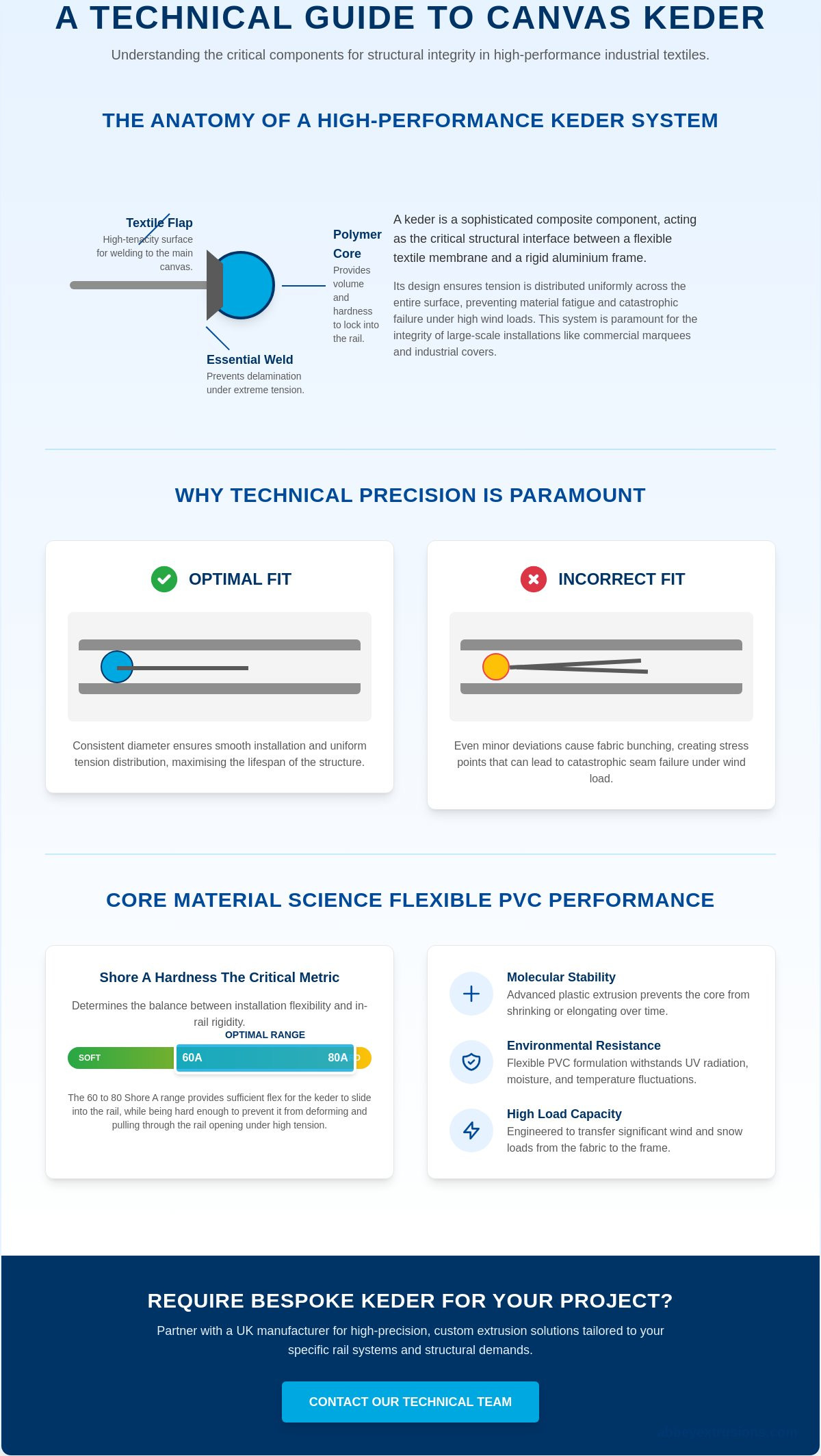
A high performance keder system relies on three primary elements which are the core, the fabric, and the weld. The core, typically manufactured from flexible PVC, provides the necessary volume and hardness to lock the assembly into an aluminium extrusion track. This bead must be sized correctly. It cannot pull through the opening of the rail whilst remaining easy enough to slide into place during installation. The fabric flap, which is often a PVC coated polyester, provides the robust surface area required for sewing or welding the keder to the main canvas. A high quality weld between the flap and the core is essential to prevent delamination under extreme tension.
Why Technical Precision Matters for Commercial Marquees
Technical precision is not merely a preference; it's a safety requirement for commercial marquees and industrial covers. If the diameter of the canvas keder deviates by even a small margin, the fabric may bunch or slip within the rail. This causes stress. In high wind environments, such inconsistencies lead to uneven load distribution and eventual seam failure. Consistent diameters ensure that installation is smooth and that the final structure can withstand the rigours of long term outdoor use. By maintaining strict control over the extrusion process, we provide components that extend the lifespan of industrial covers and reduce the need for frequent maintenance or costly repairs.
If you require detailed material specifications or want to discuss a custom polymer blend for your project, please enquire with our technical team today.
Material Science and Polymer Performance for Professional Keder Cords
The selection of the core material is the most significant factor in the long-term performance of canvas keder. Whilst various polymers exist, Flexible Polyvinyl Chloride (PVC) remains the industry benchmark due to its versatility and cost-efficiency. The performance of this core is defined by its Shore A hardness rating, which typically ranges from 60 to 80 for industrial textile applications. Achieving this precise balance requires advanced plastic extrusion techniques to ensure the polymer maintains its physical properties throughout the manufacturing cycle. Our production processes focus on maintaining molecular stability, which prevents the core from shrinking or elongating once it is welded to the textile flap.
Shore Hardness and Flexural Behaviour
Shore hardness directly influences how the keder behaves during both fabrication and installation. Hardness dictates performance. A softer core, perhaps around 60 Shore A, is often preferred for curved tracks or marine covers where the material must navigate tight radii without kinking or creating excessive friction. Conversely, a more rigid core is essential for straight industrial runs in large marquees. This ensures the fabric remains under high tension without the core compressing and pulling through the rail opening. Material consistency is vital. If the hardness fluctuates along the length of the cord, it creates uneven tension across the seam, leading to unsightly fabric distortion. This level of detail is a key part of Keder construction and applications, as the right hardness makes threading onto long rails significantly easier for installation teams. Choosing the correct canvas keder for the specific rail geometry prevents installation delays and ensures a professional finish.
Environmental Resistance and Durability
Industrial keder must withstand harsh environmental factors that would degrade standard plastics. UV stabilisers are integrated into the PVC compound to prevent the core from becoming brittle after prolonged sun exposure. UV stability is non-negotiable. In marine environments, chemical resistance is equally important to protect against salt spray and cleaning agents. Temperature fluctuations cause polymers to expand and contract. High grade polymers are engineered to remain flexible in sub-zero temperatures whilst resisting excessive softening in high heat. This thermal stability ensures the core doesn't degrade or lose its shape over years of service. Maintaining the bond between the polymer and the fabric is critical, as any degradation of the core material will eventually compromise the weld. For projects requiring specific durability standards, we suggest you request a technical consultation to find the right material match for your specific climate.
To discuss your specific manufacturing requirements or to request technical data sheets, please visit our contact page to speak with our specialists.
Structural Variations and Profile Comparisons for Commercial Textile Systems
The selection of a specific profile is as critical as the polymer choice discussed previously. In commercial textile engineering, the physical configuration of the canvas keder must be matched to the anticipated mechanical loads and the aesthetic requirements of the final installation. High precision kedar cord is available in various structural formats to accommodate everything from light retail awnings to massive industrial warehouses. Choosing the wrong profile often leads to premature wear or installation difficulties that can compromise the entire project timeline.
Single Flap versus Double Flap Configurations
Single flap profiles are the standard choice for lightweight applications such as standard awnings and light covers where the tension forces are relatively low. They're simpler to handle and integrate into smaller systems. However, for high stress environments, double flap keder provides superior strength and stability. The symmetrical design of a double flap allows the keder to sit more securely within the track whilst distributing forces more evenly across the fabric. Beyond strength, double flaps serve a functional aesthetic purpose. They hide the raw edge of the canvas between the two layers of material, resulting in a cleaner and more professional finish that is highly valued in high end commercial projects.
Matching Diameter to the Extrusion Track
The diameter of the core, typically ranging from 3mm to 15mm, must be selected based on the internal dimensions of the extrusion track. Precision is non-negotiable. If a system is designed for a 7mm keder, the component must be exactly 7mm to ensure a secure fit. Even minor deviations can lead to failure. It's vital to remember that the final diameter includes both the polymer core and the fabric wrap. Small diameters like 3mm or 4mm are typically reserved for indoor signage or light banners. Larger diameters, such as 12mm or 15mm, are essential for heavy duty industrial structures that face significant environmental pressure.
Understanding Tensile structure terminology helps engineers communicate these requirements accurately to manufacturers. Flap width must also be matched to the fabric weight. Heavier textiles require wider flaps to provide a sufficient welding or sewing surface to prevent the canvas keder from tearing away under load. When specifying these components, you should always measure the internal diameter of the rail and the width of the opening to ensure the bead cannot pull through. Our manufacturing process ensures that every millimetre of the profile meets these exacting standards to provide a reliable and secure fit for every application.
To request a technical consultation or obtain specific material data for your high stress application, please speak with our engineering team.
Technical Selection Criteria for High Stress Marine and Marquee Applications
Selecting the appropriate canvas keder requires a systematic evaluation of the mechanical environment in which the textile system will operate. Engineers must consider the fabric weight and the anticipated wind loads as primary variables. For lighter textiles under 350gsm, a smaller diameter keder with a single flap is often sufficient. However, as the structural span increases, the requirements change. Industrial structures spanning over 20 metres demand a double flap configuration with a core diameter of at least 12mm to distribute tension effectively. The weld strength between the core and the textile flap is the ultimate point of failure. We ensure that this bond is capable of withstanding the high shear forces encountered during extreme weather events.
Marine Environment Requirements
Marine applications present unique challenges due to constant exposure to salt water and high UV levels. For spray hoods and sail covers, keder must be entirely non-corrosive and chemically stable. Whilst traditional sewing is common, high frequency welding is often superior for marine keder because it creates a hermetic seal that prevents water ingress into the core. This manufacturing method ensures the polymer remains protected from the internal degradation caused by trapped moisture and salt crystals. Durability in these environments is achieved through the use of high grade stabilisers within the PVC compound to maintain flexibility across a wide temperature range.
Marquee and Temporary Structure Specifications
In the marquee industry, keder facilitates the rapid assembly and disassembly of large scale roof panels and side walls. Efficiency is key. The keder must slide smoothly through the aluminium tracks without snagging, even when the rails are slightly misaligned. For these temporary structures, the load distribution must be precisely calculated to prevent the fabric from tearing at the seams. High precision extrusion ensures that the diameter remains consistent across hundreds of metres of cord, which is vital for maintaining uniform tension in large structures. In specialised transport applications, this technology is also applied to curtainsider pelmet sections to ensure a reliable seal against wind and rain at motorway speeds.
When standard PVC cores do not provide sufficient rigidity, engineers may look to alternative materials. The mechanical properties of a nylon tube core offer significantly higher tensile strength and resistance to compression. This makes it an ideal choice for specialised high strength applications where the canvas keder must maintain its profile under extreme lateral pressure. To ensure your project meets these technical standards, we recommend you contact our technical department for a comprehensive material assessment.
For bespoke profile development or to discuss large scale supply requirements for the upcoming season, please contact our production facility to speak with a technical lead.
Custom Keder Manufacturing and Bespoke Extrusion Solutions in the UK
Sourcing canvas keder directly from a UK manufacturer provides significant logistical and technical advantages that standard stockists cannot replicate. With the UK manufacturing sector showing sustained expansion in early 2026, as evidenced by a Purchasing Managers' Index (PMI) of 53.7 in April, domestic production remains a cornerstone of industrial quality assurance. Direct communication with the extrusion team allows for the refinement of technical specifications to meet the exact needs of a project. This proximity ensures that dimensional tolerances are maintained to within +/- 0.05mm, which is essential for high performance industrial applications where even minor deviations lead to failure. Beyond keder, our facility produces a wide range of complementary components, including high quality pvc tube, providing a consolidated supply chain for complex textile engineering projects.
The Benefits of Bespoke Tooling and Profiles
Standardisation often falls short when dealing with innovative architectural membranes or unique rail systems. Custom tooling enables the production of keder with non-standard core shapes or specific flap lengths tailored to unique sewing and welding machinery. The prototyping process allows engineers to test the flexural behaviour of a new profile before committing to large scale production. This bespoke approach solves specific installation challenges, such as navigating complex curves in permanent textile structures. By designing the tool specifically for the project, we ensure the canvas keder fits the extrusion track with absolute precision, eliminating the risk of movement or pull-through under load.
Supply Chain Reliability and Quality Assurance
Reliability is a critical factor for businesses operating within the £89.4 billion UK textile product manufacturing market. Consistent material batches are vital for large projects to ensure that every metre of keder performs identically under tension. Domestic manufacturing significantly reduces lead times, which is particularly beneficial during time sensitive marquee seasons when rapid turnaround is required. Every production run undergoes rigorous testing for tensile strength and polymer stability to ensure it meets our internal excellence norms. This commitment to precision engineering provides our partners with the confidence that their structures will remain secure, regardless of the environmental stresses they face. We prioritise long term trust over short term gains by maintaining these strict manufacturing standards across every custom extrusion we deliver.
To discuss your project requirements or request a quotation for custom profiles, please get in touch with our technical team today.
Advancing Industrial Textile Performance with Precision Keder
The structural integrity of a tensioned textile system rests upon the technical precision of its smallest components. We've examined how selecting the correct Shore hardness and profile configuration prevents common issues such as fabric bunching and seam failure. Understanding these material science principles ensures that your industrial covers and marine structures remain secure under the most demanding environmental loads. As the UK textile manufacturing market continues to grow, the requirement for high precision components becomes even more critical for maintaining competitive engineering standards.
Abbey Extrusions has been a leader in UK manufacturing since 1985, specialising in high precision bespoke extrusions that meet exacting industrial requirements. Our deep technical expertise in industrial polymer performance allows us to develop solutions that standard stockists simply cannot provide. Whether you require a specific diameter for a unique rail system or a custom polymer blend for extreme climates, we're equipped to deliver canvas keder components that ensure long term reliability.
Contact our technical team to discuss your bespoke keder requirements and ensure your next project benefits from nearly four decades of engineering excellence. We look forward to supporting your manufacturing goals with precision and professional integrity.
Frequently Asked Questions
What is the most common keder diameter for a standard caravan awning
The industry standard for the majority of caravan awning rails in the United Kingdom is a 6mm or 7mm diameter. It's essential to measure the internal channel of your specific rail before selection. A diameter that is too small will pull out under wind load, whilst a diameter that is too large will be impossible to thread through the track.
Can I sew canvas keder using a standard domestic sewing machine
Domestic sewing machines generally lack the motor torque and presser foot clearance required to handle the combined thickness of a polymer core and industrial textile. Professional results require an industrial walking foot machine. This equipment ensures that the needle can penetrate the multiple layers of the canvas keder flap without skipping stitches or damaging the internal mechanism.
What is the difference between keder cord and keder strip
Keder cord refers to the raw extruded polymer bead before it has been integrated with a textile component. In contrast, a keder strip is the finished assembly where the cord is already welded or sewn into a high tenacity fabric flap. Most industrial manufacturers purchase the finished strip to save time during the final fabrication of marquee panels or marine covers.
Which polymer is best for keder cores in extreme cold weather
Specialised flexible PVC compounds formulated with low temperature plasticisers are the most effective choice for sub zero environments. Standard polymers can become brittle and crack when temperatures drop significantly. These engineered blends ensure the core remains flexible enough to navigate rails without compromising the structural integrity of the entire textile system.
How do I choose between a single and a double flap keder
Single flap profiles are typically reserved for lightweight retail awnings and banners where tension forces are relatively low. You should specify a double flap canvas keder for industrial structures or large marquees. The double flap provides superior load distribution and allows you to sandwich the main fabric between the flaps for a much stronger and cleaner finish.
Is it possible to weld keder to fabric without specialised machinery
Achieving a reliable structural bond requires specialised high frequency or hot wedge welding equipment. Standard heat guns don't provide the consistent temperature and pressure needed to create a seam that can withstand industrial wind loads. Using the correct machinery ensures the polymer core and the fabric flap become a single, inseparable unit that won't delaminate under stress.
What maintenance does canvas keder require in marine environments
Regular rinsing with fresh water is the most important maintenance task to prevent salt crystals from building up inside the rail. These crystals act as an abrasive that can wear down the fabric flap over time. You should also periodically check for any signs of UV degradation or chemical damage from hull cleaning agents to ensure the system remains safe.
Why is Shore hardness important when selecting a keder core
Shore hardness determines whether a core is flexible enough for curved tracks or rigid enough for straight, high tension runs. A core with a lower Shore A rating is easier to manipulate around corners. However, a higher Shore hardness is vital for large scale industrial applications to prevent the bead from compressing and pulling through the rail opening during a storm.

Article by
Bryan Cowan
Bryan Cowan is the Founder and Managing Director of Abbey Extrusions Ltd, a leading UK manufacturer of high-quality plastic tubes and hoses. With over 40 years of industry experience, Bryan established the company in 1985, growing it from a startup into a BS ISO9001-registered supplier for global sectors including aerospace, automotive, and pharmaceuticals.
Disclaimer
This article is intended for informational purposes only. Please ensure you seek expert advice or carry out your own research to confirm the information is suitable for your specific needs.