The traditional trade-off between hose weight and burst pressure is a technical limitation that modern professional garages no longer need to accept. You shouldn't have to sacrifice safety for the sake of reducing operator fatigue or preventing the constant annoyance of tangled lines. Integrating an air 60 hose for garage airlines into your workshop infrastructure provides a technical middle ground that satisfies both health and safety requirements and daily operational efficiency.
We understand the frustrations of dealing with rigid hoses that resist movement and deteriorate when exposed to common workshop oils. This article details why the Air 60 hose has emerged as the industry standard, offering a remarkable 60 bar burst pressure whilst remaining flexible enough to prevent wrist strain during long shifts. We will explore the material science behind its chemical resistance and how it assists in maintaining compliance with the Pressure Systems Safety Regulations 2000 (PSSR).
Key Takeaways
- Understand the technical specifications of the three-ply reinforced PVC structure and how its 60 bar burst pressure ensures maximum workshop safety.
- Learn how switching to an air 60 hose for garage airlines reduces operator fatigue by providing a lightweight and highly flexible alternative to heavy rubber hoses.
- Identify the correct internal diameters and hose lengths required to maintain optimal pressure levels for your specific pneumatic tools.
- Discover the best practices for airline layout and routine inspections to extend the service life of your compressed air system.
- Recognise the benefits of sourcing industrial grade hoses from a UK manufacturer to ensure consistent quality and access to bespoke configurations.
If you require technical assistance or bespoke specifications for your workshop, please feel free to contact our specialist team.
Understanding Air 60 Hose and its Essential Role in Garage Airlines
The Air 60 hose represents a significant advancement in the delivery of compressed air within industrial environments. Unlike standard pneumatic tubing, this specific product is engineered as a high performance three-ply reinforced PVC hose designed to withstand the rigorous demands of professional workshops. Compressed air plays an essential role in garage airlines, powering everything from impact wrenches to tyre inflation systems, yet the delivery method is often overlooked. Traditionally, workshops relied on heavy rubber lines that were prone to degradation and physical weight issues. The transition towards the Air 60 hose marks a move towards materials that offer a superior balance of durability and ease of use.
Many professional workshops are moving away from traditional heavy rubber lines because of the physical toll they take on technicians. Rubber hoses, whilst durable, are often cumbersome and difficult to organise. The supple nature of the Air 60 material differs significantly from standard rigid plastics, which can be prone to kinking or cracking under stress. This flexibility ensures that the hose follows the movement of the user without resisting. It's a critical factor in reducing repetitive strain during long shifts and maintaining a tidy workspace.
The Technical Three-Ply Construction Advantage
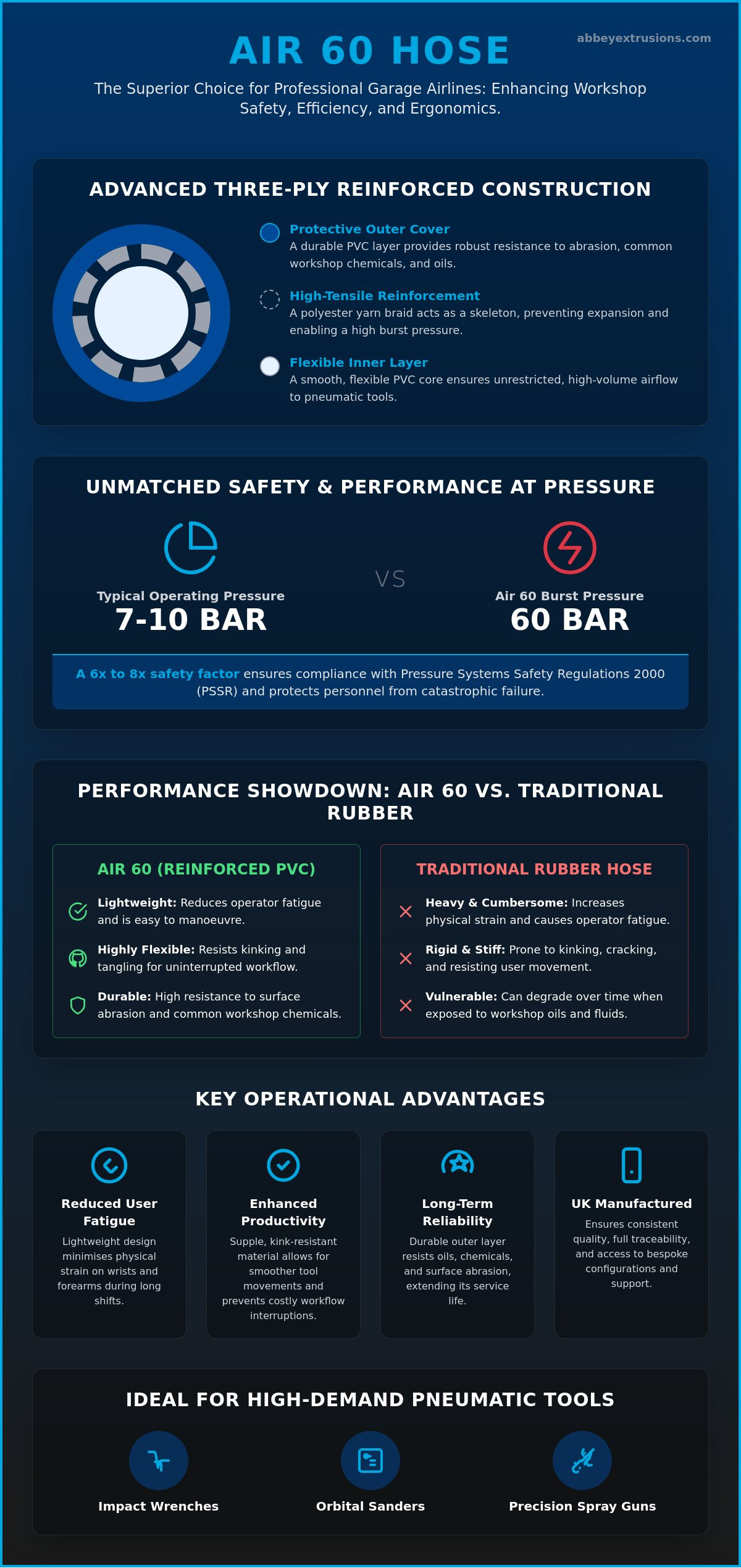
The performance of the air 60 hose for garage airlines is rooted in its sophisticated material composition. It features a flexible PVC inner layer and a protective outer cover, which are bonded together with a middle layer of high-tensile polyester yarn reinforcement. This specific construction method allows the hose to maintain its structural integrity even when subjected to high internal pressures. The polyester braiding acts as a skeleton, preventing the PVC from expanding or bursting, whilst the outer PVC layer provides resistance to common workshop chemicals and oils.
High Pressure Capacity and Workshop Safety Standards
Safety in a compressed air system is largely determined by the relationship between working pressure and burst pressure. The Air 60 hose is defined by its 60 bar burst pressure rating, which provides a substantial safety margin for systems typically operating at 7 to 10 bar. Having a high safety factor is critical amongst high-pressure pneumatic tools to prevent catastrophic failure. This rating ensures compliance with industrial safety standards and provides workshop managers with the confidence that their air distribution system can handle unexpected pressure spikes without risk to personnel.
For technical guidance on upgrading your workshop infrastructure, please consult with our engineers.
Operational Advantages of High Pressure PVC Hoses in Professional Workshops
Traditional rubber hoses are often chosen for their perceived ruggedness, yet they introduce significant ergonomic disadvantages that can hinder productivity. The primary benefit of an air 60 hose for garage airlines is the substantial weight reduction achieved through advanced PVC compounding. Whilst a standard rubber hose can feel cumbersome and resistant to movement, high pressure PVC variants are considerably lighter per metre. This reduction in mass directly translates to improved handling for technicians who operate handheld pneumatic tools for extended periods throughout a shift.
Reducing User Fatigue with Lightweight Design
The ergonomic impact of hose weight shouldn't be underestimated in a busy industrial setting. When using heavy tools, the weight of a trailing rubber line adds constant tension to the user's wrist and forearm. By switching to a lightweight air 60 hose for garage airlines, workshops can reduce this physical strain. This is especially beneficial for:
- High-torque impact wrenches used in busy tyre bays
- Orbital sanders in automotive body repair shops
- Precision spray guns for high-end refinishing
A less intrusive hose allows for smoother, more controlled movements, which is vital for achieving a high quality finish. Technicians find that they can work for longer durations without the onset of wrist fatigue, which is a common complaint with heavier traditional systems.
Resistance to Kinking and Surface Abrasion
One of the most common operational frustrations in a professional garage is the tendency for air lines to kink, which restricts flow and can potentially damage the compressor. The technical three-ply structure of the Air 60 ensures it remains kink-resistant even when under pressure or coiled tightly. The outer PVC layer is specifically formulated to resist the abrasive nature of concrete workshop floors and metal edges. For environments where extreme mechanical wear is expected, we recommend using a nylon spiral cut hose guard to provide an additional layer of external protection.
Maintaining a safe workspace requires adhering to strict Installation and Maintenance for Long Term Reliability protocols. This includes ensuring that hoses are resistant to the common contaminants found in professional garages. Unlike some low-grade materials, the PVC used in Air 60 hoses is resistant to oil, grease, and many industrial chemicals. It also maintains thermal stability across a broad temperature spectrum, ensuring the hose doesn't become brittle in winter or overly soft in summer heat. If you're unsure which material grade is best for your specific workshop chemicals, you can speak with our technical team for tailored advice.
To discuss specific dimensions or pressure requirements for your facility, please contact our technical department.
Technical Considerations for Specifying Your Compressed Air System
Specifying the correct air 60 hose for garage airlines involves more than simply matching a hose to a compressor. You must evaluate the entire path from the air receiver to the tool to ensure peak performance. One of the most common errors in workshop design is ignoring the cumulative effect of pressure drop. As air travels through a hose, friction against the internal walls causes a loss of energy. If your hose is too long or the diameter is too narrow, the pressure at the tool will be significantly lower than the pressure at the gauge. This leads to inefficient tool operation and increased wear on your compressor.
Workshops with multiple bays should consider a ring main system with individual drop lines. This layout provides a more consistent pressure distribution across the entire facility. When selecting your delivery lines, ensure the material is rated for the maximum possible pressure your system can produce. The 60 bar burst pressure of our standard air lines provides a significant safety buffer, ensuring that even in the event of a regulator failure, the hose remains intact.
Matching Internal Diameters to Pneumatic Tool Requirements
The internal diameter (ID) of the hose must be matched to the air consumption of your most demanding tool. For light duty applications such as tyre inflators or blow guns, a 6mm hose is often sufficient. However, heavy duty pneumatic tools like impact wrenches or large grinders require a higher volume of air. Using a 10mm ID hose ensures that these tools aren't starved of the power they need to perform correctly. When calculating flow requirements, always refer to the manufacturer's litres per minute (LPM) specifications. Selecting an undersized line results in a performance bottleneck that no amount of increased compressor pressure can resolve.
Compatibility with Standard Fittings and Couplings
Maintaining a leak-free environment is essential for both safety and energy efficiency. The reinforced pvc tube structure of the Air 60 hose is designed to work seamlessly with standard hose tail adaptors and high quality safety couplings. Secure these connections using appropriately sized worm drive clips to prevent accidental disconnection under pressure. For workshops with compact workstations or assembly benches, integrating nylon recoil air hoses can help keep the floor clear of trip hazards whilst providing immediate access to air. All installations should be carried out with reference to OSHA Compressed Air Regulations to ensure the system meets established safety benchmarks for pressure gauges and supply lines.
If you require a bespoke length or specific technical advice for your workshop installation, please speak with our technical advisors.
Installation and Maintenance for Long Term Reliability
Professional garage environments demand a structured approach to airline management to ensure both technician safety and equipment longevity. Even a high performance air 60 hose for garage airlines can suffer premature wear if the installation layout is poorly conceived. We recommend a design that minimises sharp bends and obstructions, as these create turbulence and unnecessary pressure loss. Fixed piping should be secured firmly to walls, whilst flexible drop lines should be positioned to allow for a natural radius when in use. Maintaining a high performance air 60 hose for garage airlines involves consistent vigilance and an understanding of the mechanical stresses placed upon the material.
Moisture management is another critical factor in maintaining system integrity. Compressed air naturally generates condensate, which can lead to internal corrosion or the degradation of pneumatic tool seals. Integrating water traps and automatic drains at the lowest points of your system prevents this moisture from reaching your flexible lines. When storing hoses, avoid coiling them too tightly around sharp hooks. Using a dedicated hose reel or a large diameter hanger will prevent the material from developing a permanent set or internal stress points that could compromise the burst pressure rating over time.
Best Practices for Garage Airline Setup
Integrating filters and regulators into your air 60 air hose system ensures that the air reaching your tools is clean and at the correct operating pressure. Smooth transitions between fixed piping and flexible lines are essential for maintaining a steady flow rate. It's a modular approach that ensures repairs happen swiftly, minimising downtime for your technicians. We suggest using a high quality ball valve at every drop point to allow for easy maintenance without depressurising the entire workshop infrastructure.
Routine Inspection and Maintenance Protocols
Establishing a regular inspection schedule is the most effective way to prevent catastrophic failures in high pressure systems. Technicians should conduct a visual check at the start of every shift, looking specifically for surface abrasions, cuts, or soft spots in the PVC layers. These soft spots often indicate internal reinforcement damage or excessive oil contamination that has begun to break down the compound. Don't ignore small leaks, as they represent a significant financial loss in wasted energy and compressor wear. If a hose shows signs of swelling near a coupling or if the outer cover has been compromised by chemical exposure, it must be replaced immediately. If you're unsure about the condition of your current lines, you can request a technical review from our team.
For enquiries regarding bulk orders or custom manufacturing specifications, please contact our UK-based facility.
The Value of British Manufacturing for Industrial Grade Air Lines
Sourcing an air 60 hose for garage airlines directly from a British manufacturer ensures a level of technical oversight that is often absent in mass-market imports. Local production allows for rigorous monitoring of the extrusion process, ensuring that every metre of hose meets the exact polymer density and reinforcement tension required for industrial applications. When you choose a UK-made product, you're investing in a supply chain that prioritises material traceability and consistent quality over volume-driven cost cutting. This relationship between the manufacturer and the end user provides a foundation of trust that is essential for safety-critical workshop components.
Technical expertise is not just about the final product; it's about the decades of experience that inform the production cycle. Our commitment to excellence means that we understand the subtle nuances of polymer behaviour under pressure. By maintaining control over the entire manufacturing process, we can offer bespoke solutions that smaller retailers cannot match. Whether you require specific lengths for a large-scale facility or unique internal diameters for specialised equipment, a direct manufacturing partnership makes these requirements achievable.
The Importance of Technical Manufacturing Standards
Precision extrusion is the cornerstone of a reliable air line. Any inconsistency in the wall thickness of a hose creates a weak point that could lead to failure under high pressure. Our manufacturing standards involve constant monitoring of the extrusion line to ensure perfect concentricity and structural uniformity. Every batch of air 60 hose for garage airlines undergoes hydrostatic testing to verify its 60 bar burst pressure rating. This level of quality control is what separates industrial grade equipment from consumer grade alternatives, providing the stability and safety that professional garages require.
Sourcing Directly from a Specialist UK Manufacturer
One of the most significant advantages of sourcing directly from a specialist is the access to immediate technical support. You aren't speaking to a generalist distributor, but to the engineers who understand the material properties of the product. This direct line of communication ensures that you receive the most accurate advice for your specific workshop environment. Industrial partners also benefit from reliable stock levels and significantly faster lead times, which is vital for maintaining operational continuity. Beyond air lines, workshops often require other specialised fluids delivery solutions, such as diesel fuel hoses, which can be sourced concurrently to ensure material compatibility across the facility. Supporting local industry ensures that high-level manufacturing skills remain accessible to the UK garage trade.
If you are looking to upgrade your compressed air infrastructure, please get in touch with our specialists.
Optimising Your Workshop Performance with Professional Grade Airlines
Selecting the correct air line infrastructure is a fundamental decision that impacts both the safety and productivity of your facility. By implementing an air 60 hose for garage airlines, you ensure that your technicians benefit from a lightweight, flexible system that actively reduces physical fatigue whilst maintaining a high 60 bar burst pressure safety rating. This technical balance between ease of use and structural integrity is essential for modern workshops operating under strict safety regulations. We understand that every garage setup has unique requirements that demand precision and material traceability.
We've been at the forefront of UK manufacturing since 1985, providing precision engineered solutions that meet the rigorous demands of the traditional manufacturing sector. Our team provides specialist technical support for industrial applications, ensuring your system is specified for long term reliability and efficiency. Please contact our technical sales team to discuss your specific air line requirements. We look forward to helping you build a safer and more efficient professional workspace through our commitment to industrial excellence.
Frequently Asked Questions
Is Air 60 hose suitable for use with high pressure compressors
Yes, it's perfectly suited for high pressure systems. With a 60 bar burst pressure, it provides a substantial safety margin for standard 7 to 10 bar compressors found in most workshops. This rating ensures the system can handle unexpected pressure spikes without failing, maintaining a safe working environment for all technicians.
Can I use Air 60 hose for outdoor garage applications
Yes, the UV resistant PVC construction makes it suitable for outdoor environments. It maintains its structural integrity when exposed to sunlight and varying weather conditions without becoming brittle. This durability is essential for mobile mechanics or workshops with external service bays that require reliable performance in all seasons.
What are the main differences between rubber air hoses and Air 60
The primary differences lie in weight and chemical resistance. An air 60 hose for garage airlines is significantly lighter than traditional rubber, which makes it much easier to manoeuvre around a vehicle. It also offers superior resistance to oil and grease, which often causes standard rubber compounds to swell and degrade over time.
How do I choose the correct fitting for an Air 60 hose
You must match the fitting size to the internal diameter of your specific hose. Standard 6mm or 10mm hose tails are typically used with worm drive clips to ensure a secure, leak free connection. Always check that your chosen couplings and adaptors are rated for the maximum working pressure of your compressor system.
Is the Air 60 hose resistant to oil and workshop chemicals
Yes, the technical PVC compound is specifically formulated to withstand common workshop contaminants. It resists degradation when in constant contact with motor oils, hydraulic fluids, and many industrial cleaning agents. This chemical resistance ensures a long service life even in the most demanding automotive and industrial environments.
Does the Air 60 hose help prevent user fatigue during long shifts
Yes, the lightweight nature of the material reduces the physical burden on the operator. Using a lighter air 60 hose for garage airlines minimises the drag weight felt at the wrist when operating handheld tools. This ergonomic advantage is vital for technicians performing repetitive tasks like sanding or impact work during a full shift.
What is the maximum working temperature for an Air 60 air line
The hose is typically rated for operation at temperatures up to +60 degrees Celsius. It's designed to remain flexible and stable within standard workshop temperature ranges without losing its structural properties. If your application involves higher temperatures, you should consult with a technical advisor for a more specialised material recommendation.
Can Air 60 be used with a standard hose reel
Yes, its supple construction and kink resistance make it ideal for use with manual or automatic hose reels. It coils easily without developing a permanent set, which ensures smooth deployment and retraction every time. This compatibility helps maintain an organised workshop floor and reduces the risk of trip hazards amongst staff.

Article by
Bryan Cowan
Bryan Cowan is the Founder and Managing Director of Abbey Extrusions Ltd, a leading UK manufacturer of high-quality plastic tubes and hoses. With over 40 years of industry experience, Bryan established the company in 1985, growing it from a startup into a BS ISO9001-registered supplier for global sectors including aerospace, automotive, and pharmaceuticals.
Disclaimer
This article is intended for informational purposes only. Please ensure you seek expert advice or carry out your own research to confirm the information is suitable for your specific needs.