The most expensive ingredient in your craft beer isn't the hops; it is the entire batch you are forced to discard due to bacterial leaching from an inferior hose. We recognise that maintaining product purity is your highest priority, yet the physical reality of manoeuvring heavy, rigid lines in confined brewery spaces often leads to operational frustration. Selecting the correct sanitary hose for craft brewing requires more than just a food grade label; it demands a precise match between polymer specifications and your specific temperature and pressure cycles.
You likely already know that porous materials and poor cleaning protocols are the primary enemies of a consistent flavour profile. We promise to provide a comprehensive guide to selecting and maintaining high quality hoses tailored for these unique demands. This article explores how modern manufacturing standards, including the 3-A Sanitary Standards updates released in early 2026, influence your equipment choices to ensure a longer lifespan and improved operational efficiency.
Key Takeaways
- Understand why a non-porous bore is essential for preventing microbial growth and how brewery-specific standards differ from general food grade options.
- Evaluate the technical benefits of Reinforced PVC and LDPE tubing to ensure you select the most effective sanitary hose for craft brewing applications.
- Compare the weight and visibility advantages of transparent PVC against traditional rubber hoses to improve both safety and product monitoring during transfers.
- Calculate precise internal diameters and working pressure ratings to match your brewery's specific flow rates and equipment configurations.
- Gain insights into the quality control and customisation advantages available when partnering with a dedicated UK manufacturer for bespoke hose lengths.
If you require technical guidance on specific polymer compatibility for your production line, please contact our specialist engineering team.
Defining Sanitary Hoses for Craft Brewing Applications
A sanitary hose for craft brewing is distinguished from standard industrial tubing by its internal surface profile and chemical stability. In the precision-driven environment of a modern brewhouse, a hose is more than a simple conduit; it is a critical component that must maintain the organoleptic properties of the beer. This means the material must not impart any unwanted flavours, odours, or chemical residues into the liquid during transfer. While many products are marketed as food grade, brewery-specific applications demand a higher threshold of resistance to high-temperature cleaning cycles and acidic environments. Beer itself is a complex solvent. The presence of alcohol and carbon dioxide means that inferior polymers can leach plasticisers over time, which irrevocably alters the taste profile of the final product.
Choosing a dedicated sanitary hose for craft brewing ensures that the integrity of your recipe remains intact from the fermentation vessel to the kegging line. Professional brewers must look beyond basic flexibility and focus on the molecular stability of the hose liner. High-quality polymers are engineered to be inert, meaning they won't react with the organic compounds in the beer. This stability is essential for maintaining the clarity and crispness of the beverage, especially when dealing with delicate styles like pilsners or session ales where any off-flavour is immediately apparent.
The Role of Smooth Bore Technology
The internal surface of a hose, known as the bore, must be perfectly smooth and non-porous to meet sanitary standards. During the transfer of wort or finished beer, microscopic pits or ridges in inferior materials can trap yeast cells, proteins, and sugars. These deposits create biofilms which are notoriously difficult to remove even with aggressive chemicals. Our brewery hose solutions utilise advanced extrusion techniques to ensure a mirror-like finish on the internal wall. This precision reduces the cleaning time required between batches and significantly reduces the volume of caustic agents needed to achieve total sanitisation. Consistent extrusion quality is the only reliable way to avoid the "orange peel" effect often found in cheaper imports, which serves as a breeding ground for wild yeast and spoilage bacteria.
Regulatory Compliance and Food Standards
Adherence to international safety standards is the foundation of professional brewing operations. Every component must align with Good Manufacturing Practices (GMPs) to ensure that materials in contact with food do not compromise consumer health. For craft brewers, this means prioritising phthalate-free polymers and ensuring every hose has a clear chain of traceability. European food contact regulations and FDA compliance provide the framework for these standards, but modern brewers should also look toward the latest industry updates. For example, the 3-A Sanitary Standards updates released in February 2026 introduce stricter specifications for clean-in-place (CIP) gasket joints and seal requirements. By selecting hoses manufactured from high-grade reinforced PVC tube or specialised polymers, brewers can ensure their equipment meets these evolving safety audits while protecting the long-term reputation of their brand.
If you would like to discuss a custom specification for your production facility, you can reach out to our technical department for assistance.
Material Specifications for High Performance Beer Transfer
The selection of a specific polymer determines the operational limits of your brewery. Whilst standard food grade tubes might suffice for basic water transport, a dedicated sanitary hose for craft brewing must withstand the rigours of ethanol exposure and pressurised transfer without losing structural integrity. Modern craft brewing relies heavily on phthalate-free materials to eliminate the risk of endocrine-disrupting chemicals migrating into the product. This is a critical consideration often overlooked by generic suppliers, but it is foundational to maintaining the purity of your beer. High-clarity extrusions also play a vital role in quality control, as they allow brewers to monitor the flow and colour of the liquid in real time, ensuring that yeast sediment or fining agents are not being prematurely pulled into the bright tank.
Thermal performance is another key metric. During the brewing cycle, hoses may be exposed to temperatures ranging from near-freezing during cold crashing to high-heat sanitisation phases. Traditional rubber hoses often fail to provide the necessary visibility and can become excessively heavy when wet. In contrast, advanced polymers maintain their flexibility and clarity across a wider temperature range, making them easier to handle in the fast-paced environment of a cellar.
Reinforced PVC vs Standard Tubing
The primary advantage of a reinforced PVC tube lies in its composite construction. By embedding high tensile polyester yarn between the inner and outer layers, the hose achieves the strength required to handle significant working pressures during pump-assisted transfers. This reinforcement prevents the hose from kinking or collapsing under vacuum, which is essential for consistent flow rates. The bond between these layers must be absolute; any delamination creates a void where beer can sit and spoil, leading to catastrophic contamination. Engineers often refer to the Engineering Guide to Reinforced PVC Hose to verify that the burst pressure ratings meet their specific safety margins.
Chemical Resistance and CIP Compatibility
Clean-in-place (CIP) protocols involve the use of aggressive chemicals such as caustic soda and peracetic acid. A high-performance sanitary hose must be chemically inert to these agents to prevent material degradation. When a hose begins to pit or soften due to chemical attack, it loses its smooth bore, creating the microbial traps discussed in previous sections. For secondary transfers and gas lines, many brewers utilise low-density polythene tube (LDPE) due to its excellent chemical resistance and cost-effectiveness. Adhering to the Brewers Association GMP guidelines ensures that your material choices align with industry best practices for hygiene. If you are unsure which polymer suits your specific cleaning regime, our team can provide technical data sheets to guide your selection.
If you require a technical consultation regarding the specific pressure ratings for your cellar equipment, you can speak with our engineering department to discuss your requirements.
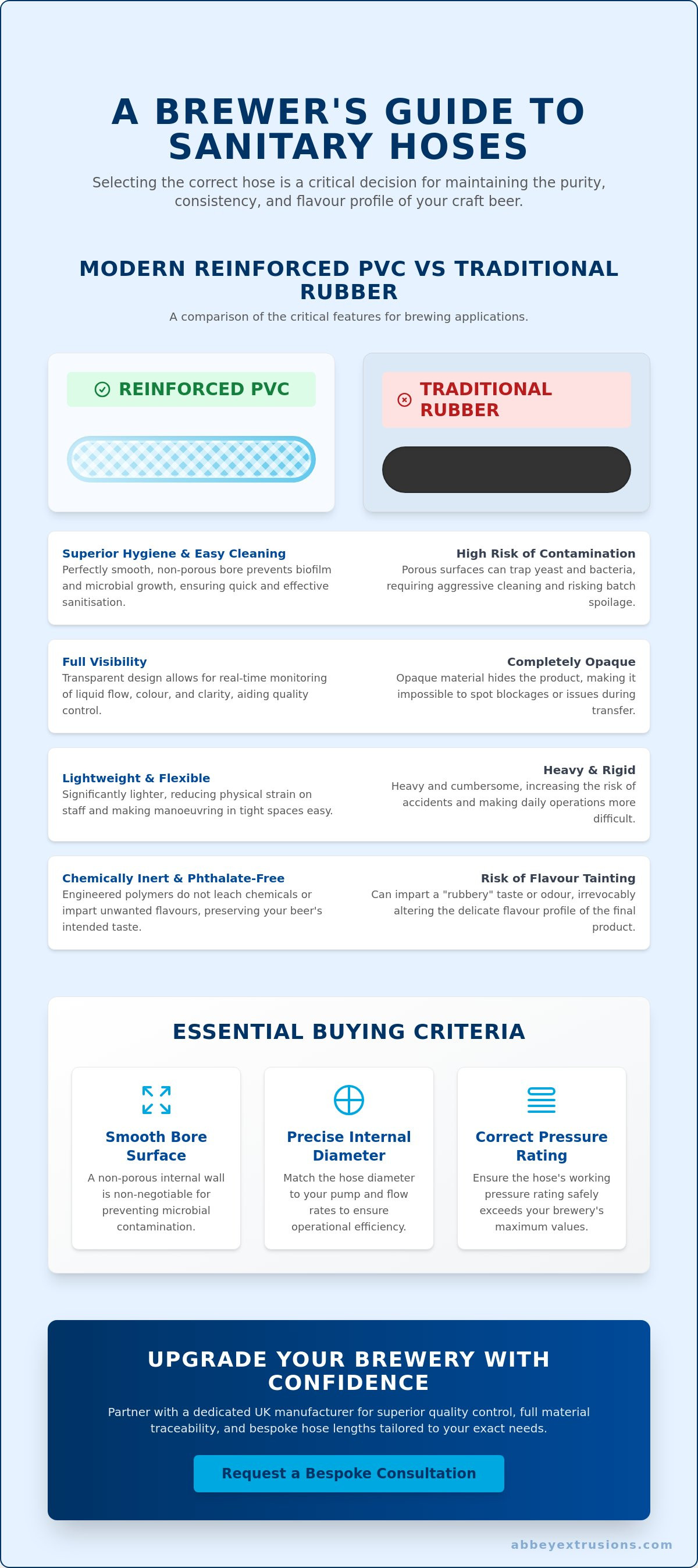
Comparing Reinforced PVC and Traditional Rubber Brewery Hoses
Choosing between material types is a fundamental decision for any cellar manager. Whilst traditional rubber hoses have been the industry standard for decades, they present significant challenges in modern, smaller-scale craft environments. A high-quality sanitary hose for craft brewing must balance durability with practical usability. Rubber hoses are often over-engineered for the pressures found in craft brewing, which leads to unnecessary weight and rigidity. In contrast, reinforced PVC tube offers a more agile solution without compromising on safety or technical compliance. This agility is particularly valuable when working in limited floor plans where equipment must be moved frequently.
Cost-effectiveness is another factor that favours modern polymers. Rubber hoses require a higher initial investment and can be difficult to clean if the internal liner becomes compromised. PVC alternatives provide a smooth, glass-like internal finish at a lower price point, allowing breweries to replace lines more frequently as part of a proactive maintenance schedule. This ensures that the risk of microbial build-up is kept to an absolute minimum throughout the equipment's lifespan.
Weight and Ergonomics in the Brewhouse
Manual handling is a daily reality in the brewhouse. Moving heavy, water-filled rubber hoses between fermenters and bright tanks is physically demanding. It increases the risk of operator fatigue and potential injury. PVC hoses are significantly lighter, allowing for easier manoeuvrability in tight spaces. This reduced weight doesn't just benefit the staff; it simplifies the entire organisation of the cellar. Lighter hoses are easier to coil and hang on wall-mounted racks, which helps in keeping the floor clear of trip hazards and maintaining a tidy workspace.
Hygiene and Visual Monitoring
One of the most significant advantages of our brewery hose is its transparency. In a traditional rubber hose, the brewer is effectively working blind. You cannot see air bubbles, yeast slugs, or the clarity of the beer as it moves through the line. Transparent PVC provides immediate visual feedback. If you see sediment being pulled from the cone of a fermenter, you can stop the transfer instantly. This saves the batch from contamination and ensures that only the highest quality product reaches the bright tank.
Hygiene also extends to the exterior of the equipment. Rubber hoses, particularly those with black covers, often leave unsightly marks on stainless steel vessels and polished brewery floors. PVC extrusions feature a non-marking outer cover that maintains the professional appearance of your facility. This material choice aligns with the FDA food-contact material regulations, ensuring that every part of the hose, from the inner bore to the outer layer, is safe for use in a food production environment. Whilst rubber may offer a longer absolute lifespan in high-abrasion industrial settings, the operational benefits of PVC make it the superior choice for most craft applications.
If you need assistance calculating the specific flow requirements for your cellar setup, you can contact our technical support team for expert advice.
Technical Specifications and Buying Criteria for Craft Brewers
Selecting a sanitary hose for craft brewing involves a rigorous assessment of your facility's hydraulic requirements. Whilst the material properties ensure product purity, the technical dimensions determine the efficiency of your daily operations. Brewers must account for the physical constraints of their equipment, including the pump capacity and the distance between vessels. A hose that is incorrectly sized will either restrict flow, leading to pump cavitation, or fail to provide the necessary velocity for effective clean-in-place (CIP) cycles. Beyond diameter, the bend radius is a critical factor. In the confined spaces of a microbrewery, a hose must be able to navigate tight turns around fermenter legs and manifolds without kinking, which would otherwise cause pressure spikes and potential equipment failure.
Temperature and pressure are the two variables that most significantly impact the performance of polymer extrusions. As temperature increases, the molecular structure of the hose becomes more flexible, which naturally reduces its ability to withstand high internal pressures. It is essential to verify that your chosen hose can maintain its structural integrity at the peak temperatures of your cleaning cycle or wort transfer.
Sizing and Flow Rate Calculations
Most craft breweries utilise standard Tri-Clamp or hose barb fittings, making it vital to match the internal diameter (ID) of the hose to these existing connections. A 1.5 inch ID is common for most transfers, but larger production facilities may require 2 inch lines to handle higher volumes. Choosing a larger diameter reduces friction loss over long distances, which preserves the life of your pumps. Conversely, smaller diameters increase the velocity of the liquid. This is often desirable during cleaning phases to ensure enough turbulence to scrub the internal walls. Our brewery hose range is manufactured in standard sizes to ensure seamless integration with your current stainless steel hardware.
Pressure and Temperature Limits
It is vital to distinguish between working pressure and burst pressure. Working pressure is the maximum pressure a hose can safely handle during continuous operation, whilst burst pressure is the point of catastrophic failure. For safety, most industrial standards require a safety factor of at least 3 to 1. If your pump operates at 3 bar, your hose should be rated for a minimum of 9 bar working pressure to account for sudden surges or blockages. Temperature ratings must also be scrutinised. A hose rated for 60 degrees Celsius may lose up to half of its pressure resistance if the liquid temperature exceeds this limit. Always consult technical data sheets to ensure your sanitary hose for craft brewing matches the specific thermal profile of your production line. For a detailed breakdown of how these variables interact, you can request a technical consultation with our engineering team.
If you would like to request a quote for a bespoke production run, please get in touch with our sales team.
The Advantages of UK Manufactured Sanitary Hosing Solutions
Sourcing a sanitary hose for craft brewing directly from a UK manufacturer offers a level of quality control that imported alternatives often fail to match. Abbey Extrusions brings over 40 years of experience to the production of high-performance polymers, ensuring that every batch meets rigorous safety and durability standards. This domestic supply chain reduces lead times and provides brewers with a reliable partner who understands the specific regulatory landscape of the UK and European markets. By eliminating intermediaries, you gain direct access to the technical expertise required to solve complex fluid transfer problems. This proximity allows for a more rigorous oversight of the manufacturing process, from the initial raw material selection to the final quality inspection.
Working with a local manufacturer also simplifies the logistics of equipment replacement. When a critical line fails, waiting for an international shipment can lead to costly downtime. A UK-based supplier can respond rapidly, ensuring that your production schedule remains on track. This reliability is built on a foundation of long-term trust and technical competence, which are the hallmarks of traditional British manufacturing.
Bespoke Manufacturing for Unique Brewery Layouts
Standard off-the-shelf hoses often result in unnecessary waste or awkward loops in the cellar. The ability to specify exact lengths is a significant advantage for breweries with unique footprints or non-standard equipment heights. Through custom plastic extrusion, we can address specific engineering challenges that generic products ignore. This includes the production of non-standard colours for line identification, which helps operators quickly distinguish between gas lines, water lines, and beer transfer lines. This level of organisation improves safety and reduces the risk of accidental cross-contamination during busy shifts. Ordering exact lengths also minimises the clutter of excess hosing on the brewery floor, contributing to a cleaner and safer working environment.
Direct Technical Support and Expertise
Accuracy in material selection is paramount for maintaining the long-term integrity of your brewing equipment. Speaking directly with the manufacturer ensures that the polymer chosen is fully compatible with your specific temperature cycles and chemical cleaning agents. Abbey Extrusions supports the craft brewing industry by providing tailored solutions that go beyond simple product sales. We encourage brewers to utilise the expertise of a dedicated UK plastic extrusion company to ensure their hose specifications are optimised for both performance and longevity. This direct relationship allows for ongoing technical support and the development of bespoke profiles that meet the evolving needs of modern craft production. When you partner with a manufacturer that has decades of experience, you aren't just buying a component; you're investing in a technical partnership designed to ensure product purity and operational efficiency.
If you require a technical consultation regarding the specific pressure ratings for your cellar equipment, you can speak with our engineering department to discuss your requirements.
Optimising Your Production Line with Engineering Precision
Ensuring the long-term success of a brewery requires a meticulous approach to equipment selection. We have explored how the transition from traditional rubber to modern reinforced PVC can improve ergonomics whilst maintaining the highest levels of hygiene. By prioritising smooth-bore technology and phthalate-free food grade resins, you protect the organoleptic properties of your beer and reduce the risk of microbial contamination. Selecting the right sanitary hose for craft brewing is not merely a purchase; it is a critical decision that impacts your operational efficiency and product consistency.
Abbey Extrusions has been at the forefront of UK manufacturing since 1985, providing the technical competence required for high-stakes production environments. Our bespoke extrusion capabilities allow us to deliver tailored solutions that match your specific cellar layout and pressure requirements. If you require technical assistance or a bespoke quotation for your brewery setup, please contact our specialist team to discuss your requirements. We look forward to helping you achieve a more efficient and reliable production cycle.
Frequently Asked Questions
Can I use standard garden hoses for craft brewing
No, you should never use standard garden hoses for any stage of the brewing process. These hoses are typically manufactured from non-food-grade materials that can leach lead and phthalates into your liquid. They lack the thermal stability required for hot wort and the chemical resistance needed for brewery sanitisation. Investing in a dedicated sanitary hose for craft brewing ensures your product remains free from toxic contaminants and unwanted plastic tastes.
What is the best way to clean a sanitary brewery hose
The most effective method is a standard clean-in-place (CIP) cycle using compatible chemicals like caustic soda or peracetic acid. You must ensure the cleaning agents are circulated at the correct velocity to create turbulence within the smooth bore. This turbulence mechanically removes yeast and protein deposits. Always rinse thoroughly with potable water after the chemical cycle to ensure no residue remains that could affect the beer's flavour profile.
How often should I replace my brewery transfer hoses
You should replace your brewery transfer hoses whenever you notice internal pitting, surface discolouration, or any signs of layer delamination. Whilst the lifespan varies based on the frequency of your cleaning cycles, many professional brewers implement a proactive replacement schedule every twelve to eighteen months. Regular inspection is vital because microscopic cracks can harbour bacteria that a standard CIP cycle cannot reach, potentially ruining an entire batch of beer.
Are Abbey Extrusions brewery hoses phthalate free
Yes, all our brewery hoses are manufactured using phthalate-free, food-grade resins to meet the highest safety standards. We recognise that product purity is a priority for craft brewers, so we exclude endocrine-disrupting chemicals from our extrusion process. This commitment to quality ensures that our products comply with current European and FDA regulations, providing you with a stable and reliable conduit for your beer transfers.
What fittings are compatible with your reinforced PVC brewery hoses
Our reinforced PVC hoses are designed to be compatible with all standard brewery hardware, including Tri-Clamp fittings, hose barbs, and camlocks. It is essential to match the internal diameter of the hose precisely to your fitting size to ensure a leak-proof seal. We recommend using high-quality stainless steel worm-drive clips or swaged ferrules to secure the connections, especially during pump-assisted transfers where internal pressures are higher.
Can these hoses handle boiling wort transfer
Most reinforced PVC hoses are rated for temperatures up to 60 degrees Celsius, making them ideal for fermentation transfers and cold-side operations. However, they are generally not suitable for boiling wort directly from the kettle. High temperatures significantly reduce the pressure rating of the polymer and can lead to hose failure. For hot-side transfers, you must verify the specific thermal limits of the material or consider a specialised high-temperature hose.
What is the difference between a food grade hose and a sanitary hose
A food-grade hose is simply made from materials safe for food contact, whereas a sanitary hose for craft brewing features a specific hygienic design. Sanitary hoses must have a mirror-smooth, non-porous internal bore to prevent the accumulation of organic matter and microbial growth. Whilst all sanitary hoses are food grade, not all food-grade tubes possess the surface finish required to meet the strict hygiene standards of a professional brewery environment.
Do you offer bespoke lengths for small microbrewery setups
We certainly offer bespoke lengths and custom extrusion profiles to suit the specific needs of small microbrewery setups. Unlike many mass-market suppliers, we can produce hoses to your exact measurements, which helps to reduce waste and keep your cellar organised. Whether you need a non-standard diameter or a specific colour for line identification, our UK manufacturing facility is equipped to handle custom requests with precision and technical expertise.

Article by
Bryan Cowan
Bryan Cowan is the Founder and Managing Director of Abbey Extrusions Ltd, a leading UK manufacturer of high-quality plastic tubes and hoses. With over 40 years of industry experience, Bryan established the company in 1985, growing it from a startup into a BS ISO9001-registered supplier for global sectors including aerospace, automotive, and pharmaceuticals.
Disclaimer
This article is intended for informational purposes only. Please ensure you seek expert advice or carry out your own research to confirm the information is suitable for your specific needs.