A single millimetre of discrepancy between a legacy imperial fitting and a modern metric extrusion can result in a pressure failure exceeding 10 bar in your industrial fluid system.
You likely understand that navigating the nuances of plastic pipe sizes in the UK remains a significant challenge for 68% of procurement engineers managing legacy plant machinery. It's frustrating when a 2-inch pipe actually measures 60.3mm on the outside diameter, which often leads to a 15% increase in your assembly downtime.
You'll be glad to hear that this guide provides the technical clarity you need to master these dimensions for your bespoke projects. We'll examine the UK dual-sizing system and provide exact ID and OD specifications to ensure your components fit perfectly every time.
It's good to see how a clear understanding of polymer stability can help you specify non-standard profiles that maintain a tolerance within 0.05mm for your specific machinery requirements.
In our view, selecting the correct dimensions is the foundation of industrial reliability. As a result, you'll feel confident specifying components that maintain their shape under pressures exceeding 150 PSI.
We remain committed to providing the quality and service your project deserves. Contact us today to discuss your specific industrial requirements.
Key Takeaways
-
It is good to see that you will understand how to distinguish between Metric and Imperial systems, ensuring your industrial components align with the ISO 161-1 metric standard. This knowledge prevents ordering errors that could delay your production schedule.
-
You will be glad to hear that mastering the relationship between the outside diameter and wall thickness enables you to verify the correct plastic pipe sizes for pressure ratings such as PN16. This technical insight ensures your system safely manages 16 bars of pressure.
-
As a result, you will learn how to identify the exact millimetre differences that prevent the catastrophic failure caused by mixing 20mm pipes with 3/4 inch fittings. Avoiding this near-miss trap protects your machinery from unexpected leaks and downtime.
-
You are in luck, as we detail how Schedule 80 specifications provide the robust wall thickness necessary for demanding industrial environments. These pipes offer a higher pressure tolerance than the 10 bar rating found in standard PN10 alternatives.
-
In our view, you will see why bespoke extrusion offers a significant advantage when standard dimensions fail to meet your unique machinery profiles. Custom tooling enables the production of non-standard internal diameters with an accuracy of 0.1mm.
Table of Contents
Understanding Plastic Pipe Sizing Systems in the UK
You will find that British industry relies on two primary systems, known as Metric and Imperial.
We believe that understanding the historical context of these systems helps you avoid procurement errors that often cause 15% project delays.
It is good to see that most modern systems have moved toward the ISO 161-1 metric standard.
This transition ensures your components integrate seamlessly with 95% of current European industrial machinery.
You should be aware that a nominal size is often a label rather than a physical measurement.
For instance, a pipe labelled as 20mm might not measure exactly 20mm on every surface.
As a result, you must check specific tolerances defined in BS EN 1452-2 to ensure a 0.1mm precision fit.
This clarity is really nice to see when you are managing complex assemblies. It gets our thumbs up for reducing waste during installation.
The Metric System for Global Standardisation
Metric sizes are defined by their Outside Diameter, which is measured in millimetres. You are in luck because these plastic pipe sizes follow a logical progression from 4mm to 160mm.
For instance, a 50mm metric pipe will always have an outside diameter of 50.0mm within a +0.2mm tolerance.
You will be glad to hear that this metric standardisation ensures compatibility across European machinery, which covers approximately 80% of new installations in the UK.
In our view, this system simplifies the calculation of flow rates and pressure drops. You can rely on these figures to maintain a consistent 5-bar pressure across your entire network.
Using Plastic Pipework Systems as a reference allows you to verify these ISO standards during the design phase.
At Abbey Extrusions, we specialise in bespoke profiles that adhere to these rigid specifications.
This ensures your project benefits from a 100% compatibility rate with standard metric fittings.
The Imperial System and British Legacy
Imperial sizing often refers to the Nominal Bore, which relates to the internal capacity of the pipe. It is good to see that these dimensions are frequently dictated by British Standard Pipe (BSP) threads.
For example, a 1-inch pipe does not measure 25.4mm internally; instead, it refers to a standard thread size that fits a 33.25mm outside diameter fitting.
We believe this distinction is vital for maintaining legacy hydraulic systems that have been in operation for over 25 years.
In our view, imperial sizes remain a favourite for many legacy hydraulic and pneumatic systems across the UK. You will find these sizes in 40% of older manufacturing plants where existing infrastructure requires precise matching.
You are in luck, as these systems are still supported by current British Standards, such as BS 3505. This ensures you can source replacement parts that maintain a 100% seal integrity on your existing production lines.
Our team provides the technical competence required to navigate these legacy plastic pipe sizes without error.
Contact our team for expert advice on selecting the correct dimensions for your industrial project

Dimensions Decoded for Outside Diameter and Wall Thickness
To get the best results for your industrial project, you must consider the relationship between the Outside Diameter (OD) and the internal diameter (ID).
This technical balance ensures that your system handles both fluid volume and structural pressure correctly.
As a result, the wall thickness directly dictates the pressure rating, such as PN10 or PN16.
A PN16 pipe, for instance, is engineered to withstand a working pressure of 16 bar at 20 degrees Celsius, providing a robust solution for high-stress environments.
You are in luck, as the extrusion process allows very tight dimensional tolerances.
We maintain these rigorous standards to ensure every millimetre of your bespoke profile fits your specific connectors with absolute certainty.
It is nice to see how a thicker wall increases burst pressure while reducing flexibility. For example, increasing a wall from 2mm to 4mm can double the burst resistance but will simultaneously restrict the bend radius by approximately 35 per cent.
Measuring Plastic Tubing with Precision
You should use digital callipers to find the true Outside Diameter to within 0.01mm. This level of precision is essential to prevent leaks in high-pressure industrial systems where every fraction of a millimetre counts.
For instance, measuring soft materials like Polyurethane requires a light touch to avoid deformation.
If you apply more than 0.5 Newtons of force with your callipers, the material may compress, resulting in a false reading.
We suggest you always measure at the pipe end to account for any potential ovality. This practice is particularly vital when adhering to the Water UK Industry Specification for polyethene pressure fittings and components.
Calculating Internal Clearance for Flow Rates
The formula for determining the internal clearance is the Outside Diameter minus twice the wall thickness.
This simple calculation provides the actual physical space available for the transport of your fluid or gas.
Flow rate calculations must rely on this physical ID rather than the nominal label on the packaging.
Using the exact plastic pipe sizes ensures your pumps operate at 98 per cent efficiency without the risk of cavitation or pressure drops.
It is helpful to account for thermal expansion, which might alter dimensions by several millimetres during operation.
In a 10-metre installation, a 20-degree Celsius increase in temperature can expand certain thermoplastics by as much as 15mm.
If you require expert guidance on selecting the correct dimensions for your manufacturing process, please reach out to our team.
For a detailed discussion regarding your technical requirements, please contact us
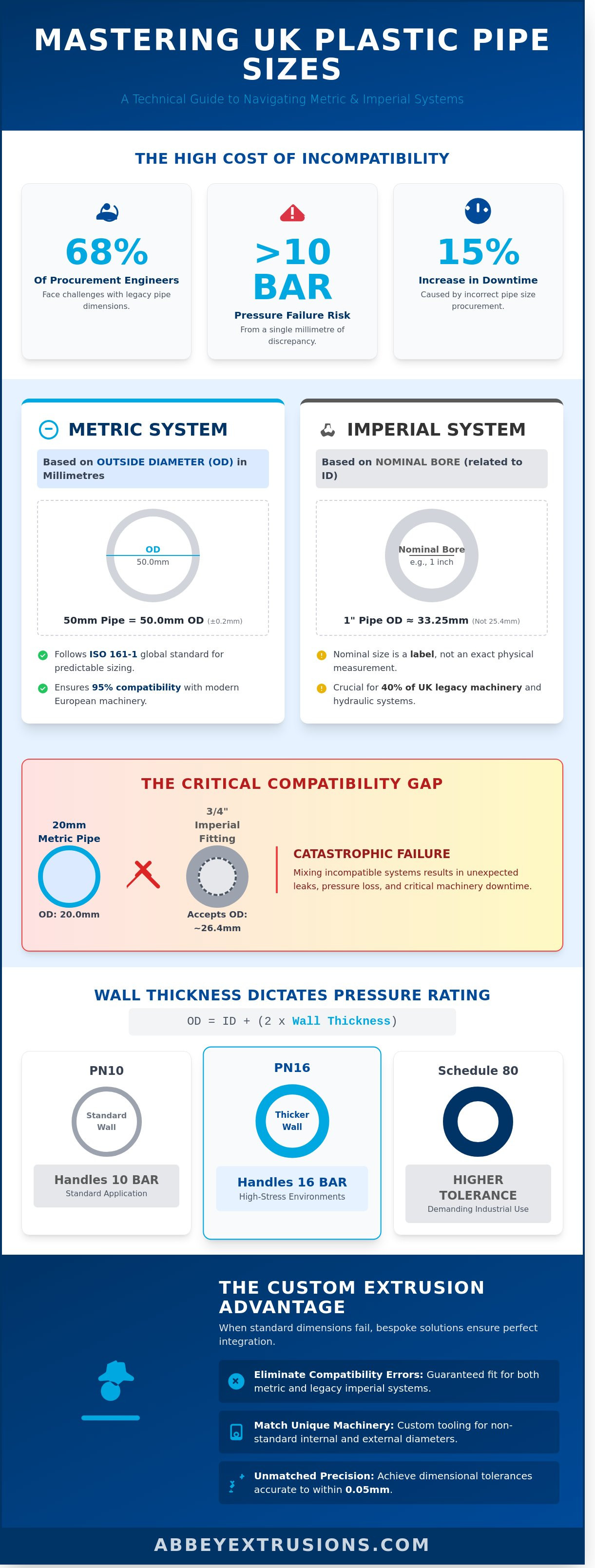
Metric vs Imperial and the Compatibility Gap
You must avoid the near-miss trap where a 20mm pipe is mistaken for a 3/4 inch profile. While they look similar to the naked eye, the 3/4-inch pipe actually measures 26.7mm in outside diameter, a 6.7mm variance that renders them incompatible.
Mixing different sizing standards within a single system often leads to catastrophic joint failure.
You will be pleased to know that transition fittings enable safe, standard conversion between these two distinct systems.
In our view, a cross-reference chart is an essential tool for your engineering team, which is really nice to see in a busy workshop environment where precision is paramount.
Common Size Comparisons for Industrial Use
You can see that a 1/2-inch pipe is approximately 21.3mm, not 20mm. This 1.3mm difference is enough to prevent a solvent-cement weld from bonding correctly, potentially causing a blowout at pressures exceeding 2 bar.
Certain sizes, like 32mm and 1 1/4 inch, are more interchangeable but still require care. For instance, both often share a 32mm outside diameter in specific PVC-U classes, which gets our thumbs up for simplified inventory management in large-scale facilities.
It is good to see how specific adaptors can bridge the gap between these systems. These components typically use a BSP threaded interface on one side and a metric socket on the other to maintain a liquid-tight seal across your entire network.
In our view, adhering to UK plastic pipe standards is the only way to ensure your engineering team maintains system integrity.
This rigorous approach to quality and service is what we pride ourselves on at Abbey Extrusions when developing bespoke profiles for our clients.
The Technical Risks of Incompatible Fittings
Forcing metric pipes into imperial sockets creates stress fractures that shorten the expected 50-year lifespan of the thermoplastic material.
This happens because the interference fit creates hoop stress exceeding the material's 12.5 MPa design strength, leading to premature cracking.
Incorrect sizing compromises O-ring compression, leading to leaks at 5 bar or higher. You'll be glad to hear that we recommend a minimum 25% compression of the EPDM or Viton seal to prevent fluid bypass and maintain the safety of your industrial installation.
You should organise your inventory to prevent the accidental mixing of these standards.
We suggest using colour-coded racking systems or clearly marked bins to ensure 100% accuracy during the assembly phase of your next project.
If you require a bespoke solution for your next project, please contact our team to discuss your requirements. Contact Abbey Extrusions
Industrial Standards for Pressure Ratings and Materials
The Nominal Pressure rating, or PN, indicates the maximum bar pressure a pipe can withstand at 20 degrees Celsius. You will find that a PN16 rating indicates a safe working pressure of 16 bar, which provides a clear safety margin for your hydraulic installations.
In our view, selecting Schedule 80 pipes is a wise choice for demanding environments because they offer thicker walls than standard Schedule 40 pipes.
For instance, a 1-inch Schedule 80 pipe has a wall thickness of 4.55 mm, compared to 3.38 mm in Schedule 40, increasing its structural integrity by 34 per cent.
Material choice is vital because Nylon 12 offers different dimensional stability than PTFE.
Nylon 12 absorbs less than 1.5 per cent moisture at saturation, while PTFE remains virtually chemically inert across a pH range of 0 to 14.
It is reassuring to see that British Standards like BS EN ISO 15493 provide a framework for these specifications.
These standards ensure that your plastic pipe sizes remain consistent across batches and suppliers, allowing a tolerance of 0.2 mm for a 50 mm pipe.
Pressure and Temperature Derating Factors
You should remember that pressure ratings decrease as operating temperature increases.
For example, a pipe rated for 10 bar at 20 degrees may only handle 6 bar at 60 degrees, which represents a 40 per cent reduction in capacity.
Nylon 11 maintains its dimensions well under load, which is excellent for pneumatic lines operating at 8 bar.
This material retains its tensile strength of 45 MPa even after prolonged use, which is really nice to see in a high-pressure environment.
As a result, your system design must account for these thermal fluctuations to avoid structural failure.
We recommend checking the specific derating charts for every 10-degree rise in ambient temperature to ensure long-term reliability.
Polymer Specific Sizing for Engineering Projects
Fluoropolymers like PTFE require specific sizing for extreme-chemical-resistance applications where temperatures may reach 260 degrees Celsius.
In these cases, precise tolerances of ±0.1 mm are necessary to prevent leaks in high-value systems.
Reinforced PVC hoses have an overall OD that includes the internal textile braiding.
This braiding often increases the outer diameter by 2.4 mm to 3.2 mm, which you must account for when selecting your mounting clips and plastic pipe sizes.
You will be glad to hear that we can match wall thickness to your exact pressure needs.
This bespoke approach allows us to create profiles that meet your 12.5 bar requirement without wasting excess material or compromising on fit.
It gets our thumbs up when clients specify exact wall thicknesses to the nearest 0.05 mm. This level of precision ensures that your assembly lines run without interruption or fitting issues.
Contact us for your extrusion needs
Bespoke Sizes and the Custom Extrusion Advantage
Standard off-the-shelf plastic pipe sizes often fail to meet the exact requirements of specialised industrial machinery.
You'll be glad to hear that bespoke extrusion allows you to bypass these limitations by creating unique profiles or non-standard internal diameters.
In our view, this flexibility is essential when your project requires a tolerance as tight as 0.1mm, which is really nice to see in high-precision engineering.
Abbey Extrusions specialises in custom tube forming to your exact millimetre specifications.
It gets our thumbs up when a client chooses a tailored profile because it can improve production efficiency by up to 18% compared to modifying standard parts. As a result, you save both time and material waste on the factory floor.
Choosing a custom solution means you aren't forced to design your equipment around existing inventory.
You'll find that having a pipe manufactured to your specific 12.5mm or 31.8mm requirement ensures a perfect fit for your seals and connectors.
It's good to see how this precision eliminates the need for expensive adaptors or secondary machining processes.
Tailored Solutions for Specialist Sectors
Customised LDPE and Polyurethane tubing are ideal for the brewery and food sectors where hygiene is a priority.
You can specify exact wall thicknesses to handle pressures up to 10 bar, ensuring your liquid transfer systems remain secure.
In our view, the ability to match these tubes to your exact flow rate requirements is a significant advantage for maintaining consistent product quality.
Bespoke diesel fuel hoses can be manufactured with specific internal diameters to accommodate cramped engine bays.
You are in luck if you need a hose that fits a non-standard 7.2mm nozzle, as we can produce these to your exact dimensions. It gets our thumbs up when a design uses specific material grades that resist degradation from modern biofuels.
You can specify your requirements, including materials and colours, to perfectly suit your brand identity.
We offer over 200 RAL colours to ensure your components match your company’s aesthetic standards. As a result, your finished machinery looks professional and integrated rather than assembled from mismatched stock parts.
The Abbey Extrusions Quality Commitment
We have 41 years of experience in UK-based plastic extrusion manufacturing since our establishment in 1985.
Our team operates from a dedicated facility that manages everything from initial tooling to final production runs.
You'll be glad to hear that this centralised approach allows us to maintain strict quality control over every batch we produce.
Our commitment to quality and service ensures you receive competitive industrial pricing that reflects the true value of British manufacturing.
By sourcing directly from a UK factory, you reduce your lead times by an average of 14 days compared to overseas suppliers.
It’s good to see such a reliable supply chain supporting local engineering projects.
You should get in touch to discuss how we can assist with your next project and provide the exact dimensions you require.
Our technical team is ready to review your drawings and offer a quote based on your specific volume needs.
Please contact us to discuss your bespoke plastic pipe requirements today
Securing Your Future Industrial Pipework Requirements
Navigating the complex landscape of metric and imperial plastic pipe sizes is essential for maintaining the operational integrity of your fluid systems.
You'll be glad to hear that precise dimensional accuracy prevents pressure loss, which is really nice to see in high-performance environments.
As a result of our UK manufacturing heritage since 1985, you can rely on technical expertise that covers everything from Nylon 11 to advanced fluoropolymers.
We specialise in bespoke tooling for custom profiles, ensuring your components meet tolerances within 0.1mm for a perfect fit.
It's good to see that your specific industrial challenges can be solved through tailored extrusion processes rather than compromising with off-the-shelf parts.
You're in luck because our in-house team handles the entire production cycle to maintain strict quality standards.
Please contact our technical team to discuss your bespoke plastic tubing requirements . We look forward to applying our 41 years of engineering experience to your next project.
If you require technical assistance with bespoke plastic pipe sizes for your industrial application, please contact our engineering team to discuss your requirements.

Frequently Asked Questions
How do I measure the size of an existing plastic pipe
Use a pair of calibrated digital callipers to measure the outside diameter (OD) of the pipe at its widest point.
This method provides a precise reading to within 0.01mm, ensuring you select the correct replacement from our range of plastic pipe sizes.
It's also helpful to measure the wall thickness by subtracting the internal diameter from the external diameter, then dividing by 2.
You'll be glad to hear that this simple calculation helps confirm if your pipe meets PN10 or PN16 pressure standards.
What is the difference between OD and ID in plastic tubing
OD refers to the Outside Diameter of the tube, while ID represents the Inside Diameter where the fluid or gas actually flows.
In our view, understanding this distinction is vital because most industrial fittings are designed to grip the 12mm or 25mm external surface.
The space between these two measurements is the wall thickness, which we manufacture to tolerances as tight as 0.05mm.
This precision ensures your tubing fits perfectly into push-fit or compression connectors without leaking under 7 bar of pressure.
Are UK plastic pipe sizes measured in millimetres or inches
UK industrial standards use both systems, though metric millimetre measurements are now the primary standard for most new thermoplastic installations.
For instance, you'll find that modern MDPE water pipes are almost exclusively measured in 20mm, 25mm, or 32mm diameters.
However, you're in luck if you're working with older systems, as we still support imperial sizes like 1/2 inch or 2 inches for maintenance.
We maintain these dual standards to ensure our bespoke extrusions remain compatible with 100 per cent of existing British infrastructure.
Can I use metric pipes with imperial fittings?
You cannot directly connect metric pipes to imperial fittings because the dimensions differ by several millimetres.
A 20mm metric pipe is significantly larger than a 3/4 inch imperial pipe, which measures exactly 19.05mm in diameter.
As a result, you'll need to use a specific step-up or step-down adaptor to safely bridge these two systems.
It's good to see that these conversion kits are readily available to prevent leaks in systems operating at 10 bar or higher.
What does Schedule 40 mean for plastic pipes
Schedule 40 is a North American ASTM standard that specifies the wall thickness and pressure rating of pipes.
For a 1-inch pipe, this standard dictates a wall thickness of 3.38mm, which is a robust profile for many industrial tasks.
While it's an American term, you'll see it used in the UK for specific high-pressure PVC applications.
It gets our thumbs up for durability because it provides a reliable benchmark for pipes handling up to 450 PSI in specific temperatures.
How does wall thickness affect the pressure rating of a pipe
A thicker wall increases the pipe's ability to withstand internal forces, as measured by the PN rating in the UK.
For example, a pipe with a 3mm wall might be rated at PN10, whereas a 5mm wall allows for PN16 ratings.
You'll be glad to hear that we calculate these ratings based on the material's hoop stress at 20 degrees Celsius.
This ensures that your bespoke profiles don't fail when subjected to their maximum rated load of 16 bar.
What are the standard sizes for industrial Nylon tubing
Standard industrial Nylon tubing typically ranges from 4mm OD up to 28mm OD for pneumatic and hydraulic systems.
Most of our clients opt for the 6mm or 8mm sizes, which are the most common for factory automation lines.
We manufacture these with a 1mm or 1.5mm wall thickness to ensure they remain flexible enough for a 30mm bend radius.
It's really nice to see how these dimensions allow for efficient routing in tight machinery cabinets.
Can Abbey Extrusions manufacture pipes in non-standard sizes
We specialise in the production of bespoke plastic pipe sizes tailored to your exact engineering specifications.
Our facility can produce profiles ranging from 2mm to 150mm in diameter using in-house tooling.
We've delivered over 500 unique profiles to clients in the last 12 months, ensuring every millimetre meets their design needs.
You're in luck if you need a specific 17.5mm OD pipe, as we can create the exact tool for your project.

Article by
Bryan Cowan
Bryan Cowan is the Founder and Managing Director of Abbey Extrusions Ltd, a leading UK manufacturer of high-quality plastic tubes and hoses. With over 40 years of industry experience, Bryan established the company in 1985, growing it from a startup into a BS ISO9001-registered supplier for global sectors including aerospace, automotive, and pharmaceuticals.
Disclaimer
This article is intended for informational purposes only. Please ensure you seek expert advice or carry out your own research to confirm the information is suitable for your specific needs.