A single millimetre of variance in your industrial plastic tubing dimensions can be the difference between a high performance fluid system and a costly assembly failure. In the demanding world of industrial manufacturing, precision isn't merely a preference; it's a fundamental requirement for safety and operational longevity. You've likely encountered the persistent frustration caused by the overlap of metric and imperial standards, or perhaps struggled to find a partner capable of producing non-standard diameters that off-the-shelf stockists simply cannot provide. With global standards like ISO 161-1 and ISO 11922-1 constantly evolving, maintaining technical accuracy is more critical than ever.
We understand that specifying custom tubing involves more than just selecting a size. It requires a deep technical knowledge of how wall thickness influences pressure ratings and how material behaviour changes under stress. This expert guide provides a clear framework for understanding, measuring, and specifying the exact dimensions required for your bespoke projects. We'll explore the critical relationship between dimensional accuracy and performance, whilst outlining how to secure reliable, volume-scale solutions from a specialist UK manufacturer.
Key Takeaways
- Master the relationship between internal and external diameters to ensure seamless integration with existing industrial fittings and connectors.
- Learn how wall thickness acts as the primary determinant for burst pressure and how to calculate industrial plastic tubing dimensions for high stress applications.
- Understand why different materials such as custom PVC tube require specific manufacturing tolerances to maintain performance integrity during volume production.
- Discover a systematic approach to measuring and specifying bespoke tubing to eliminate the need for expensive adapters in your fluid systems.
- Optimise your material usage and reduce overall system weight by tailoring tube dimensions to the exact requirements of your specific industrial application.
For detailed technical assistance with your specific project requirements, please reach out to our engineering team via our contact page.
Understanding the Core Parameters of Industrial Plastic Tubing Dimensions
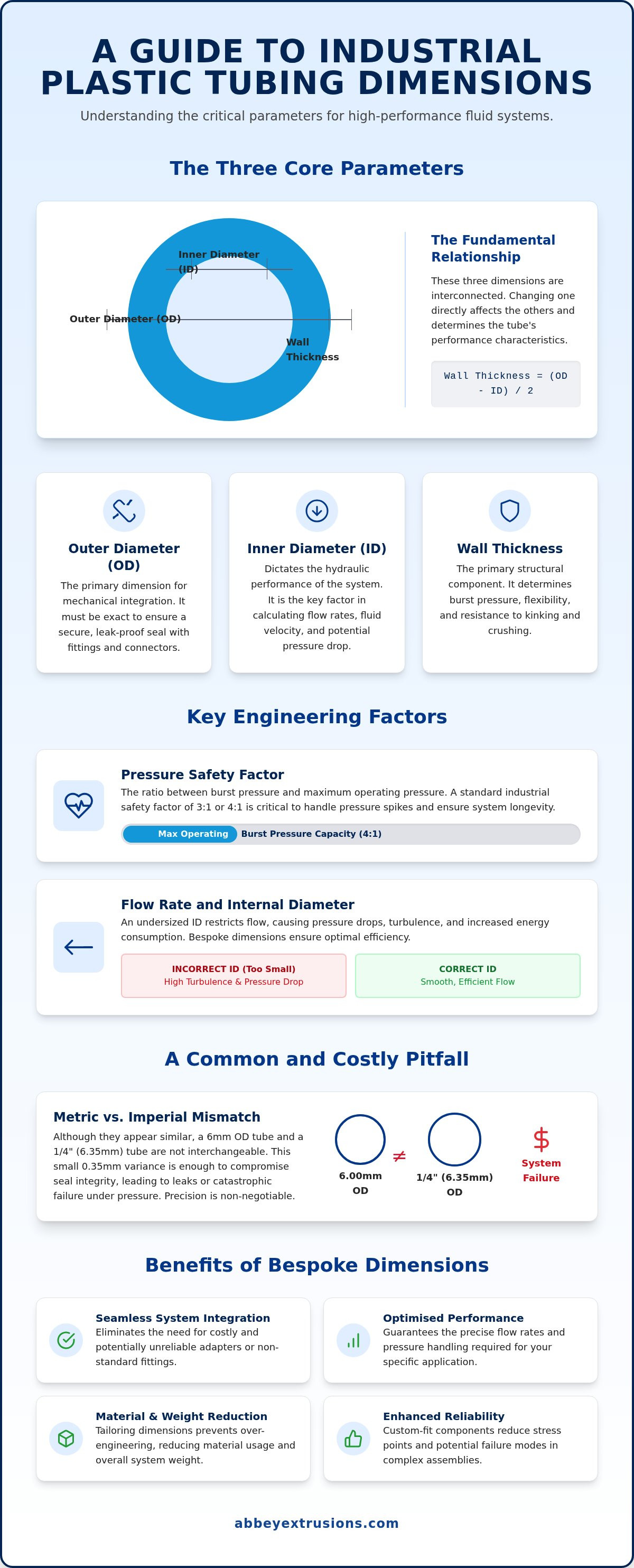
Precision engineering in fluid systems begins with a rigorous understanding of three primary variables: the outer diameter (OD), the inner diameter (ID), and the wall thickness. Although these metrics appear straightforward, their interplay determines the functional limits of any extruded profile. In the UK manufacturing sector, we define industrial plastic tubing dimensions through precise tolerances that ensure compatibility with standardised couplings and connectors. This technical foundation is essential whether you're designing a complex pneumatic circuit or a simple drainage system using Plastic pipework.
Outer Diameter and Inner Diameter Explained
The outer diameter is the most critical dimension for external routing and mechanical integration. If you're using push-in fittings or compression couplings, the OD must be exact; even a fractional deviation can lead to pneumatic leaks or assembly failure. Conversely, the inner diameter dictates the hydraulic performance of the system. It's the primary factor used to calculate flow rates and fluid velocity. A common pitfall for engineers is the unintentional mixing of metric and imperial specifications. Although a 6mm OD tube and a 1/4 inch tube (6.35mm) look similar, they aren't interchangeable. Using the wrong standard will compromise the seal integrity and may cause the tube to blow out under pressure.
The Critical Role of Wall Thickness in Performance
Wall thickness isn't merely the difference between the OD and the ID; it's the primary structural component that determines burst pressure. A thicker wall provides superior resistance to kinking and crushing, which is vital for hoses used in heavy duty environments. However, there's always a trade off. Increasing the wall thickness for a fixed OD will inevitably reduce the ID, thereby restricting flow. When specifying a PVC tube or a nylon variant, we must calculate the nominal wall thickness to balance these competing needs. Whereas thinner walls offer greater flexibility and a tighter bend radius, thicker walls provide the safety factor required for high pressure applications. We often find that custom dimensions are the only way to achieve the perfect balance between system weight and structural durability.
For technical guidance on specifying dimensions for complex industrial applications, please contact our engineering team to discuss your project requirements.
Engineering Factors that Dictate Tubing Size Requirements
Selecting the correct industrial plastic tubing dimensions requires a comprehensive analysis of the operational environment. It's not enough to match an existing fitting; you must account for the physical forces acting upon the polymer. Engineers must prioritise the safety factor, which is the ratio between the burst pressure and the maximum operating pressure. In high volume industrial settings, a safety factor of 3:1 or 4:1 is standard. This ensures the system handles pressure spikes without catastrophic failure. Chemical compatibility also plays a vital role. Some fluids cause polymers to swell, which can narrow the internal diameter and disrupt flow rates over time. This swelling isn't just a surface issue; it affects the structural integrity of the entire tube wall.
Fluid Flow Rates and Internal Pressure Capacity
The internal diameter dictates the efficiency of your entire fluid system. If the ID is too small, you'll experience significant pressure drops and increased turbulence. This forces pumps to work harder and leads to premature component wear. Bespoke dimensions are often the only solution when standard off the shelf sizes cause flow restriction. For instance, a high grade Nylon tube offers excellent pressure resistance, but its wall thickness must be carefully calculated against the required flow velocity. We frequently manufacture custom profiles where the internal geometry is optimised for specific viscous fluids or high speed pneumatic cycles. Precision in these measurements prevents the energy losses associated with undersized tubing and ensures the system operates at peak capacity.
Environmental Conditions and Thermal Expansion
Polymers are sensitive to thermal fluctuations. When temperatures rise, most industrial plastics expand, which can alter the effective OD and ID of the tube. This dimensional shift is particularly problematic in outdoor installations or high heat manufacturing zones. You must account for this coefficient of linear thermal expansion during the design phase. If the tubing is constrained by rigid fittings, thermal expansion can lead to buckling or stress cracking. Conversely, in vacuum applications, the wall thickness must be sufficient to prevent collapse. Selecting a material with high dimensional stability is crucial whilst operating at the limits of the polymer's thermal range. If you're unsure about material behaviour under specific thermal loads, our specialists can provide technical data to support your specification process.
For bespoke enquiries regarding large volume extrusion orders, please visit our contact page.
Manufacturing Tolerances and Precision in Plastic Extrusion
Manufacturing tolerances in plastic extrusion represent the permissible limit of variation in a physical dimension. When we discuss industrial plastic tubing dimensions, these tolerances aren't merely suggestions; they're the guardrails that prevent system failure. For automated assembly lines, even a minor deviation in the outer diameter can stall a production run or cause a fitting to leak. Precision is the foundation of reliability in the traditional manufacturing sector, much like the quality standards upheld by JABAL AL NOOR Steel for structural industrial components. Our approach centres on maintaining a rigorous standard of accuracy that ensures every millimetre of tubing performs as intended under operational stress.
Different polymers exhibit unique behaviours during the cooling phase of the extrusion process. For instance, a high grade PVC tube may have different shrinkage rates compared to a rigid nylon profile. Nylon 12 is known for its exceptional dimensional stability, allowing us to maintain very tight tolerances. Conversely, more flexible materials like LDPE tend to have higher shrinkage rates and can be more challenging to control as they transition from a molten state to a solid form. Factors such as the temperature of the cooling bath and the speed of the haul off equipment directly influence these final dimensions. If these variables aren't strictly managed, the resulting dimensional drift can render a batch of tubing useless for precision applications.
Achieving Consistency Across Large Volume Production Runs
Maintaining precision over a run of several thousand metres requires a systematic approach to quality control. We monitor the outer diameter and wall thickness continuously to ensure every part of the extrusion meets the specific technical requirement. Modern extrusion equipment plays a vital role here; it allows for real time adjustments that counteract the natural variances in raw material batches. This level of control is why bespoke manufacturing is superior to relying on mixed stock batches from various distributors. When you order a custom run, you receive a product with uniform characteristics from the start of the reel to the end. This consistency is essential for high performance systems where reliability is the primary metric of success. Our facility has refined these processes since 1985 to ensure we deliver the technical excellence our partners expect.
For technical support in measuring your existing components or to request a custom quote, please reach out via our contact page.
How to Measure and Specify Dimensions for Custom Tubing
Accuracy in determining industrial plastic tubing dimensions is often compromised by improper technique or the use of unsuitable tools. Unlike rigid metal piping, flexible polymers are susceptible to deformation during the measurement process. If you apply too much pressure with a digital calliper, you'll inevitably compress the material and record an inaccurate reading. We recommend measuring the tubing whilst it's in a relaxed state, away from any tension or coiled stress, to ensure the profile hasn't become ovalised. For larger diameters where callipers may lack the necessary reach or precision, pi tapes are the industry standard for measuring the circumference and calculating an accurate OD without deforming the tube wall.
Tools and Techniques for Accurate Dimension Measurement
Measuring the internal diameter of small bore tubing presents a specific challenge. Standard calliper jaws are often too bulky to provide a true reading of the ID. In these instances, we utilise precision pin gauges or optical comparators to verify the internal geometry. It's essential to take multiple readings at different points along the length of the extrusion to account for any minor manufacturing variances. This level of detail is particularly important when providing specifications for tube forming, as the secondary shaping process can be affected by the initial dimensional accuracy of the straight extrusion. Ensuring the material is at a consistent ambient temperature during measurement is also vital to prevent thermal expansion from skewing your data.
Navigating Metric and Imperial Unit Specifications
The UK industrial market remains a complex environment where legacy imperial systems frequently intersect with modern metric ISO standards. This duality often leads to confusion when converting dimensions for international projects. A common error is rounding off millimetre conversions to the nearest fraction of an inch, which can result in a loose fit with high pressure couplings. We always advise specifying dimensions in the primary unit of the intended fitting system. If your project relies on 1/4 inch pneumatic connectors, specify the tubing in inches rather than converting to 6.35mm. This eliminates the risk of cumulative rounding errors that could compromise the safety of the final assembly. Standardising your specifications early in the design phase is the most effective way to avoid compatibility issues during volume production.
If you require assistance in standardising your specifications for a large volume project, please contact our technical department for expert guidance.
To discuss how bespoke dimensions can improve your specific manufacturing process, please visit our contact page.
Benefits of Bespoke Dimensions for Industrial Fluid Handling
Bespoke engineering offers a strategic advantage that standard stock items simply cannot match. Whilst many distributors suggest that standard sizes cover most applications, the reality of high volume industrial manufacturing often requires more precision. By specifying exact industrial plastic tubing dimensions, you can eliminate the need for expensive adapters and secondary fittings. These components are not only costly but also represent potential leak points and added weight in a fluid system. When you work with a custom manufacturer, you gain the ability to match the tubing perfectly to your existing hardware, ensuring a more reliable and streamlined assembly.
Economic efficiency is another primary driver for bespoke specifications. In large volume orders, even a fractional reduction in wall thickness can lead to significant material savings without compromising the required safety factor. This optimisation reduces the overall weight of the system, which is particularly beneficial in portable or mobile equipment. Additionally, developing unique profiles, such as a custom low density polythene tube, allows you to address specific chemical or environmental challenges that off the shelf products might fail to withstand. Precision at the design stage translates directly into long term operational savings.
Beyond Standard Sizes with Custom Extrusion Profiles
Custom dimensions allow for greater design freedom in equipment manufacturing. We often work with partners in the brewery and automotive sectors who require non standard outer diameters to fit within tight housing constraints or specific routing paths. A bespoke profile can improve the aesthetic integration of the tubing whilst ensuring it meets the functional demands of the application. For instance, in the brewery industry, a tailored internal diameter can be critical for maintaining specific flow velocities during the bottling process. These unique requirements are often impossible to meet with standard stock, making custom extrusion the only viable path for technical excellence. To maintain this level of precision during transport, many manufacturers utilise specialised logistics solutions, such as custom industrial packaging southern california, to protect their bespoke components from environmental stress.
The perfect internal diameter is essential for reducing turbulence and maintaining consistent system pressure. When tubing is undersized, the resulting pressure drops force pumps to work harder; this leads to increased energy consumption and premature wear. Conversely, oversized tubing adds unnecessary cost and volume to the system. By tailoring the wall profile, we can enhance durability in harsh environments where abrasion or chemical exposure is a concern. Working with a specialist UK manufacturer ensures you receive the technical support necessary to verify these dimensions before production begins. This collaborative approach guarantees that your fluid handling system operates at peak efficiency from the first day of installation.
If you require assistance in standardising your specifications for a large volume project, please contact our technical department for expert guidance.
For bespoke enquiries regarding large volume extrusion orders, please visit our contact page.
Securing Technical Precision for Your Industrial Projects
Achieving the correct industrial plastic tubing dimensions is a technical necessity that underpins the safety and efficiency of every fluid handling system. We've explored how the synergy between outer diameter, inner diameter, and wall thickness dictates performance under pressure, whilst highlighting the critical role of material specific tolerances. By prioritising bespoke specifications over standard stock, you can eliminate operational inefficiencies and reduce long term costs. Precision in measurement and a clear understanding of thermal behaviour ensure that your components integrate seamlessly into complex assemblies, regardless of the application's complexity.
Since 1985, we've provided UK based manufacturing expertise to partners requiring high performance polymer solutions. Our team specialises in bespoke extrusion and advanced tube forming, ensuring that every project meets the most rigorous engineering standards. For expert guidance on custom specifications and large volume orders, please contact the specialist team at Abbey Extrusions. We look forward to supporting your next manufacturing challenge with technical excellence and the reliable service that only decades of experience can provide.
Frequently Asked Questions
What is the most important dimension when choosing a plastic tube?
The application requirements usually dictate whether the inner diameter or the outer diameter is the most critical industrial plastic tubing dimensions. If the tubing must fit over a barb, the inner diameter takes priority. Conversely, if you're using push in fittings, the outer diameter becomes the primary concern. We work with clients to identify these priorities during the design phase to ensure the finished product meets every technical demand.
How do I calculate the wall thickness if I only know the ID and OD?
You can determine the wall thickness of a plastic tube by subtracting the inner diameter from the outer diameter and then dividing that result by two. For example, if a tube has a 10mm OD and an 8mm ID, the total difference is 2mm, which means the wall thickness is 1mm. This calculation is essential for understanding the pressure rating and flexibility of custom nylon or PVC tubing during the specification process for your order.
Can Abbey Extrusions manufacture tubing to non standard metric sizes?
Yes, we specialise in manufacturing bespoke tubing to non standard metric or imperial sizes that typical stockists cannot provide. Our extrusion process allows us to create custom dimensions tailored specifically to your industrial machinery or unique product requirements. Whether you need a specific wall thickness for custom Polyurethane tube or a unique diameter for LDPE tubing, our Leicestershire facility can produce the exact industrial plastic tubing dimensions your project requires for high volume orders.
What are the typical manufacturing tolerances for industrial nylon tubing?
Manufacturing tolerances for industrial nylon tubing generally range between plus or minus 0.1mm and 0.2mm depending on the specific diameter and material grade used. At Abbey Extrusions, we maintain strict control over the extrusion process to ensure that custom Nylon 11 and 12 flexible tubing stays within these narrow industrial plastic tubing dimensions. This precision is vital for ensuring that the tubing performs reliably in high pressure environments or complex pneumatic systems.
How does temperature affect the dimensions of a plastic hose?
Increased temperatures cause most plastic materials to expand, which can slightly alter both the diameter and the length of a hose. This thermal expansion is particularly relevant for materials like LDPE or flexible PU when they operate near their upper thermal limits. We recommend accounting for these dimensional changes during the design phase, especially if the tubing must maintain a tight seal or fit within a restricted space under varying heat conditions on your site.
Why is the outer diameter critical for push in fittings?
The outer diameter is the primary interface for push in fittings, as the internal O ring and gripping teeth rely on a precise fit to create a leak proof seal. If the industrial plastic tubing dimensions for the outer diameter are too large, the tube won't seat correctly; if they're too small, the connection will fail under pressure. We ensure our custom nylon and polyurethane tubes meet the exacting tolerances required for these common connection systems.
Is it possible to specify different wall thicknesses for the same outer diameter?
Yes, we can produce tubing with various wall thicknesses while maintaining a constant outer diameter to suit different pressure or flexibility needs. By increasing the wall thickness, you improve the burst pressure and kink resistance of the tube without changing the fittings required for the outer diameter. This customisation is a core part of our bespoke service for materials such as reinforced PVC hose and custom nylon tube for industrial clients.
How can I ensure my custom tubing dimensions are consistent across a large order?
Consistency across large volume orders is achieved through continuous monitoring and advanced extrusion control systems at our UK manufacturing site. We employ rigorous quality checks throughout the production run to verify that every metre of tubing adheres to your specified industrial plastic tubing dimensions. Our decades of experience as a custom tubing manufacturer ensure that the first coil we produce is identical to the last, providing reliability for your production line assembly.

Article by
Bryan Cowan
Bryan Cowan is the Founder and Managing Director of Abbey Extrusions Ltd, a leading UK manufacturer of high-quality plastic tubes and hoses. With over 40 years of industry experience, Bryan established the company in 1985, growing it from a startup into a BS ISO9001-registered supplier for global sectors including aerospace, automotive, and pharmaceuticals.
Disclaimer
This article is intended for informational purposes only. Please ensure you seek expert advice or carry out your own research to confirm the information is suitable for your specific needs.