Did you know that an estimated 70% of pneumatic system leaks in UK manufacturing facilities result from selecting the wrong materials for their specific thermal environments? It's a common frustration for engineers who require precision-engineered nylon tubing but find themselves limited by generic off-the-shelf options or confusing technical data. Finding a partner that understands the nuances of industrial applications whilst offering bespoke extrusion capabilities is often the difference between a reliable system and costly downtime.
This technical guide provides the clarity needed to specify and source bespoke nylon tubing for high-volume industrial requirements within the United Kingdom. We'll examine the critical performance differences between Nylon 11 and Nylon 12 to ensure your selection meets every mechanical and thermal demand. Precision matters. By the end of this article, you'll understand how to navigate complex specifications and establish a secure manufacturing partnership that eliminates the long lead times associated with international distributors.
Key Takeaways
- Differentiate between Nylon 11 and Nylon 12 to select the material that best suits your specific thermal and mechanical requirements.
- Identify the most effective industrial applications for high quality nylon tubing across the automotive and manufacturing sectors.
- Learn how bespoke tube forming and custom extrusion solve complex engineering challenges where space is limited or standard profiles are insufficient.
- Understand the technical implications of the BS5409 standard to ensure your components meet rigorous British safety and performance benchmarks.
- Discover the logistical and communication advantages of establishing a direct partnership with a specialist UK manufacturer for large volume supply.
To discuss your specific technical requirements for industrial applications, please reach out to our engineering team through our contact page.
Technical Characteristics of Nylon 11 and Nylon 12 Materials
Specifying the correct polymer is the first step in ensuring the longevity of any pneumatic or fluid transfer system. In technical terms, nylon tubing is a high performance thermoplastic polyamide designed specifically for the efficient transfer of fluids and gases under pressure. Whilst many industrial users treat different grades of nylon as interchangeable, the molecular distinctions between Polyamide 11 (PA11) and Polyamide 12 (PA12) significantly influence their performance in the field. We provide detailed technical data for these materials on our nylon tube product pages to assist with accurate specification.
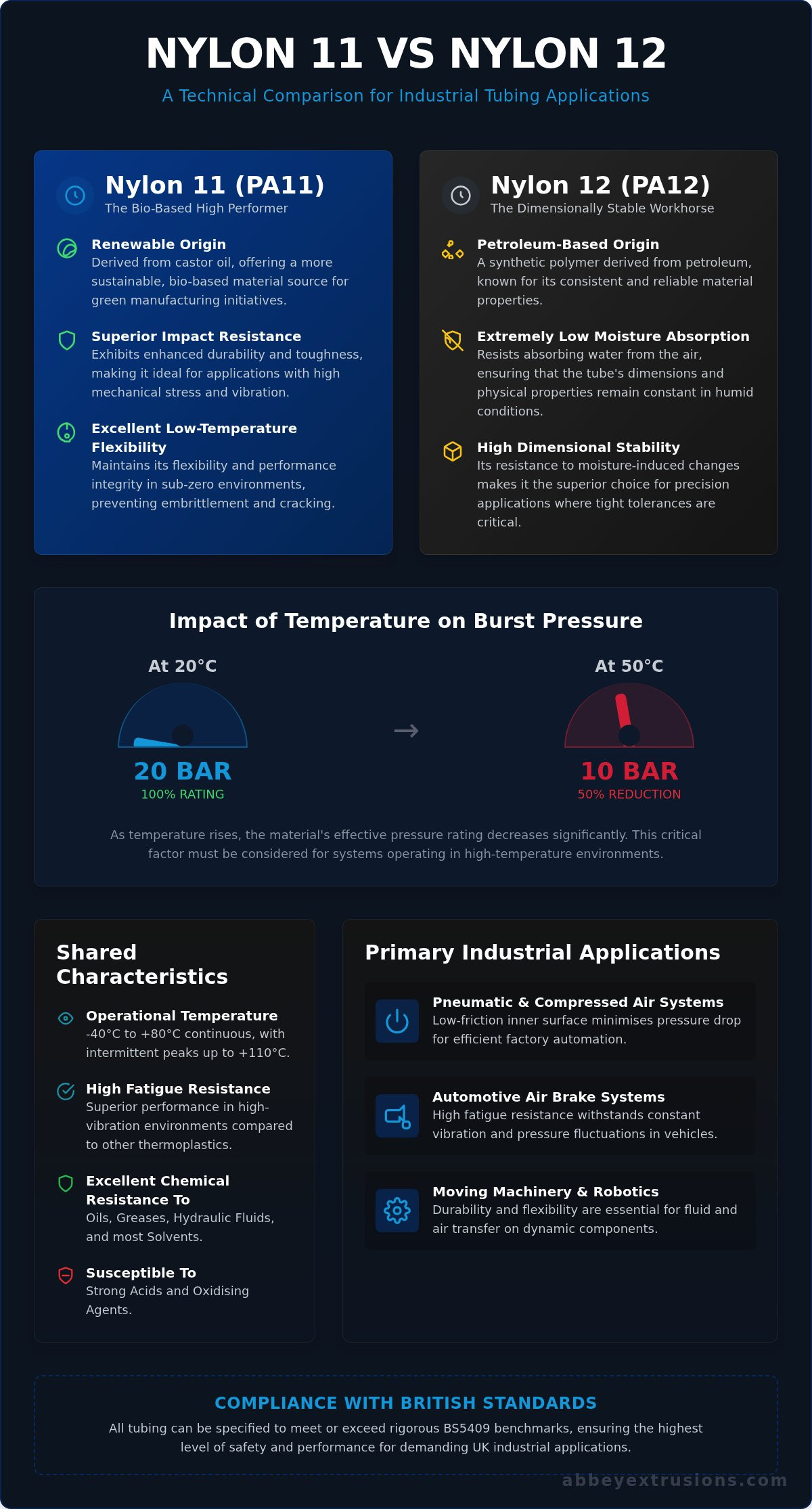
The primary difference lies in their chemical origins and molecular structures. Nylon 12 is a petroleum-based polymer that offers exceptionally low moisture absorption, which ensures dimensional stability even in humid environments. Conversely, Nylon 11 is derived from renewable castor oil. Many engineers prefer this bio-based material because the Technical properties of Nylon 11 include superior impact resistance and better flexibility at sub-zero temperatures. Because Nylon 11 has a higher concentration of amide groups, it provides a slightly different mechanical profile than its petroleum-based counterpart. Choosing between them requires a precise understanding of the moisture levels and physical stresses present in your specific application.
Chemical Resistance and Thermal Stability
Industrial nylon extrusions are prized for their resilience amongst harsh chemical environments. These materials exhibit excellent resistance to oils, greases, hydraulic fluids, and most solvents. However, they are susceptible to degradation when exposed to strong acids or oxidising agents. Thermal stability is another critical factor. Standard industrial-grade nylon typically operates within a range of -40°C to +80°C. Whilst it can withstand intermittent peaks of up to +110°C, prolonged exposure to high temperatures will reduce the pressure rating. For engine bay or outdoor applications, we incorporate specific heat and UV stabilisers during the extrusion process to prevent premature embrittlement and cracking.
Mechanical Strength and Abrasion Resistance
The relationship between wall thickness and burst pressure is a fundamental engineering consideration. As the temperature rises, the effective pressure rating of the tube decreases. For instance, a tube rated for 20 bar at 20°C might only support 10 bar at 50°C. High quality nylon tubing is frequently selected for high vibration environments because it possesses superior fatigue resistance compared to other thermoplastics. This prevents the material from failing under the constant mechanical stress found in automotive air brake systems or moving machinery. For a deeper analysis of these physical traits, you may consult our guide on Nylon Tubing Properties.
For large volume manufacturing requirements or bespoke profile enquiries, please contact our technical department to discuss your specific project needs.
Primary Industrial Applications for Flexible Nylon Tubing
The versatility of nylon tubing across the UK industrial landscape is a direct result of its unique balance of rigidity and flexibility. Whilst standard polymers often fail under the mechanical stresses of high speed manufacturing, nylon maintains its integrity amongst varying pressures and temperatures. This makes it an essential component in sectors ranging from heavy automotive engineering to precision food production. Engineers frequently consult a Guide to Polyamide (Nylon) Variants to match specific application demands with the correct material grade. Our manufacturing experience allows us to provide high volume supply for these diverse and demanding requirements.
Pneumatic and Compressed Air Systems
Airflow efficiency is paramount in automated factory environments. Nylon's low friction inner surface minimises pressure drops, ensuring that pneumatic actuators receive consistent power without unnecessary energy loss. Its high dimensional tolerance allows for seamless integration with push-in fittings, facilitating rapid assembly and reducing the risk of leaks in complex factory layouts. To protect these critical lines from mechanical abrasion, many facilities utilise a nylon spiral cut hose guard to extend the service life of their installations. For mobile workshop applications or assembly lines, a nylon recoil air hose provides a space-saving solution that prevents trip hazards whilst maintaining high pressure delivery.
Fuel and Chemical Transfer Solutions
The automotive sector relies heavily on the low permeability of Polyamide 11 and 12. These materials are ideally suited for diesel fuel lines because they prevent fuel vapours from escaping and resist the corrosive effects of modern additives. Heavy vehicle applications often require a specialised diesel fuel hose designed to withstand the harsh conditions of engine compartments. This resistance extends to many chemicals used in industrial cleaning and processing, making it a reliable choice for chemical dosing systems where safety is non-negotiable. For specialised liquid transfer, our brewery hose options meet the strict requirements of the beverage industry. If you are unsure which grade is suitable for your specific chemical environment, reach out to our experts for technical guidance.
To discuss your specific project requirements or request a technical consultation, please visit our contact page.
Bespoke Tube Forming and Custom Extrusion Capabilities
While standard metric lengths of nylon tubing are suitable for basic pneumatic circuits, complex industrial assemblies often demand more sophisticated solutions. We specialise in bespoke extrusion and secondary processing to meet these specific engineering challenges. By moving beyond off-the-shelf components, manufacturers can integrate multiple functions into a single extrusion. This reduces assembly time and improves component reliability. Our facility produces profiles to exacting tolerances that frequently exceed standard commercial specifications. This ensures a perfect fit for high-precision applications.
The Benefits of Bespoke Tube Forming
Space constraints within machinery enclosures often lead to installation errors, such as kinking, which can restrict airflow or fluid movement. Our tube forming services address this by pre-shaping the nylon to a permanent set that follows the exact geometry of the machine. This approach eliminates the need for multiple elbow joints and compression fittings. It significantly reduces the potential for leak points whilst lowering overall material costs. Organised tube routing also provides a cleaner aesthetic and makes routine maintenance much simpler for field engineers. Citing technical specifications for polyamide tubing highlights how critical precise shaping is in sensitive gas supply systems where flow consistency is non-negotiable.
Precision Manufacturing for Complex Profiles
Beyond standard cylindrical tubes, we possess the technical competence to develop custom dies for unique cross-sectional shapes. These bespoke profiles are engineered to perform specific mechanical tasks, such as our curtainsider pelmet sections used in the transport industry. During the design phase of a new project, our engineering team provides comprehensive technical support. We ensure the selected profile geometry is optimised for the extrusion process and the end-use environment. This collaborative approach ensures that the final product meets the rigorous demands of UK manufacturing. It provides a level of customisation that international distributors simply cannot match. We focus on delivering value through precision, ensuring that every bespoke order aligns with the long-term reliability our partners expect.
If you require a detailed technical specification for a bespoke project or wish to discuss volume supply for your manufacturing facility, please contact our engineering team.
Engineering Specifications and British Standards for Nylon Tubing
The primary benchmark for quality in the UK market is the BS 5409 standard. This specification ensures that flexible nylon tubing meets rigorous requirements for tensile strength, burst pressure, and resistance to environmental stress cracking. Compliance with this standard is often mandatory for components used in safety-critical systems, such as automotive air brakes or industrial pneumatic circuits. It is frequently harmonised with international standards like DIN 74324 and ISO 7628. This alignment allows UK manufacturers to supply components that are globally compatible whilst maintaining local quality control. We integrate these standards into our core Plastic Extrusion Principles to ensure every production run is consistent and reliable.
Pressure ratings are determined by a precise calculation involving the material grade and the wall thickness relative to the outside diameter. Polyamide 12 typically offers higher pressure resistance at ambient temperatures than Polyamide 11. However, engineers must remember that these ratings are temperature-dependent. As the operating temperature increases, the maximum working pressure of the tube decreases. Selecting the correct wall thickness is therefore essential for maintaining a safety factor of at least 3 to 1 or 4 to 1, depending on the specific industrial application.
Standard and Metric Size Specifications
Metric sizes are the industry standard across the United Kingdom. Common outside diameters include 4mm, 6mm, 8mm, 10mm, and 12mm. These sizes are engineered for perfect compatibility with push-in and compression fittings. The relationship between the outside diameter (OD) and the inside diameter (ID) is vital. For example, an 8mm OD tube with a 1mm wall thickness results in a 6mm ID. We maintain tight dimensional tolerances during the extrusion process to prevent leaks and blow-outs. Whilst metric is the norm, we also manufacture imperial sizes for legacy machinery or specific export requirements. For large volume specialised orders, we can produce custom dimensions that fall outside standard metric ranges.
Safety Standards and Regulatory Compliance
Industrial safety often requires materials with specific fire retardancy ratings. For sectors like rail or aerospace, we can produce nylon tubing that meets UL94 V0 or V2 standards to ensure low smoke toxicity and self-extinguishing properties. In the food and beverage industry, compliance with UK and EU food-contact regulations is a non-negotiable requirement. Our food grade nylon ensures that no harmful chemicals leach into the product stream. Choosing a UK manufacturer provides the added benefit of full traceability. Every batch is documented, allowing our partners to conduct thorough quality audits and maintain their own regulatory standing. This level of transparency is a fundamental business norma for our Leicestershire based facility.
For large volume industrial enquiries or to discuss a specific bespoke profile requirement, please reach out to our technical sales team.
Strategic Benefits of Sourcing Directly from a UK Manufacturer
Whilst global distributors offer a wide range of stock components, industrial excellence requires a more integrated approach to the supply chain. Sourcing nylon tubing directly from a UK manufacturer eliminates the technical disconnect often found when dealing with middle-men or international agents. Direct communication with our production team ensures that every nuance of a custom order is understood from the initial enquiry through to final delivery. This proximity allows for the rapid development of custom colours or specific branding to match your corporate identity or specialised product lines. Abbey Extrusions positions itself as a long term partner for industrial supply chains, providing the stability and technical competence required to support continuous manufacturing processes.
The logistical advantages of a domestic partnership are substantial. UK based manufacturing significantly reduces lead times and eliminates the unpredictability of international shipping and customs delays. For national clients, this translates to lower shipping costs and a reduced carbon footprint. By maintaining production within the United Kingdom, we provide a level of supply chain security that is increasingly vital for modern industrial operations. Our ability to respond quickly to changes in volume requirements or design specifications ensures that your production lines remain active and efficient.
Advantages of Direct Manufacturer Partnerships
One of the most significant benefits of a direct relationship is the opportunity for technical consultation during the product development phase. Our engineering team provides expert guidance on material selection and profile design, ensuring that the final extrusion is perfectly suited for its intended environment. We offer the flexibility of production runs tailored to bespoke extrusion requirements, which is often not possible with high volume stockists. This personalised service is backed by over four decades of experience. Since our establishment in 1985, we've refined our processes to provide the highest levels of quality assurance. Every order benefits from the collective expertise of a team that understands the rigorous demands of the British manufacturing sector.
Streamlining Large Scale Industrial Procurement
Reliable volume supply is the cornerstone of successful industrial procurement. Working with a Leicestershire based national supplier simplifies your logistics and allows for more precise inventory management. We understand that consistency is essential; therefore, we ensure that every batch of nylon meets the same exacting standards as the last. Bespoke nylon tubing offers a superior choice for high performance systems because it's engineered for a specific purpose rather than being a compromise. By choosing a direct manufacturing partner, you gain access to specialised services like tube forming and custom profile development that standard distributors simply cannot offer. This strategic choice secures your supply chain and ensures your components meet the highest technical benchmarks.
To discuss your bespoke industrial requirements or to request a technical quote for volume orders, please contact our engineering team at Abbey Extrusions.
Securing Your Industrial Supply Chain with Precision Extrusions
Selecting the appropriate grade of nylon tubing is a fundamental engineering requirement for ensuring long term system reliability. We have examined how the distinct molecular structures of Polyamide 11 and 12 influence moisture absorption and impact resistance, whilst bespoke tube forming eliminates common installation risks in confined spaces. Adhering to BS 5409 standards ensures that your components meet the rigorous safety benchmarks required for UK industrial applications. This technical precision is what separates a standard assembly from a high performance system.
Established in 1985, Abbey Extrusions provides over 40 years of manufacturing experience to the British industrial sector. As specialists in custom Nylon 11 and 12 flexible tubing, we possess the technical competence to deliver bespoke tube forming and custom profile extrusions tailored to your specific volume requirements. Our Leicestershire based facility is equipped to support your national supply chain with precision, reliability, and reduced lead times.
We look forward to supporting your next manufacturing project with engineering excellence and a commitment to quality that has defined our business for decades.
Frequently Asked Questions
What is the difference between Nylon 11 and Nylon 12 tubing?
Nylon 11 is a bio-based polymer derived from castor oil, offering superior impact resistance and flexibility at sub-zero temperatures. In contrast, Nylon 12 is petroleum-based and provides exceptionally low moisture absorption, which ensures better dimensional stability in humid environments. Both grades of nylon tubing are high-performance polyamides, but the selection depends on the specific chemical exposure and mechanical stresses present within your industrial system or manufacturing process.
Is nylon tubing suitable for use with petrol or diesel fuel?
High quality nylon is excellent for fuel transfer due to its low permeability and resistance to hydrocarbons. Polyamide 12 is frequently specified for diesel fuel lines in the automotive sector because it resists degradation from modern fuel additives. We manufacture specialised diesel fuel hoses that maintain their integrity amongst the high-vibration and high-temperature conditions of heavy vehicle engine bays, ensuring a reliable and leak-free performance over long service lives.
What is the maximum operating temperature for industrial nylon tubes?
Standard industrial nylon typically operates reliably between -40°C and +80°C. Whilst the material can withstand intermittent thermal peaks of up to +110°C, it's important to recognise that pressure ratings decrease as temperatures rise. For applications requiring constant exposure to heat, we can add specific stabilisers during the extrusion process. This prevents the polymer from becoming brittle, ensuring the tubing maintains its mechanical strength and flexibility in demanding environments.
Can nylon tubing be pre formed into specific shapes for my machinery?
We specialise in bespoke tube forming to create permanent shapes tailored to your specific machinery layouts. This technique is particularly beneficial for installations with restricted space where standard tubing might kink or require multiple elbow fittings. By pre-forming the tube, we reduce the number of potential leak points and simplify the assembly process for your engineers. This results in a more efficient system with organised routing that facilitates easier long-term maintenance.
Does your nylon tubing comply with BS5409 standards?
Every batch of our flexible nylon tubing is manufactured to meet the BS 5409 standard. This ensures that the product adheres to strict British requirements for dimensional accuracy, burst pressure, and environmental stress resistance. Compliance with this standard is often a mandatory requirement for safety-critical pneumatic systems and vehicle air brake lines. Our Leicestershire-based facility maintains rigorous quality control processes to ensure that all industrial extrusions consistently meet these high technical benchmarks.
What are the main benefits of using nylon over other plastics like PVC?
Nylon provides significantly higher mechanical strength and fatigue resistance compared to PVC. It handles much higher pressures and is more resistant to abrasion and chemical degradation. Whilst PVC is a cost-effective solution for simple low-pressure tasks, nylon is the superior choice for high-performance industrial applications. Its ability to maintain dimensional stability under vibration and its wider temperature range make it the standard for pneumatic circuits and automated manufacturing lines.
Do you offer custom colours for large volume nylon extrusion orders?
We offer a comprehensive custom colouring service for large volume extrusion orders to assist with system organisation or brand alignment. Our production team can match specific RAL or Pantone colours during the manufacturing process, allowing for easy identification of different air or fluid lines within complex machinery. This bespoke service is an essential part of our commitment to providing tailored industrial solutions that meet the specific functional and aesthetic requirements of our partners.

Article by
Bryan Cowan
Bryan Cowan is the Founder and Managing Director of Abbey Extrusions Ltd, a leading UK manufacturer of high-quality plastic tubes and hoses. With over 40 years of industry experience, Bryan established the company in 1985, growing it from a startup into a BS ISO9001-registered supplier for global sectors including aerospace, automotive, and pharmaceuticals.
Disclaimer
This article is intended for informational purposes only. Please ensure you seek expert advice or carry out your own research to confirm the information is suitable for your specific needs.