Could a single miscalculation in polymer crystallinity or a misunderstood pressure rating compromise your entire industrial assembly? For many engineers, the transition from a standard component to a bespoke solution is fraught with technical ambiguity, particularly when balancing chemical compatibility with the physical rigours of the United Kingdom's manufacturing environments. We understand that precision is the only acceptable standard in high-volume production. This custom plastic tubing design guide serves as a definitive technical framework, designed to help procurement managers and design teams specify high-performance tubing that adheres to the most rigorous industrial standards for 2026.
You likely recognise that choosing between Nylon 12 and Polyurethane involves more than just comparing data sheets; it requires a deep understanding of how materials behave under specific thermal and chemical loads. We'll provide you with the clarity needed to navigate these complexities, ensuring your designs are both manufacturable and cost-effective. Throughout this guide, we detail the essential material properties for specialised applications, offer precise methods for specifying dimensions to eliminate manufacturing errors, and outline a streamlined methodology for moving from initial design to large-scale production.
Key Takeaways
- Understand the technical limitations of off the shelf components and how bespoke extrusion solves complex fluid and air transfer challenges.
- Utilise this custom plastic tubing design guide to compare the mechanical properties of industrial polymers like Nylon 12 and Polyurethane for regulatory compliance.
- Master the critical relationship between wall thickness and burst pressure to ensure your tubing specifications meet specific industrial safety margins.
- Discover how secondary processes like bespoke tube forming can create permanent shapes to simplify assembly within tight or complex spatial constraints.
- Learn the essential documentation and quality standards required to transition a custom design into a successful high volume manufacturing partnership.
To discuss your specific technical requirements for large volume orders, please speak with our engineering team via our contact page.
Fundamentals of Custom Plastic Tubing Design
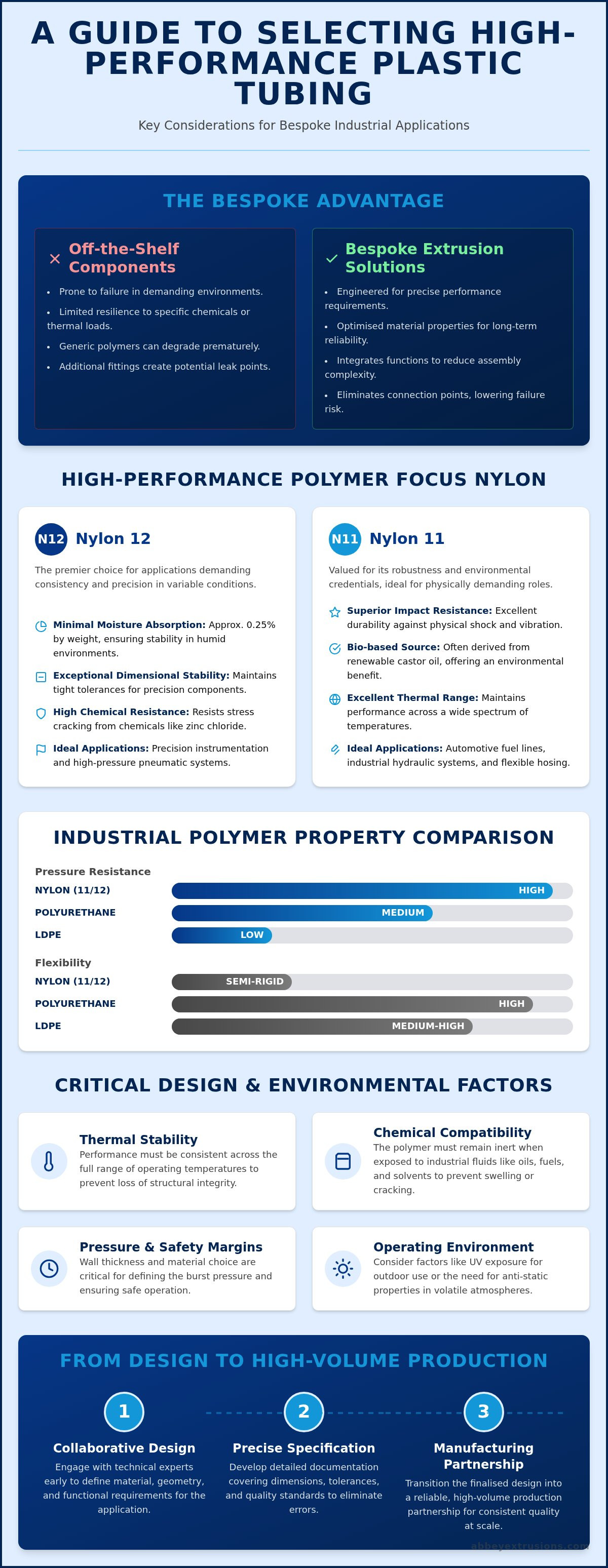
Custom extrusion serves as the technical foundation for solving complex fluid and air transfer challenges within the United Kingdom's industrial landscape. Whilst standard components are readily available, they often lack the resilience required for high performance environments. This custom plastic tubing design guide highlights that bespoke solutions are essential when off the shelf products cannot meet specific chemical or thermal demands. Generic polymers often degrade prematurely when exposed to extreme temperatures or aggressive industrial solvents; this leads to costly system failures and unplanned downtime.
Achieving a reliable result requires early stage design collaboration between the engineer and the manufacturer. By engaging with our technical team during the conceptual phase, you can ensure that the material selection and profile geometry are perfectly suited for the intended application. We specialise in creating bespoke profiles that integrate multiple functions into a single extrusion. These might include external fluting for improved grip or internal reinforcement for enhanced pressure resistance, which effectively reduces the complexity of your final product assembly.
Identifying the Primary Application and Environment
Engineers must carefully assess temperature fluctuations and their direct impact on polymer stability over time. A material that performs well at room temperature may lose its structural integrity when subjected to consistent thermal cycles. Chemical exposure is another critical variable. Whether the tubing encounters hydraulic oils, diesel fuels, or abrasive cleaning agents, the polymer must remain inert to prevent swelling or cracking. The physical environment, such as prolonged UV exposure in outdoor settings or the requirement for anti static properties in volatile atmospheres, must be defined at the start of the design process to ensure long term reliability.
The Role of Custom Extrusion in Industrial Efficiency
Bespoke designs significantly improve industrial efficiency by reducing the reliance on external fittings and connectors. This reduction not only lowers the overall component cost but also eliminates potential leak points within the assembly. We also offer custom lengths and specialised packaging tailored to your assembly line speed, which helps to streamline the manufacturing process and reduce manual handling time. In large volume production, custom extrusion minimises material waste by delivering a product that matches your exact dimensional requirements without the need for secondary trimming.
To discuss your specific technical requirements for large volume orders, please speak with our engineering team via our contact page.
Selecting the Right Polymer for Performance
Selecting the correct polymer is the most critical decision in the custom plastic tubing design guide process. Mechanical properties vary significantly amongst industrial polymers; engineers must balance tensile strength against environmental resistance. Whilst LDPE offers a cost effective solution for low pressure applications, specialised systems require the superior performance of a Nylon tube to handle high pressure pneumatic loads safely. Compliance with UK and international regulations, including REACH and RoHS, ensures that your components are suitable for the global market. The trade-offs between cost and performance are often dictated by the chemical complexity of the application, where a higher initial investment in premium polymers can prevent expensive failures.
High Performance Nylon 11 and 12 Solutions
Nylon 12 is distinguished by its exceptional dimensional stability and minimal moisture absorption, typically around 0.25 percent by weight. This makes it the preferred choice for precision instrumentation where tolerances must remain constant even in humid environments. Nylon 11, often derived from renewable castor oil, provides superior impact resistance and is frequently specified for automotive fuel lines and hydraulic systems. These materials offer high resistance to stress cracking and chemicals such as zinc chloride. For a deeper analysis of these materials, you may consult our comprehensive guide to Nylon tubing properties and industrial applications.
Versatile PVC and Polyurethane Options
When your application requires high flexibility and elastic memory, a Polyurethane tube is the ideal specification. It offers remarkable kink resistance and abrasion protection, making it suitable for robotic arms and dynamic machinery. Alternatively, a PVC tube remains the standard for general fluid transfer due to its clarity and economical price point. Whilst standard PVC is limited to low pressure use, reinforced variants incorporate high tenacity polyester braiding to support significantly higher pressure ratings without sacrificing flexibility. This versatility allows manufacturers to tailor the tubing to specific industrial environments, from food processing to general factory air lines.
Effective polymer selection remains a cornerstone of a successful custom plastic tubing design guide, ensuring that every bespoke extrusion meets its intended operational lifespan. If you are unsure which polymer aligns with your technical requirements, our team can provide a detailed material consultation for your bespoke project.
To discuss your specific technical requirements for large volume orders, please speak with our engineering team via our contact page.
Critical Dimensional and Mechanical Specifications
Precision in dimensional specification is the hallmark of professional engineering. This custom plastic tubing design guide emphasises that wall thickness is not merely a physical dimension but a critical performance variable. It directly dictates the burst pressure of the extrusion; as wall thickness increases, the hoop stress on the material decreases, allowing for higher operating pressures. Engineers must define strict tolerances to ensure seamless compatibility with standard push fit or barbed fittings. Even a minor deviation in the outside diameter can lead to catastrophic leaks or assembly failures on a high speed production line.
Understanding Diameter and Wall Thickness Calculations
Precision engineering requires the clear definition of Inside Diameter (ID) and Outside Diameter (OD). When calculating the required wall thickness, engineers must account for the maximum operating pressure whilst applying a safety factor, often 3 to 1 or 4 to 1, to accommodate pressure spikes. Concentricity is the measure of how evenly the wall thickness is distributed around the circumference of the tube, and it is vital for maintaining uniform flow dynamics and structural integrity under load. Poor concentricity creates thin spots that act as failure points when the system is pressurised. Specifying the minimum bend radius is equally essential. If a tube is forced into a tighter curve than its material properties allow, it will kink. This kinking restricts flow and creates mechanical stress that can lead to permanent deformation or stress cracking over time.
Balancing Flexibility and Tensile Strength
We utilise Shore hardness ratings to specify the exact level of flexibility required for your application. A lower Shore A rating indicates a softer, more pliable material like Polyurethane, whereas a higher Shore D rating signifies a more rigid material like Nylon. For applications requiring extreme pressure resistance, we offer reinforced PVC tube options where high tenacity yarn is embedded within the extrusion to significantly boost tensile strength. Engineers must also consider long term creep behaviour, which is the tendency of a solid material to move slowly or deform permanently under the influence of persistent mechanical stresses. Selecting a material with low creep ensures the tubing maintains its dimensional integrity throughout its service life.
To discuss your specific technical requirements for large volume orders, please speak with our engineering team via our contact page.
Advanced Features and Bespoke Tube Forming
Integrating advanced features into the extrusion process allows engineers to address specific environmental challenges that standard tubing cannot withstand. This custom plastic tubing design guide highlights that additives like UV stabilisers or flame retardants can be compounded directly into the polymer matrix during production. We also produce custom profiles that move beyond simple circular cross sections to solve mechanical problems. Specialised profiles like curtainsider pelmet sections demonstrate our ability to extrude complex geometries that serve specific structural purposes. These bespoke shapes are often utilised in unique industrial sealing or structural applications where the tubing must perform a dual role as both a fluid conduit and a mechanical component.
Specialised Chemical and Food Grade Requirements
Designing for chemical compatibility requires a rigorous assessment of material purity and resistance. In sensitive sectors like the beverage industry, specifying a brewery hose ensures that the transfer process does not impart any unwanted taste or odour to the product. These food grade requirements are strictly regulated to maintain hygiene standards across the United Kingdom. In contrast, volatile industrial environments often necessitate anti static additives. These compounds are integrated into the polymer to provide a controlled path for electrical discharge. This prevents the accumulation of static electricity that could lead to combustion in explosive atmospheres or damage sensitive electronic components during transit.
The Advantages of Custom Tube Forming Services
Post-extrusion tube forming offers significant logistical and assembly advantages for large volume manufacturers. By creating permanent, three dimensional shapes, we help you eliminate the need for additional elbows and connectors. This reduces the total part count and minimises the risk of leaks at joints. Technical limits must be considered during the design phase, particularly the minimum bend radii for different materials. Our heat setting process involves precise temperature control to ensure the polymer reaches its glass transition phase without compromising its molecular structure. This ensures that the bespoke formed tube remains resilient under the vibration and thermal loads common in heavy industrial machinery. If your assembly requires complex geometries to fit within restricted spaces, you can enquire about our bespoke tube forming capabilities today.
To discuss your specific technical requirements for large volume orders, please speak with our engineering team via our contact page.
Optimising the Custom Manufacturing Partnership
A successful custom extrusion project relies on a transparent and technically grounded partnership between the procurement team and the manufacturer. This custom plastic tubing design guide serves as the initial step in defining your requirements, but the transition to production requires detailed documentation. Providing clear technical drawings, material specifications, and anticipated annual volume forecasts allows us to evaluate the feasibility of your design with precision. Selecting a specialist UK manufacturer with a proven track record ensures that you benefit from decades of technical expertise and direct communication channels, which are often lost when dealing with overseas suppliers. Our experience since 1985 allows us to identify potential production issues before they affect your timeline.
Designing for Large Volume Production Efficiency
Design choices made during the early stages significantly impact the final unit cost and production speed. Complex geometries or extremely tight tolerances can increase tooling costs and lead to slower extrusion rates. By understanding the engineering principles of plastic extrusion for industrial applications, engineers can refine their designs to suit high volume manufacturing constraints. Long run extrusions are particularly beneficial for unit cost reduction, as they amortise the initial setup time and tooling expenses over a larger number of components. We also work closely with our partners to manage logistics and lead times, ensuring that high volume industrial orders arrive exactly when needed to maintain assembly line continuity.
Quality Assurance and Compliance Standards
Maintaining batch to batch consistency is paramount in industrial applications where a single failure can have widespread consequences. Our quality management systems are designed to ensure that every metre of tubing meets the agreed specifications without deviation. This includes verifying material certifications to confirm compliance with REACH and RoHS standards, which is essential for components used in global supply chains. We implement rigorous testing protocols, including real time laser micrometer dimensional checks and hydrostatic pressure testing, to ensure that the final product adheres to your acceptance criteria. Establishing these clear standards at the start of the partnership provides the stability and reliability that professional engineering teams require for their bespoke components.
To discuss your technical design requirements or to request a bespoke quote, please contact our engineering team today.
Advancing Industrial Performance with Bespoke Extrusion
Designing for the future of British industry requires a move away from generic components towards precision engineering. This custom plastic tubing design guide has provided the technical framework necessary to navigate polymer selection and dimensional tolerances for 2026. By integrating features like bespoke tube forming and anti static properties into your designs, you ensure that every extrusion performs reliably under specific industrial loads. These strategies reduce assembly complexity whilst maintaining high standards of quality and consistency across large volume production runs.
As a specialist UK manufacturer since 1985, we remain dedicated to providing high performance Nylon 11 and 12 tubing alongside comprehensive profile extrusion services. Our decades of expertise in large volume industrial supply allow us to support your procurement needs with technical authority and manufacturing stability. To discuss your technical design requirements or to request a bespoke quote, please contact our engineering team today. We are ready to help you achieve long term operational excellence through precise engineering and a commitment to quality that defines our business norms.
Frequently Asked Questions
What are the most common materials used for custom plastic tubing design?
The most common materials for industrial applications include Nylon 11, Nylon 12, Low Density Polyethylene (LDPE), and Polyurethane (PU). We also produce reinforced PVC and anti-static variations for specialised environments. Each polymer provides unique benefits, such as UV stability or high flexibility. Selecting the correct material is a foundational element of our custom plastic tubing design guide to ensure your product survives its intended operational lifespan.
How do I determine the correct wall thickness for high-pressure applications?
Determining the correct wall thickness involves calculating the hoop stress based on your maximum operating pressure and the specific tensile strength of the polymer. It's essential to apply a safety factor, often 3 to 1 or 4 to 1, to account for temperature fluctuations and pressure surges. Whilst thicker walls improve pressure resistance, they also increase the bend radius. Our engineers help balance these factors for optimal performance.
Can custom plastic tubing be manufactured in bespoke colours for identification?
We can manufacture tubing in almost any bespoke colour to facilitate easy identification or match your brand identity. We use high-quality masterbatches to ensure colour consistency across large-volume production runs. This is particularly useful for complex pneumatic systems where colour coding prevents installation errors. We can also provide translucent or opaque finishes depending on whether you need to monitor fluid flow visually during operation.
What is the difference between custom extrusion and custom tube forming?
Custom extrusion is the process of creating a continuous length of tubing with a consistent cross-section by forcing molten plastic through a die. In contrast, custom tube forming involves secondary operations where straight extruded tubes are shaped into specific geometries, such as coils or permanent bends. Extrusion creates the base product, whilst forming adds the structural configuration required for specific spatial constraints within your industrial machinery or equipment.
How does chemical resistance vary amongst different types of nylon tubing?
Chemical resistance varies between Nylon 11 and Nylon 12, although both types are highly durable. Nylon 11 is derived from renewable sources and offers excellent resistance to hydraulic fluids and fuels. Nylon 12 has lower moisture absorption, which ensures better dimensional stability and resistance to stress cracking in harsh environments. We advise consulting a compatibility matrix during the early stages of your custom plastic tubing design guide to avoid material failure.
What information should I provide when requesting a quote for custom tubing?
When requesting a quote, please provide the internal and external diameters, the material required, and the total volume for the order. Details regarding the operating temperature, pressure requirements, and any specific chemical exposures are also vital for an accurate assessment. If you require secondary services like tube forming or bespoke colours, include these specifications. This data allows us to provide a precise technical proposal and competitive pricing.
Are there specific design considerations for food-grade or brewery hoses?
Design considerations for food-grade or brewery hoses focus on hygiene and material migration limits. We use specific FDA-compliant or EU-regulated polymers that don't taint the taste or odour of the conveyed liquids. The internal bore must be exceptionally smooth to prevent bacterial buildup and facilitate effective cleaning. Reinforced PVC or specialised polyurethane are often selected for their flexibility and ability to withstand the rigorous cleaning cycles common in brewing.
Why is it important to work with a specialised UK manufacturer for bespoke orders?
Working with a specialised UK manufacturer like Abbey Extrusions ensures superior quality control and direct communication with the engineering team. Local production reduces lead times and eliminates the complexities of international logistics and currency fluctuations. Our decades of experience allow us to provide deep technical insights into material selection and profile design. This partnership fosters a reliable supply chain for high-volume, bespoke industrial components that meet British standards.

Article by
Bryan Cowan
Bryan Cowan is the Founder and Managing Director of Abbey Extrusions Ltd, a leading UK manufacturer of high-quality plastic tubes and hoses. With over 40 years of industry experience, Bryan established the company in 1985, growing it from a startup into a BS ISO9001-registered supplier for global sectors including aerospace, automotive, and pharmaceuticals.
Disclaimer
This article is intended for informational purposes only. Please ensure you seek expert advice or carry out your own research to confirm the information is suitable for your specific needs.