A single millimetre of dimensional variance or an overlooked polymer incompatibility can bring an entire industrial production line to a standstill, costing thousands in lost revenue. Procurement teams often face the exhausting challenge of managing inconsistent batches from overseas suppliers whilst attempting to find materials that won't fail under extreme thermal or chemical stress. It's a common frustration to receive custom flexible plastic tubing that meets a drawing on paper but fails to perform in a rigorous high-volume environment.
We believe that technical precision is the only way to avoid these costly pitfalls and ensure long-term reliability. This article explores how deep expertise in polymer selection and advanced manufacturing techniques ensures the success of your bespoke extrusion projects. We'll examine the methods for securing a reliable UK-based supply chain and the critical steps required to guarantee chemical and thermal compatibility for your specific industrial applications.
Key Takeaways
- Learn how the custom plastic extrusion process uses precision engineered dies to create complex profiles that maintain dimensional consistency across large production runs.
- Understand why selecting the correct polymer is the most critical stage of the design process to ensure your custom flexible plastic tubing withstands chemical and thermal stress.
- Discover how bespoke flexible profiles are engineered to meet the specific mechanical demands of the transport and heavy textile sectors.
- Identify the rigorous quality manufacturing standards and testing protocols required to prevent premature failure in high performance industrial applications.
- Gain insights into the essential criteria for selecting a reliable UK manufacturing partner capable of securing your supply chain for high volume orders.
If your project requires high volume production and technical precision, please get in touch with our technical team to discuss your specific requirements.
The Fundamentals of the Plastic Extrusion Process
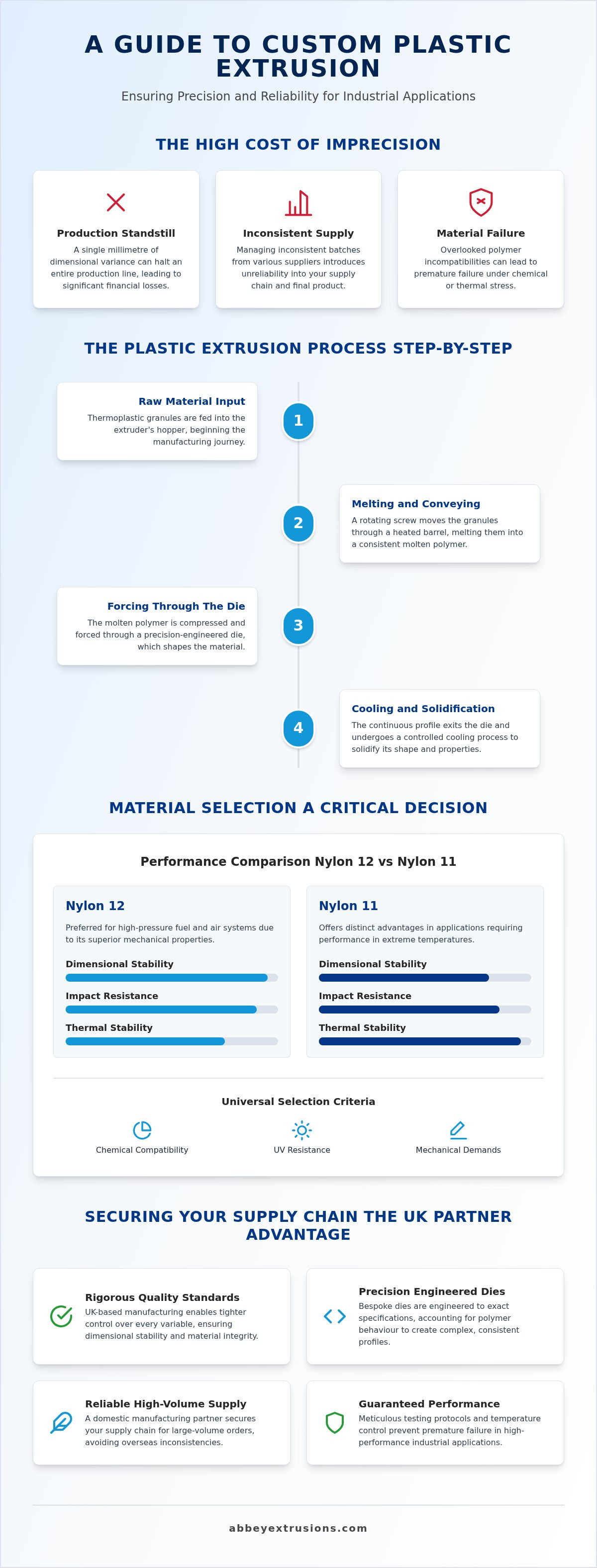
Custom plastic extrusion is a sophisticated manufacturing method where molten polymer is forced through a precision engineered die to create a continuous profile. This transition begins with raw thermoplastic granules, which are fed into a heated barrel and moved along by a rotating screw. As the material melts, it's compressed and pushed through the die to form the desired shape. For industrial clients, understanding the plastic extrusion process is vital because it determines the structural integrity of the finished product. When sourcing custom flexible plastic tubing for demanding environments, this process must be managed with absolute precision to ensure every metre of material meets the exact specification.
Maintaining dimensional stability is the primary challenge during manufacturing. Without rigorous technical oversight, the polymer can warp or thin as it exits the die, which leads to structural weaknesses and premature failure. Our UK based manufacturing facility prioritises these high quality standards, providing the reliability needed for heavy duty industrial use. By keeping production within the UK, we can maintain tighter control over every variable, from the initial melt to the final cooling stage.
The Role of the Extrusion Die in Profile Creation
Bespoke dies are the heart of any extrusion line. These components are engineered to meet exact customer specifications, accounting for the specific way different polymers expand or contract during the process. The relationship between die pressure and material flow consistency is delicate. If the pressure isn't perfectly balanced, the resulting profile will suffer from uneven wall thickness or internal stresses. In cases where complex geometries or specific curvatures are required, tube forming provides additional shaping and manipulation after the initial extrusion is complete.
Temperature Control and Material Consistency
Precise heat management is critical for maintaining polymer integrity throughout the production cycle. If the temperature is too high, the material may degrade or lose its essential mechanical properties. Conversely, insufficient heat leads to poor fusion and surface defects that compromise the tube's pressure rating. Cooling rates are equally vital because they directly affect the final flexibility and "memory" of the material. We monitor these variables meticulously to ensure every batch performs as intended. Thermal stability prevents structural defects in bespoke profiles and ensures long term performance in harsh environments.
If you require expert guidance on material specifications for high volume orders, please contact our technical specialists to ensure your project meets all necessary industrial standards.
Material Selection for Custom Industrial Tubing
Selecting the appropriate polymer is the most critical stage of the design process. It dictates the lifespan, safety, and mechanical performance of the final component. Industrial environments often expose custom flexible plastic tubing to aggressive fluid types, including hydraulic oils, fuels, and corrosive chemicals. Failure to account for chemical compatibility at the outset can lead to polymer degradation, swelling, or sudden rupture. For outdoor applications, UV resistance is equally vital to prevent brittleness and cracking caused by long term solar exposure. Manufacturers must also adhere to strict environmental guidelines during the production of these materials to ensure compliance with modern industrial standards. Understanding the engineering principles of plastic extrusion helps procurement teams appreciate how material choice influences the extrusion speed and final tolerances of the profile.
Comparing Nylon 11 and Nylon 12 Performance
Nylon 11 and Nylon 12 are both high performance polyamides, yet they offer distinct advantages for industrial applications. Nylon tube variants derived from Nylon 12 are frequently preferred for high pressure fuel and air systems due to their exceptional dimensional stability and impact resistance. Whilst Nylon 11 offers slightly better thermal stability in certain extreme temperatures, Nylon 12 provides superior resistance to moisture absorption. Lower moisture uptake ensures that the tubing maintains its mechanical strength and pressure rating even in humid or submerged environments, preventing the softening that often affects other polyamide grades. These materials are essential for safety critical systems where material fatigue is not an option.
Advantages of Polyurethane and LDPE Tubing
Polyurethane offers unmatched abrasion resistance and kink recovery, making it ideal for dynamic environments. A Polyurethane tube can withstand constant flexing and mechanical wear without losing its structural integrity or developing stress cracks. For applications where budget and basic fluid transfer are the primary concerns, low density polythene tube provides a highly cost effective solution. LDPE is naturally flexible and resistant to a wide range of acids and alkalis, making it a staple for pneumatic systems and low pressure fluid transfer across the UK manufacturing sector. Our engineers can help you select the ideal material for your specific operating environment to maximise the service life of your components.
If your operations require high volume manufacturing with guaranteed dimensional accuracy, please contact our technical sales team to discuss your bespoke requirements.
Bespoke Flexible Profiles for Transport and Industry
Standard off the shelf solutions often fail to meet the tight tolerances and specific mechanical requirements needed for specialised industrial hardware. For transport and heavy textile manufacturers, the procurement of custom flexible plastic tubing is frequently just one element of a broader requirement for complex, non-standard profiles. These components must integrate seamlessly with existing mechanical systems whilst maintaining performance under high stress conditions. Our manufacturing processes focus on the niche requirements of these sectors, where a single ill-fitting part can lead to significant operational delays.
Reliability in high volume production is essential for fleet maintenance and large scale industrial projects. Large scale operators cannot afford the downtime caused by inconsistent batches or material failures. Specialised manufacturing allows for the creation of functional components tailored to specific hardware, ensuring that every profile performs its intended role with precision. By moving away from generic products, businesses can secure a supply chain that provides components specifically engineered for their unique environmental and mechanical stressors.
Curtainsider Pelmet Sections and Vehicle Maintenance
For projects that require a combination of polymer and metal components, you can learn more about Velocity Sheet Metal to discover how precision fabrication and laser cutting can support your broader engineering needs.
Curtainsider pelmet sections play a vital role in protecting vehicle cargo from environmental ingress and road debris. These profiles require a specific balance of weather resistance and flexibility to ensure they remain effective throughout the life of the trailer. Bespoke extrusions allow for a perfect fit against specific trailer designs and configurations, which standard profiles simply cannot match. This precision prevents water from entering the load area, which is critical for maintaining cargo integrity during long haul transport across the UK and Europe. The use of high grade flexible PVC ensures the pelmet retains its shape despite constant exposure to wind and temperature fluctuations.
Kedar Cord Specifications for Heavy Duty Textiles
Industrial tents, marquees, and commercial awnings rely on Kedar cord to provide a secure attachment point between the fabric and the structural frame. The manufacturing process must guarantee a consistent diameter and high tensile strength to ensure the textile slides smoothly into its aluminium track whilst remaining anchored under significant wind load. By using bespoke PVC formulations, we can adjust the hardness and flexibility of the cord to match the specific textile weight and application. This level of customisation ensures the structural integrity of large scale temporary buildings and industrial covers, providing a reliable connection that won't fail under tension.
If you require high volume production that adheres to strict engineering tolerances, please speak with our technical team to discuss your quality requirements.
Precision Engineering and Quality Manufacturing Standards
Industrial grade extrusions demand a level of scrutiny that standard commercial products rarely undergo. Producing high performance custom flexible plastic tubing requires a manufacturing environment where quality control is an integrated part of the entire production lifecycle. At our UK facility, we've refined these processes since 1985, ensuring that every batch of bespoke profiles meets the rigorous expectations of our industrial partners. Maintaining tight dimensional tolerances over long production runs is essential for ensuring that components remain compatible with complex machinery and safety systems. We're committed to producing high performance components that meet international standards, providing a level of reliability that supports the most demanding industrial applications.
Working with an established UK manufacturer provides the transparency and technical accountability that overseas suppliers often lack. This decades long commitment to excellence defines our approach to every bespoke project we undertake. By maintaining all manufacturing within the UK, we can provide immediate technical support and ensure that the final product aligns perfectly with the initial engineering brief. This stability is vital for clients who manage large volume orders and require a guaranteed, consistent supply chain.
Dimensional Tolerances and Specification Compliance
Precision measurement tools are used throughout the production cycle to ensure every batch aligns perfectly with the client's design. Even a minor deviation in wall thickness can significantly alter the performance and safety rating of a reinforced PVC tube. We monitor these parameters in real time to prevent the fluctuations that lead to assembly issues or mechanical weaknesses. Rigorous pressure testing and micrometer checks prevent failure in high pressure industrial applications by identifying potential defects before the material leaves the factory floor. This level of precision is non negotiable for safety critical systems.
Testing for Chemical and Environmental Resistance
Material integrity must be verified against the specific industrial fluids the tubing will encounter in the field. Our verification procedures involve exposing samples to aggressive chemicals and oils to observe any adverse reactions or structural changes. Accelerated ageing tests are also employed to predict the lifespan of custom extrusions, simulating years of environmental stress in a controlled setting. For a deeper understanding of how different polymers react to these stressors, our guide to nylon tubing properties provides detailed material testing insights. These protocols ensure that the final product excels in its specific operating environment.
To ensure your next project benefits from these rigorous quality standards, request a technical consultation with our engineering specialists today.
If you are looking to secure a reliable supply chain for your next high volume project, please contact our UK manufacturing facility to discuss your technical specifications.
Choosing a Reliable UK Extrusion Partner
Selecting a manufacturing partner for large scale industrial projects requires a careful evaluation of technical competence and production capacity. When your operations depend on a consistent supply of custom flexible plastic tubing, the geographical and professional proximity of your supplier becomes a strategic advantage. A reliable partner must demonstrate more than just the ability to extrude material; they must provide a stable foundation of engineering expertise that ensures every batch meets the required specifications. Working with a domestic manufacturer simplifies complex logistics and provides a level of accountability that is often difficult to maintain with overseas suppliers. Clear communication and a shared understanding of UK industrial standards are essential for the smooth execution of bespoke extrusion projects.
Technical support during the initial design and polymer selection phase is another critical factor. As discussed in previous sections, the success of an industrial component depends on the precise alignment of material properties with environmental stressors. An experienced manufacturer will act as a technical consultant, helping you navigate the complexities of polymer chemistry to ensure long term durability. This collaborative approach reduces the risk of premature failure and helps optimise the manufacturing process for high volume reliability.
Managing Large Volume Industrial Orders
Manufacturing capacity directly impacts lead times and the overall success of bespoke industrial projects. In the UK, the typical lead time for bespoke extrusion tooling ranges from four to six weeks, which includes the design, manufacturing, and initial testing phases. Sourcing from a centrally located UK supplier offers significant logistical advantages, reducing the carbon footprint of your supply chain and providing faster response times for urgent requirements. Coordinating complex custom requirements and production schedules is much more efficient when you have a direct line of communication with the engineers on the factory floor. This transparency allows for real time updates and ensures that production remains aligned with your project deadlines.
Technical Support from Concept to Production
Expert advice on polymer selection can significantly reduce overall project costs by preventing the over specification of materials or the use of unsuitable compounds. Prototyping and sample verification are vital steps that must be completed before full production commences. This stage allows for the physical testing of the profile in its intended application, ensuring that flexibility, wall thickness, and chemical resistance meet the operational reality. Establishing a long term partnership with a specialist manufacturer provides the stability needed for ongoing high volume requirements. We focus on building these relationships through consistent quality, technical transparency, and a commitment to meeting the evolving needs of the UK industrial sector.
If you are ready to start a bespoke project or need assistance with material selection for high volume production, please contact our technical specialists today.
Securing Industrial Reliability through British Engineering
Success in modern manufacturing requires a move away from generic components toward engineered solutions that address specific mechanical stressors. By aligning polymer chemistry with precise dimensional control, businesses can ensure their systems operate without the risk of costly downtime or material degradation. The integration of technical expertise at every stage, from polymer selection to the final cooling process, remains the only way to guarantee performance in safety critical environments.
As a specialist UK manufacturer since 1985, we provide the technical stability and bespoke profile and tube forming expertise necessary for high performance projects. Sourcing your custom flexible plastic tubing from an established domestic partner guarantees a reliable supply chain for large volume orders whilst maintaining the highest quality standards. Our focus on high performance polymers ensures that your components withstand the most aggressive industrial conditions.
For expert advice on bespoke manufacturing or to discuss your specific project requirements, please contact our technical team through our online enquiry form. We are ready to support your next engineering challenge with decades of professional experience.
Frequently Asked Questions
What are the main benefits of using custom plastic extrusions instead of standard parts?
Custom plastic extrusions offer precise performance characteristics that standard off-the-shelf parts cannot match. By opting for custom flexible plastic tubing, you ensure the material properties, dimensions, and tolerances align perfectly with your specific industrial application. This tailored approach reduces the need for secondary modifications and minimises waste during assembly. It also allows for the integration of specific features like UV resistance or unique colour coding that standard products lack.
Which polymers are best suited for flexible industrial tubing applications?
The selection of the ideal polymer depends on the environmental demands of your project. Nylon 11 and 12 are excellent choices for applications requiring high chemical resistance and thermal stability. Polyurethane provides exceptional flexibility and abrasion resistance; whilst Low Density Polyethylene is preferred for its cost effectiveness and chemical inertness. For high pressure environments, reinforced PVC hose offers the necessary structural integrity whilst maintaining the required degree of flexibility.
Can you manufacture bespoke profiles like Kedar cord for specific industrial needs?
We manufacture a wide range of bespoke profiles including Kedar cord for the transport and marquee industries. These specialised sections are designed to meet exact geometric requirements that standard tubing cannot satisfy. Our facility produces these profiles using dedicated tooling to ensure consistent performance across large production runs. Whether you require specific pelmet sections or unique sealing strips, our technical team works to your precise drawings to deliver reliable industrial solutions.
How do you ensure dimensional accuracy in large volume extrusion orders?
Ensuring dimensional accuracy in large volume extrusion orders requires rigorous process control and decades of technical expertise. We utilise advanced monitoring equipment during the production of custom flexible plastic tubing to maintain tight tolerances. Regular inspections and calibrated measuring tools are used to verify that every batch meets the agreed specifications. This methodical approach to manufacturing ensures that components remain consistent from the start of the production run to the final unit.
What information is required to provide a quote for a custom extrusion project?
To provide an accurate quote for a custom extrusion project, we require detailed technical specifications. Please include the internal and external diameters, the preferred polymer type, and the intended application environment. Information regarding the total volume, required lengths, and any specific tolerances is also essential. If you have a technical drawing or a sample of the profile, this helps our engineers assess the tooling requirements and provide a precise commercial proposal.
Do you offer tube forming services as part of the manufacturing process?
We provide specialised tube forming services as part of our comprehensive manufacturing process. This secondary operation allows us to create permanent bends and complex shapes in flexible tubing to meet specific installation requirements. By forming the tubes in-house, we ensure that the structural integrity of the material is maintained whilst providing a component that is ready for immediate integration. This service is particularly beneficial for clients needing precise routing in confined industrial spaces.
What industries typically require bespoke flexible plastic profiles?
Bespoke flexible plastic profiles are essential across various sectors including transport, brewing, and general manufacturing. The transport industry often requires custom curtainsider pelmet sections; whilst the brewing sector relies on specialised food grade hoses for fluid transfer. Additionally, industrial air systems frequently utilise custom coiled air hoses and reinforced tubing. Our ability to tailor material properties and shapes makes our extrusions suitable for any application where standard components fail to meet technical demands.
How does UK manufacturing compare to overseas sourcing for custom extrusions?
Sourcing custom extrusions from a UK manufacturer offers significant advantages in terms of quality control and lead times. Working with a domestic supplier reduces the complexities of international logistics and ensures clearer communication throughout the design phase. Our UK facility provides the stability and technical competence required for high volume orders, allowing for faster response times to design changes. Domestic production supports local industrial standards and ensures the reliability of your supply chain.

Article by
Bryan Cowan
Bryan Cowan is the Founder and Managing Director of Abbey Extrusions Ltd, a leading UK manufacturer of high-quality plastic tubes and hoses. With over 40 years of industry experience, Bryan established the company in 1985, growing it from a startup into a BS ISO9001-registered supplier for global sectors including aerospace, automotive, and pharmaceuticals.
Disclaimer
This article is intended for informational purposes only. Please ensure you seek expert advice or carry out your own research to confirm the information is suitable for your specific needs.