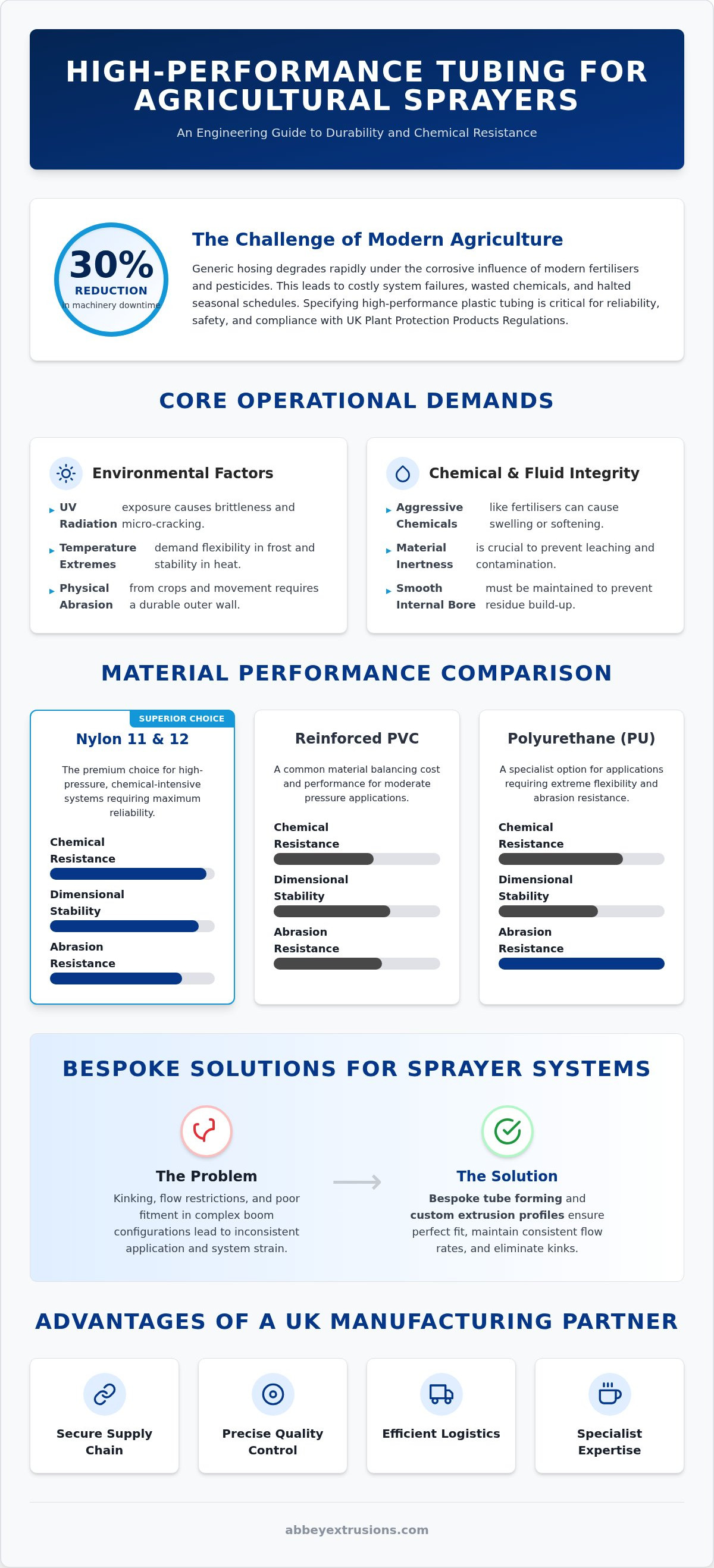
Advanced polymer engineering can reduce machinery downtime by up to 30 per cent, yet many large-scale operations still rely on generic hosing that degrades rapidly under the corrosive influence of modern fertilisers. You recognise that a single perished line or a kinked tube in a complex boom setup does more than just waste expensive chemicals; it halts your entire seasonal schedule and impacts yield precision. This technical guide provides the engineering clarity required to specify high-performance plastic tubing for agricultural sprayers that withstands aggressive liquid fertilisers and pesticides whilst maintaining consistent flow rates.
We understand the pressure of meeting the stringent UK Plant Protection Products Regulations of 2026, where equipment reliability is non-negotiable for mandatory inspections. This article explores the critical technical distinctions between materials like Nylon 12 and reinforced PVC, addresses the logistical challenges of sourcing bespoke profiles for unique machinery, and explains how partnering with a specialist UK manufacturer secures your supply chain. By the end of this guide, you will possess the technical criteria necessary to select durable, chemical-resistant solutions that ensure your spraying systems operate at peak efficiency throughout the 2026 season and beyond.
Key Takeaways
- Evaluate the technical performance of Nylon 11 and 12 to ensure maximum chemical resistance against modern liquid fertilisers and pesticides.
- Identify the correct pressure ratings and safety factors required for plastic tubing for agricultural sprayers to prevent system failure during high volume applications.
- Explore how bespoke tube forming and custom extrusion profiles can solve kinking issues and flow restrictions in complex sprayer boom configurations.
- Gain insights into the logistical and quality control benefits of partnering with a specialist UK manufacturer for large scale industrial supply.
To discuss your bespoke requirements for large-volume tubing orders, please reach out to our technical sales team via our bespoke enquiry form.
Understanding the demands of agricultural sprayer systems
Modern agricultural sprayer systems operate in some of the most punishing industrial environments in the United Kingdom. Unlike static factory installations, these systems are mobile, exposed to the elements, and tasked with transporting volatile chemical compounds under varying pressures. The selection of plastic tubing for agricultural sprayers is a critical engineering decision that dictates the reliability and safety of the entire application process. If the chosen polymer fails to withstand the cumulative stress of UV radiation, chemical attack, and physical abrasion, the resulting system failure can lead to significant financial losses and environmental hazards.
Sprayer booms often extend over large areas, requiring tubing that can maintain consistent flow rates without kinking or collapsing. Mechanical stresses such as constant vibration from the tractor engine and the physical impact of moving through dense crops place immense strain on every connection point. We understand that durability isn't just about the material's strength but its ability to perform consistently over hundreds of hectares of operation. Every millimetre of the extrusion must be uniform to ensure that pressure is distributed evenly across the system.
Environmental factors in modern farming
The exterior surface of a sprayer tube faces relentless degradation from solar radiation. Prolonged UV exposure breaks down the polymer chains within the plastic, which typically leads to surface micro-cracking and eventual brittleness. This degradation is accelerated by the extreme temperature fluctuations common in British agriculture, where components must remain flexible during early morning frosts whilst resisting thermal expansion and softening in the summer heat. Mechanical durability is equally vital because as booms move, the tubing experiences constant external abrasion. High-performance materials must maintain their structural integrity despite this physical contact to ensure the protective outer wall doesn't fail prematurely.
Chemical compatibility and fluid integrity
Inside the tube, the challenges are even more acute. Liquid fertilisers and high-concentration pesticides are chemically aggressive. Their specific formulations can cause certain plastics to swell, soften, or leach plasticisers into the fluid stream, which alters the chemical balance of the spray. We focus on materials like Nylon tube that offer exceptional chemical inertness to prevent these reactions. Maintaining a perfectly smooth internal bore is also essential for long-term flow efficiency. A rough or degraded surface allows for the accumulation of chemical residues, which eventually leads to clogging or dangerous cross-contamination between different batches of treatments.
For large-volume industrial orders or to request bespoke extrusion profiles tailored to your machinery, please speak with our manufacturing experts.
Material selection for chemical delivery and durability
Selecting the appropriate polymer for plastic tubing for agricultural sprayers is a precise engineering task that balances chemical resistance, mechanical strength, and cost-efficiency. Whilst generic hosing might offer a lower initial purchase price, the long-term operational costs associated with premature failure and chemical degradation often outweigh these savings. We prioritise technical performance by matching the specific requirements of the spraying system to the inherent properties of the plastic material.
Polyurethane (PU) tubing remains a specialist choice for applications that demand extreme abrasion resistance and flexibility. In environments where the tube is frequently dragged across abrasive surfaces or requires a tight bend radius without kinking, PU provides a robust solution. However, for the majority of high-volume agricultural applications, the choice typically narrows down to Nylon, reinforced PVC, or Polyethylene based on the specific delivery pressures and chemical concentrations involved.
Technical properties of Nylon 11 and 12
Nylon 11 and 12 are widely regarded as the superior choice for high-pressure chemical delivery systems. These polymers offer exceptional dimensional stability, meaning they maintain their shape and diameter even when subjected to fluctuating temperatures and internal pressures. This precision is vital for maintaining consistent flow rates across a sprayer boom. Our Nylon tube is specifically engineered to resist stress cracking, a common failure point when tubes are exposed to aggressive pesticides and fertilisers over extended periods. Because Nylon has a high burst pressure rating relative to its wall thickness, it allows for lighter, more manageable systems without compromising on safety or fluid integrity.
Advantages of reinforced PVC and LDPE
For general-purpose spraying where pressures are moderate, reinforced PVC tube offers a versatile and cost-effective alternative. The addition of high-tenacity polyester braiding within the PVC wall significantly enhances the pressure rating, allowing the hose to handle the surges common in pump-driven systems whilst remaining flexible enough for easy routing. This material is particularly effective for delivering water-based treatments where extreme chemical resistance isn't the primary concern.
Conversely, low density polythene tube (LDPE) is the preferred option for low-pressure fluid transfer and suction lines. Its primary advantage lies in its excellent flexibility and resistance to a wide range of chemicals at a lower price point. Whilst LDPE doesn't match the pressure capabilities of Nylon, its lightweight nature and ease of installation make it ideal for secondary delivery lines. If you're unsure which material best suits your specific application, our engineers can provide a technical consultation to ensure your system uses the most efficient polymer for its intended purpose.
To discuss your specific pressure requirements or to request a quote for high-volume orders, please contact our technical manufacturing team.
Pressure ratings and reinforcement methods for industrial spraying
The mechanical integrity of plastic tubing for agricultural sprayers is defined by its ability to contain fluid under pressure without diametrical expansion or structural failure. In high-volume agricultural systems, pumps often generate significant surges that can momentarily exceed the standard operating pressure. We engineer our tubing to manage these dynamic loads by focusing on the precise relationship between polymer density, wall thickness, and reinforcement architecture. A failure to account for these variables often results in hose fatigue, which manifests as localised bulging or catastrophic bursting during critical spraying windows.
Wall thickness is a primary factor in preventing the tube from kinking in tight boom configurations or collapsing under suction. Whilst a thinner wall may reduce weight, it lacks the hoop strength necessary to maintain a consistent internal diameter when bent. We ensure that our extrusion processes maintain strict tolerances, providing a uniform profile that distributes internal stress evenly across the entire length of the assembly. This precision is essential for ensuring that every nozzle on a 36-metre boom receives fluid at the exact same pressure.
The role of polyester braiding in high pressure hoses
Internal reinforcement is essential for applications exceeding moderate pressure thresholds. Our reinforced PVC tube utilises a multi-layer extrusion process where a high-tenacity polyester braid is encapsulated between an inner core and an outer cover. This braided layer acts as a structural skeleton that prevents the polymer from stretching under load. By adjusting the pitch and density of the braid, we can balance the need for flexibility with the rigidity required for high bar ratings. This multi-layer approach also allows us to use different polymer blends for the inner and outer layers, ensuring the core remains chemically resistant whilst the cover provides UV and abrasion protection.
Calculating safety factors for field operations
Engineering a reliable spraying system requires a clear understanding of the difference between working pressure and burst pressure. It's standard practice in the UK agricultural sector to maintain at least a two to one safety factor, though many industrial operators prefer a higher margin to account for equipment wear. Industry recommendations suggest selecting a hose with a working pressure at least 25 per cent above the system's maximum sustained pressure to accommodate pump surges. It is also vital to consider that temperature significantly impacts these ratings; as the ambient temperature rises during summer operations, the plastic polymer softens, which reduces the effective pressure capacity of the tube. We provide detailed technical data sheets to help you calculate these derating factors accurately for your specific environment.
To enquire about bespoke extrusion profiles or large-volume production runs, please contact our manufacturing facility.
Custom extrusion and tube forming for bespoke sprayer designs
Standard hosing often fails to meet the exact tolerances required for modern, high-efficiency spraying equipment. When designing new machinery, relying on off-the-shelf components can force compromises in flow dynamics or fitment. Custom plastic tubing for agricultural sprayers allows engineers to specify exact internal and external diameters, ensuring a perfect seal with proprietary fittings. We provide the technical flexibility to blend specific polymers that enhance UV resistance or chemical stability beyond standard industry grades. This tailored approach ensures that the tubing is perfectly matched to the specific chemical concentrations and operating pressures of your system.
For fleet operators and machinery manufacturers, consistency across every unit is non-negotiable. Our large-volume manufacturing capabilities ensure that every metre of tubing meets the same rigorous quality standards. This reliability is the foundation of long-term trust in industrial partnerships. We maintain strict control over the extrusion process to guarantee that wall thickness and material density remain uniform, which is essential for predictable performance in the field.
Benefits of bespoke profile extrusion
Bespoke extrusion provides a level of customisation that generic retailers cannot offer. We can manufacture multi-bore tubing that allows for the simultaneous delivery of different fluids within a single, organised profile. This reduces the complexity of boom layouts and simplifies maintenance. We can also produce tubing in specific colours to allow for immediate identification of different chemical lines, which is a vital safety feature in large-scale operations. By specifying unique dimensions, you can optimise the flow path for specific liquid fertilisers, reducing the energy required for pumping and improving overall system efficiency.
Precision tube forming for agricultural machinery
Complex machinery often requires fluid lines to navigate tight spaces without kinking or restricting flow. Our tube forming services allow us to create rigid, pre-shaped components that maintain their profile under stress. These formed tubes possess a structural memory that resists the vibration and mechanical strain common in field operations. By using pre-formed plastic parts, you can replace multiple complex fitting assemblies, which significantly reduces the number of potential leak points in the system. This process improves the overall organisation of sprayer boom layouts, resulting in a cleaner, more professional finish for original equipment manufacturers. Request a technical consultation for your bespoke sprayer design to see how pre-shaped components can improve your machinery.
To discuss a high-volume supply partnership or to request technical data sheets for our product range, please get in touch with our manufacturing team.
Partnering with a UK manufacturer for large volume supply
Sourcing plastic tubing for agricultural sprayers from a domestic manufacturer provides a level of supply chain security that international importers cannot replicate. By maintaining our production facility in Leicestershire, we eliminate the logistical volatility associated with global freight and customs delays. This proximity allows for a more responsive relationship where technical specifications are discussed directly with the engineers who oversee the extrusion process. For original equipment manufacturers (OEMs), this direct line of communication ensures that every bespoke requirement is understood and implemented without the risk of misinterpretation across multiple intermediaries.
Reliability in the agricultural sector is built on consistent performance. We understand that large-scale operations require more than just a product; they require a partnership that supports long-term growth and operational stability. Our manufacturing protocols are designed to handle high-volume orders whilst maintaining the precision typically reserved for small-batch engineering. This commitment to excellence has been the foundation of our business since 1985, allowing us to support the UK agricultural industry with durable polymer solutions.
Streamlining procurement for equipment manufacturers
Lead times matter. Equipment manufacturers can significantly reduce their inventory costs by utilising scheduled delivery patterns that align with their production cycles. Instead of holding vast quantities of stock, you can rely on our consistent output to provide the necessary components exactly when they're needed. This approach frees up capital and warehouse space, improving the overall efficiency of your business. Accessing technical support directly from the extrusion experts also means that any design adjustments or material queries are resolved quickly, preventing costly delays in the assembly of new sprayer systems.
Quality assurance and industrial standards
Quality control is maintained through rigorous in-house testing that ensures compliance with relevant UK manufacturing standards. We adhere to strict tolerances, such as those specified in BS EN ISO 1307 2008, to guarantee that our tubing fits perfectly with standard industrial couplings. Batch-to-batch consistency is vital for critical components like Nylon tube, where even a slight variation in material density can affect the burst pressure and chemical resistance. Our decades of experience in the plastic extrusion industry allow us to identify and mitigate potential material issues before the product ever leaves the factory. This proactive approach to quality assurance ensures that your machinery remains compliant with the latest pesticide application regulations, protecting both the operator and the environment.
To discuss your bespoke manufacturing requirements for large-volume industrial orders, please contact our technical sales team.
Securing your agricultural spraying infrastructure for the 2026 season
Selecting the correct plastic tubing for agricultural sprayers is a high-stakes engineering decision that directly impacts the efficiency and safety of your chemical delivery systems. We've explored how the technical properties of Nylon 11 and 12 provide the chemical resistance needed for aggressive fertilisers, whilst reinforced PVC offers a versatile solution for general spraying. By calculating accurate pressure safety factors and considering bespoke tube forming, you can eliminate the common failure points associated with generic hosing.
As a specialist UK manufacturer with decades of experience in high-performance polymers, Abbey Extrusions is dedicated to providing the technical precision that modern agriculture demands. Our Leicestershire-based facility offers a comprehensive range of Nylon, PVC, and LDPE solutions tailored to your specific machinery requirements. We invite you to speak with our engineers about your bespoke tubing enquiries to discuss your high-volume production needs. Investing in superior polymer quality today ensures your spraying systems remain reliable and compliant throughout the 2026 season and beyond.
Frequently Asked Questions
What is the best plastic tubing material for liquid fertilisers?
Nylon 12 and Low Density Polyethylene (LDPE) are the most suitable materials for transporting liquid fertilisers in agricultural settings. Nylon 12 provides exceptional resistance to the corrosive nature of many chemical compounds whilst maintaining structural integrity over long periods. Our manufacturing process ensures that these tubes withstand the harsh chemicals found in modern fertilisers. This makes them a reliable choice for farmers who require long term durability and consistent performance.
Can I use standard PVC tubing for high pressure agricultural spraying?
Standard PVC tubing is generally unsuitable for high pressure agricultural spraying because it lacks the necessary reinforcement to handle significant internal stress. For applications involving high pressures, we recommend using reinforced PVC hose which contains a high tensile polyester braid. This reinforcement prevents the tube from expanding or bursting under load. Using the incorrect material can lead to equipment failure and safety risks during critical spraying operations in the field.
Why is Nylon 12 preferred over Nylon 6 for chemical resistance?
Nylon 12 is preferred over Nylon 6 for agricultural applications because it has much lower moisture absorption rates and superior chemical stability. Whilst Nylon 6 can swell and lose mechanical strength when exposed to moisture or certain chemicals, Nylon 12 remains dimensionally stable. This ensures that plastic tubing for agricultural sprayers made from Nylon 12 maintains a precise fit with connectors and provides a longer service life in demanding outdoor environments.
Do you offer custom lengths for large agricultural sprayer orders?
We specialise in providing custom lengths for large volume agricultural sprayer orders to meet specific manufacturing requirements. Our Leicestershire facility is equipped to handle bespoke requests, ensuring that your production line receives tubing cut to exact specifications. This service reduces waste and simplifies the assembly process for equipment manufacturers. Please contact our technical team to discuss your specific volume requirements and how we can tailor our production to your needs.
How does UV exposure affect the lifespan of agricultural tubing?
Prolonged UV exposure can cause plastic tubing to become brittle and eventually crack, which significantly reduces its operational lifespan. To combat this, we often incorporate UV stabilisers or suggest black pigmented tubing, which offers the best natural resistance to solar radiation. Without these protections, the molecular structure of the plastic breaks down over time. Choosing UV resistant materials is essential for any equipment that remains outdoors for extended periods during the growing season.
What is the difference between working pressure and burst pressure?
Working pressure refers to the maximum pressure at which a tube can safely operate on a continuous basis. In contrast, burst pressure is the theoretical point at which the tubing will physically fail and rupture. We typically maintain a safety factor of at least 3 to 1 between these two values to ensure operator safety. Understanding these technical parameters is vital when selecting plastic tubing for agricultural sprayers to prevent accidental system failures.
Can you manufacture bespoke profiles for specific sprayer fittings?
Abbey Extrusions has the technical capability to manufacture bespoke profiles and custom tube shapes for specific sprayer fittings and unique agricultural machinery. Our engineering team works closely with clients to develop tooling that meets precise dimensional tolerances. This ensures a perfect interface between the tubing and your existing hardware. Whether you require a non standard diameter or a specific wall thickness, our extrusion expertise allows us to provide a tailored solution.
Is reinforced tubing necessary for suction applications in farming?
Reinforced tubing is essential for suction applications in farming to prevent the hose from collapsing under vacuum pressure. Whilst standard tubing might flatten when the pump draws liquid, reinforced variants like our braided PVC or heavy wall options maintain their circular profile. This ensures a consistent flow of fluids from tanks to the sprayer nozzles. Using the correct reinforced hose is a critical factor in maintaining the efficiency and reliability of your suction systems.

Article by
Bryan Cowan
Bryan Cowan is the Founder and Managing Director of Abbey Extrusions Ltd, a leading UK manufacturer of high-quality plastic tubes and hoses. With over 40 years of industry experience, Bryan established the company in 1985, growing it from a startup into a BS ISO9001-registered supplier for global sectors including aerospace, automotive, and pharmaceuticals.
Disclaimer
This article is intended for informational purposes only. Please ensure you seek expert advice or carry out your own research to confirm the information is suitable for your specific needs.