The structural integrity of an entire pneumatic system often hinges on a single millimetre of material performance. Many engineers find themselves battling constant machine downtime because their choice of polyurethane pneumatic tubing cannot withstand the rigours of tight routing or abrasive environments. It's frustrating when kinking restricts airflow or when a standard length simply doesn't fit the unique footprint of a bespoke assembly. We understand that in high-volume manufacturing, a minor component failure leads to significant financial losses and disrupted production schedules.
By selecting high-grade materials, you can achieve a level of flexibility and durability that standard polymers fail to provide. This article explores the technical properties and industrial advantages of this versatile material for high-performance air systems. We'll examine how specific material grades reduce maintenance costs and why a reliable UK-based supply chain is essential for sourcing non-standard lengths. You'll gain the insights needed to optimise machine uptime through precise material selection and custom extrusion solutions tailored to your specific industrial requirements.
Key Takeaways
- Understand how the unique thermoplastic elastomer composition provides the flexibility of rubber with the durability of plastic for demanding circuits.
- Discover why the inherent kink resistance of polyurethane pneumatic tubing makes it the superior choice for compact machinery and tight bend radii.
- Learn to identify the specific environments where superior abrasion resistance and chemical compatibility with industrial oils can prevent premature system failure.
- Explore the advantages of sourcing bespoke extrusion profiles and pre-formed tubes directly from a specialist UK manufacturer to ensure supply chain reliability.
- Recognise how selecting the correct material grade directly impacts machine uptime and reduces long term maintenance costs in large volume applications.
To discuss your specific requirements for high volume orders or bespoke profiles, please reach out to our technical team via our contact page.
Technical Characteristics of Polyurethane Pneumatic Tubing
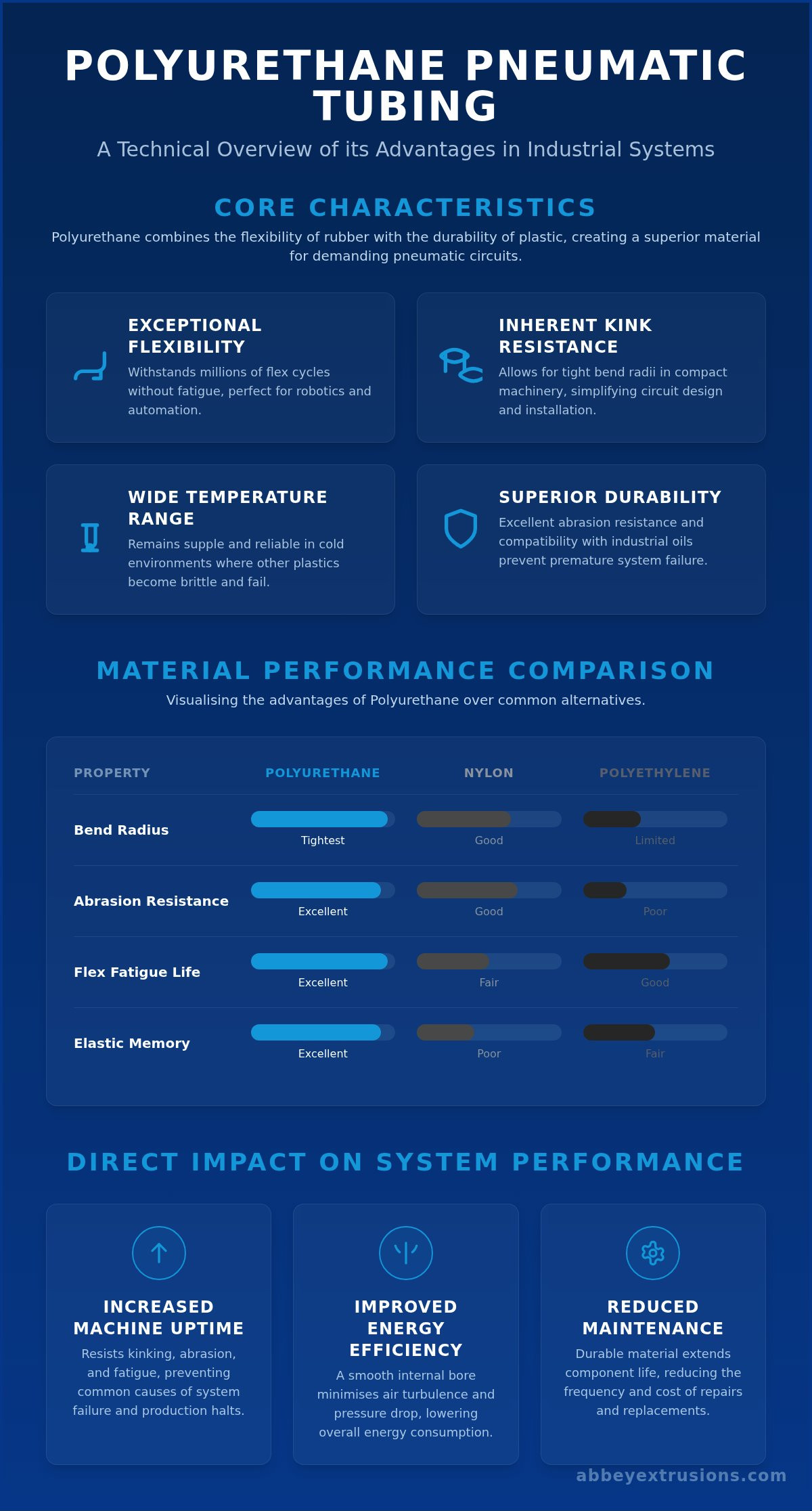
Polyurethane pneumatic tubing represents a critical advancement in material science for fluid power applications. As a versatile thermoplastic elastomer, Polyurethane successfully integrates the high performance flexibility of rubber with the structural durability of traditional plastics. This unique combination allows engineers to design systems that require both resilience and mechanical strength. We often see these tubes utilised in complex pneumatic circuits where space is limited and reliability is paramount.
The performance of these tubes is largely dictated by their Shore hardness, typically measured on the A scale for pneumatic applications. A higher Shore rating indicates a stiffer tube capable of handling greater pressures, whilst a lower rating offers enhanced flexibility for intricate routing. This balance is fundamental when specifying components for automated production lines where every millimetre of space is accounted for. Choosing the correct hardness ensures that the system operates efficiently without the risk of tube wall collapse or premature bursting under load.
Material Composition and Flexibility
The molecular architecture of polyurethane provides exceptional flexural fatigue resistance. Unlike more rigid polymers that might crack under repeated stress, the elastomer structure absorbs energy and maintains its integrity over millions of cycles. This makes it an ideal choice for robotic arms and moving machinery parts that undergo constant motion. The material effectively resists the stresses of continuous bending, ensuring long term reliability in dynamic industrial environments.
Temperature stability is another hallmark of this material. It remains supple in cold environments where other plastics might become brittle and fail. You can review specific technical data and pressure ratings on our polyurethane tube specification page to ensure the material meets your environmental requirements. Our manufacturing process ensures that the material properties remain consistent throughout the entire production run, which is vital for high volume industrial projects and maintaining strict quality standards.
Kink Resistance and Memory Properties
In the demanding environment of a manufacturing plant, a single kinked line can halt an entire assembly process. Polyurethane pneumatic tubing is engineered with inherent kink resistance. This characteristic allows for much tighter bend radii than traditional nylon or polyethylene alternatives. By allowing the tube to curve sharply without collapsing, engineers can simplify circuit designs and reduce the overall footprint of pneumatic manifolds. This is particularly beneficial in compact machine builds where space is at a premium.
Elastic memory is equally important for dynamic applications. This property refers to the ability of the material to return to its original profile after being stretched or bent. In systems where tubing is frequently moved or retracted, this memory prevents permanent deformation. It also reduces the necessity for additional elbow fittings or connectors in tight spaces, as the tube itself can navigate complex paths without losing its structural shape. This leads to fewer potential leak points and a more streamlined installation process for bespoke machinery.
For technical assistance regarding high volume manufacturing or custom material specifications, please contact our specialist team.
Performance Advantages in Industrial Air Systems
The operational environment of a modern factory floor presents a range of mechanical and chemical challenges that can quickly degrade inferior components. High performance polyurethane pneumatic tubing is specifically engineered to withstand these stresses whilst maintaining consistent system pressure. One of the most significant advantages of this material is its smooth internal bore. This precision finish minimises air turbulence and reduces pressure drops across long runs of tubing, which directly contributes to the energy efficiency of the entire pneumatic system. For engineers managing large scale installations, these marginal gains in flow consistency result in more predictable machine behaviour and lower energy costs.
Maintenance and circuit organisation are also greatly improved through the use of colour coded lines. We provide tubing in a wide spectrum of colours, allowing technicians to identify specific air lines within complex pneumatic manifolds instantly. This simplifies fault finding and reduces the risk of incorrect connections during routine servicing or system upgrades. By organising circuits logically, manufacturers can significantly decrease the mean time to repair for critical machinery.
Abrasion and Impact Resistance
In high friction applications where tubing may rub against machine frames or other components, polyurethane offers durability that standard PVC simply cannot match. It possesses a high resistance to tearing and surface wear, making it the preferred choice for automated assembly lines and mining equipment. Impact resistance is equally vital, particularly for tubing located near floor level or in areas with heavy foot traffic. The material can absorb significant mechanical shocks without cracking or losing its seal, which prevents the sudden air leaks that often plague systems using more brittle plastics. This resilience ensures that the tubing remains functional even in the harshest manufacturing environments.
Chemical and Environmental Stability
Industrial air systems often involve exposure to more than just compressed air. Polyurethane pneumatic tubing maintains its structural integrity when in contact with the oils, greases, and non corrosive lubricants typically found in pneumatic machinery. Its resistance to ozone and UV radiation also ensures long term performance in environments with high levels of electrical equipment or natural light exposure. We maintain strict quality control throughout our manufacturing process to ensure every batch meets these rigorous standards. You can learn more about our commitment to precision by reading about the engineering principles of plastic extrusion for industrial applications. If you are designing a system for a specialised environment, we can help you select the most appropriate material grade for your specific chemical exposure requirements.
To discuss your specific requirements for high volume orders or bespoke profiles, please reach out to our technical team through our bespoke enquiry form.
Comparing Polyurethane with Alternative Pneumatic Materials
Selecting the correct polymer is a technical decision that impacts both the immediate installation and the long term maintenance cycle of a factory. Whilst polyurethane pneumatic tubing is often the preferred choice for its balance of properties, it is essential to understand how it performs against alternatives like Nylon and LDPE. Polyurethane offers a unique middle ground; it provides the flexibility required for complex routing whilst maintaining a higher pressure rating than standard polyethylene options. We find that many engineers transition to PU when they require a more robust solution that can withstand mechanical stress without the rigidity of traditional piping.
When comparing PU to Low Density Polyethylene (LDPE), the decision often rests on the expected lifespan of the installation. LDPE is a cost effective solution for simple air lines, yet it lacks the abrasion resistance and elastic memory of polyurethane. In environments where tubing is exposed to external friction or frequent handling, the initial savings of LDPE are often outweighed by the costs of premature failure. We suggest that for any high performance industrial system, the durability of polyurethane pneumatic tubing provides a better return on investment through reduced maintenance and increased machine uptime.
Polyurethane versus Nylon 11 and 12
The primary distinction between these materials lies in their flexural modulus. Nylon is significantly stiffer, which makes it the superior choice for long, straight pneumatic runs where the tubing must maintain its own weight or span distances between supports. However, nylon tube lacks the elasticity required for articulated joints or robotic applications. In these scenarios, polyurethane pneumatic tubing is indispensable because it can endure millions of flex cycles without fatigue. For a deeper technical analysis of these differences, you may refer to our guide to nylon tubing properties for further reading. Whilst nylon handles higher burst pressures, the kink resistance of PU often makes it more practical for compact machine interiors.
Shore Hardness and Pressure Ratings
The Shore hardness of a material defines its resistance to indentation and is a critical metric for pneumatic components. Polyurethane pneumatic tubing is usually produced in the 95A to 98A range, providing a blend of toughness and flexibility. By contrast, semi rigid nylon sits on the Shore D scale. When calculating system requirements, engineers must consider how wall thickness and outside diameter interact. A larger outside diameter with a thin wall will have a significantly lower burst pressure than a thicker walled variant of the same material. It is also important to remember that safety factors should be adjusted based on environmental variables, as the mechanical strength of all thermoplastics is temperature dependent.
To discuss your specific requirements for high volume orders or bespoke profiles, please reach out to our technical team through our bespoke enquiry form.
Bespoke Extrusion and Custom Tube Forming Services
Whilst many suppliers focus on standard reels, we recognise that high volume manufacturing often requires components tailored to specific machine footprints. Standard off the shelf solutions can lead to inefficient routing and increased assembly times. By opting for bespoke polyurethane pneumatic tubing, original equipment manufacturers can specify exact dimensions and material characteristics that align with their engineering goals. Our facility handles non standard material formulations, ensuring that the final product meets the precise chemical or mechanical requirements of the application. This level of customisation allows for a more integrated design approach where the tubing is treated as a precision engineered component rather than a generic commodity.
Custom lengths and specialised packaging also play a vital role in streamlining the assembly process for OEMs. We can provide tubing cut to precise tolerances or wound onto specific reel sizes to suit automated assembly lines. This attention to detail reduces waste and minimises the time spent on manual preparation during the manufacturing cycle. Our decades of experience in the industry allow us to act as a technical partner, providing guidance on material selection and profile design to ensure the most efficient outcome for your project.
Custom Profile Extrusion Capabilities
Designing custom dies is a fundamental part of our manufacturing service. We collaborate with engineers to create profiles that meet unique industrial requirements, whether that involves specific wall thicknesses or non standard diameters. Our capability extends to co extrusion, where multiple materials or colours are combined into a single profile. This is particularly useful for applications requiring integrated mounting strips or reinforced sections. We encourage bespoke enquiries for high volume projects where a tailored profile can solve complex engineering challenges that standard products cannot address.
Advanced Tube Forming and Shaping
Advanced tube forming is an essential service for designers of compact machinery. By heat setting polyurethane pneumatic tubing into specific geometries, we eliminate the need for numerous angled connectors and elbow fittings. This process not only streamlines the physical layout of the machine but also significantly reduces the number of potential leak points within the pneumatic circuit. Pre shaped lines arrive ready for immediate installation, which allows manufacturers to optimise their production flow and maintain higher quality standards. If you are looking to simplify your assembly process, you can request a quote for custom polyurethane profiles today.
To discuss your specific requirements for high volume orders or bespoke profiles, please reach out to our technical team through our bespoke enquiry form.
Procuring High Volume Polyurethane Tubing in the UK
Sourcing polyurethane pneumatic tubing directly from a UK manufacturer provides significant advantages for supply chain security and technical precision. When you bypass third party retailers, you gain direct access to the engineering expertise responsible for the extrusion process. This relationship ensures that large scale industrial orders are handled with a level of care and technical oversight that standard retail channels cannot provide. Our technical team supports engineers throughout the product selection phase, offering guidance on material suitability and performance parameters to ensure the chosen tubing meets the specific demands of the intended system. We believe that a manufacturer should be a technical partner rather than just a supplier, providing the stability and reliability required for long term industrial partnerships.
The ability to communicate directly with the production team allows for a more responsive service when engineering challenges arise. Whether you are developing a new piece of machinery or upgrading an existing assembly line, having a manufacturer based in the United Kingdom simplifies the logistics of your project. It eliminates the complexities of international trade and ensures that you have a consistent point of contact for all technical enquiries. This direct line of communication is essential for maintaining the high standards of quality and performance that modern manufacturing environments demand.
UK Manufacturing Excellence
Since 1985, we have maintained a focus on technical precision at our Leicestershire facility. Sourcing locally within the United Kingdom offers more than just reduced lead times; it also provides significant environmental benefits by minimising the carbon footprint associated with international logistics. We adhere to rigorous British manufacturing standards, ensuring that every batch of polyurethane pneumatic tubing undergoes strict quality control. This commitment to domestic production allows us to provide a reliable supply chain for OEMs who cannot afford the risks associated with overseas shipping delays or inconsistent material quality. Our facility is equipped with advanced extrusion lines that allow for high volume output without compromising the exacting tolerances required for pneumatic fittings.
Large Volume Orders and Bespoke Enquiries
Providing accurate quotes for high volume industrial orders requires detailed technical information. When submitting an enquiry, we recommend including specifications such as operating pressures, temperature ranges, and any chemical exposure requirements. This allows us to tailor our manufacturing schedules and material formulations to your exact needs. Our professional B2B relationships are built on a foundation of flexibility and technical competence. We understand the urgent nature of industrial projects and can often adjust our production cycles to accommodate critical deadlines. By working directly with the manufacturer, you ensure that your bespoke requirements are translated perfectly from the design phase to the final extruded product. We pride ourselves on our ability to handle complex enquiries that standard distributors often reject, focusing on bespoke solutions that drive industrial efficiency.
To discuss your specific requirements for high volume orders or bespoke profiles, please reach out to our technical team through our bespoke enquiry form.
Advancing Pneumatic Performance through Specialist Material Selection
Selecting the right polyurethane pneumatic tubing is a fundamental step in ensuring the long term efficiency of any industrial air system. We've explored how the unique elastomeric properties of this material provide the essential kink resistance and durability required for complex machine builds and high friction environments. By integrating custom tube forming and bespoke extrusion profiles, manufacturers can significantly reduce potential leak points and streamline their assembly processes.
Since 1985, we've focused on delivering technical excellence from our UK based manufacturing facility. We specialise in bespoke industrial extrusions and maintain a high volume capacity to meet the rigorous demands of OEM requirements. Our team is ready to act as your technical partner, providing the precision and reliability that your projects deserve. We look forward to supporting your next engineering challenge. Contact our technical sales team for bespoke polyurethane tubing enquiries and discover the benefits of partnering with a specialist British manufacturer.
Frequently Asked Questions
What is the difference between ether based and ester based polyurethane tubing?
Ether based polyurethane tubing offers superior resistance to moisture and fungus, which makes it the preferred choice for humid environments or applications involving water contact. Conversely, ester based variants provide higher tensile strength and better resistance to oils and fuels, though they can degrade if exposed to high humidity for long periods. We help clients select the specific grade that ensures the longest service life for their industrial systems.
Can polyurethane pneumatic tubing be used with push in fittings?
Yes, polyurethane pneumatic tubing is perfectly suited for use with standard push in fittings due to its excellent flexibility and outer diameter tolerances. The material's elastic nature allows for a secure, leak proof seal when inserted into the fitting's internal gripping mechanism. This compatibility simplifies installation processes and reduces maintenance time in complex pneumatic circuits across various manufacturing sectors.
What is the maximum working pressure for standard polyurethane tubing?
The maximum working pressure for standard polyurethane tubing typically ranges between 8 and 10 bar at ambient temperatures of 23 degrees Celsius. It's vital to remember that pressure ratings decrease as operating temperatures rise, so engineers must account for this thermal factor during the design phase. For high pressure requirements, we can manufacture bespoke tubing with increased wall thicknesses to meet specific safety margins.
Is polyurethane tubing suitable for use in outdoor environments?
Standard polyurethane tubing isn't naturally resistant to prolonged ultraviolet radiation and can become brittle when used outdoors without protection. If your application requires outdoor exposure, we recommend specifying UV stabilised grades or darker colours like black to mitigate degradation from sunlight. Our technical team provides guidance on material additives that enhance environmental resistance for specific outdoor industrial installations.
How does the bend radius of polyurethane compare to nylon tubing?
Polyurethane tubing has a significantly smaller bend radius compared to nylon tubing, which allows for much tighter routing in confined spaces without the risk of kinking. Whilst nylon is stiffer and better for higher pressures, the superior flexibility of polyurethane makes it the ideal solution for robotic arms and moving machinery parts. This flexibility helps prevent flow restrictions that often occur with more rigid materials in compact pneumatic assemblies.
Can you provide polyurethane tubing in custom colours for brand matching?
We provide a comprehensive colour matching service for polyurethane tubing to ensure consistency with your corporate branding or specific safety coding requirements. Our extrusion process allows us to produce bespoke batches in virtually any shade, provided the order meets our minimum volume thresholds for custom runs. This service is particularly beneficial for original equipment manufacturers who wish to maintain a professional and unified appearance across their product lines.
What sizes of polyurethane pneumatic tubing are available for high volume orders?
We manufacture polyurethane pneumatic tubing in a wide range of standard metric sizes from 3mm to 16mm outer diameter, alongside common imperial dimensions for high volume requirements. For large scale industrial projects, we also offer bespoke sizing and wall thicknesses tailored to unique pneumatic specifications. Our UK based facility is equipped to handle significant production runs, ensuring consistent quality and reliable lead times for our B2B partners.
Does polyurethane tubing require special storage conditions to maintain its properties?
Polyurethane tubing requires storage in a cool, dry environment away from direct sunlight to prevent premature aging or UV degradation. It's also important to keep the tubing in its original packaging to protect it from dust and chemical contaminants that might affect its performance during installation. Maintaining these controlled conditions ensures that the material retains its mechanical properties and flexibility until it's ready for use in your industrial system.

Article by
Bryan Cowan
Bryan Cowan is the Founder and Managing Director of Abbey Extrusions Ltd, a leading UK manufacturer of high-quality plastic tubes and hoses. With over 40 years of industry experience, Bryan established the company in 1985, growing it from a startup into a BS ISO9001-registered supplier for global sectors including aerospace, automotive, and pharmaceuticals.
Disclaimer
This article is intended for informational purposes only. Please ensure you seek expert advice or carry out your own research to confirm the information is suitable for your specific needs.