The polymer you choose for a tube extrusion run will either protect your application for years or fail it within months. That is not an overstatement; it is the engineering reality that procurement engineers and production managers face every time a new specification lands on their desk.
If you've ever dealt with premature material failure, out-of-tolerance tubing across a high volume batch, or the frustration of searching for a manufacturer willing to take on a genuinely bespoke profile, you'll know precisely how costly those problems become when they compound at scale.
Getting tube extrusion right demands more than a capable machine. It requires a precise understanding of polymer behaviour under pressure, temperature, and chemical exposure, combined with the tooling expertise to hold tight dimensional tolerances across thousands of metres of production. These are not separate considerations; they are inseparable disciplines.
This guide covers the core engineering principles behind industrial tube extrusion, from the mechanics of the process itself through to polymer selection, tolerance control, and the options available for bespoke profile manufacture. Whether you're specifying a standard material or developing a custom solution for a demanding application, what follows will give you the technical grounding to make confident, informed decisions.
Key Takeaways
- The fundamentals of tube extrusion rely on precise screw geometry and controlled melt temperatures, and understanding these mechanics helps you specify tolerances with confidence rather than guesswork.
- Polymer selection is rarely straightforward, and matching thermoplastic properties to your specific chemical environment, pressure conditions, and temperature range is the single most important decision in any tubing specification.
- Bespoke profile extrusion, including multi-lumen and fluted designs, is achievable at high volumes when the tooling is engineered correctly from the outset, making customisation a practical option rather than a last resort.
- Secondary tube forming services extend the value of extruded tubing by heat-setting permanent shapes post-extrusion, which can eliminate costly downstream assembly steps in complex applications.
- Sourcing from a specialist UK manufacturer with established capability in flexible hosing and custom profiles simplifies both logistics and technical communication, particularly for large-volume or bespoke orders.
If you're specifying tubing for an industrial application, understanding what actually happens inside an extrusion line will sharpen every decision you make downstream, from material selection through to dimensional tolerancing.
Understanding the process of tube extrusion for industrial applications
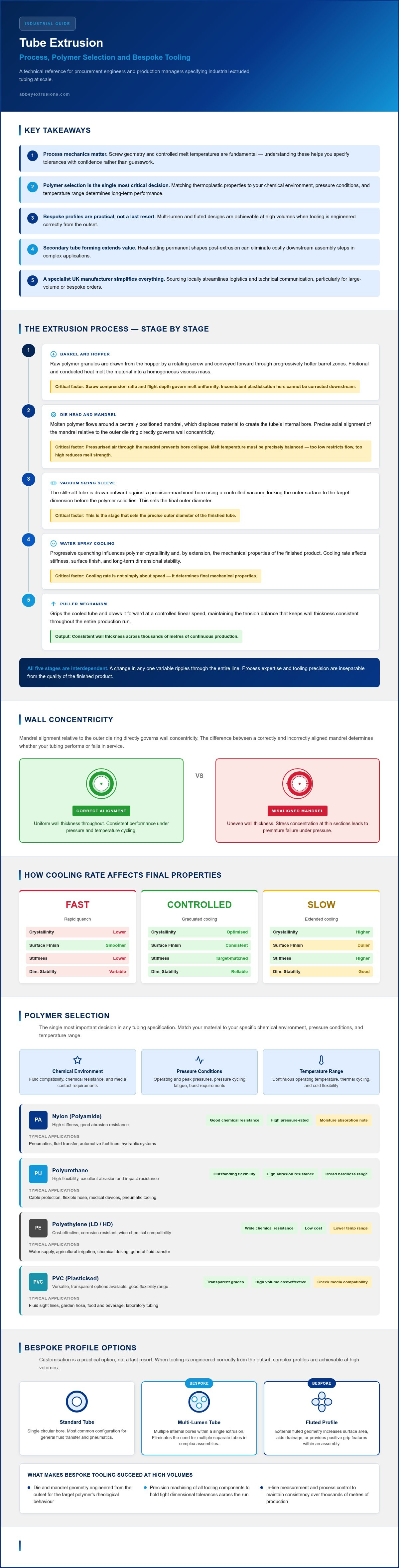
Tube extrusion is a continuous manufacturing process in which raw polymer granules are converted into a hollow cylindrical profile of consistent cross-section. Unlike batch-forming methods, the process runs without interruption, producing tubing in lengths determined by downstream handling and cutting requirements rather than by the forming operation itself. That continuity is precisely what makes it suited to high-volume industrial supply.
The process begins at the extruder barrel, where a rotating screw draws granules from a hopper and conveys them forward through progressively hotter zones. As the polymer travels along the screw's helical flight, frictional heat and conducted barrel heat combine to melt the material into a homogeneous viscous mass. Screw geometry, specifically the compression ratio and flight depth, determines how effectively the polymer is plasticised and how uniform the melt becomes before it reaches the die. Inconsistent plasticisation at this stage will produce wall thickness variation that no downstream process can correct.
The mechanics of forming internal cavities
At the die head, the molten polymer flows around a centrally positioned mandrel, which displaces material to create the tube's internal bore. The mandrel is held in place by a spider or crosshead arrangement, and its precise axial alignment relative to the outer die ring directly governs wall concentricity. A pressurised air supply is introduced through the mandrel's centre bore to maintain a positive internal pressure within the emerging tube. Without this, atmospheric pressure and the polymer's own surface tension would cause the soft melt to collapse before it reaches the cooling stage. Melt temperature and throughput rate must be balanced carefully; too low a melt temperature increases viscosity and restricts flow, whilst too high a temperature reduces melt strength and makes wall thickness control unreliable.
Cooling and sizing for dimensional stability
Once the tube exits the die, it enters a vacuum sizing sleeve, which is the component that sets the final outer diameter. The sleeve draws the still-soft tube outward against a precision-machined bore using a controlled vacuum, locking the outer surface to the target dimension before the polymer solidifies. Downstream water spray cooling then quenches the tube progressively, a process that influences polymer crystallinity and, by extension, the mechanical properties of the finished product. Cooling rate is not simply a speed consideration; it affects stiffness, surface finish, and long-term dimensional stability in ways that matter considerably for demanding fluid transfer applications.
The puller mechanism, positioned at the downstream end of the line, grips the cooled tube and draws it forward at a controlled linear speed, maintaining the tension balance that keeps wall thickness consistent throughout the run.
For manufacturers supplying large-volume orders of nylon tube or polyurethane tube, each of these stages must be calibrated in concert. A change in one variable ripples through the entire line, which is why process expertise and tooling precision are inseparable from the quality of the finished product.
If you have a bespoke tubing requirement or need to discuss a high-volume production run, get in touch with the Abbey Extrusions technical team to discuss your specification in detail.
If you need a specialist tube extrusion manufacturer to discuss your polymer requirements, speaking with an experienced technical team early in your specification process will save considerable time and cost downstream.
Selecting the correct polymer for your extruded tubing requirements
Polymer selection is where most specification errors originate. The temptation is to default to a familiar material or to accept whatever a supplier holds in stock, but that approach routinely produces tubing that underperforms in service. The correct choice depends on a precise understanding of the chemical environment, the operating temperature range, the mechanical loads the tube will carry, and any regulatory requirements that govern the application.
Common thermoplastics used in industrial tube extrusion each occupy a distinct performance envelope. Nylon grades offer high burst pressure ratings and excellent fuel resistance. Polyurethane delivers outstanding flexibility and abrasion resistance. Low-density polyethylene suits low-pressure, chemically benign environments. None of these materials is universally superior; each is the right answer for a specific set of conditions.
Chemical compatibility deserves particular attention in fluid transfer applications. A polymer that performs reliably with water or compressed air may degrade rapidly when exposed to hydrocarbons, solvents, or aggressive cleaning agents. Material data sheets provide a starting point, but real-world conditions, including temperature cycling, intermittent exposure, and pressure surges, can accelerate chemical attack in ways that standard compatibility tables don't fully capture.
UV stabilisers and flame retardant additives also influence long-term material behaviour. Tubing deployed in outdoor environments without UV stabilisation will embrittle over time, regardless of its initial mechanical properties. Similarly, flame retardant compounds affect melt flow characteristics during extrusion, which means the processing parameters must be adjusted accordingly to maintain dimensional consistency across a production run.
Nylon 11 and Nylon 12 for high performance environments
Nylon 11 and Nylon 12 are closely related but distinct materials, and the difference matters in demanding applications. Nylon 12 absorbs less moisture than Nylon 11, which translates directly into better dimensional stability in humid or wet environments. Where tight bore tolerances must be maintained across varying ambient conditions, Nylon 12 is typically the more reliable choice. Nylon 11, derived from a bio-based monomer, offers slightly greater flexibility and impact resistance at low temperatures, making it well suited to outdoor pneumatic installations subject to cold weather cycling.
Both grades are widely specified for pneumatic systems and fuel lines because of their high burst pressure ratings relative to wall thickness, their resistance to hydrocarbons, and their ability to hold consistent dimensions under sustained pressure. For procurement engineers sourcing nylon tube at high volumes, understanding which grade suits the specific operating conditions avoids costly material substitutions mid-contract.
Polyurethane and polyethylene options
Polyurethane tube occupies a different performance space entirely. Its defining characteristics are exceptional flexibility across a wide temperature range and a surface hardness that resists abrasion in applications where the tube is in repeated contact with moving components. Robotic cable management systems are a prime example; the tube must flex through thousands of cycles without fatiguing or cracking, and polyurethane's elastomeric nature makes it the material of choice where nylon would eventually work-harden and split. Polyurethane tube is also available in a range of Shore hardness values, giving engineers precise control over stiffness without changing the base polymer.
Low-density polythene tube serves a different function. It's the preferred option for low-pressure chemical transfer and laboratory applications where broad chemical inertness matters more than mechanical strength. LDPE is compatible with a wide range of aqueous solutions and mild chemicals, it's lightweight, and it's straightforward to cut and connect without specialist tooling. Its limitations, primarily low burst pressure and a relatively modest upper temperature threshold, are well understood, and for applications that fall within those limits it represents a practical and cost-effective choice.
If you're weighing up polymer options for a specific application and want technical input before committing to a specification, contact the Abbey Extrusions team to discuss your requirements in detail.
If you'd like to discuss a bespoke tube profile or a large-volume production requirement, speak with the Abbey Extrusions technical team before committing to a specification.
Customisation and bespoke tooling for complex tube profiles
Standard round tubing covers a wide range of industrial needs, but there are applications where a circular cross-section simply isn't the right answer. When the geometry of an assembly demands a specific internal channel arrangement, a non-circular outer profile, or a combination of materials within a single extruded section, bespoke tooling becomes the only viable route. That transition from standard to custom is not a minor step; it requires a fundamentally different approach to die design, process calibration, and quality assurance.
Multi-lumen tubes, which carry two or more separate fluid or air channels within a single extruded body, are a practical example of where standard tooling reaches its limits. Each internal cavity requires its own mandrel arrangement within the die head, and the geometry of those mandrels must be engineered to distribute melt flow evenly across all channels simultaneously. Uneven flow distribution produces wall thickness variation between lumens, which compromises both the structural integrity of the tube and its performance under pressure. Getting this right demands detailed computational flow analysis at the tooling design stage, not trial and error on the production line.
Fluted profiles present a different set of challenges. The outer surface geometry creates localised variations in wall section, and the die must be designed to compensate for the differential cooling rates that result from those varying thicknesses. Without that compensation, the finished profile will exhibit distortion or warping as it cools, making consistent dimensional control across a long production run genuinely difficult to achieve.
Specialist profiles and co-extrusion
Some of the most demanding bespoke tube extrusion work sits outside conventional industrial fluid transfer entirely. Fluted water hose combines a functional internal bore with an outer surface geometry that provides both flexibility and structural rigidity, a balance that requires careful die design and precise melt temperature control. In the transport industry, components such as Kedar Cord and curtainsider pelmet sections are extruded profiles that must meet tight dimensional tolerances whilst maintaining consistent mechanical properties across very high production volumes. These are not incidental product lines; they represent a distinct area of extrusion capability that draws on the same tooling precision and process control required for complex industrial tubing.
Co-extrusion extends the possibilities further by combining two polymers within a single die, producing a tube with, for example, a chemically resistant inner layer and a more flexible or abrasion-resistant outer layer. Each material flows through a separate feed channel within the die and joins at a precisely controlled interface point. Maintaining a clean, consistent bond line between the two materials across the full length of a production run requires both compatible melt temperatures and carefully matched viscosities.
Managing tolerances and quality control
Tolerance requirements differ substantially between industrial and commercial applications. Industrial fluid transfer tubing may carry a bore tolerance of plus or minus 0.1 mm or tighter, where dimensional drift directly affects flow rate, connection integrity, or pressure rating. Commercial applications often permit broader tolerances, but bespoke profiles typically demand the tighter end of the range regardless of end use, because the profile geometry itself is the functional requirement.
In-line measurement systems, including laser gauging and ultrasonic wall thickness monitors, provide continuous real-time data throughout a production run, allowing operators to detect and correct dimensional drift before it accumulates into out-of-tolerance product. This is particularly important for large-volume orders where a systematic error left unchecked across several thousand metres represents significant material waste and potential rework costs.
Die swell is a factor that every bespoke tooling project must account for; when the molten polymer exits the die, it expands slightly as the shear stress imposed by the die walls is released, meaning the finished profile dimensions will always differ from the die aperture dimensions by a material-specific and processing-condition-specific amount that must be calculated and built into the tooling design from the outset.
If you'd like to discuss secondary forming options alongside your tube extrusion specification, contact the Abbey Extrusions technical team to talk through your production requirements.
The technical advantages of secondary tube forming services
Tube forming is a post-extrusion process in which extruded tubing is reshaped into a permanent configuration using controlled heat and tooling. The distinction matters because the tube is not simply bent at the point of installation; it is heat-set into a fixed geometry that it retains under operating conditions without springing back. For procurement engineers designing assemblies with fixed routing paths, complex bend sequences, or specific end configurations, this capability removes a significant burden from the assembly stage.
The underlying mechanism relies on the thermoplastic nature of the polymers used in tube extrusion. When the extruded tube is reheated to a temperature within its forming range, the polymer chains regain sufficient mobility to conform to the shape of a mandrel or forming tool. Controlled cooling then locks the molecular structure into the new geometry permanently. The key engineering requirement is that the forming temperature must be high enough to relax residual stresses from the extrusion process without degrading the material or distorting the wall thickness.
Formed tubes reduce assembly time considerably. Where a straight tube would require additional fittings, clamps, or brackets to follow a routed path through a machine frame, a pre-formed tube arrives ready to locate and connect. That reduction in component count also reduces potential leak points, which is a meaningful benefit in fluid transfer applications where connection integrity is critical.
Maintaining flow integrity through bends requires careful attention to the bend radius relative to the tube's outer diameter. An insufficient bend radius will cause the bore to ovalize under the forming load, restricting flow and creating localised stress concentrations that reduce the tube's pressure rating. Properly engineered forming tooling prevents this by supporting the tube wall throughout the bend arc, preserving the circular cross-section of the bore and ensuring that the finished component performs to the same specification as its straight counterpart.
Coiling and spiralling for pneumatic applications
Coiled tubing is one of the most practical expressions of secondary forming. Nylon recoil air hose is produced by winding extruded nylon tube around a mandrel at elevated temperature and then cooling it in the coiled position. The result is a hose that extends under pressure and retracts automatically when pressure is released, keeping workspaces clear and reducing trip hazards in production environments. The spring-back force is determined by the forming temperature, the coil pitch, and the nylon grade selected, giving engineers precise control over the hose's behaviour in service.
For applications involving multiple hoses or cables routed together, nylon spiral cut hose guard provides a protective sleeve that wraps around a bundle and holds it in an organised configuration. The spiral geometry allows the guard to be applied and removed without disconnecting the lines it protects, which is a practical advantage in maintenance-intensive environments.
Bespoke bending and end manipulation
Custom bending produces tubes shaped to follow a specific routed path within a machine or vehicle assembly. Each bend angle, radius, and plane orientation is defined by the application geometry, and the forming tooling is built to reproduce that geometry consistently across every unit in a production batch. End manipulation techniques, including flaring and cuffing, reshape the tube's terminal sections to create secure mechanical connections without additional fittings. A flared end seats positively against a mating component, whilst a cuffed end provides a reinforced collar that resists pull-out under sustained load.
Full details of the available secondary processing options are set out on the tube forming service page, where specific forming capabilities can be reviewed against your application requirements.
If you'd like to discuss your tube extrusion requirements with a specialist team before committing to a specification, contact Abbey Extrusions to talk through your project in detail.
Sourcing high volume tube extrusion from a specialist UK manufacturer
Working with a UK-based manufacturer carries practical advantages that extend well beyond shorter delivery distances. Lead time predictability, direct technical communication without time zone complications, and the ability to visit a production facility for quality audits are all factors that matter considerably when you're placing large-volume or bespoke orders. For procurement engineers managing supply chains with tight scheduling requirements, those logistical certainties have genuine commercial value.
Preparing a well-structured technical enquiry is the single most effective way to accelerate the early stages of a project. A complete enquiry should include the following information as a minimum:
- Bore and outer diameter dimensions with stated tolerances
- Wall thickness requirements and any concentricity specifications
- Polymer preference or the operating conditions that will determine material selection
- Chemical exposure, temperature range, and pressure rating for the application
- Annual volume estimate and preferred batch sizes
- Any relevant regulatory or compliance requirements
Providing this detail at the outset allows a specialist manufacturer to assess tooling requirements, confirm material availability, and give an accurate lead time estimate rather than a provisional one that shifts once engineering review begins. Bespoke tooling development typically requires additional lead time ahead of the first production run, and that timeline should be factored into project planning from the start rather than treated as a surprise.
Partnering for large scale industrial projects
Technical support during the design phase is where a specialist manufacturer adds disproportionate value. Material selection advice, die design input, and tolerance feasibility assessment are all disciplines that benefit from direct collaboration between the customer's engineering team and the manufacturer's technical staff. Long-term supply agreements further strengthen that relationship by establishing consistent process parameters, approved material batches, and agreed quality benchmarks that remain stable across successive production runs. When evaluating a manufacturer's capacity for high-volume tube extrusion, it's worth assessing not just their machine count but their process control infrastructure and their track record with comparable specifications. Abbey Extrusions has operated as a specialist UK manufacturer since 1985, with established capability across nylon, polyurethane, and LDPE tubing for demanding industrial applications.
Ensuring compliance and material traceability
Safety-critical applications require material certification that traces each production batch back to its raw polymer source. Compliance with relevant British and international standards for industrial hosing and fluid transfer tubing is not optional in regulated sectors; it's a contractual requirement that must be confirmed before production commences, not after delivery. A reputable specialist manufacturer will hold batch records, material data sheets, and test certificates as standard practice rather than as an exception to their process.
Sourcing from a dedicated UK specialist means that bespoke capability, technical depth, and supply chain reliability are available within a single, accountable relationship. For large-volume orders or complex profile requirements, that consolidation simplifies both procurement and ongoing quality management in ways that a general-purpose supplier simply cannot replicate.
To discuss your specific requirements with the Abbey Extrusions technical team, submit your enquiry through the contact page and a specialist will respond with a considered technical assessment.
Put These Engineering Principles to Work in Your Next Project
Effective tube extrusion is the product of decisions made well before a production run begins. Polymer selection, tooling design, dimensional tolerancing, and secondary forming all interact, and a weakness in any one area will compromise the finished product regardless of how well the others are executed.
The engineering principles covered in this guide give you a practical framework for specifying tubing with confidence, whether you're working with standard nylon grades or developing a genuinely bespoke multi-lumen profile. Getting those fundamentals right from the outset protects both the application and the procurement budget.
Abbey Extrusions has operated as a specialist UK manufacturer since 1985, with deep expertise in Nylon 11 and 12, polyurethane, and LDPE tubing, alongside in-house bespoke tooling and tube forming capabilities. That breadth of technical resource sits within a single, accountable supply relationship.
For bespoke manufacturing enquiries or to discuss large volume orders, contact our technical team and a specialist will respond with a considered assessment of your requirements.
Frequently Asked Questions
What is the difference between tube extrusion and profile extrusion?
Tube extrusion produces a hollow cylindrical section with a defined bore and outer diameter, using a mandrel and pressurised air to maintain the internal cavity as the polymer exits the die. Profile extrusion produces solid or semi-solid cross-sections of almost any geometry, from simple rods through to complex structural shapes, without the requirement for an internal air supply. The tooling principles share common ground, but the die design and process control demands differ considerably between the two.
Which materials are best for high pressure tube extrusion applications?
Nylon 11 and Nylon 12 are the most widely specified polymers for high pressure tube extrusion, offering excellent burst pressure ratings relative to wall thickness alongside strong resistance to hydrocarbons and fuels. Fluoropolymer grades including PTFE, FEP, and PFA are specified where chemical aggression is extreme and temperature resistance is also required. The correct choice depends on the specific pressure rating, the fluid being conveyed, and the operating temperature range of the application.
Can you extrude bespoke shapes and multi-lumen tubes?
Yes. Bespoke profile extrusion, including multi-lumen tubes with two or more separate internal channels, is achievable through purpose-engineered tooling designed to distribute melt flow evenly across all cavities simultaneously. Each bespoke project requires dedicated die design and process calibration before production commences. Abbey Extrusions has in-house technical manufacturing capability for custom profiles, and early engagement with the technical team ensures that tooling is designed correctly from the outset rather than adjusted reactively during production.
What are the typical tolerances for extruded plastic tubing?
Tolerances vary by polymer, wall thickness, and application requirement. Industrial fluid transfer tubing is commonly specified to bore and outer diameter tolerances of plus or minus 0.1 mm or tighter, where dimensional accuracy directly affects connection integrity and pressure performance. Commercial applications often permit broader tolerances, though bespoke profiles typically demand the tighter end of the range regardless of end use. Confirming your tolerance requirements at the enquiry stage allows the manufacturing team to assess tooling feasibility accurately.
How does secondary tube forming benefit industrial assembly?
Secondary tube forming heat-sets extruded tubing into a permanent geometry, meaning the tube arrives ready to locate and connect within an assembly rather than requiring additional fittings or brackets to follow a routed path. This reduces component count, shortens assembly time, and eliminates potential leak points at intermediate connections. For applications with complex bend sequences or fixed routing constraints, pre-formed tubing delivers measurable efficiency gains across high volume production batches.
What information is required for a bespoke extrusion quote?
A complete enquiry should include bore and outer diameter dimensions with stated tolerances, wall thickness requirements, your preferred polymer or the operating conditions that will determine material selection, chemical exposure details, temperature range, and pressure rating. An annual volume estimate and preferred batch sizes are also needed to assess production scheduling accurately. Providing this detail at the outset avoids provisional quotations that shift once engineering review begins, particularly where bespoke tooling development is involved.
Are your extruded hoses suitable for food grade or brewery applications?
Abbey Extrusions produces food grade hoses and brewery hose within its confirmed product range. Suitability for a specific food contact or brewing application depends on the polymer grade, any additives used in the compound, and the relevant regulatory requirements governing your sector. If you're specifying tubing for food grade or brewery use, raising compliance requirements at the enquiry stage ensures that material certification and batch traceability are confirmed before production commences rather than queried after delivery.
Do you offer anti-static properties for extruded tubing?
Anti-static tubing is available within Abbey Extrusions' product range, and it's a relevant specification for applications where static charge accumulation presents a safety or process risk, such as pneumatic conveying of flammable powders or fuel transfer environments. The anti-static compound is incorporated into the polymer during extrusion rather than applied as a surface treatment, which means the property is consistent throughout the tube wall rather than subject to wear or degradation in service. Confirm your specific anti-static performance requirement when submitting your enquiry.

Article by
Bryan Cowan
Bryan Cowan is the Founder and Managing Director of Abbey Extrusions Ltd, a leading UK manufacturer of high-quality plastic tubes and hoses. With over 40 years of industry experience, Bryan established the company in 1985, growing it from a startup into a BS ISO9001-registered supplier for global sectors including aerospace, automotive, and pharmaceuticals.
Disclaimer
This article is intended for informational purposes only. Please ensure you seek expert advice or carry out your own research to confirm the information is suitable for your specific needs.