Whilst steel remains the traditional choice for vehicle chassis construction, high performance polymers have become the silent workhorses of modern automotive efficiency. You likely recognise the constant pressure to reduce vehicle weight without compromising on chemical resistance or safety. Sourcing bespoke components for cramped engine bays often leads to frustration, especially when overseas lead times delay production schedules and traditional metal piping succumbs to corrosion. This article explores how specialist polymer extrusions and custom tube forming provide the essential tubing solutions for automotive industry applications that modern engineering demands.
We understand that selecting the correct material is a technical necessity rather than a simple procurement choice. You'll discover how to identify the optimal Nylon 11, Nylon 12, or polyurethane grades for specific vehicle systems, ensuring your components withstand harsh under-bonnet environments. We will also examine how UK based manufacturing and precision tube forming solve the logistical and spatial challenges inherent in contemporary vehicle design. This guide provides the technical insight needed to achieve weight reduction whilst maintaining the uncompromising durability and chemical resistance required by the latest international quality standards.
Key Takeaways
- Learn why Nylon 11 and Nylon 12 are the preferred materials for flexible vehicle systems because of their exceptional chemical resistance and low moisture absorption.
- Understand how to implement advanced tubing solutions for automotive industry projects to achieve significant weight reduction without sacrificing component safety.
- Discover how custom tube forming allows for the creation of complex shapes that optimise space within crowded engine compartments and chassis layouts.
- Identify the technical specifications required for high quality diesel fuel hoses and bespoke profiles used in commercial and passenger vehicles.
- Recognise the strategic advantages of sourcing bespoke polymer extrusions from a UK based manufacturer to improve supply chain security and technical collaboration.
Contact our technical team to discuss your bespoke automotive tubing requirements
The Role of Polymer Tubing in Modern Automotive Engineering
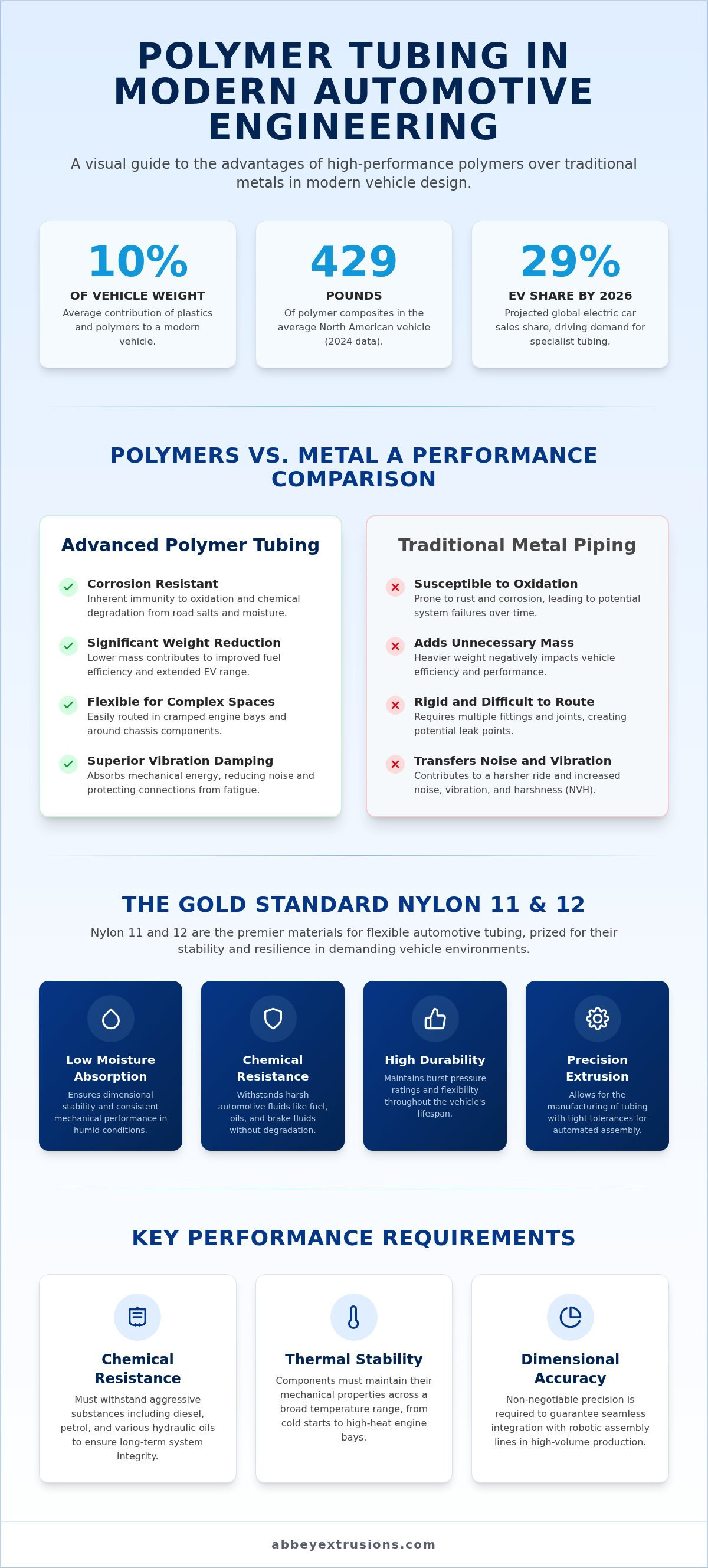
Polymer automotive tubing refers to high performance plastic extrusions engineered specifically for the transfer of fluids and gases within a vehicle. These components serve as the critical circulatory system for modern transport, handling everything from fuel and air to brake fluids and coolants. As automotive manufacturers face intensifying pressure to meet stringent emission standards, the industry has undergone a fundamental shift in material selection. Weight matters. Every gram saved contributes to better fuel efficiency in internal combustion engines and extends the range for the growing electric vehicle (EV) market. According to industry data from 2024, the average North American vehicle already contains approximately 429 pounds of plastics and polymer composites. This represents nearly 10% of the total vehicle weight, a figure that continues to rise as engineers seek effective tubing solutions for automotive industry applications.
Modern vehicle architectures require materials that offer more than just a reduction in mass. UK manufacturers increasingly rely on specialist polymers like Nylon and Polyurethane to replace traditional metal systems. These materials provide a level of versatility that rigid piping cannot match, especially in the cramped configurations of contemporary engine bays and battery packs. With global electric car sales shares projected to reach 29% by 2026, the demand for non-conductive, lightweight, and chemically resistant tubing has never been higher.
Why Polymers Are Outperforming Metal in Vehicle Systems
Traditional steel piping remains highly susceptible to oxidation and chemical degradation. In contrast, polymer extrusions offer inherent corrosion resistance, ensuring that fluid lines remain clear and functional throughout the entire lifespan of the vehicle. This durability is particularly vital for under-chassis components exposed to road salts and moisture. Beyond chemical stability, flexible tubing provides superior vibration damping. Metal pipes often suffer from fatigue or noise transfer, whereas a high quality nylon tube absorbs mechanical energy, protecting connections and improving the overall refinement of the vehicle. Switching to polymer solutions allows engineers to achieve significant weight savings whilst maintaining the structural integrity required for high pressure systems.
Key Performance Requirements for Automotive Extrusions
Automotive environments are notoriously harsh. Components must demonstrate exceptional chemical resistance against aggressive substances including diesel, petrol, and various hydraulic oils. Whilst many systems historically relied on Synthetic Rubber in Automotive Applications for flexibility, modern thermoplastics offer better long term stability and lower permeability. Thermal stability is equally critical. Tubing located near engine blocks or high voltage battery modules must maintain its mechanical properties across a broad temperature range. Finally, dimensional accuracy is non-negotiable. In high volume production environments, even a fractional deviation in diameter can disrupt automated assembly lines. We ensure that every extrusion meets precise tolerances to guarantee seamless integration into the final vehicle build.
Speak with our experts about high-volume Nylon tubing orders
Engineering Properties of Nylon 11 and Nylon 12 for Vehicles
Nylon 11 and Nylon 12 represent the gold standard for high performance flexible tubing within the automotive sector. Their primary advantage lies in exceptionally low moisture absorption, which ensures dimensional stability and consistent mechanical performance even in humid or wet conditions. For engineers developing tubing solutions for automotive industry applications, this predictability is essential. Whilst other polymers may swell or degrade when exposed to environmental moisture, these specific polyamides maintain their burst pressure ratings and flexibility. This stability allows for tighter tolerances during the design phase, ensuring that fluid systems perform exactly as intended throughout the life of the vehicle.
When compared to alternative materials, Nylon 12 demonstrates superior impact resistance, particularly at low temperatures. In climates where vehicles face sub-zero conditions, many standard plastics become brittle and prone to cracking under mechanical stress. Nylon 12 remains resilient, absorbing energy without failure. Detailed material science insights regarding these characteristics are available in our technical resources for nylon tube production. These polymers are capable of handling high pressure environments whilst remaining flexible enough to be routed through the complex, non-linear paths required by modern vehicle architectures. This balance of strength and pliability reduces the need for multiple connectors, which in turn minimises the risk of potential leak points.
Nylon 12 for Fuel and Air Brake Systems
The chemical inertness of Nylon 12 makes it an ideal candidate for fuel lines. Modern petrol and diesel blends often contain bio-components and additives that can be aggressive toward lesser materials. Nylon 12 provides a robust barrier that prevents permeation and resists internal degradation. This reliability extends to air brake systems, where any failure in pressure retention constitutes a significant safety risk. The material's ability to withstand constant pressure cycling without fatigue makes it the primary choice for heavy-duty vehicle braking circuits. Beyond the vehicle itself, these properties are utilised in maintenance environments through nylon recoil air hoses, which provide durable air delivery in commercial vehicle workshops.
Durability and Environmental Resistance
Environmental factors pose a constant threat to under-chassis components. Road salts, UV radiation, and external contaminants can cause stress cracking in lower grade plastics. Nylon 11 and 12 offer exceptional resistance to these external stressors, ensuring a long service life for both passenger and commercial vehicles. Nylon 11 is particularly valued for its longevity in demanding underbody applications where it must resist abrasion from road debris whilst maintaining its chemical barrier properties. This sustained performance reduces the need for premature replacements and enhances the overall reliability of the vehicle's fluid transfer systems. If you require specific technical data for your project, please consult with our engineering team to discuss your requirements.
Enquire about our custom tube forming services for your automotive project
Bespoke Tube Forming for Precision Automotive Components
The transition from standard straight extrusions to complex three dimensional geometries is where technical expertise meets practical application. Bespoke tube forming is the process by which a polymer extrusion is permanently shaped to meet the specific spatial requirements of a vehicle's architecture. As modern engine bays become increasingly congested with sensors, cooling systems, and electronic modules, the ability to route fluid and gas lines with surgical precision is vital. These pre-formed components represent essential tubing solutions for automotive industry suppliers who must balance mechanical performance with rapid assembly speeds.
By providing tubes that already possess the necessary bends and curves, we eliminate the need for manual manipulation on the production line. This not only speeds up the manufacturing process but also ensures that every component fits perfectly without inducing unnecessary stress on the material or the connection points. Workers no longer need to fight against the natural coil of the plastic, which significantly reduces the risk of kinking or improper installation during the build phase.
The Technical Process of Polymer Tube Forming
Achieving a permanent set in a polymer tube requires a sophisticated heat setting process. We place the extruded profiles into custom engineered jigs before subjecting them to controlled thermal cycles. This ensures the plastic retains its intended shape even under the fluctuating temperatures found during vehicle operation. Maintaining internal diameter integrity is a priority throughout this process. If a bend is too tight or poorly executed, it can cause the tube wall to collapse, which restricts flow and compromises system efficiency. Our use of precision jigs guarantees repeatable accuracy across high volume production runs, ensuring every part meets the original design specification exactly.
Advantages for Vehicle Manufacturers and Tier 1 Suppliers
One of the most significant benefits of bespoke forming is the reduction in potential leak points. Traditional systems often rely on multiple straight sections joined by elbows and connectors. Each joint represents a failure risk. A single, multi bend formed tube removes these vulnerabilities, creating a more reliable system. Furthermore, polymer forming is often more cost effective than complex metal pipe bending, which requires expensive machinery and heavy materials. These bespoke solutions support the modular assembly techniques favoured by modern original equipment manufacturers (OEMs), allowing for entire sub assemblies to be prepared off site and installed with minimal effort. This streamlined approach reduces both material waste and labour costs whilst enhancing the overall durability of the vehicle's fluid transfer networks.
Request a quote for specialised automotive fuel or profile extrusions
Specialised Solutions for Fuel Systems and Commercial Vehicle Profiles
Heavy duty vehicles require robust fluid management systems that can endure the rigours of long haul transport. A high quality diesel fuel hose must be engineered to withstand internal pressure whilst resisting external degradation from road grime and oils. These specialised products represent the pinnacle of tubing solutions for automotive industry requirements in the commercial sector, where reliability directly impacts operational uptime. Beyond fuel delivery, modern vehicle cabins utilise polyurethane tube for precision pneumatic controls, such as seat adjustments and door mechanisms. To protect these vital lines from mechanical wear, many engineers specify a nylon spiral cut hose guard. This component provides an essential layer of abrasion resistance in high friction areas, ensuring that bundled lines remain intact throughout the vehicle's service life.
Fuel Transfer and Fluid Management
Modern environmental regulations mandate strict permeability standards for fuel lines to prevent harmful evaporative emissions. To meet these targets, we can utilise multi layer extrusions that combine different polymers to achieve the best balance of flexibility and chemical containment. For instance, combining a chemically inert inner liner with a tough outer jacket provides a superior barrier compared to single material hoses. For certain diagnostic and maintenance applications, clear fuel lines are essential. They allow technicians to perform a visual inspection of the fluid flow to identify air bubbles or contaminants during service intervals. This level of technical specificity ensures that our extrusions perform reliably under the most demanding operational conditions.
Profiles for Commercial Vehicle Body Building
The commercial trailer industry requires more than just standard tubing. Specialist profiles such as curtainsider pelmet sections play a critical role in weatherproofing trailers. These profiles ensure that cargo remains dry and protected during transit by redirecting water away from the trailer's interior. We also manufacture bespoke weather seals and trim profiles designed specifically for vehicle body builders who require precise fits for unique chassis designs. These exterior plastic components must demonstrate exceptional durability to survive years of exposure to harsh motorway conditions, including UV radiation and extreme temperature fluctuations. Our expertise in custom profile extrusion allows us to support body builders with components that fit perfectly and last the life of the vehicle.
If your project requires high volume fuel lines or bespoke trailer profiles, contact our technical team to discuss your specific requirements.
Find out how our UK manufacturing facility can support your supply chain
Strategic Sourcing from a Specialist UK Extrusion Manufacturer
Partnering with a domestic specialist provides distinct advantages that overseas suppliers can't match. Supply chain security has become a primary concern for Tier 1 suppliers and original equipment manufacturers (OEMs). By sourcing locally, businesses reduce lead times and mitigate the risks associated with international logistics and customs delays. This approach also aligns with corporate sustainability goals by significantly lowering transport-related carbon emissions. Abbey Extrusions possesses the capacity to manage high-volume B2B contracts, providing the reliable tubing solutions for automotive industry partners require for continuous, uninterrupted production cycles.
Direct manufacturer relationships lead to better technical support and faster prototyping phases. When you work with a UK based specialist, communication is streamlined, allowing for rapid adjustments to designs or material specifications. This proximity is particularly beneficial during the development of new vehicle platforms where agility and technical collaboration are essential for meeting tight launch deadlines.
Quality Control and Material Traceability
Rigorous quality control is the foundation of our manufacturing process. Every automotive-grade extrusion undergoes thorough testing to ensure it meets the mechanical and chemical specifications demanded by the sector. Material batch traceability is essential for safety-critical components such as fuel lines and air brake systems. We maintain detailed records of all raw materials and production parameters to ensure full accountability. This level of precision ensures that our plastic extrusion processes deliver consistent results, minimising the risk of field failures and protecting the reputation of the vehicle brand. Consistent manufacturing processes guarantee that every metre of tubing performs reliably under real-world conditions.
Collaborating on Bespoke Extrusion Projects
Successful engineering projects often require more than just off-the-shelf products. Our consultation process allows for the development of custom profiles and non-standard tube sizes tailored to specific chassis layouts. We encourage engineers to engage with our technical team early in the design phase. This collaboration allows us to optimise the extrusion geometry for manufacturing efficiency and performance. Our technical expertise in polymer selection helps solve complex engineering challenges, such as finding the right balance between flexibility and burst pressure for specific vehicle systems. Whether you require a unique profile or a specific material grade, direct access to our manufacturing experts ensures a faster prototyping phase and a more refined final component.
Contact Abbey Extrusions for bespoke automotive tubing and custom extrusion enquiries
Advancing Vehicle Efficiency through Specialist Polymer Extrusions
The shift toward high performance polymers represents a critical evolution in vehicle engineering. By prioritising materials like Nylon 11 and Nylon 12, manufacturers can achieve the necessary weight reductions to meet emission standards without compromising on safety or chemical resistance. These technical developments provide the robust tubing solutions for automotive industry applications that define modern transport efficiency. The integration of precision tube forming ensures that even the most congested engine bays can be serviced with reliable, leak free fluid lines that simplify the assembly process.
As a specialist UK manufacturer since 1985, we possess the technical expertise and production capacity to support large scale B2B automotive contracts. Our focus on material traceability and bespoke profile extrusion ensures that every component performs to the highest industrial standards. We encourage you to reach out to our technical team to explore how our custom extrusions can optimise your next vehicle project. We look forward to partnering with you to deliver excellence in automotive engineering through precise and reliable manufacturing.
Frequently Asked Questions
What are the main advantages of using nylon tubing instead of steel in vehicles?
Nylon tubing offers substantial weight savings compared to traditional steel piping, which is essential for meeting modern emission targets. Unlike metal, these polymers are naturally resistant to corrosion from road salts and moisture, ensuring a longer service life. Additionally, flexible nylon provides superior vibration damping. This reduces mechanical noise and prevents fatigue at connection points, making it one of the most effective tubing solutions for automotive industry applications where refinement and durability are priorities.
Can polymer automotive tubing handle high-pressure fuel injection systems?
Yes, specific grades of polymer tubing are engineered to manage the pressures found in modern fuel delivery systems. High performance Nylon 11 and Nylon 12 extrusions are the industry standard for these applications because of their high burst pressure ratings and chemical inertness. Whilst they are suitable for primary fuel lines and return systems, it's essential to verify the specific pressure and temperature requirements of your injection system to ensure the correct material grade is selected for the project.
What is the difference between Nylon 11 and Nylon 12 for automotive use?
Nylon 11 is a bio-based polymer that offers excellent chemical resistance and thermal stability, whilst Nylon 12 is known for its superior impact resistance at extremely low temperatures. Both materials exhibit very low moisture absorption, which ensures dimensional stability. Nylon 12 is frequently preferred for air brake systems and fuel lines because it maintains its mechanical properties even in sub-zero climates. The choice between them often depends on the specific environmental stressors and mechanical requirements of the vehicle system.
How does custom tube forming improve vehicle assembly processes?
Custom tube forming eliminates the need for manual bending on the production line, which significantly reduces assembly time and labour costs. By providing tubes that are pre-shaped to the exact geometry of the vehicle chassis or engine bay, manufacturers can ensure a perfect fit every time. This precision prevents kinking and reduces internal stress on the material. Pre-formed tubes also allow for more complex routing in cramped spaces, supporting the modular assembly techniques favoured by modern OEMs.
Are plastic automotive tubes resistant to engine bay temperatures?
Engineering polymers such as Nylon 12 and polyurethane are designed to maintain their structural integrity across a broad range of operating temperatures. These materials are commonly used in under-bonnet environments where they must resist heat from the engine and cooling systems. However, direct contact with exhaust components or high-heat zones should be avoided. We provide technical data sheets that detail the maximum continuous operating temperatures for each material to help engineers specify the correct solution for their environment.
Why should automotive OEMs source tubing from a UK manufacturer?
Sourcing from a UK manufacturer like Abbey Extrusions provides greater supply chain security and significantly shorter lead times compared to overseas suppliers. Local sourcing reduces transport-related carbon emissions and simplifies technical collaboration during the prototyping phase. B2B partners benefit from direct access to engineering expertise and faster response times for bespoke enquiries. This proximity ensures that high-volume production schedules remain on track whilst maintaining the rigorous quality standards required by the domestic tubing solutions for automotive industry sectors.
What protective solutions are available for automotive hydraulic hoses?
We manufacture nylon spiral cut hose guards specifically designed to protect hydraulic and pneumatic lines from external abrasion and mechanical wear. These guards are easily installed over existing hose bundles to provide a durable protective layer in high-friction areas. Using these protective components extends the service life of internal hoses and prevents premature failure caused by rubbing against vehicle chassis parts. This solution is particularly effective for heavy-duty commercial vehicles and agricultural machinery where hoses are exposed to harsh conditions.
Can you manufacture bespoke plastic profiles for commercial vehicle trailers?
Yes, we specialise in the manufacturing of bespoke plastic profiles for the commercial vehicle body building sector. This includes curtainsider pelmet sections used for weatherproofing trailers and custom-designed weather seals for vehicle bodies. Our extrusion capabilities allow us to create unique profiles that meet specific geometric and durability requirements. These exterior components are engineered to withstand harsh motorway conditions and UV exposure, ensuring they remain functional and aesthetically consistent throughout the lifespan of the trailer.

Article by
Bryan Cowan
Bryan Cowan is the Founder and Managing Director of Abbey Extrusions Ltd, a leading UK manufacturer of high-quality plastic tubes and hoses. With over 40 years of industry experience, Bryan established the company in 1985, growing it from a startup into a BS ISO9001-registered supplier for global sectors including aerospace, automotive, and pharmaceuticals.
Disclaimer
This article is intended for informational purposes only. Please ensure you seek expert advice or carry out your own research to confirm the information is suitable for your specific needs.