The difference between a fluid system that performs reliably for years and one that fails prematurely often comes down to a single oxygen atom. When evaluating ester vs ether polyurethane tubing, many procurement managers mistakenly assume these materials are interchangeable, whilst this oversight frequently leads to catastrophic failure in humid or chemically aggressive environments. We understand that deciphering technical data sheets can be a frustrating process, especially when the terminology feels designed to obscure rather than clarify the practical risks involved.
You require a material that withstands the specific rigours of your industrial application without the persistent threat of microbial growth or hydrolytic degradation. In wet climates, ether based polyurethane tubing can reduce replacements by up to 40 per cent compared to ester types. This guide explores the critical chemical and mechanical differences between these two polymers to ensure you select the most durable tubing for your unique environment. We will examine how each polymer reacts to moisture, oils, and fungi, providing you with a clear roadmap to reduce maintenance costs and improve long term system reliability through precise material selection.
Key Takeaways
- Understand the fundamental chemical structure that differentiates ester vs ether polymers to prevent premature material failure in your fluid systems.
- Identify why polyester based polyurethane is the preferred choice for high pressure pneumatic applications requiring superior tensile strength and abrasion resistance.
- Recognise the necessity of polyether variants for environments involving water exposure or microbial risks where hydrolytic stability is essential.
- Learn how to evaluate chemical compatibility to determine whether your application requires the oil resistance of an ester or the moisture resilience of an ether.
- Discover how bespoke extrusion services can tailor these polymer properties into custom profiles designed for your specific industrial challenges.
To discuss your specific material requirements or to request a quote for high volume production, please get in touch with our technical team through our contact page.
Chemical Fundamentals of Ester and Ether
Selecting the correct polymer for industrial tubing requires a precise understanding of molecular architecture. The fundamental debate surrounding ester vs ether performance is rooted in the specific arrangement of atoms within the polymer backbone. These variations are not merely academic; they define how a custom polyurethane tube will behave when subjected to environmental stresses. Whilst both materials fall under the category of polyurethanes, their internal chemistry dictates their resistance to degradation and their ultimate mechanical longevity in the field. Our manufacturing process accounts for these molecular differences to ensure that every extrusion meets the rigorous demands of the intended industrial environment.
The Role of the Carbonyl Group in Esters
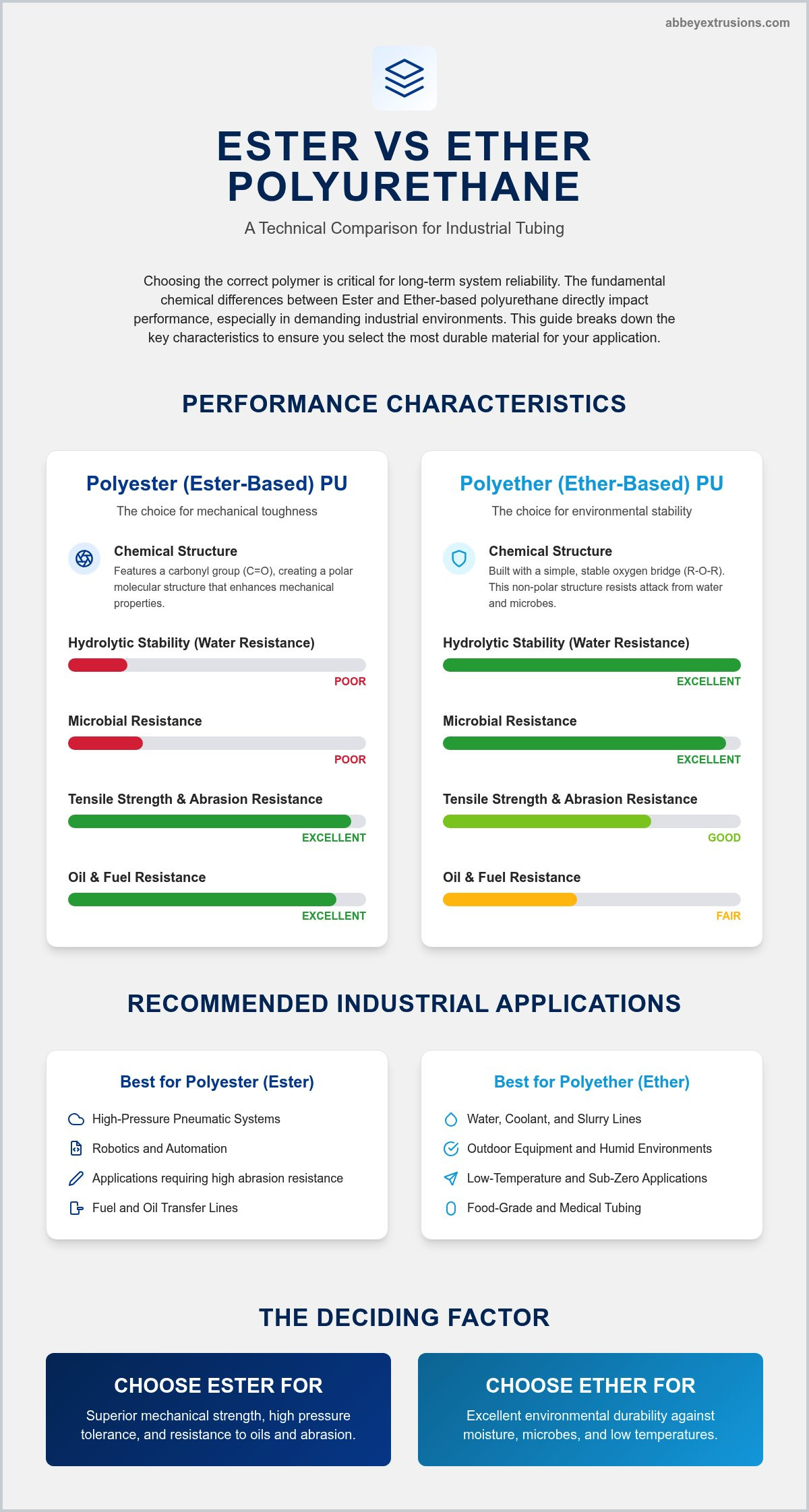
Esters are defined by the presence of a carbonyl group, which consists of a carbon atom double bonded to an oxygen atom amongst the polymer chain. This specific functional group creates a permanent dipole, making ester based polymers significantly more polar than their ether counterparts. This increased polarity enhances the material's attraction to certain solvents and fuels, which can be a distinct advantage in specific chemical transfer applications. However, this double bond also represents a primary site for potential chemical reactions. In the context of Thermoplastic polyurethane chemistry, this structure provides the exceptional tensile strength and abrasion resistance associated with polyester tubing. The trade off for this mechanical toughness is a heightened vulnerability to moisture; the carbonyl site is susceptible to a process known as hydrolysis, where water molecules attack and break the polymer chains.
Ether Structural Simplicity and Stability
Ethers feature a noticeably simpler molecular arrangement, characterised by a single oxygen bridge connecting two alkyl or aryl groups. This lack of a carbonyl group results in a more chemically stable structure, particularly in the presence of water and microbial life. Because there is no double bonded oxygen to act as a reactive site, the ether functional group is far less susceptible to hydrolytic cleavage. This structural simplicity leads to several key performance benefits:
- Hydrolytic Stability: The oxygen bridge remains intact even when the material is submerged for extended periods.
- Microbial Resistance: Fungi and bacteria find it far more difficult to break down the ether bond compared to the ester bond.
- Low Temperature Flexibility: The molecular chain allows for better movement at sub zero temperatures.
Whilst esters rely on their complex polar bonds for mechanical toughness and oil resistance, ethers provide a reliable and stable alternative for applications where chemical simplicity translates directly to operational durability. The symmetrical nature of the ether bond ensures that the polymer maintains its physical integrity in humid or wet conditions that would typically cause an ester based material to become brittle and fail.
For technical assistance with material selection or to discuss a bespoke manufacturing project, please visit our contact page to speak with our engineering team.
Performance Characteristics of Polyester and Polyether Polyurethane
Whilst the chemical structure defines the base properties, the physical performance of the finished product determines its industrial utility. The debate of ester vs ether is often settled by the mechanical stresses the tubing must endure during daily operation. Polyester based polyurethane typically offers superior tensile strength and durability, making it the standard for applications where the hose is subjected to high internal pressures or external physical abuse. Conversely, polyether variants are selected when environmental stability and operational flexibility are the primary concerns. The chemical bonding within each polymer determines the ultimate burst pressure and the expected service life of the tube in the field.
Mechanical Strength and Abrasion Resistance
Polyester PU is the preferred choice for high pressure pneumatic applications because of its dense molecular structure. This density translates to a higher ultimate burst pressure and a greater resistance to tearing under load. In sliding or vibrating environments, such as those found in automated assembly lines or heavy machinery, ester based materials demonstrate superior abrasion resistance. They maintain their wall thickness and structural integrity far longer than other polymers when subjected to constant surface friction. When you examine the technical specifications of a polyurethane tube intended for heavy duty industrial use, the ester grade is almost always favoured for its sheer mechanical toughness and resistance to impingement.
Flexibility and Low Temperature Performance
Temperature fluctuations significantly impact polymer behaviour. Polyether based tubing features a lower glass transition temperature, which allows it to remain flexible in colder UK outdoor environments where polyester might become stiff or brittle. This flexibility is not merely about temperature; it relates to the polymer's ability to recover after repeated bending or coiling without permanent deformation. Ether chains are less prone to stress cracking and work hardening during dynamic applications. This makes them ideal for automated machinery where the tube must move through a constant, repetitive radius. This inherent resilience ensures that the tubing does not develop kinks or micro fractures that could lead to a sudden loss of pressure. Selecting the right grade ensures your system operates at peak efficiency, and you can enquire about bespoke extrusion specifications to get technical guidance from our Leicestershire based team.
To discuss your specific application requirements or to request a technical consultation, please contact our expert team via our contact page.
Selecting the Correct Polymer for Specific Environments
The selection process for industrial tubing often hinges on the environmental stressors present in the operational area. Whilst mechanical strength is vital, the chemical interaction between the polymer and its surroundings determines the ultimate longevity of the system. When comparing ester vs ether, water exposure is the primary deciding factor that engineers must address. Beyond moisture, factors such as microbial attack in subterranean conditions and UV stability for outdoor installations in the UK play a significant role in material selection. Our bespoke extrusion services allow us to advise on the most resilient polymer based on these specific environmental variables.
Hydrolysis and the Water Problem
Hydrolysis is a chemical process where water molecules directly attack and break down the ester bonds in a polyester based polyurethane. This degradation is not immediate but occurs over time, especially in high humidity or submerged conditions, leading to a loss of physical properties and eventual tube failure. For any application involving water transfer, polyether is the essential choice due to its inherent hydrolytic stability. Whilst an ester tube might appear functional initially, prolonged moisture exposure will cause it to become brittle and lose its tensile strength. In wet climates, ether based polyurethane tubing can reduce replacements by up to 40 per cent compared to ester types, making it the more cost effective solution for long term installations.
Oil Fuel and Chemical Resistance
In contrast to their vulnerability to water, polyester based polyurethanes offer superior resistance to oils, greases, and many hydrocarbon based solvents. The polar nature of the ester group, which we discussed in the chemical fundamentals section, provides a robust barrier against non polar substances. This makes ester based tubing an excellent choice for a diesel fuel hose or for use in pneumatic lines where lubricating oils are present. Conversely, we warn against using ether based products in applications involving prolonged oil contact. Ether polymers tend to swell and degrade when exposed to certain oils, which can lead to a loss of dimensional stability and system leaks. Selecting the correct polymer ensures that your tubing maintains its integrity regardless of the chemicals it encounters.
Microbial attack is another critical consideration, particularly for tubing used in damp or subterranean environments. Fungi and bacteria can actively consume the ester bonds in polyester PU, leading to rapid degradation and failure. Polyether variants are naturally resistant to these organisms, ensuring they remain viable in soil or stagnant water. For outdoor applications, UV stability is paramount. Whilst both polymers require stabilisers for long term sun exposure, the base stability of the chosen polymer influences how well these additives perform over time.
To arrange a technical consultation regarding high volume orders or to discuss bespoke extrusion profiles, please speak with our specialists through our contact page.
Industrial Applications for Ester and Ether Based Tubing
The practical deployment of polyurethane depends on matching the material's chemical strengths to the specific rigours of the sector. Industrial environments present varied challenges that dictate the ester vs ether selection. In automotive and agricultural machinery, ester based polyurethanes are the industry standard due to their exceptional resistance to hydraulic oils, greases, and fuels. Conversely, sectors dealing with constant moisture or sensitive consumables prioritse the stability of ether variants. Our Leicestershire based facility produces high volumes of both materials, ensuring that each custom extrusion is engineered for its precise operational role.
Pneumatics and Tooling
Factory air lines and robotic assembly systems rely on the high burst pressure and mechanical toughness of ester based polyurethane. These environments often involve moving parts that subject the tubing to constant vibration and abrasion. Because ester PU resists kinking and maintains its structural integrity under pressure, it is the superior choice for busy workshop environments where downtime is costly. Whilst many systems utilise traditional plastics, our customers often seek ester based alternatives for a nylon recoil air hose where greater flexibility and impact resistance are required. The material's ability to return to its original shape after stretching makes it indispensable for dynamic pneumatic tooling.
Water Management and Marine Environments
Marine and subsea applications almost exclusively utilise polyether solutions to combat the inevitable threat of hydrolytic degradation. Whether for drainage, irrigation, or marine fluid lines, the tubing must withstand constant contact with untreated water without becoming brittle. We frequently supply ether based materials for fluted water hose applications where long term stability is paramount. Beyond simple water resistance, ether based polyurethanes are essential in these environments because they resist the microbial growth and fungal attack commonly found in damp or outdoor settings. This ensures the fluid lines remain clear and structurally sound throughout their service life.
Food Grade and Brewery Applications
The food and beverage processing sector requires specific grades of ether based hoses to meet hygiene and safety standards. When manufacturing a brewery hose or food safe extrusion, we select ether based PU for its excellent resistance to the aggressive cleaning chemicals used in Clean In Place (CIP) processes. These chemicals can often degrade ester bonds, leading to contamination or premature failure. Furthermore, the non toxic formulations of our ether based polyurethanes ensure that the taste and integrity of the product are never compromised. If you are developing a new fluid transfer system for the food industry, you can request a technical quote to ensure your material choice meets all regulatory and mechanical requirements.
To discuss your specific material requirements or to request a quote for high volume production, please get in touch with our technical team through our contact page.
Bespoke Extrusion Solutions for Complex Chemical Requirements
Standard circular tubing provides a versatile solution for many fluid transfer needs, yet many industrial systems require specialised geometries to function within confined spaces or under specific mechanical loads. Custom extrusion allows for the precise combination of material properties with unique physical shapes, ensuring that the final product meets the rigorous demands of your application. By selecting the appropriate polymer through the ester vs ether evaluation, we can engineer profiles that offer both the required chemical resilience and the necessary structural integrity. Our in house tooling capabilities ensure that every bespoke profile is manufactured to exacting tolerances, whether you require a simple modification or a completely new design.
Custom Profiles and Tube Forming
The versatility of polyurethane makes it an ideal candidate for advanced shaping techniques that extend beyond standard extrusion. Our tube forming services can be applied to both polyester and polyether grades, allowing for the creation of complex coils and pre-bent sections that maintain their memory and performance. This is particularly valuable in space constrained pneumatic systems where standard tubing might kink if forced into a tight radius. Beyond standard tubing, we manufacture specialised items such as curtainsider pelmet sections, where the material must balance flexibility with long term weather resistance. We develop these custom extrusions directly from your technical drawings, ensuring that the specific chemical advantages of the chosen polymer are preserved through the shaping process.
Technical Support and Material Specification
Working with a dedicated UK manufacturer provides a significant advantage when navigating the complexities of polymer selection. Abbey Extrusions offers comprehensive technical guidance to help our clients resolve the ester vs ether debate based on their specific environmental conditions. We analyse the presence of moisture, the types of chemicals involved, and the mechanical stresses the component will face to recommend the most durable solution. This methodical approach reduces the risk of premature material failure and helps to lower long term maintenance costs for your operation. We encourage large volume enquiries for specialised industrial projects where precision and material expertise are critical to success. Our commitment to quality and technical competence ensures that your custom fluid systems perform reliably in even the most challenging environments.
For expert advice on polymer selection and bespoke extrusion enquiries please contact the technical team at Abbey Extrusions.
Optimising Material Selection for Industrial Longevity
Choosing between these two polymers is a fundamental engineering decision that dictates the reliability of your entire fluid system. We have established that the ester vs ether debate is primarily a choice between mechanical toughness and environmental stability. Whilst polyester based tubing provides the tensile strength required for high pressure pneumatics and oil resistance; polyether variants remain essential for any application involving water exposure or microbial risks. Selecting the wrong material leads to unnecessary maintenance costs and system downtime that could be avoided with precise technical specification from the outset.
Abbey Extrusions has been a specialist UK manufacturer since 1985; providing national supply for high volume industrial orders. Our expertise in custom Nylon and PU extrusions ensures that your bespoke profiles are engineered to survive the specific chemical and mechanical stresses of your environment. For expert advice on polymer selection and bespoke extrusion enquiries please contact the technical team at Abbey Extrusions. We look forward to partnering with you to develop a reliable and durable solution for your next project.
Frequently Asked Questions
What is the main difference between ester and ether polyurethane?
The fundamental difference between ester vs ether polyurethane lies in their chemical backbone. Ester based polyurethanes contain a carbonyl group that provides superior mechanical strength and oil resistance. Polyether variants utilise a simpler oxygen bridge that offers exceptional hydrolytic stability and resistance to microbial attack. This molecular variation determines whether the finished tubing is suited for dry, oil rich environments or wet, humid conditions where degradation is a constant risk.
Which material is better for water applications, ester or ether?
Ether based polyurethane is the superior choice for all water transfer applications. Unlike ester based materials, ether polymers don't undergo hydrolytic degradation when submerged or exposed to high humidity for extended periods. In wet climates, using ether based tubing can reduce the frequency of replacements by up to 40 per cent compared to ester types. This makes it the standard specification for marine environments, irrigation systems, and any industrial process involving untreated water.
Is polyester polyurethane resistant to oil and fuel?
Polyester based polyurethane demonstrates excellent resistance to oils, greases, and many hydrocarbon based fuels. The polar nature of the ester group creates a robust barrier that prevents these substances from penetrating the polymer chain. Because of this characteristic, we frequently manufacture ester based tubing for use as diesel fuel hoses and in pneumatic lines where lubricating oils are present. It maintains its dimensional stability and physical properties far better than ether when in contact with lubricants.
Can ether based tubing withstand high pressure pneumatic systems?
Ether based tubing can be used in pneumatic systems, but it generally offers lower burst pressures than equivalent polyester grades. Whilst ether provides better flexibility at low temperatures and resistance to moisture, it lacks the dense molecular structure that gives ester its high tensile strength. For high pressure factory air lines, polyester is typically preferred. However, for outdoor pneumatic applications in the UK where moisture and cold are factors, ether based tubing often provides the best balance.
Why does polyester tubing fail in humid conditions?
Polyester tubing fails in humid conditions due to a chemical process called hydrolysis. Water molecules in the air attack the ester bonds within the polymer backbone, causing the chains to break down over time. This leads to a significant loss of physical properties, eventually making the tube brittle or prone to cracking. This failure is often accelerated by heat, making ester based materials unsuitable for tropical environments or industrial areas where steam or high humidity is present.
Is there a difference in price between ester and ether based polymers?
There is a notable price difference between the two materials, as polyether resins typically cost more to produce than standard polyester resins. Industry data from 2023 reported that ether based polyurethane resins cost approximately 18 per cent more than their ester counterparts. Whilst the initial procurement cost is higher for ether, the reduced maintenance requirements and longer service life in wet environments often result in a lower total cost of ownership for many industrial fluid systems.
Which polymer has better abrasion resistance for industrial use?
Polyester based polyurethane offers superior abrasion resistance for demanding industrial applications. Its molecular structure is more resilient to surface wear, impingement, and sliding friction compared to ether variants. This makes ester the ideal material for automated assembly lines, robotic tooling, and any environment where the tubing is in constant contact with moving machinery. When mechanical toughness and the ability to withstand physical abuse are the primary requirements, ester based extrusions provide the most durable performance.
How do I know if my existing tubing is ester or ether based?
Identifying the polymer type through visual inspection alone is extremely difficult as both materials can appear identical. The most reliable method is to consult the technical data sheet or the original manufacturer's specification. If records are unavailable, a simple immersion test can provide clues; ester based tubing will eventually swell or degrade when left in water for several weeks, whilst ether will remain stable. For high volume replacements, we recommend a professional material analysis to ensure the correct polymer.

Article by
Bryan Cowan
Bryan Cowan is the Founder and Managing Director of Abbey Extrusions Ltd, a leading UK manufacturer of high-quality plastic tubes and hoses. With over 40 years of industry experience, Bryan established the company in 1985, growing it from a startup into a BS ISO9001-registered supplier for global sectors including aerospace, automotive, and pharmaceuticals.
Disclaimer
This article is intended for informational purposes only. Please ensure you seek expert advice or carry out your own research to confirm the information is suitable for your specific needs.