What if a 0.05mm deviation in your fluid lines was the only thing standing between continuous operation and a total system shutdown? In the demanding environment of UK manufacturing, standard PVC or Nylon lines often succumb to thermal degradation once temperatures exceed 100°C, leading to catastrophic material failure. Selecting the correct PTFE tubing for high temperature applications is therefore not just a procurement task; it's a fundamental engineering requirement for any facility operating under extreme conditions. At Abbey Extrusions, we specialise in providing the technical clarity needed to navigate these high-stakes material choices.
You probably understand that inconsistent tolerances and chemical leaching from inferior imported materials can compromise your entire production cycle. This article provides the precise technical framework you need to select tubing that maintains its structural integrity at 260°C. We'll examine how to achieve +/- 0.05mm precision and ensure zero chemical leaching during continuous operation at 200°C plus, allowing your bespoke profiles to meet the most rigorous industrial standards.
Key Takeaways
- Discover why PTFE tubing for high temperature applications maintains structural integrity at 260°C through superior molecular stability and polymer chain resistance.
- Evaluate precise manufacturing specifications, including ID sizes from 3mm to 75mm, produced to strict +/- 0.05mm tolerances at our specialist UK facility.
- Compare the thermal limitations of industrial-grade Nylon and Polyurethane against the superior heat-resistant properties required for extreme fluid transfer.
- Identify critical industrial sectors where PTFE is essential for food-grade compliance and rigorous steam-cleaning protocols in environments exceeding 200°C.
- Explore how bespoke extrusion solutions provide tailored profiles and custom metric sizes to meet the most demanding thermal management requirements.
PTFE Performance Factors in Extreme Heat
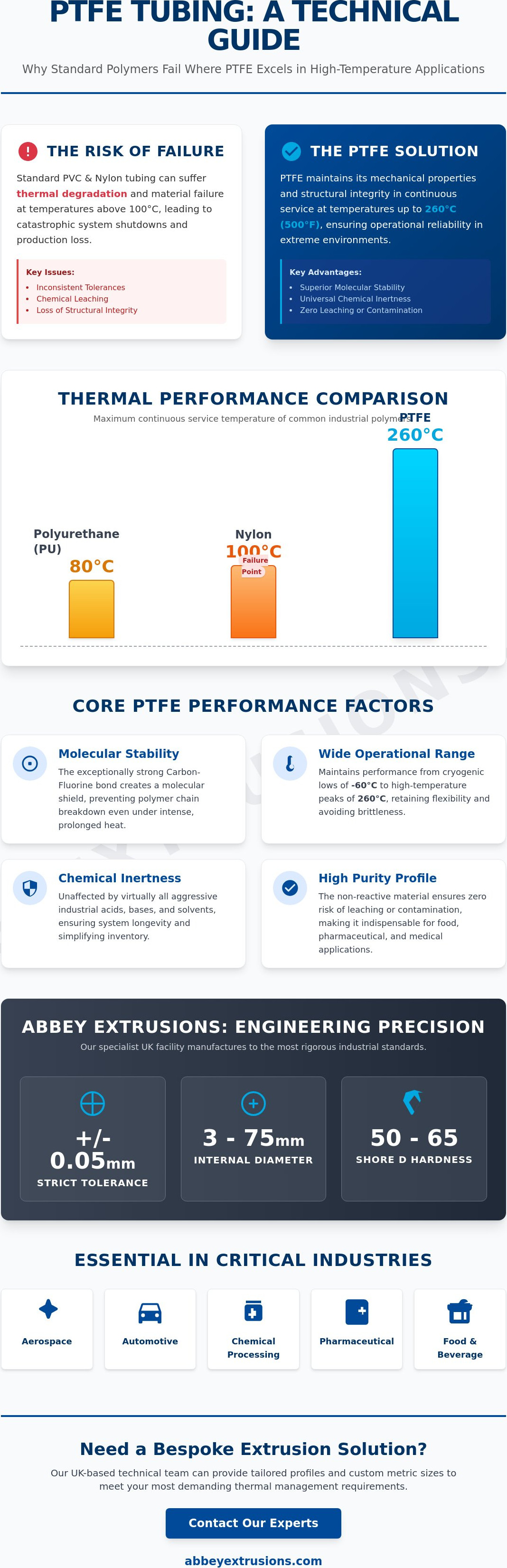
Abbey Extrusions specialises in the manufacturing of high-performance components designed to withstand the most demanding industrial environments. At the core of our thermal solutions is Polytetrafluoroethylene (PTFE), a fluoropolymer that remains the gold standard for fluid transfer under thermal stress. Unlike standard industrial plastics that begin to soften or lose structural integrity at approximately 70°C, PTFE maintains its mechanical properties during continuous service at temperatures up to 260°C. This makes PTFE tubing for high temperature applications an essential component for UK manufacturers operating in the aerospace, automotive, and chemical processing sectors.
The resilience of this material stems from its molecular architecture. The exceptionally strong bond between carbon and fluorine atoms creates a shield that prevents polymer chain breakdown, even when exposed to intense heat for prolonged periods. We focus on providing technical reliability; ensuring that every extrusion we produce meets the precise tolerances required for high-heat fluid transfer. In critical systems, a failure in material stability doesn't just lead to downtime; it can compromise the safety of the entire facility. Our commitment to quality ensures that these risks are mitigated through superior material selection.
Thermal Stability and Structural Integrity
Standard PTFE extrusions offer a remarkable operational window, ranging from an upper limit of 260°C down to a lower limit of -60°C. This wide range is vital for UK industries that require versatile components. At sub-zero temperatures, where most polymers become brittle and prone to cracking, PTFE retains its flexibility. This characteristic is particularly beneficial for cryogenic cooling systems and outdoor installations exposed to harsh British winters. Because the material doesn't support combustion and has a high limiting oxygen index, it's a safe choice for high-risk environments. It doesn't melt in the traditional sense; instead, it transitions into a high-viscosity gel, maintaining its form even near its service limit.
Chemical Inertness in Hazardous Environments
Beyond heat resistance, PTFE tubing for high temperature applications provides near-universal chemical inertness. It's unaffected by virtually all aggressive acids, bases, and solvents found in modern industrial processing. For UK manufacturers, this means a single tubing solution can often serve multiple roles, simplifying inventory and reducing maintenance cycles. Because the material is non-reactive, there's zero risk of leaching or contamination. This high-purity profile is indispensable for pharmaceutical production and food processing where fluid integrity is non-negotiable. At Abbey Extrusions, we understand that chemical and thermal resistance must go hand in hand to ensure long-term system performance.
Technical Specifications and Thermal Limits
Abbey Extrusions manufactures PTFE tubing for high temperature applications with a focus on engineering precision. We maintain a strict manufacturing tolerance of +/- 0.05mm at our UK facility. This level of control ensures that every millimetre of tubing meets the rigorous demands of industrial environments. Our production capabilities include internal diameter (ID) sizes ranging from a standard 3mm to 75mm for bespoke orders. High-temperature fluoropolymers typically exhibit a Shore D hardness between 50 and 65. This rigidity provides the structural integrity needed to resist deformation while maintaining the material's signature low-friction properties.
The reliability of these components is backed by extensive research into material performance. For instance, a U.S. Department of Energy report on fluoropolymers highlights how these materials remain irreplaceable in manufacturing due to their thermal stability and chemical inertness. We apply these technical principles to every batch we extrude, ensuring that our clients receive products that perform exactly as specified in their technical data sheets.
Dimensional Precision and Tolerances
Achieving a +/- 0.05mm precision is vital for secure fitment in pneumatic systems where leakages lead to operational downtime. We offer standard ID ranges starting at 3mm, while our bespoke tooling allows for custom profiles up to 75mm. Consistent wall thickness is a non-negotiable requirement; it prevents localised bulging under thermal stress. If the wall thickness varies by even 0.1mm, the risk of failure increases when the material softens at its upper thermal limits. Our manufacturing process uses continuous monitoring to ensure that the wall remains uniform throughout the entire extrusion length.
Pressure Ratings at Elevated Temperatures
Temperature and pressure share an inverse relationship in thermoplastic extrusions. While certain configurations handle up to 50 bar at ambient temperatures, this capacity diminishes as heat rises. Best practice dictates derating the maximum pressure once temperatures exceed 23°C. At the upper limit of 260°C, the physical strength of the polymer is significantly lower than at room temperature. We've provided technical solutions since 1985, helping engineers calculate the safe operating window for their specific thermal environments. Our experience ensures that the chosen bespoke profiles align with the safety margins required by UK industrial standards. Using a material that hasn't been properly derated can lead to catastrophic bursting, so we always recommend reviewing the specific pressure-to-temperature curve for your application.
Comparing PTFE with Industrial Grade Nylon and PU
Selecting the correct thermoplastic requires a precise understanding of the thermal and mechanical stresses within your manufacturing environment. While Nylon tube and Polyurethane tube serve as the workhorses of British industry, they possess clear physical limitations. PTFE stands apart due to its carbon-fluorine bond, providing a level of thermal stability that standard polymers cannot replicate. We often see engineers struggle with material fatigue because they've pushed standard plastics beyond their natural operating windows.
Nylon 12 typically features a Shore D hardness rating around 70 to 75, offering excellent pressure resistance at ambient temperatures. However, its structural integrity begins to degrade once temperatures exceed 80°C. For UK manufacturers, the 100°C threshold represents the critical transition point. Beyond this temperature, Nylon loses its tensile strength and risks catastrophic failure. This is exactly where PTFE tubing for high temperature applications becomes essential, as it remains chemically inert and mechanically sound long after Nylon has reached its functional limit.
Polyurethane is frequently selected for its exceptional abrasion resistance, making it ideal for grit blasting or moving parts. It typically carries a Shore A rating between 85 and 98, providing a rubber-like flexibility. Despite this resilience to wear, PU has a low melting point and begins to soften significantly at just 60°C. If your process involves steam cleaning or proximity to heat exchangers, PU will fail quickly, leading to costly downtime on the factory floor.
Thermal Performance Comparison
The performance gap between these materials is stark. Standard Nylon 12 operates safely up to 80°C, whereas PTFE maintains its properties at a continuous 260°C. Data found in our Technical Guide to Nylon Tubing highlights that while Nylon is cost-effective for pneumatic lines, it cannot match the 327°C melting point of PTFE. Even at elevated temperatures, PTFE maintains a consistent 50mm bend radius in standard sizes, ensuring that flow rates aren't compromised by heat-induced kinking or wall collapse.
Flexibility and Installation Requirements
PTFE is significantly more rigid than PU, which can present challenges during installation in tight machinery compartments. While PU can be looped easily, PTFE requires a more calculated approach to routing. We solve this through bespoke tube forming, a process where we heat-set the fluoropolymer into specific geometries. This tailored service allows us to deliver PTFE tubing for high temperature applications that fits perfectly into your existing UK production lines, eliminating the internal stress that occurs when forcing rigid tubes into tight bends.
Critical Application Areas and Selection Criteria
UK manufacturing sectors such as aerospace, chemical processing, and automotive testing frequently operate in environments where 200°C plus temperatures are standard. In these high-stress conditions, standard polymers fail, leading to embrittlement or catastrophic melting. We provide PTFE tubing for high temperature applications to ensure system integrity remains uncompromised. The material's thermal stability allows it to maintain its mechanical properties across a vast thermal range, making it indispensable for modern industrial plants.
In the food and beverage industry, hygiene is non-negotiable. PTFE plays a vital role in food-grade applications where aggressive steam cleaning is a daily requirement. The polymer's chemically inert nature means it won't leach contaminants into the product stream. Its exceptionally low friction coefficient of 0.1 is another technical advantage. This "slipperiness" prevents clogging during the transfer of viscous fluids, such as industrial syrups or heavy oils, which can otherwise cause significant pressure drops and pump strain.
Selecting the correct tubing involves more than just temperature ratings. We anchor our selection criteria to the specific ID (Internal Diameter) and OD (Outer Diameter) requirements of UK machinery. Precision is essential for secure fitment with British Standard Pipe (BSP) fittings and bespoke manifold systems. We manufacture to tight tolerances to ensure that every millimetre of the extrusion performs under pressure.
Industrial Fluid Transfer and Steam Lines
We specialise in PTFE for steam lines where temperatures consistently reach 150°C or higher. The non-stick internal surface is a critical feature here; it prevents mineral build-up and scaling inside the 3mm to 75mm tubing. This longevity reduces maintenance cycles in hard-water areas across the UK. As UK extrusion specialists, we advocate for PTFE in all high-pressure steam roles to avoid the premature degradation seen in lower-grade rubber hoses.
Electrical and Mechanical Insulation
The high dielectric strength of PTFE makes it a premier choice for protecting sensitive wiring in industrial control panels. It effectively prevents electrical arcing in high-voltage equipment, even when the surrounding ambient temperature exceeds 200°C. PTFE remains stable when exposed to UV radiation and atmospheric ozone. This environmental resistance ensures that the insulation won't crack or perish in outdoor installations or high-exposure manufacturing bays.
If your project requires precision-engineered solutions for extreme environments, explore our full range of bespoke plastic extrusions and PTFE tubing to find the perfect fit for your machinery.
Bespoke Extrusion Solutions for Thermal Management
Abbey Extrusions has remained at the forefront of the British plastics industry since 1985, providing a level of technical expertise that off-the-shelf suppliers simply cannot match. We recognise that standard metric sizes often fall short when engineers face the unique constraints of modern industrial machinery. Our commitment to bespoke profiles ensures that every client receives a component designed precisely for their specific thermal and fluid dynamics requirements. When you require PTFE tubing for high temperature applications, you aren't limited to a catalogue; you're supported by a manufacturing partner capable of translating complex blueprints into high-performance reality.
Custom Sizing and Tooling Capabilities
Our facility houses comprehensive in-house tooling services, allowing us to maintain complete control over the production cycle from initial design to final extrusion. This capability is vital for creating unique inner diameter (ID) and outer diameter (OD) combinations that aren't found in standard stock. We specialise in manufacturing bespoke orders that meet rigorous performance criteria, such as specific 50 bar pressure ratings for high-stress environments. Our engineering team frequently produces specialised profiles that integrate seamlessly with other industrial components, including curtainsider pelmet sections and complex housing units. By managing the tooling process internally, we reduce lead times and ensure that the finished product aligns perfectly with your existing hardware.
Quality Assurance and Manufacturing Standards
Precision is the cornerstone of our manufacturing philosophy. Every millimetre of tubing we produce undergoes a strict inspection process to ensure it adheres to a +/- 0.05mm accuracy standard. This level of consistency is essential for PTFE tubing for high temperature applications, where even a minor deviation in wall thickness can lead to catastrophic failure under thermal stress. Sourcing directly from a UK manufacturer provides more than just technical precision; it offers vital supply chain security in an increasingly volatile global market. Our clients benefit from transparent lead times and the peace of mind that comes from working with a company that has built a four-decade reputation for service and technical excellence.
Complex fluid system challenges require more than just a product; they require a solution. We encourage engineers and procurement managers to engage in a technical consultation with our team to discuss specific environmental factors, chemical exposures, and pressure requirements. Our approach isn't about selling a standard part, it's about engineering a component that enhances the reliability of your entire system. Whether you're dealing with aggressive solvents or extreme thermal cycling, our experience ensures your project is in capable hands.
- In-house tooling for rapid prototyping and custom profiles.
- Rigorous quality control with +/- 0.05mm tolerance levels.
- Direct UK manufacturing for reliable supply and communication.
- Specialist expertise in high-pressure and high-temperature environments.
Securing Reliability in Extreme Thermal Environments
Selecting the right materials for extreme environments ensures long-term operational stability and safety across your production lines. While industrial grade Nylon and PU serve many purposes, they often fail when temperatures exceed their narrow thermal limits. Our analysis shows that PTFE tubing for high temperature applications provides the essential chemical inertness and thermal resistance needed to withstand environments where standard thermoplastics would simply degrade. Since 1985, Abbey Extrusions has specialised in delivering these high-performance solutions to the British manufacturing sector, ensuring that technical specifications are never compromised.
We maintain rigorous manufacturing tolerances of +/- 0.05mm to ensure every component meets your exact engineering requirements. Our products are built for durability and are capable of handling operating pressures up to 50 bar in the most demanding thermal management scenarios. We're committed to providing the technical expertise and bespoke profiles your specific project demands to maintain a competitive edge. To find out more about our bespoke extrusion capabilities please contact us at abbeyextrusions.com. We look forward to supporting your next engineering challenge with precision and reliability.
Frequently Asked Questions
What is the maximum operating temperature for PTFE tubing?
PTFE tubing operates continuously at temperatures up to 260°C without compromising its mechanical properties. This thermal threshold makes it superior to Nylon 12, which typically fails at 80°C. We ensure structural integrity is maintained across this entire range to facilitate safe fluid transfer in extreme UK manufacturing environments.
How does temperature affect the pressure rating of PTFE tubing?
The pressure rating of PTFE tubing must be derated as the operating temperature increases toward its 260°C limit. While Abbey Extrusions manufactures tubing capable of 50 bar at ambient temperatures, this capacity reduces significantly in high-heat applications. We recommend engineers consult our technical team to determine the safe working pressure for their specific thermal profile.
Can PTFE tubing be used in tight spaces with limited clearance?
PTFE is more rigid than Polyurethane but achieves a 50mm bend radius depending on the wall thickness and internal diameter. We provide bespoke tube forming services to create permanent bends for installations with restricted space. This process ensures the tubing doesn't kink or restrict flow in critical systems.
What sizes and tolerances do you offer for PTFE tubing?
Abbey Extrusions specialises in manufacturing tubing with internal diameters ranging from 3mm to 75mm. We maintain a strict manufacturing tolerance of +/- 0.05mm to ensure compatibility with standard industrial fittings. Custom sizes are produced through our in-house tooling department to meet bespoke requirements for UK manufacturers.
Is PTFE tubing suitable for food grade or chemical applications?
PTFE is chemically inert and resists almost all industrial chemicals, including aggressive acids and steam cleaning agents. This makes it an ideal solution for food grade environments where hygiene and chemical resistance are paramount. The material won't leach or degrade when exposed to pH extremes ranging from 0 to 14.
Why should I choose PTFE tubing over Nylon 12 for heat-intensive tasks?
PTFE tubing for high temperature applications is the preferred choice when service temperatures exceed 100°C. While Nylon 12 is an excellent polymer for general pneumatics, it's limited to a maximum temperature of 80°C. We advocate for PTFE because it extends this capability to 260°C while offering superior chemical resistance across the entire range.

Article by
Bryan Cowan
Bryan Cowan is the Founder and Managing Director of Abbey Extrusions Ltd, a leading UK manufacturer of high-quality plastic tubes and hoses. With over 40 years of industry experience, Bryan established the company in 1985, growing it from a startup into a BS ISO9001-registered supplier for global sectors including aerospace, automotive, and pharmaceuticals.
Disclaimer
This article is intended for informational purposes only. Please ensure you seek expert advice or carry out your own research to confirm the information is suitable for your specific needs.