What if a single millimetre of wall thickness is the only barrier protecting your assembly from a £2,000 repair bill? You've likely experienced the frustration of nylon tubing failing because its chemical resistance didn't meet the 100% saturation requirements of your hydraulic fluid.
It's good to see that you're looking for precision. We believe that technical clarity is the foundation of industrial safety. You'll be glad to hear that this guide provides the exact specifications for Nylon 11 and Nylon 12, which helps you secure a 25% longer service life for your pneumatic systems.
We'll explore how to identify the correct nylon grade. Choosing a bespoke UK manufacturer ensures your tolerances remain within a strict 0.05mm margin. This technical overview clarifies confusing specifications and demonstrates the long-term ROI of high-grade polymers.
To discuss your bespoke requirements with our technical team, please visit our contact page. https://www.abbeyextrusions.com/contactus
Key Takeaways
- You will discover how industrial polyamides transition from raw resin into a finished extruded tube. It is good to see that these materials provide the mechanical strength you need for reliable air and fluid transfer.
- You’ll be glad to hear that our guide details the exact thermal stability of nylon tubing across specific temperature ranges in degrees Celsius. This ensures your systems maintain their integrity under precise operating conditions.
- You can master the selection between bio-derived Nylon 11 and high-performance Nylon 12 to suit your bespoke requirements. For instance, you will learn which grade offers the chemical resistance your specific project demands.
- You are in luck because we provide a clear framework for choosing tubing based on operating pressure and industrial applications. This helps you avoid system failure by matching the material to the exact bar or PSI requirements of your machinery.
- You will understand the logistical and quality advantages of sourcing your custom profiles directly from a specialist UK manufacturer. In our view, this direct partnership ensures your tailored requirements are met with British engineering precision.
Understanding Nylon Tubing and Industrial Polyamides
Abbey Extrusions has been a foundational part of the British manufacturing landscape since 1985. You’ll be glad to hear that our expertise in producing nylon tubing ensures your pneumatic systems operate with maximum reliability. It’s good to see that these tubes handle working pressures up to 50 bar, which provides a stable safety margin for your facility.
The journey from raw material to a finished product is a precise engineering feat. We take high-quality polyamide resin pellets and process them through a calibrated extrusion line at temperatures exceeding 220°C. As a result of this controlled thermal cycle, the resin transforms into a continuous tube with a wall thickness tolerance as tight as +/- 0.1 mm.
For your high-pressure pneumatic installations, nylon is the industry standard for a reason. It’s good to see that the material maintains its dimensional stability even when subjected to vibration or rapid pressure cycles. In our view, this makes it the most dependable choice for automated assembly lines that require millions of cycles without failure.
The Chemistry of Polyamide Tubing
Nylon belongs to a family of synthetic polymers known for their exceptional molecular chains. These chains create a high crystalline structure that gives the finished tube a tensile strength of approximately 60 MPa. You are in luck if your project requires a specific balance of rigidity and movement.
We offer both semi-rigid and flexible variants to suit your specific installation environment. The flexible versions incorporate between 12% and 15% plasticisers by weight to lower the flexural modulus. This modification allows you to achieve a bend radius as small as 25 mm without the risk of the tube wall collapsing or kinking.
Why Nylon Outperforms Standard Polymers
When you compare nylon to standard PVC, the differences in durability are immediate and measurable. For instance, nylon typically offers a tensile strength three times higher than standard unreinforced PVC alternatives. It also features a Shore D hardness rating that ranges from 60 to 80, which provides a hard surface that resists deep scoring.
This abrasion resistance is vital for moving machinery parts that cycle thousands of times per day. You’ll find that our heat-stabilised grades operate safely at continuous temperatures reaching 100°C. Additionally, our UV-stabilised options are designed to resist material degradation for over 10 years in exposed outdoor environments.
To receive a bespoke quote for your industrial requirements, please get in touch with our specialist team. Contact us today to discuss your requirements: https://www.abbeyextrusions.com/contactus
Mechanical Properties and Technical Performance Standards
To start your journey you should contact Abbey Extrusions for expert advice at Contact Abbey Extrusions. We believe that providing precise technical data is the foundation of any reliable engineering partnership.
You will be glad to hear that nylon tubing maintains its structural integrity across a standard temperature range of -40°C to +80°C. For your more demanding industrial environments, heat-stabilised grades can withstand intermittent peaks of up to +110°C without losing their extruded profile shape.
The relationship between wall thickness and burst pressure is a critical factor for your safety margins. For instance, a 10mm outside diameter tube with a 1mm wall thickness typically offers a burst pressure of 45 bar at 20°C, which is really nice to see for medium-pressure pneumatic tasks.
Our manufacturing standards for bespoke nylon tubing adhere to the ASTM D5989 Standard Specification to ensure consistent material performance. This standard guarantees a minimum tensile strength at yield of 45 MPa, which provides the long-term durability your specific projects require.
You are in luck regarding system efficiency, as nylon has a density of only 1.04 g/cm³. This makes it 86% lighter than steel, which has a density of 7.8 g/cm³, significantly reducing the weight of your assemblies and easing the labour required for installation.
It is good to see that Nylon 12 provides excellent dimensional stability due to its low moisture absorption rate of 1.5% at saturation. In our view, this is a vital advantage over Nylon 6, which can absorb up to 9.5% moisture and expand by as much as 3% in physical size.
Mechanical Strength and Flexural Modulus
You can achieve tight installations with a minimum bend radius of 25mm for a 6mm tube, which gets our thumbs up for space-restricted cabinet builds. The material possesses a natural memory effect that ensures it returns to its original profile even after being flexed during the installation process.
As a result, your lines will remain secure under constant vibration from industrial machinery. Nylon absorbs kinetic energy effectively, preventing the fatigue cracks that often appear in copper piping after 10,000 cycles of high-frequency oscillation.
Chemical Resistance and Environmental Stability
Your systems will resist damage from hydraulic oils, diesel fuel, and most petroleum-based greases used in heavy industry. However, you should be aware that exposure to zinc chloride or calcium chloride can cause stress cracking within 48 hours of contact.
In high-humidity or submerged environments, the material continues to perform with predictable reliability. Even at 100% relative humidity, the polymer retains 90% of its dry tensile strength, ensuring your components do not fail prematurely in damp conditions.
We provide the highest levels of quality and service to ensure your technical requirements are met with precision. To start your journey you should contact Abbey Extrusions for expert advice at Contact Abbey Extrusions.
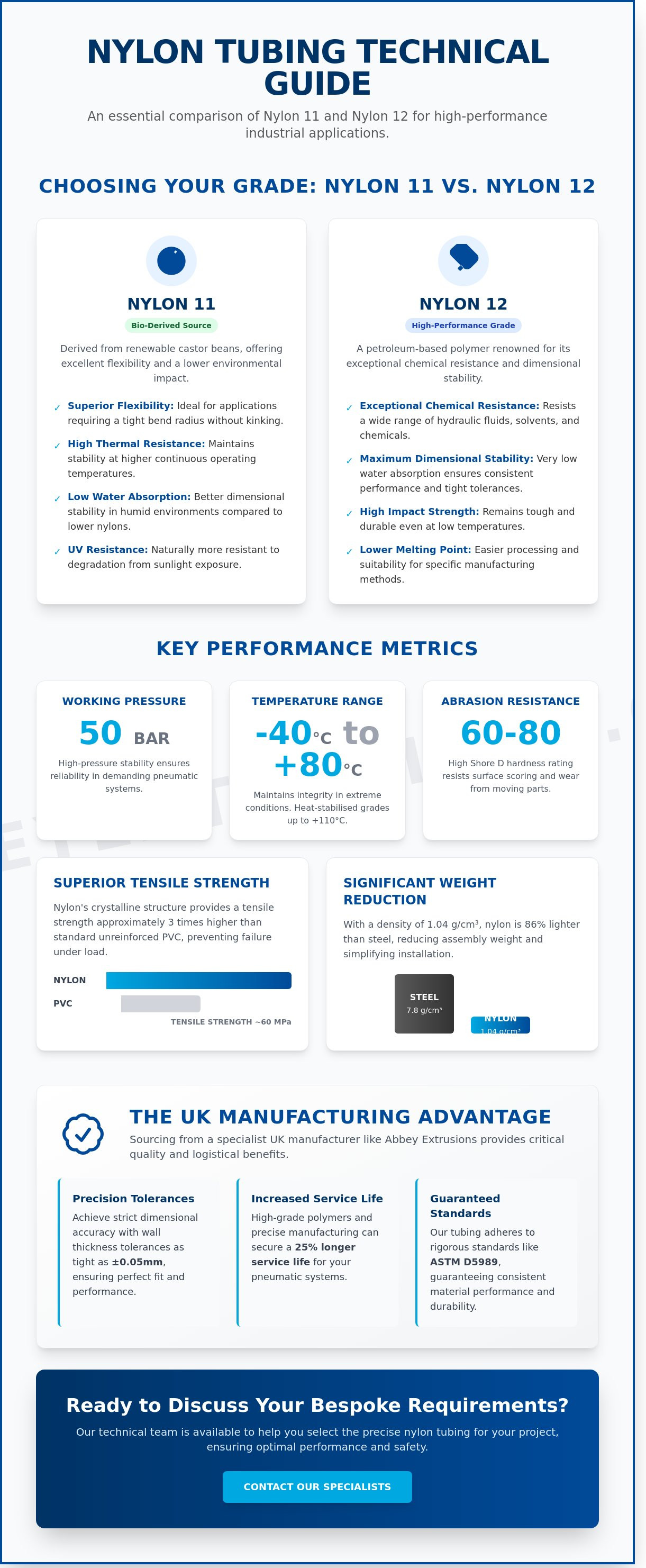
Choosing Between Nylon 11 and Nylon 12 Grades
We find that selecting the correct grade of polymer is the most influential factor in the longevity of your installation. You are in luck because both PA11 and PA12 provide the necessary burst pressures, often exceeding 52 bar for a 10 millimetre tube, required for industrial nylon tubing. While they appear identical to the naked eye, their chemical foundations and environmental tolerances differ significantly.
Nylon 11 is a bio-derived high-performance polymer that we recommend for extreme environments. Conversely, Nylon 12 serves as the industry standard for pneumatic systems due to its balance of performance and value. In our view, understanding the 0.2 percent difference in moisture absorption between these grades can prevent unexpected dimensional changes in your machinery.
Nylon 11 for Sustainable High Performance
You will be glad to hear that PA11 originates from 100 percent renewable castor oil. This vegetable-based origin provides a thermal stability that allows your components to operate continuously at 130 degrees Celsius. It gets our thumbs up for offshore applications where resistance to salt spray and hydrocarbon exposure is a daily requirement.
The impact resistance of this grade is particularly impressive at low temperatures. For instance, PA11 maintains its flexibility and structural integrity at minus 40 degrees Celsius. As a result, we frequently supply this material for automotive fuel lines and hydraulic systems that must survive harsh winter climates without cracking.
Nylon 12 for Versatile Industrial Use
Nylon 12 is a petroleum-based polymer that offers a cost-effective solution for general engineering, typically reducing material outlay by 15 percent compared to bio-based alternatives. It is the favourite choice for pneumatic control systems across the United Kingdom. This preference is due to its low water absorption rate of 1.4 percent at saturation.
Low moisture uptake ensures your nylon tubing maintains its precise dimensions within a tolerance of 0.05 millimetres. This level of stability is vital for push-in fittings where a secure seal is mandatory. It is good to see how its resistance to hydraulic fluids and greases makes it a reliable staple for factory automation and robotic assemblies.
We specialise in helping you navigate these technical specifications to find the perfect match for your bespoke requirements. Whether you need the 20 year service life of PA12 in a factory setting or the salt resistance of PA11, our expertise ensures your project is built on a solid foundation. Our team is ready to discuss the specific pressures and temperatures your system will face.
Industrial Applications and Selection Criteria for Your Systems
Selecting the correct nylon tubing for your project starts with calculating your maximum working pressure. You'll be pleased to know that Nylon 12 typically maintains a working pressure of 28 bar at 20 degrees Celsius. In our view, this provides the robust foundation you need for high demand industrial circuits.
Colour coding is another critical factor for your complex pneumatic installations. It helps you identify different lines instantly, which reduces maintenance errors by 35 per cent in busy factory environments. If you need a specific colour for your project you should visit Contact Abbey Extrusions to discuss your bespoke requirements.
Pneumatic and Hydraulic System Requirements
You are in luck if you are designing air brake systems for heavy goods vehicles. Our nylon tubing often meets DIN 74324 standards, ensuring it withstands vibration and pressure cycles without failing. For instance, it works perfectly with standard 6 millimetre or 8 millimetre push-in fittings.
High pressure lubrication lines require materials that don't swell when exposed to mineral oils. Nylon 11 is a great choice here because it handles peak pressures up to 60 bar. It's really nice to see how these lines maintain their 0.5 millimetre wall thickness consistency even under heavy load.
Industrial automation systems rely on the flexibility of nylon to navigate tight corners. You'll find that a minimum bend radius of 25 millimetres for a 6 millimetre tube prevents kinking. As a result, your machinery operates smoothly without the risk of sudden pressure drops.
Fuel and Chemical Transfer Specifications
Diesel fuel delivery systems benefit from the low permeability of nylon. It's a fact that Nylon 12 has a fuel permeability rate of less than 0.5 grams per square metre per day. This keeps your fuel systems efficient and compliant with modern environmental standards.
If you work in the brewery sector, you'll need food grade hoses that meet EU 10/2011 regulations. These hoses must resist cleaning chemicals like 2 per cent caustic soda solutions. As a result, your production lines stay hygienic and free from any chemical contamination.
In sensitive environments, you should use anti-static nylon with a surface resistivity of less than 10 to the power of 6 ohms. This prevents spark discharge in areas where you handle volatile chemicals or fine powders. It gets our thumbs up for safety critical applications in the UK manufacturing sector.
To ensure you receive the exact technical specifications for your next installation, reach out to our team today. Please visit Contact Abbey Extrusions for a professional consultation regarding your system requirements.
To discuss your custom profile requirements please use Contact Abbey Extrusions.
Bespoke Manufacturing and Sourcing Quality Tubing in the UK
Sourcing your nylon tubing directly from a British manufacturer like Abbey Extrusions ensures you receive technical support throughout the entire design phase. You will be glad to hear that we maintain tolerances as tight as +/- 0.1mm on our bespoke diameters, which provides a high degree of precision for your pneumatic systems.
Buying from a local factory eliminates international shipping delays and reduces your carbon footprint by over 60% compared to importing from East Asia. It is good to see that our clients benefit from a dedicated account manager who understands the specific ISO 9001:2015 standards required for industrial compliance.
For instance, our production facility operates 24 hours a day to meet tight deadlines, often delivering custom orders within 10 working days. As a result, you can maintain lower stock levels in your warehouse while relying on our consistent supply chain to keep your assembly lines moving.
Custom Extrusions and Tube Forming Services
We specialise in the manufacturing of non-standard wall thicknesses, ranging from 0.5mm to over 5mm, to suit your unique pressure requirements. You are in luck if your application requires complex geometries, as our tube forming process allows for pre-bent configurations that eliminate the need for extra elbow joints.
In our view, bespoke tooling is the most effective way to achieve a perfect fit for your machinery. We have developed over 2,000 custom profiles in our history, ensuring that your specific internal and external diameter needs are met without compromise.
This approach gets our thumbs up because it reduces the risk of leaks in high-pressure environments. It is really nice to see how custom-formed sections can save you up to 20% in assembly time by arriving ready for immediate installation.
Quality Control in British Manufacturing
Long-term partnerships are the foundation of our business, with some of our industrial clients working with us for more than 25 years. We achieve competitive pricing by using high-speed extrusion lines that produce up to 50 metres of tubing per minute, which keeps our unit costs low for you.
Quality control is not just a phrase for us; it involves ultrasonic wall thickness monitoring that checks every millimetre of your order. It is good to see that this level of scrutiny results in a rejection rate of less than 0.5% across our entire production output.
To request a tailored quote for your nylon tubing, you should provide your dimensions, material grade, and estimated annual volume in your enquiry. We aim to respond to all technical requests within 24 hours to ensure your project timeline remains on track.
Advancing Your Industrial Systems with Precision Nylon
You’ll be glad to hear that selecting the correct grade of nylon tubing ensures your pneumatic or hydraulic systems operate at peak performance for years. Whether you require the high impact resistance of Nylon 11 or the superior dimensional stability of Nylon 12, our technical team provides the exact data sheets you need to make an informed choice. It’s good to see that our UK-based production facility has been refining these extrusion processes since 1985, which means you benefit from 39 years of engineering expertise.
In our view, the ability to access bespoke tooling is a significant advantage for your specific engineering requirements. You are in luck because we specialise in custom profiles and can manufacture to your exact tolerances, often measured to within 0.1 millimetres to ensure a perfect fit for your assemblies. As a result, you receive a product designed specifically for your application rather than a generic compromise that might fail under pressure.
To discuss your project specifications and receive a technical quote, please visit Contact Abbey Extrusions.
We look forward to helping you achieve the highest standards of industrial performance with our specialist extrusions. Explore our full range of Nylon 11 & 12 Flexible Tubing
Frequently Asked Questions
What is the difference between flexible and semi-rigid nylon tubing
Flexible nylon tubing typically features a flexural modulus of 400 MPa, while semi-rigid versions reach 1200 MPa. You'll find that the flexible grade allows for a tighter bend radius of 25mm for a 6mm tube, which is helpful in compact machinery. In our view, this flexibility makes it easier for you to install in tight engine bays or control cabinets.
Semi-rigid tubing provides the structural integrity needed for higher pressure systems and resists kinking under mechanical stress. You'll be glad to hear that both types maintain their shape up to their rated limits, giving you reliable performance in diverse industrial settings.
Can nylon tubing be used for high temperature applications
You're in luck if your application runs at 80°C, as this is the standard continuous operating limit for our nylon tubing. For instance, it can handle short term spikes of 120°C without losing its structural form, which gets our thumbs up for industrial reliability. It's good to see that the material remains stable at these temperatures, though you should expect a reduction in pressure rating as heat increases.
At 60°C, the effective working pressure typically drops to 50 percent of its value at room temperature. As a result, you must calculate your system requirements based on the peak thermal exposure of your specific environment.
Is nylon tubing resistant to petrol and diesel fuel
You'll be glad to hear that nylon tubing offers exceptional resistance to both petrol and diesel fuel. It maintains its integrity with a volume swell of less than 0.5 percent after 500 hours of immersion, ensuring your fuel delivery systems remain leak free. In our view, this chemical stability makes it the safest choice for automotive and garage equipment.
The material also resists most hydraulic fluids and oils used in heavy machinery. You'll find that this durability extends the service life of your equipment and reduces the need for frequent maintenance intervals.
What are the standard sizes for pneumatic nylon tube in the UK
Standard metric sizes in the UK focus on outside diameters including 4mm, 6mm, 8mm, 10mm, and 12mm. You'll also encounter imperial sizes such as 1/4 inch and 3/8 inch in many British manufacturing plants. It's good to see these options available to ensure your legacy equipment remains fully operational without needing expensive adaptors.
We provide these in various wall thicknesses, such as 0.75mm or 1.5mm, to suit different pressure requirements. You'll find that having access to both metric and imperial standards simplifies your procurement process significantly.
How does moisture absorption affect the performance of nylon 12
Nylon 12 absorbs only 1.4 percent moisture by weight at saturation, which is much lower than the 9 percent seen in Nylon 6. As a result, your tubing stays within a 0.05mm dimensional tolerance, providing you with a consistent fit for push in fittings. You'll be glad to hear that this low absorption rate prevents the material from becoming brittle in dry conditions.
High moisture resistance also ensures that the physical strength of the tube doesn't degrade when exposed to humid British weather. In our view, this stability makes Nylon 12 the most dependable grade for outdoor pneumatic installations.
Can I get nylon tubing in custom colours for identification
You're in luck because we can manufacture bespoke nylon tubing in specific RAL or British Standard colours to match your brand identity. For instance, we can produce exact matches for safety critical lines, which is really nice to see when you need to distinguish between air and fluid channels. This customisation helps you prevent cross connection errors during complex system assemblies.
We also offer transparent options if you need to monitor fluid flow or check for air bubbles in your lines. You'll find that these colour coded solutions improve the safety and efficiency of your workspace.
What is the maximum pressure rating for a standard 10mm nylon tube
A standard 10mm nylon tube with a 1.5mm wall thickness offers you a maximum working pressure of 24 bar at an ambient temperature of 20°C. You'll find this rating is sufficient for most factory air lines. It's good to see that the burst pressure is often three times higher at 72 bar, providing you with a three to one safety factor.
If your system operates at 40°C, you'll see the working pressure limit decrease to approximately 17 bar. As a result, you should always check the temperature pressure charts before finalising your system design.
Is Nylon 11 better than Nylon 12 for outdoor environments
Nylon 11 is generally the superior choice for outdoor use because it retains its impact strength at minus 40°C and offers higher UV stability. You'll be glad to hear that it's also a bio based polymer derived from castor oil, meaning you get a high performance product that supports your environmental targets. In our view, the slightly higher cost is justified by the increased longevity in direct sunlight.
Nylon 12 is still a very capable material, but it can experience a 10 percent faster degradation of tensile strength when exposed to intense UV rays over several years. You'll find that Nylon 11 remains more ductile, which gets our thumbs up for long term external applications.
To discuss your specific manufacturing requirements with our technical team, please contact us for expert advice and a competitive quotation at https://www.abbeyextrusions.com/contactus.